
Read the first chapter
The whole of chapter one, free. About 7 min. Turn the pages with the arrows, your keyboard, or a swipe.
Chapter 1
Choose One of Three Business Problems
Stop Setting Goals That Do Not Change the Business
Which of your current goals would still matter if nobody checked whether you completed it?
That question exposes a common business problem: teams stay busy while the business stays in the same place. They publish more content, add meetings, rebuild dashboards, launch features, and “improve the process.” Those activities may sound useful, but a goal only earns its place when it solves a real business problem.
Every goal in your company should connect to one of three outcomes:
1. Get more customers. 2. Make customers worth more. 3. Increase the enterprise value of the business.
If a goal does not connect to one of those three, you probably do not understand why the goal exists. You may be measuring motion instead of progress.
This matters whether you run a plumbing company, a gym, a software business, or a team inside a larger company. You need a simple way to reject attractive distractions and choose work that moves the business. The Three-Lane Value Filter gives you that way. By the end of this section, you will be able to take any proposed goal, place it in one lane, explain the business value in plain English, or remove it from the list.
That discipline creates the foundation for the rest of the 4-Step Goal System. First, you choose the problem. Then you create a hypothesis, execute one input, and measure whether the expected result happened. But none of those steps can rescue a goal that solves nothing important.
Use the Three-Lane Value Filter
The Three-Lane Value Filter starts with a hard rule: every goal must point to one primary business problem. Do not place one goal in all three lanes because you want it to sound important. Pick the lane that best explains why the work deserves time and money.
1. Get more customers. Choose this lane when the goal should create more qualified buyers, more sales conversations, or more completed purchases. “Publish twelve blog posts” does not belong here by itself. “Increase qualified demo requests from 40 to 55 per month through search content” does.
2. Make customers worth more. Choose this lane when the goal should increase what existing customers pay or produce over time. That could mean a higher average purchase, more renewals, more repeat visits, or more customers buying an additional service. “Add a premium plan” belongs here only if customers actually adopt it and spend more.
3. Increase the enterprise value of the business. Choose this lane when the goal should make the company stronger, more predictable, or less dependent on one person. Enterprise value means what the business could be worth to a buyer or investor. A documented sales process, dependable recurring revenue, or a team that can operate without the founder may support this lane. The goal still needs a measurable business result; “make the company more professional” does not qualify.
Use a short sentence to test each goal: “We are doing this so that…” Finish the sentence with one of the three outcomes. If you cannot finish it without using vague words such as “visibility,” “alignment,” or “efficiency,” stop. Rewrite the goal or remove it.
Nadia, a 34-year-old founder of a business-to-business software company, used this test on her quarterly list. Her team wanted to redesign the website, add a customer community, create six product videos, and improve the onboarding emails. The list looked productive. It also hid four different reasons for doing the work. The website redesign aimed to increase demo requests, so Nadia placed it in the first lane. The community aimed to reduce cancellations, so she placed it in the second lane. The videos had no defined business result, so she removed them. The onboarding emails aimed to help customers reach value faster and renew, so they also belonged in the second lane.
The filter did not tell Nadia which project would succeed. It did something more important first: it forced her team to state what success needed to change. That clarity makes the next steps testable instead of turning them into a list of tasks.
Put One Goal Through the Filter
Nadia’s team had a specific problem: new customers signed up, but too many stopped using the software before renewal. The team proposed, “Improve onboarding.” That phrase described effort, not an outcome. Nadia converted it into a lane-based goal and removed the extra work around it.
1. Name the business problem. Nadia wrote: “Customers are not reaching the product’s core value quickly enough.” This belongs in make customers worth more because faster value should support renewals.
2. Choose one business outcome. She set a target to increase the share of new customers who reached the core feature within their first 14 days from 52 to 68. This target measured customer behavior, not email volume.
3. Cut unrelated activity. The team had planned a new community, twelve training videos, and a live welcome event. Nadia kept only the onboarding changes that could affect the 14-day activation measure. She postponed the rest.
4. Write the value sentence. The final goal read: “Increase the number of new customers who reach the core feature within 14 days from 52 to 68 so more customers continue paying.” The team could now explain the goal to sales, product, and customer support without translating it into corporate language.
5. Record the proof you will check. Nadia’s team wrote down the starting figure, the target, the customer group, and the deadline. They planned to compare new customers who received the revised onboarding with the existing baseline after the quarter. Without that record, the team could later claim success based on activity rather than customer value.
The result might still disappoint. The new onboarding could raise early feature use without improving renewals. That would not make the filter useless. It would show that the team chose a real problem but made a weak bet about the solution. The next step would require a new hypothesis, not a new business lane.
Quick checklist
• Write the goal exactly as the team currently describes it. - Complete the sentence: “We are doing this so that…” - Place the goal in one lane: more customers, more valuable customers, or higher enterprise value. - Name the customer or business behavior that should change. - Add a starting point, target, customer group, and deadline. - Remove work that does not support the chosen outcome. - Ask one teammate outside the project to explain the goal back to you.
Catch the Goals That Look Useful but Solve Nothing
Mistaking activity for a customer goal
A marketing team may set a goal to send 20,000 emails. That number says nothing about customers. The emails could produce more purchases, but they could also produce complaints and unsubscribes.
Do this: “Generate 120 qualified sales conversations from email campaigns by the end of the quarter.”
Not this: “Send more email.”
The first goal belongs in the lane for getting more customers because it names the expected business movement. The second goal rewards output even if nobody buys.
Calling every improvement enterprise value
A cleaner office, a new logo, or updated software may feel like progress. None automatically increases enterprise value. That lane requires a stronger connection to how the business earns money, operates without the founder, or becomes more predictable to a buyer.
Do this: “Document and use a sales process that allows a trained salesperson to close deals without Nadia joining every call.”
Not this: “Professionalize the sales department.”
The revised goal points toward a business that depends less on one person. It also gives the team something observable to check.
Forcing one goal into multiple lanes
A goal can affect more than one outcome, but choosing three lanes at once weakens ownership. Suppose a price increase could raise customer value and enterprise value. Pick the primary reason for the decision. If the main problem involves low average revenue per customer, choose the second lane. Track any wider effect separately.
Do this: “Increase average monthly revenue from existing customers from $410 to $470 by introducing the premium reporting plan.”
Not this: “Increase revenue, retention, brand strength, and enterprise value.”
The first statement gives the team one problem to solve. The second statement gives everyone permission to interpret success differently.
Keeping a goal after its business reason disappears
Teams often protect old goals because someone already spent time planning them. That is sunk effort, not a reason to continue. If a customer segment leaves the market, a product changes, or another project solves the original problem, run the goal through the filter again.
Take every goal on your current list and write its lane beside it. Any goal without a clear lane needs one of two actions: rewrite it with a concrete business outcome or delete it. You are not reducing ambition. You are removing work that cannot explain how it moves the business.
Once each goal has a real problem behind it, you can make a clear bet about what will change and test whether your work caused that change.
End of chapter one. 7 more chapters in the full book.
Swipe or use the arrows to turn the page

Meta Ads For Residential Contractors

Contract Dispute Playbook For Contractors

10 Copy-Paste AI Prompts
What's inside: 8 chapters
- 1. Choose One of Three Business Problems
- 2. Write a Hypothesis With Input and Output
- 3. Define the One Activity for Execution
- 4. Set a Time-Bound Test Window
- 5. Measure “Did We Do It?”
- 6. Measure “Did It Work?” Outcomes
- 7. When Results Fail, Rewrite the Hypothesis
- 8. Run the System Across Every Role
About this book
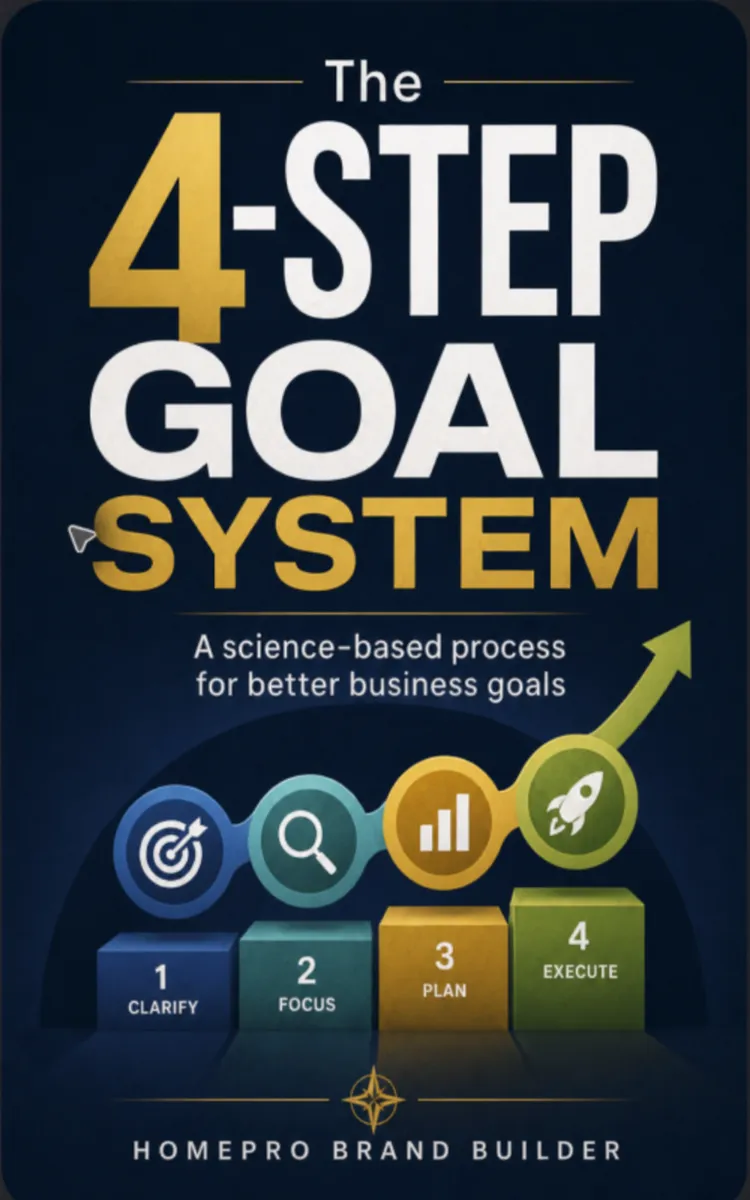
"The 4-Step Goal System" is a business book by HomePro Brand Builder with 8 chapters and approximately 13,186 words. A four-step framework for business goal-setting and measurement.
This book was created using Inkfluence AI, an AI-powered book generation platform that helps authors write, design, and publish complete books. It was made with the AI Business Book Writer.
Frequently Asked Questions
What is "The 4-Step Goal System" about?
A four-step framework for business goal-setting and measurement
How many chapters are in "The 4-Step Goal System"?
The book contains 8 chapters and approximately 13,186 words. Topics covered include Choose One of Three Business Problems, Write a Hypothesis With Input and Output, Define the One Activity for Execution, Set a Time-Bound Test Window, and more.
Who wrote "The 4-Step Goal System"?
This book was written by HomePro Brand Builder and created using Inkfluence AI, an AI book generation platform that helps authors write, design, and publish books.
How can I create a similar business book?
You can create your own business book using Inkfluence AI. Describe your idea, choose your style, and the AI writes the full book for you. It's free to start.
Write your own business book with AI
Describe your idea and Inkfluence writes the whole thing. Free to start.
Start writingCreated with Inkfluence AI


