
Read the first chapter
The whole of chapter one, free. About 6 min. Turn the pages with the arrows, your keyboard, or a swipe.
Chapter 1
Noticing Details in Everyday Moments
Your ordinary day is already full of small details: the warmth of a mug, the sound of keys in the lock, the stripe of sunlight moving across the floor. Romanticizing your life begins when you pause long enough to catch them.
For today, you don’t need a beautiful setting or a free afternoon. You need one familiar moment and your attention. Notice what your senses find, what repeats, and what the moment quietly means to you.
Turning Ordinary Moments Into Something Seen
Mindful noticing is the practice of paying close attention to what is already happening without rushing to improve it, photograph it, or explain it away. You’re not searching for a dramatic moment. You’re learning to recognize the texture of a regular one.
A useful noticing practice has three parts:
1. Sense it: Record one detail you can see, hear, smell, taste, or feel. 2. Name the pattern: Notice something that repeats, changes, or belongs to this particular time or place. 3. Receive its meaning: Write what the moment gives you - a feeling, a memory, a comfort, or a small truth.
The point isn’t to make every moment precious. That would be exhausting. The point is to become acquainted with your own life as it is, including the quiet parts that usually pass unnoticed.
Key takeaway: Romanticizing daily life starts with specific attention, not a more exciting life.
Try replacing broad statements with details. “My morning was nice” tells you very little. “The kettle clicked off while rain tapped the kitchen window, and I felt less hurried than usual” gives the moment somewhere to live.
You can use this simple sentence frame whenever you’re stuck:
> I noticed ______. It repeated or changed when ____. It made me feel or remember ______.
The Five-Minute Detail Catch
Materials needed: Your journal or three loose sheets of paper, a pen, and a timer. Time required: 10 minutes total - 5 minutes noticing and 5 minutes writing.
Choose a small, ordinary moment. You might sit with your morning drink, wait for the bus, fold laundry, water a plant, or stand at the sink. Pick something you can stay with for five minutes.
Your Turn
1. Set a timer for five minutes. Put your phone out of reach, but keep the timer where you can hear it. 2. Stay in one place and look around slowly. Don’t search for something impressive. Notice what is directly in front of you. 3. Write five sensory details. Use at least three different senses. Keep each detail specific, such as “the left sleeve of my sweater feels cool” rather than “I feel comfortable.” 4. Add two patterns. Look for something repeating, changing, or connected to a routine. Examples include the same spoon you reach for, traffic becoming louder at 8:15, or your cat appearing when the cupboard opens. 5. Write one sentence about meaning. Complete this prompt: “This small moment matters to me because…” 6. Read your notes once. Circle the detail you would usually miss. You are finished when you have five sensory details, two patterns, and one meaning sentence.
Completed example
> Sensory details: > 1. The mug handle is warm against the first two fingers of my right hand. > 2. Toast smells slightly sweet before I taste it. > 3. A truck makes a low rumble outside. > 4. The kitchen floor feels cold through my socks. > 5. Butter melts into one bright patch near the edge of the toast. > > Patterns: > The street gets louder just after I sit down. I use the blue mug on mornings when I’m trying to feel settled. > > Meaning: > This small moment matters to me because breakfast is one of the few parts of the day that belongs completely to me.
Now try the same practice in a second setting, if you have time. Choose a moment with a different texture, such as an evening shower, a walk to the mailbox, or turning off the lights. Compare the two entries.
Quick check
• [ ] I wrote five sensory details. - [ ] I used at least three senses. - [ ] I noticed two patterns. - [ ] I wrote one meaning sentence. - [ ] I circled one detail I normally miss.
Carrying Noticing Into the Day
Mindful noticing works best when it attaches to something you already do. Choose a daily “doorway,” a moment that happens reliably. The first sip of coffee, opening your laptop, getting into bed, or locking the front door can become a small reminder to look closer.
At your chosen doorway, pause for thirty seconds. Notice one physical detail, one sound, and one change from the last time you were there. The expected outcome is not a profound insight. It’s a more accurate record of your day. After a week, you’ll have seven small observations instead of one blurry impression that the days all ran together.
You can also use noticing when a routine feels dull. While folding laundry, observe the different weights of fabric and the way warm clothes hold their scent. While waiting at a pharmacy, notice the shape of the light on the floor, the rhythm of the automatic doors, and the objects people carry. While washing dishes, feel the change from greasy water to clean glass. The task may remain boring, but your experience becomes more textured.
Patterns are especially useful here. If you keep noticing that you exhale when you enter your bedroom, perhaps the room feels safe. If the same song appears whenever you cook, it may be part of how you make a place feel like yours. If Sunday evenings bring a tightness in your shoulders, that detail can tell you something without demanding an immediate solution.
Apply It
Choose one everyday doorway for the next three days. Write one entry each day using this format:
> Today I noticed: ______ > The pattern or change was: ____ > The moment meant or offered me: ______
Complete all three entries before reviewing them. Then underline any word, object, time, or feeling that appears more than once. Your expected outcome is one repeated detail or pattern you can name clearly.
For example, you might discover that you repeatedly notice the light near your kitchen window. That doesn’t mean you need to redesign the room or buy anything new. It may simply mean that this patch of light has become part of how home feels to you.
Let noticing remain gentle. Some days, the detail will be lovely. Some days, it will be a pile of receipts, a headache behind your eyes, or the sharp sound of a neighbor’s drill. Paying attention isn’t the same as pretending everything is beautiful. It’s a way of meeting your actual life honestly, with enough care to see what’s there.
Making Room for What You’ve Seen
The value of noticing often appears after the moment has passed. A detail can show you what steadies you, what drains you, and what makes a familiar place feel personal. Read back through your notes without judging the quality of your observations. Look for evidence of your preferences and your presence.
Reflect
1. Which sensory detail from your writing made the moment feel most real, and why did that particular sense matter?
__________________________________________________
__________________________________________________
__________________________________________________
2. What pattern did you notice in your routines, surroundings, or feelings? What might this pattern be showing you about the way you live?
__________________________________________________
__________________________________________________
__________________________________________________
3. Which daily doorway will you use for the next three days, and what specific reminder will help you pause there?
__________________________________________________
__________________________________________________
__________________________________________________
Before you close your journal, write one final sentence:
> I want to notice more of ______ because ______.
That sentence is a small promise to stay present for the details that are already waiting for you. A life can feel more intimate without changing its shape. Sometimes, you only need to look closely enough to recognize that you’re in it.
End of chapter one. 4 more chapters in the full book.
Swipe or use the arrows to turn the page
What's inside: 5 chapters
- 1. Noticing Details in Everyday Moments
- 2. Savoring Feelings Without Rushing
- 3. Choosing What to Feed Your Life
- 4. Participating Fully in Your Routine
- 5. Becoming Deeply Acquainted With Yourself
About this book
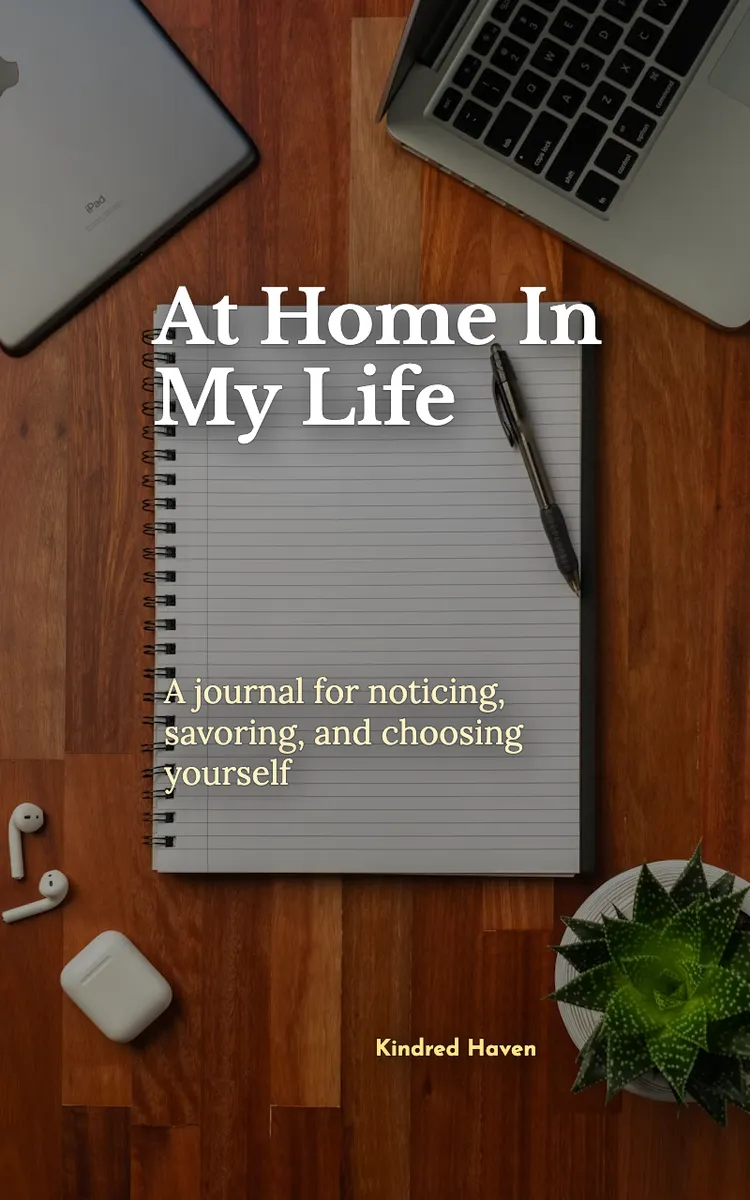
"At Home In My Life" is a workbook by Kindred Haven with 5 chapters and approximately 7,121 words. Guided journaling to romanticize daily life through mindful reflection.
This book was created using Inkfluence AI, an AI-powered book generation platform that helps authors write, design, and publish complete books. It was made with the Workbook Generator.
Frequently Asked Questions
What is "At Home In My Life" about?
Guided journaling to romanticize daily life through mindful reflection
How many chapters are in "At Home In My Life"?
The book contains 5 chapters and approximately 7,121 words. Topics covered include Noticing Details in Everyday Moments, Savoring Feelings Without Rushing, Choosing What to Feed Your Life, Participating Fully in Your Routine, and more.
Who wrote "At Home In My Life"?
This book was written by Kindred Haven and created using Inkfluence AI, an AI book generation platform that helps authors write, design, and publish books.
How can I create a similar workbook?
You can create your own workbook using Inkfluence AI. Describe your idea, choose your style, and the AI writes the full book for you. It's free to start.
Write your own workbook with AI
Describe your idea and Inkfluence writes the whole thing. Free to start.
Start writingCreated with Inkfluence AI


