

Read the first chapter
The whole of chapter one, free. About 6 min. Turn the pages with the arrows, your keyboard, or a swipe.
Chapter 1
Turning Ideas into Story Seeds
Notice the Moment Before You Invent the Plot
A story seed can begin with something tiny: a bus driver waiting three seconds too long, a cracked phone screen, or a dog staring at an empty doorway. Observation gives you the detail. Curiosity asks the question that makes the detail strange. Quick brainstorming turns that question into a possible story.
You don’t need a dramatic life to find strong ideas. Ordinary moments work because readers recognize them. Then one unexpected detail creates tension. A late train becomes interesting when nobody on the platform remembers buying a ticket. A missing lunch becomes a mystery when the lunchbox returns with a note inside.
Your job here is not to write a perfect story. It’s to collect raw material and shape it into a story premise: a short statement about who wants what, what gets in the way, and what might happen next. You’ll build one from a real observation, then test whether it has enough energy to grow.
Quick setup
Gather:
• A notebook or notes app - A pen or pencil - A timer set for 10 minutes - One ordinary place to observe, such as a kitchen, hallway, bus stop, park, or school entrance
Don’t photograph or record strangers without permission. Notice details quietly, and change identifying information if you use a real person as inspiration.
Turn One Detail into a Story Seed
This activity takes about 25 minutes. You’ll collect five observations, ask curiosity questions, and create three possible premises.
Your Turn: The Observation-to-Seed Sprint
1. Set your timer for 5 minutes. Look around your chosen place. Write down five specific details. Avoid opinions such as “the room feels boring.” Choose visible or audible facts instead: “a green backpack has one broken strap.”
2. Pick the detail that feels most unusual, emotional, or unfinished. Circle it. If none stands out, choose the one you can picture most clearly.
3. Write three curiosity questions about that detail. Start each question with why, who, what if, where, or how. Push beyond the obvious answer.
4. Choose the question with the biggest problem or surprise. Turn it into a “what if” idea. Make the change clear and specific.
5. Create a main character connected to the detail. Give the character: - A name or role - One thing they want today - One reason they can’t simply get it
6. Add a consequence. Complete this sentence: “If the character fails, then…”
7. Write three one-sentence premises using this pattern:
When [unexpected event happens], [character] must [goal], or else [consequence].
8. Read your three premises aloud. Star the one that creates the strongest question in your mind. A good seed should make you want to know what happens next.
> Worked example > > Five observations: A red umbrella is hanging open indoors. A vending machine hums. A student keeps checking a blank phone screen. A security guard has a muddy shoe. A lost-and-found box is labeled “RETURNED.” > > Chosen detail: The open red umbrella indoors. > > Curiosity questions: Who opened it? Why is the floor dry? What if the umbrella only opens when someone nearby is lying? > > Character: Mina, who wants to prove her older brother didn’t steal a school trophy. She can’t ask him because he has disappeared for the afternoon. > > Premise: When an umbrella opens inside the school every time someone lies, Mina must follow its clues to find her missing brother before the stolen trophy is blamed on him.
Apply It: Make the seed sharper
Your first premise may feel familiar. That’s normal. Sharpen it by adding one concrete limit. Choose one:
• A deadline: before the final bell, midnight, or sunrise - A location: the locked art room, the number 7 bus, or the school roof - A rule: the clue appears only once, only to one person, or only when someone tells the truth - A cost: the character risks a friendship, a secret, or a chance they may never get again
Rewrite your starred premise with one limit added.
What good looks like
• You recorded five specific observations in 5 minutes. - You wrote three curiosity questions about one chosen detail. - Your main character has a clear want. - Something blocks the character from getting that want. - Your premise includes a possible consequence. - You wrote three complete premise sentences. - Your final seed includes a concrete limit. - The idea creates at least one question you want answered.
Stretch the Seed in Different Directions
The same observation can create very different stories. That’s useful. You don’t have to wait for a brand-new idea; you can change the lens.
Try one variation below. Spend 8 minutes on it. Write one new premise for each variation you choose.
| Variation | How to adapt the activity | Best for | |---|---|---| | The Realistic Secret | Keep the setting ordinary. Explain the strange detail through a hidden human problem, such as a friendship ending, a family argument, or someone covering up a mistake. | Contemporary fiction and school stories | | The Rule-Breaking Object | Give the observed object one impossible rule. The object may answer questions, move when ignored, or reveal a memory. Decide who discovers the rule first. | Fantasy, magical realism, and mystery | | The Two Viewpoints | Write two premises about the same moment. In one, the observer is innocent. In the other, the observer caused the problem. | Suspense and character-focused stories |
Your Turn: Compare the versions
Use the red umbrella example, or return to your own observation. Complete two of these sentence starters:
• In a realistic version, the detail means ________________________________. - In a strange version, the detail means ______________________________. - From another character’s viewpoint, the detail means _________________. - If the moment happened at night instead, ______________________________.
Now choose a different context for your seed. Move it from one setting to another, such as:
• School hallway → airport waiting area - Kitchen table → spaceship cafeteria - Neighborhood park → underground city - Bus stop → train platform in 2095
Keep the character’s goal the same, but change the obstacle. This tests whether your idea has real flexibility or depends on only one setting.
Reflect: Find the strongest engine
Compare your versions by answering these specific questions in your notes:
• Which version gives the character the hardest choice? - Which version has the clearest unanswered question? - Which version could produce three different scenes?
Circle one answer for each question. If the same version wins twice or more, use it as your main story seed.
Check Your Seed Before You Grow It
A strong premise doesn’t need to be huge. It needs movement. Someone wants something, something pushes back, and the result matters. Use the questions below to check whether your everyday moment has become a workable story idea.
Reflect
1. What exact detail started your seed, and where did you observe it?
__________________________________________________
__________________________________________________
__________________________________________________
2. What does your main character want before the first major event?
__________________________________________________
__________________________________________________
__________________________________________________
3. What obstacle makes the goal difficult, and why can’t the character avoid it?
__________________________________________________
__________________________________________________
__________________________________________________
4. What question should a reader want answered after hearing your premise?
__________________________________________________
__________________________________________________
__________________________________________________
5. What changes if the character fails?
__________________________________________________
__________________________________________________
__________________________________________________
Success checklist
• [ ] I can point to one exact observation, not just a general mood. - [ ] My character wants something specific and immediate. - [ ] The obstacle creates a problem instead of a minor inconvenience. - [ ] My premise contains a question, mystery, or difficult choice. - [ ] The consequence matters to the character. - [ ] I can imagine at least three scenes from the seed. - [ ] I can say the premise in one sentence without explaining the whole plot. - [ ] I changed or invented details instead of copying a real person’s private life.
Keep your best premise somewhere easy to find. Add the date and the place where the first detail came from. Later, when you need a new idea, return to that location with a timer and look again. The ordinary world is packed with loose threads. Your job is to notice one, tug gently, and see what starts to move.
End of chapter one. 6 more chapters and about 9,469 words in the full book.
Swipe or use the arrows to turn the page


What's inside: 7 chapters
- 1. Turning Ideas into Story Seeds
- 2. Building Characters with Contradictions
- 3. Choosing a Point of View
- 4. Making Settings Shape the Story
- 5. Writing Dialogue with Subtext
- 6. Building Tension Through Scene Structure
- 7. Writing Poems with Image and Rhythm
About this book
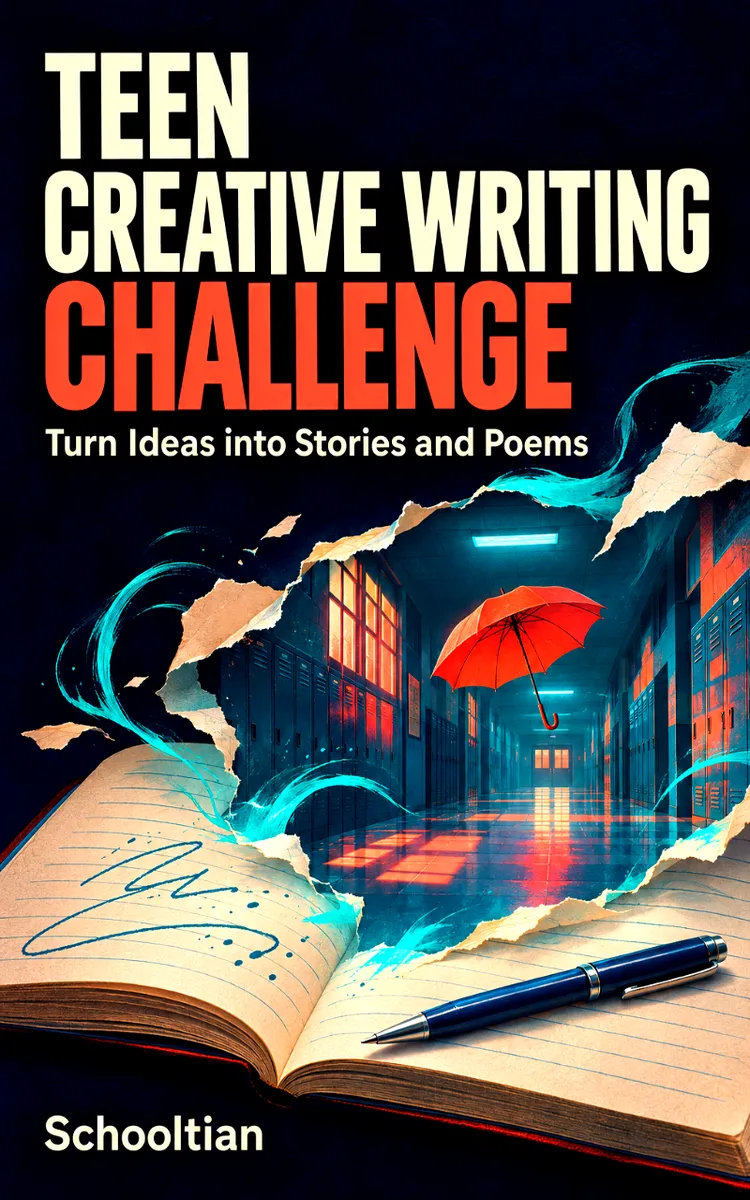
"Teen Creative Writing Challenge" is a workbook by Schooltian with 7 chapters and approximately 9,469 words. Creative writing prompts, storytelling exercises, and poetry activities for teenagers.
This book was created using Inkfluence AI, an AI-powered book generation platform that helps authors write, design, and publish complete books. It was made with the Workbook Generator.
Frequently Asked Questions
What is "Teen Creative Writing Challenge" about?
Creative writing prompts, storytelling exercises, and poetry activities for teenagers
How many chapters are in "Teen Creative Writing Challenge"?
The book contains 7 chapters and approximately 9,469 words. Topics covered include Turning Ideas into Story Seeds, Building Characters with Contradictions, Choosing a Point of View, Making Settings Shape the Story, and more.
Who wrote "Teen Creative Writing Challenge"?
This book was written by Schooltian and created using Inkfluence AI, an AI book generation platform that helps authors write, design, and publish books.
How can I create a similar workbook?
You can create your own workbook using Inkfluence AI. Describe your idea, choose your style, and the AI writes the full book for you. It's free to start.
Write your own workbook with AI
Describe your idea and Inkfluence writes the whole thing. Free to start.
Start writingCreated with Inkfluence AI


