
Read the first chapter
The whole of chapter one, free. About 7 min. Turn the pages with the arrows, your keyboard, or a swipe.
Chapter 1
The Price Tag on Privacy
Mara wished she could take the sentence back.
Not because it was untrue. She had been looking for something to do for three days. Three days since the shop sign had gone up in the window, since the landlord had handed her the keys and a list of repairs long enough to make the place feel less like a beginning than a dare. Three days since she had told herself that buying a used bookstore was not the same as running away.
But the man on the other side of the poetry shelf did not know any of that.
He only knew she had snapped at him over a book.
“You can have it,” she said.
His hand loosened. “I don’t want it if you’re giving it up to win an argument.”
“I’m not trying to win.”
“You seem very practiced at it.”
The words landed more accurately than they deserved to.
Mara released the paperback. He took it, turning the cover toward the lamp. Up close, she could see the grease on his knuckle had been joined by a pale scar running across the base of his thumb.
“You work on bikes,” she said.
“That obvious?”
“You look like someone who has been dragged into a bookstore by weather and forgotten to leave.”
“That obvious too, apparently.”
She almost smiled. Almost.
“The book’s good,” she said. “If you’re still looking for it.”
“I am.”
“Then you should buy it.”
“And you?”
“I’ll find something else to do.”
He studied her for a moment, as if the answer had a second meaning and he was deciding whether to charge her for it.
“Jonah,” he said.
It took Mara a second to understand. “Your name?”
“I thought we were exchanging things.”
She looked at the book in his hand. “Mara.”
He nodded once, as though placing her name on a shelf.
That was how it began. Not with a confession or a kiss or any of the dramatic honesty people liked to imagine was the foundation of love. It began with a price. Jonah paid for the book. Mara paid with her name. Neither of them knew yet what they had overcharged.
What We Hand Over Too Soon
In the weeks that followed, Mara learned that Jonah repaired bicycles in a narrow shop two blocks from the bookstore. The shop was called Secondhand Hearts, though the sign had been painted so badly that the last word looked like “Hears.” He fixed brakes, replaced chains, straightened wheels, and occasionally talked people out of buying expensive parts they did not need.
He also remembered everything.
He remembered that Mara took tea without sugar. He remembered that she hated being asked whether the bookstore was doing well. He remembered the exact day her sister called and Mara let the phone ring until it stopped.
Mara, in return, told him too much.
She told him about the divorce before she told him she had been married. She told him why she had left the city before she told him what city she meant. She told him about the child she and her former husband had tried to have, and the doctor’s waiting room, and the quiet ride home afterward.
She told him because he listened without interrupting. She told him because the story had been sitting inside her for so long that any open door looked like an invitation.
That is one way people mistake disclosure for intimacy. We reveal something painful, and when the other person stays, we assume we have been known. Sometimes we have. Sometimes we have simply been witnessed.
There is a difference.
Jonah did not ask for those details. He did not use them against her. That almost made it harder to admit that she had felt exposed afterward. She began watching his face whenever she spoke, searching for signs that he had received too much. If he grew quiet, she worried she had frightened him. If he asked a question, she worried she had failed to explain enough.
Meanwhile, Jonah kept his own doors closed.
He would talk about customers, weather, tools, and the best road out of town. He would not talk about the person whose bicycle still hung from the ceiling of his shop, untouched except for dust. When Mara asked, he said, “It belonged to someone I knew.”
Someone.
The word became a wall.
The Cost of Being Kept Out
Privacy is not the same as secrecy. Privacy says, “This is mine, and I will decide when and how to share it.” Secrecy says, “This affects you, but I am hiding it so I can control what you know.” The two can look alike from the outside, especially to someone who has already offered more than they meant to.
Mara did not need Jonah to tell her everything. She needed to know whether his silence had a shape.
Was he waiting until he trusted her? Was he protecting someone else? Was he protecting himself from being asked to feel something? Was he hoping that if he left the bicycle hanging long enough, the past would become part of the furniture?
Not knowing made her invent answers. Most of them were unkind.
One evening, after closing the bookstore, she found Jonah in the back room, repairing a lamp. Rain tapped the window. The sound took her back to the first weeks of the shop, when every storm had made the roof leak and every leak had seemed like proof that she had made a foolish bargain.
“You don’t have to tell me who owned the bicycle,” she said.
Jonah looked up. “I know.”
“But you do have to tell me whether there’s something I should understand about it.”
He set down the screwdriver. “That sounds like a demand.”
“It’s a request. I’m saying it badly.”
“You usually do when you’re afraid.”
She felt the old reflex rise in her, the one that wanted to explain everything at once. She could tell him about the waiting room. She could tell him how being left out had once felt worse than being hurt. She could build a bridge out of personal history and hope he crossed it.
Instead, she took a breath.
“I have been telling you things before I know whether I want you to carry them,” she said. “Then I get angry when you keep things I can’t even name. I don’t think that’s fair.”
Jonah’s face changed, not dramatically. Just enough.
“No,” he said. “It isn’t.”
A Different Kind of Honesty
They made a rule that night. Not a permanent rule, and not a punishment. A working agreement.
Before sharing something important, either of them could ask, “Do you have room for this?” The other person could say yes, not now, or tell me what you need from me first. No one had to earn privacy by becoming completely transparent. No one could use privacy as an excuse to leave the other person guessing forever.
It sounded simple. It was not.
Mara practiced by pausing before she spoke. She asked herself:
• Am I sharing because I want connection, or because I want immediate relief?
• Would I still want this known tomorrow?
• Have I asked whether the other person has the capacity to listen?
• What do I need after I disclose this: comfort, advice, patience, or simply witness?
Jonah practiced by replacing “It’s nothing” with more honest limits.
“I’m not ready to tell you the whole story,” he said one morning. “But it involves someone I loved, and I’m still learning how to talk about the loss.”
That answer did not satisfy every question. It did something better. It gave Mara a truthful boundary instead of a blank wall.
She began using one too.
“I want to tell you about the call from my sister,” she said another afternoon, “but I don’t want us to solve it tonight.”
“All right,” Jonah said. “Tell me, and I’ll listen.”
The price of privacy had once seemed to be distance. The price of disclosure had seemed to be exposure. Now they were discovering a third possibility: consent.
Not permission in the formal sense. Attention. A willingness to ask what the truth might require before placing it in someone else’s hands.
By the end of that month, Mara had stopped measuring love by how quickly someone opened every locked room. Jonah had stopped assuming that a closed door was automatically respected. They were still clumsy. They still misread each other. But when Mara reached for the old bargain - I will give you everything if you promise not to leave - she recognized it as a bargain, not a vow.
One evening, Jonah brought the faded pink book back to the bookstore.
“Finished?” Mara asked.
“Not exactly.”
He placed it on the counter between them. Inside the cover, he had written a single line: Some roads are safer when you choose the pace.
Mara read it twice.
“Is this you telling me something?” she asked.
“Partly.”
“And the rest?”
“The rest I’m not ready for yet.”
She looked at him. This time, the silence did not demand that she fill it.
“All right,” she said.
Jonah nodded.
It was not a grand declaration. No one paid for it with a confession. But the relationship moved forward all the same, one honest turn at a time. They were learning that love did not become more valuable when everything was revealed, or less real when something remained private. Its worth came from knowing what to offer, what to protect, and when to renegotiate the terms without making either person the villain.
End of chapter one. 7 more chapters in the full book.
Swipe or use the arrows to turn the page


What's inside: 8 chapters
- 1. The Price Tag on Privacy
- 2. Learning to Ask Without Begging
- 3. Knotty Trust: When Promises Slip
- 4. Bike Shop Etiquette for Broken People
- 5. Riding With the Wrong Map
- 6. The Tender Art of Not Fixing
- 7. Secondhand Smiles, New Commitments
- 8. Quiet Returns
About this book
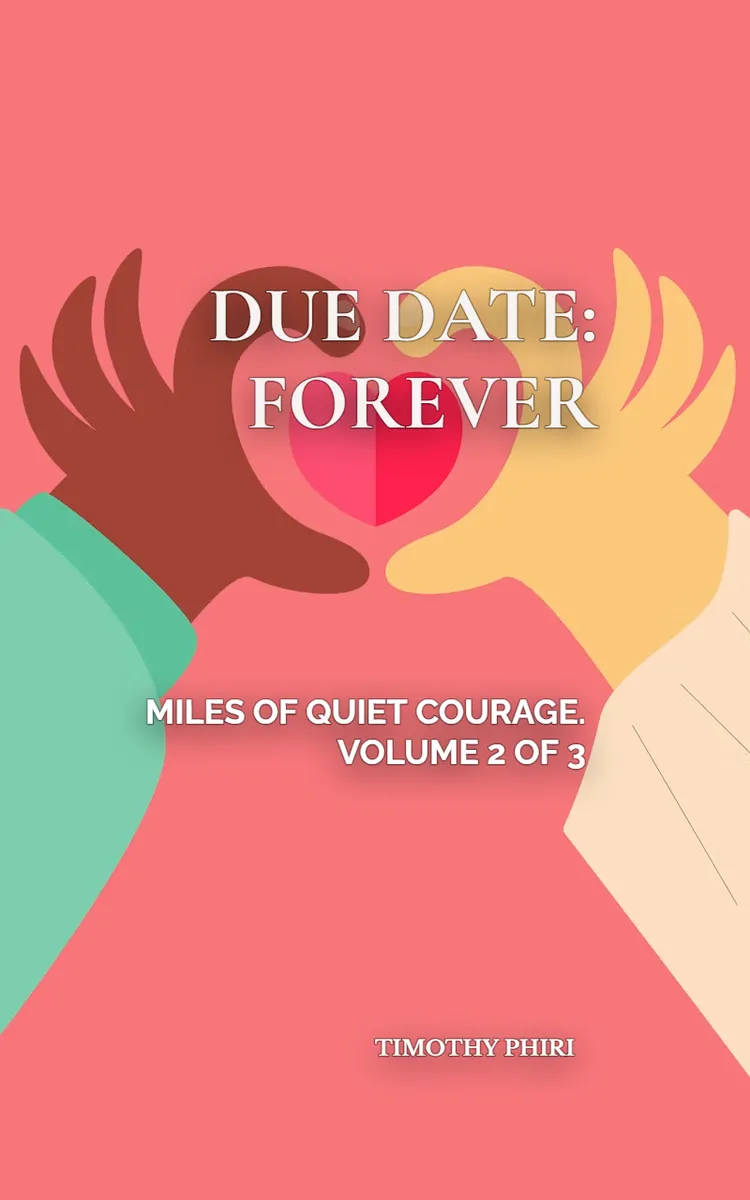
"Due Date: Forever" is a romance book by Timothy Phiri with 8 chapters and approximately 12,355 words. A deeper look at the people, places, and unspoken rules behind secondhand love—where every ride becomes a practice in boundaries, trust, and starting again..
This book was created using Inkfluence AI, an AI-powered book generation platform that helps authors write, design, and publish complete books. It was made with the AI Romance Novel Writer.
Frequently Asked Questions
What is "Due Date: Forever" about?
A deeper look at the people, places, and unspoken rules behind secondhand love—where every ride becomes a practice in boundaries, trust, and starting again.
How many chapters are in "Due Date: Forever"?
The book contains 8 chapters and approximately 12,355 words. Topics covered include The Price Tag on Privacy, Learning to Ask Without Begging, Knotty Trust: When Promises Slip, Bike Shop Etiquette for Broken People, and more.
Who wrote "Due Date: Forever"?
This book was written by Timothy Phiri and created using Inkfluence AI, an AI book generation platform that helps authors write, design, and publish books.
How can I create a similar romance book?
You can create your own romance book using Inkfluence AI. Describe your idea, choose your style, and the AI writes the full book for you. It's free to start.
Write your own romance book with AI
Describe your idea and Inkfluence writes the whole thing. Free to start.
Start writingCreated with Inkfluence AI


