
Read the first chapter
The whole of chapter one, free. About 6 min. Turn the pages with the arrows, your keyboard, or a swipe.
Chapter 1
Rewriting the Story of Who You Are
When Someone Else’s Label Starts Speaking for You
A few years ago, a friend turned down an opportunity she genuinely wanted. It involved leading a small team at work, something she’d already been doing informally. But when the offer became official, she laughed and said, “I’m not a leader. I’m the dependable one behind the scenes.”
That sentence sounded casual. It wasn’t. It carried years of family comments, school experiences, and old decisions made to stay safe. She had inherited a label, worn it so long it felt like a fact, and then used it to decide what she was allowed to try.
Maybe you’ve done something similar. You call yourself shy, unreliable, bad with money, not creative, too emotional, or “just not the confident type.” The label may have started as someone else’s opinion. Now it’s directing your choices.
What if the story you’re obeying was never truly yours?
From Inherited Label to Chosen Identity
Old Belief: Who I am is mostly fixed, and my past proves it.
New Reality: My past may explain the story I learned, but I can choose the identity I practice now.
An inherited label isn’t always cruel. Sometimes it sounds flattering: the responsible one, the tough one, the peacemaker, the sensible one. The trouble begins when a label becomes a boundary. “I’m responsible” quietly turns into “I must handle everything.” “I’m easygoing” becomes “my needs should come last.” Even praise can become a cage when you’re afraid to act outside it.
This is where the Identity Edit Method begins. You notice the label, trace where it came from, test whether it still fits, and choose a more useful identity. Not a fantasy version of yourself. A believable identity that points toward the person you’re becoming.
Take the friend who thought she wasn’t a leader. Her old identity was “the reliable helper.” It explained her history, but it left no room for authority, visibility, or growth. A more accurate identity might be “someone who creates clarity and helps people do their best work.” That identity didn’t require her to become loud. It gave her permission to lead in her own way.
The shift matters because identity shapes attention. If you believe you’re bad with money, you may avoid opening your accounts. Avoidance then creates more confusion, which seems to confirm the label. If you see yourself as someone learning to manage money, checking your balance becomes evidence of change instead of proof of failure.
You’re not pretending the past didn’t happen. You’re refusing to let old evidence have the final word.
Notice the Label Before It Makes the Decision
Self-awareness is the pause between an old label and an automatic choice. Without that pause, the label speaks in your voice. You may think, “I don’t want this,” when the deeper truth is, “I’m afraid this doesn’t match who I’ve been told I am.”
Listen for repeated phrases. Labels often hide inside words such as always, never, just, or naturally. “I’ve always been disorganized.” “I’m just not assertive.” “I never finish anything.” These statements feel like observations, but they often function as instructions. They tell you what not to attempt.
Look for the moments when the label costs you something. Maybe you stay quiet in meetings because you’re “not the outspoken one.” Maybe you avoid applying for better work because you’re “not qualified enough.” Maybe you keep rescuing other people because being needed is how you’ve learned to feel valuable.
Signs an inherited label is running your life
1. You explain your behavior with a permanent-sounding phrase. “That’s just how I am” can be a useful clue. It may signal that you’ve stopped investigating the story underneath.
2. You feel uncomfortable when you act outside the role. Saying no may feel selfish if you’ve built your identity around being helpful. Speaking up may feel arrogant if you’ve been rewarded for staying agreeable.
3. You dismiss evidence that contradicts the label. You might remember the three times you procrastinated and forget the projects you completed under pressure and care.
4. You choose familiar discomfort over unfamiliar possibility. Staying underpaid, unseen, or overextended can feel safer when those conditions match the identity you know.
A label becomes powerful when you stop treating it as a description and start treating it as a destiny.
The goal isn’t to argue with every thought. That can become exhausting. The goal is to recognize when an old identity is making decisions on your behalf. Once you can name the pattern, you can edit it.
Questions That Reveal the Story Beneath the Story
1. Who first described you this way, and what was happening when you accepted it? Think beyond obvious criticism. A parent may have called you “the mature one” during a difficult family season. A teacher may have decided you were careless after one missed assignment. Understanding the origin helps you separate context from truth.
2. What does this label help you avoid? “I’m not ambitious” might protect you from rejection. “I’m bad at relationships” might protect you from having to risk honest communication. An honest answer could be, “If I admit I want more, I might have to discover whether I can achieve it.”
3. Where is this label inaccurate, even by a small amount? Look for exceptions, not perfection. If you call yourself disorganized, remember the appointment you scheduled, the bill you paid early, or the tool system you created at work. Small contradictions weaken rigid stories.
4. What identity would support the next version of your life? Keep it grounded. Instead of “I’m fearless,” try “I’m someone who takes thoughtful risks.” Instead of “I’m confident,” try “I’m someone who can speak while still feeling nervous.”
5. What would that identity do in the next seven days? Identity becomes believable through action. A person who is becoming financially responsible might review one account. A person becoming more direct might make one clear request without adding an apology.
Don’t rush these answers. If one makes you defensive, stay curious. Defensiveness often appears when a familiar identity is being asked to loosen its grip.
The Seven-Day Identity Edit
Challenge: Replace One Label With One Practice
For the next seven days, choose one inherited label that limits your choices. Don’t pick the biggest wound in your life. Pick a label you can observe and work with safely.
• Write the label at the top of a page: “I’m not good at speaking up,” “I’m unreliable,” or “I’m the one who has to handle everything.” - Under it, write where you learned it and three pieces of evidence that support it. - Add three pieces of evidence that complicate it. Include small examples; they count. - Create a chosen identity using this sentence: “I’m becoming someone who ______.” - Each day, take one action that matches the new identity. - Record what you did, what you felt, and what the old label predicted would happen. - On the seventh day, read your notes and write one sentence beginning, “The story is changing because…”
Expected difficulty: Medium
You’ll know it’s working when:
• You catch yourself using the old label before it controls your behavior. - You notice exceptions you previously ignored. - The new action feels awkward but possible. - You recover more quickly after an imperfect attempt. - You describe yourself with language based on practice, not permanent judgment.
The point isn’t to feel transformed by day seven. That expectation can become another trap. The point is to gather fresh evidence. Every action gives your mind something new to work with.
You Are Allowed to Edit the Story
You learned how inherited labels can disguise themselves as facts, even when they began as someone else’s interpretation.
• You can trace a label back to its source and the situation that gave it power. - You can test the label against the full evidence of your life. - You can choose an identity that supports your direction without pretending to be perfect. - You make that identity believable through small, repeated actions.
You are not required to remain loyal to a version of yourself that was built for survival, approval, or someone else’s expectations.
The next time an old label rises, you don’t have to fight it or obey it. You can notice it, question it, and choose your next action with more freedom. That small act of choice is where a better way forward begins.
End of chapter one. 4 more chapters and about 7,179 words in the full book.
Swipe or use the arrows to turn the page
What's inside: 5 chapters
- 1. Rewriting the Story of Who You Are
- 2. Breaking the Perfectionism Trap
- 3. Building Habits That Survive Busy Days
- 4. Setting Boundaries Without Guilt
- 5. Turning Setbacks Into Forward Motion
About this book
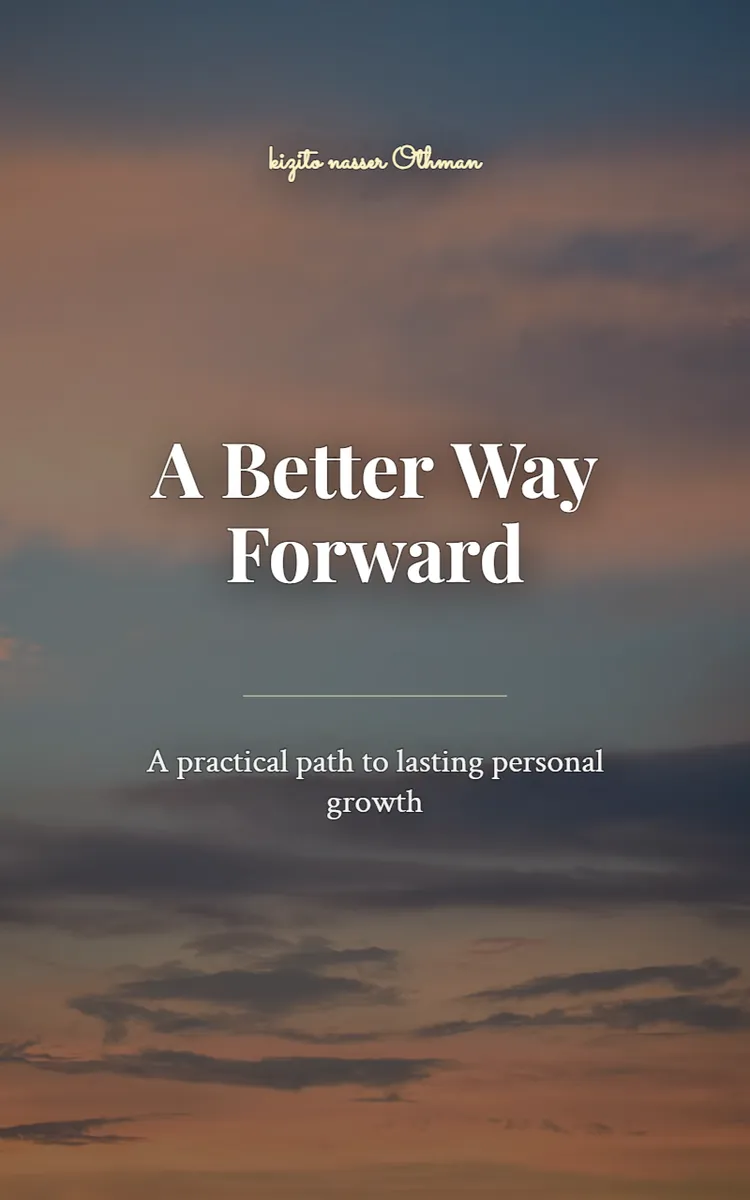
"A Better Way Forward" is a self-help book by kizito nasser Othman with 5 chapters and approximately 7,179 words. Personal growth, self-awareness, and positive change.
This book was created using Inkfluence AI, an AI-powered book generation platform that helps authors write, design, and publish complete books. It was made with the AI Self-Help Book Writer.
Frequently Asked Questions
What is "A Better Way Forward" about?
Personal growth, self-awareness, and positive change
How many chapters are in "A Better Way Forward"?
The book contains 5 chapters and approximately 7,179 words. Topics covered include Rewriting the Story of Who You Are, Breaking the Perfectionism Trap, Building Habits That Survive Busy Days, Setting Boundaries Without Guilt, and more.
Who wrote "A Better Way Forward"?
This book was written by kizito nasser Othman and created using Inkfluence AI, an AI book generation platform that helps authors write, design, and publish books.
How can I create a similar self-help book?
You can create your own self-help book using Inkfluence AI. Describe your idea, choose your style, and the AI writes the full book for you. It's free to start.
Write your own self-help book with AI
Describe your idea and Inkfluence writes the whole thing. Free to start.
Start writingCreated with Inkfluence AI


