

Read the first chapter
The whole of chapter one, free. About 8 min. Turn the pages with the arrows, your keyboard, or a swipe.
Chapter 1
The Figures Beneath the Blue Awning
On Tuesdays, the hardware store’s awning creaked with every gust and shed a fine dust of blue fabric onto the sidewalk. That afternoon it creaked three times as I walked home with a bag of bread tucked under my arm, thinking only of getting inside before the rain started.
The shopping street was almost empty. Shutters came down one after another, fluorescent tubes flickered behind shop windows, and a radio played somewhere, its voice distorted by distance. Everything kept to its usual order, that reassuring monotony of places you pass through without looking too closely.
Then I saw the figures.
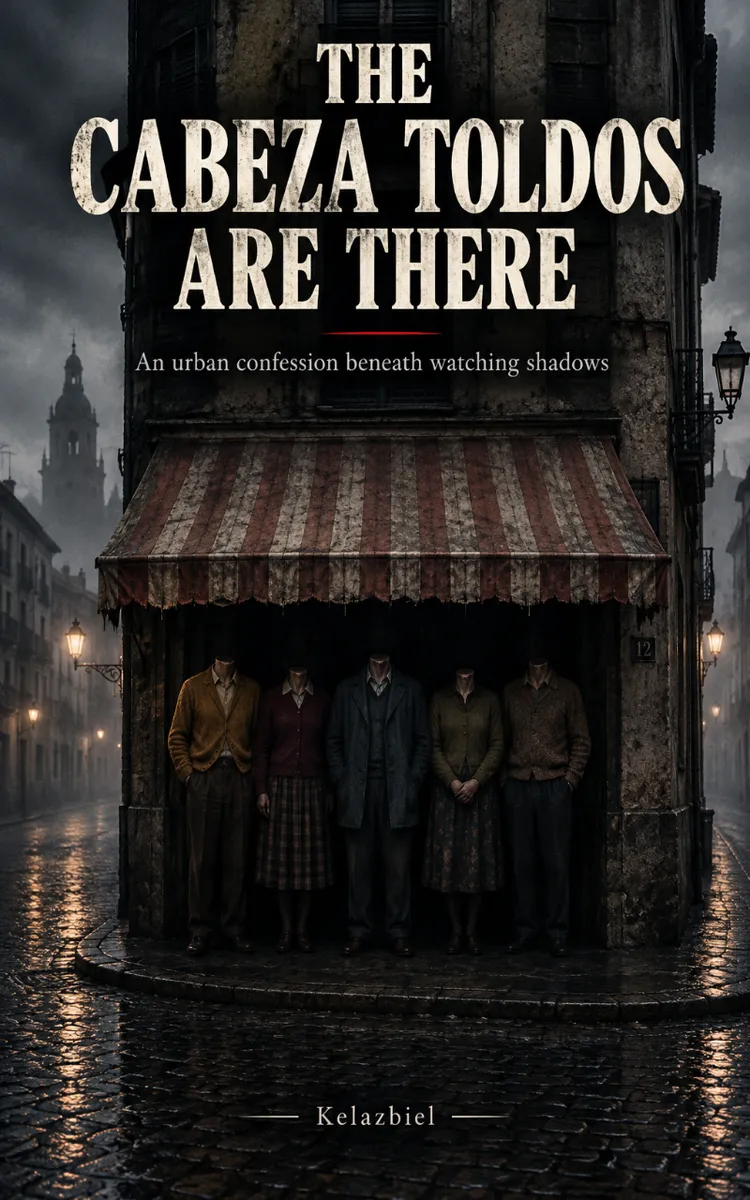
They stood beneath the hardware store’s awning, at the far end, where the shadows were thickest. There were five. Or six. I couldn’t count them properly because one was partly hidden behind a post and another seemed to blend into a dark fold in the canvas.
They were human-shaped. They wore ordinary clothes: coats, trousers, a light-colored jacket, something like a uniform. But they had no heads.
Each body ended at the neck in a smooth, horizontal surface, too clean to be a wound and too sharply defined to belong to the shadows. On some, the cut seemed to extend inward, merging with the darkness of their clothes. There was no blood. No bone. Nothing to explain where the body began and the absence ended.
I stopped, clutching the bag of bread against my side.
“Very funny,” I said.
My voice sounded small, swallowed by the awning.
I thought they were mannequins. Then I thought they were people in costume. Some joke by the shopkeepers, perhaps, a video for social media, one of those absurd installations that appear for a few days and vanish without a trace. The street was empty enough to make it seem possible.
I took a step toward them.
They all remained motionless.
It wasn’t human stillness. A body at rest betrays itself in small ways: shifting its weight from one leg to the other, the chest rising, fingers tensing. Those bodies showed none of that. They stood as if they had been placed there before the street existed, and the street had been built around them.
I felt a pressure in my forehead.
At first I mistook it for fatigue. Then it moved down toward my eyes and settled behind them, as if someone were pushing from inside my skull. They had no faces, but I knew at once that they were watching me. Not a scattered gaze, not the casual attention of someone watching a stranger pass. They were following me with absolute concentration.
I turned toward the window of the closed shop. My reflection appeared in the glass, pale and warped by the adhesive lettering. Behind me, the awning seemed empty.
I turned around.
The figures were still there.
“No,” I murmured. “That can’t be.”
A bicycle passed at the corner. The boy riding it didn’t even glance toward the hardware store. His wheels struck a seam in the pavement, and the sound receded down the street. I remained in front of the awning, unable to approach or leave.
The paper bag crinkled beneath my fingers.
One of the bodies seemed to lean forward.
I blinked.
It hadn’t moved. The light-colored coat had a crease in the shoulder I hadn’t noticed before. That was all. A crease. A shadow misread. The brain fills in shapes, I told myself. The gloom distorts objects. I’d seen too many strange images on my phone, too many movies, too many sleepless nights.
I laughed, but the laugh never quite became a sound.
“Mannequins,” I said louder. “Or people. Whatever.”
No one answered.
The fluorescent hum suddenly went out. The street hung suspended in a silence that didn’t belong to that hour. The sounds didn’t disappear; it was worse than that. I heard a refrigerator motor behind a wall, a shutter rattling, my own shoes brushing the ground. Everything seemed too separate, as if each sound were locked in a different room.
The figures made none.
I forced myself to walk. I passed along the opposite wall, leaving as much distance between us as possible. I didn’t want to look again, but I could feel their eyes where there were no eyes. The pressure grew stronger when I turned my back on them. Each step seemed to bring me closer to something I couldn’t see.
When I reached the corner, I looked at the dark reflection in a shop window.
The group was still beneath the awning.
One of them was no longer where I’d seen it.
I stopped so abruptly that the bag tore. The bread fell to the ground.
I looked straight at the hardware store. Five bodies. I counted five. The missing one might have been hidden from the start. It might have been a post, a shadow, a garment hanging there. I bent to pick up the bread, though the paper had been stained with dust and one corner was crushed.
For an instant, as I kept my eyes on the ground, I heard something behind me.
It wasn’t footsteps.
It was the slow rustle of heavy fabric against fabric.
I raised my head.
The figures were still beneath the awning, the same distance away, as motionless as before.
I started walking.
I didn’t run. Running would have meant admitting it was real. I moved with exaggerated normality, adjusting my jacket, holding the bread, looking at the shop windows. In the reflection of a clothing store, I checked that no one was following me. In the glass of a pharmacy, I saw the awning. In the window of a closed café, too.
With each reflection, the group became harder to count.
I reached the entrance to my building with a dry throat. I fumbled for my keys and dropped them twice. The first struck the ground with a clear jingle. The second caught between my sweaty fingers.
“Back already?” someone asked from the entryway.
It was the neighbor from the first floor. He leaned out from the stairwell, a garbage bag in one hand.
“Yes.”
“You dropped your bread.”
I looked at the bag I was carrying. The bread was still inside.
“I dropped one loaf.”
The neighbor frowned.
“One?”
I didn’t know what to say. Behind him, the hallway sank into a bluish gloom. There was a small awning over the entrance, installed to protect the mailbox from the rain. No one stood beneath it.
Even so, I didn’t go in.
“Did you see anything strange in the street?” I asked.
The neighbor gave a short laugh.
“Other than you, no.”
“At the hardware store.”
“It’s closed.”
“There were people under the awning.”
“People?”
“Figures. I don’t know.”
The neighbor set the garbage bag down.
“Are you all right?”
The question irritated me. I felt the pressure behind my eyes return, stronger now. I looked toward the street. From the entrance, I couldn’t see the hardware store’s awning directly, but I could see a strip of blue between two buildings.
“Never mind,” I said.
I went in and closed the door.
The latch didn’t catch. I tried again. The metal scraped against the plate and made a sharp sound that ran through my teeth. The neighbor watched me without saying anything.
“Go upstairs,” I told him.
“What?”
“Nothing. Forget it.”
I waited for him to leave by the stairs. I heard his footsteps climb, stop on the first landing, then continue. When I could no longer hear him, I opened the door again.
The street was empty.
The hardware store’s blue awning was visible from there, small and dark. There were no figures beneath it.
Relief washed over me. It came so suddenly I almost felt dizzy. I stepped onto the threshold and looked both ways. A woman was pulling a shopping cart at the far end of the street. A bus passed behind the buildings. Normality had returned, clean and complete.
Then I saw a movement in the reflection of the mailbox.
Not in the street. In the rectangle of glass covering the residents’ names.
Five headless silhouettes appeared behind my shoulder.
I turned around.
Nothing.
The entrance courtyard, the awning, the sidewalk. Everything was empty.
I went upstairs without taking off my jacket. I locked the door, put on the chain, and pushed a chair against it. Then I set the bread on the table and stood listening.
The building creaked with its usual noises. A pipe vibrated in the wall. Someone upstairs turned on a tap. A television murmured behind a door. I tried to convince myself I’d seen mannequins, or signs, or people crouching beneath a canvas. I repeated the explanations aloud, as if hearing them might give them weight.
“They weren’t headless people. They were objects. A joke. An illusion.”
The room didn’t answer.
I went to the window. I lived on the second floor, and from there I could see the shopping street between the buildings. I didn’t want to look, but I needed to check. That was why I’d come home: to close the door, watch from above, discover the angle that had distorted the scene.
I drew the curtain aside by a few inches.
The hardware store’s awning was empty.
I breathed through my mouth. I leaned against the frame and closed my eyes.
When I opened them, there were figures beneath the awning.
Not five. Seven.
They stood in a line in the shadows, motionless, their smooth necks merging with the darkness of their clothes. From that distance I couldn’t make out the details of what they wore, but I could see the shape of their bodies and the impossible direction of their attention.
They had no heads.
And yet their gaze pierced the glass.
I let go of the curtain.
The fabric striking the wall made me stumble backward. For several seconds I didn’t move. Then I crossed the room, closed the window, and lowered the blind all the way. The mechanism jammed before it reached the sill. I pulled the cord with both hands. The blind dropped with a bang.
I stood in front of it, listening.
On the other side, the street continued to exist. Cars passed. A metal shutter rattled against its track. Someone shouted from a distant window. All of it should have reassured me.
But behind the blind, behind the glass, behind the closed curtain, I could still feel the gaze.
It wasn’t coming from the street.
It was coming from the room.
I looked toward the door. Then at the ceiling. The pressure in my forehead wouldn’t go away. It was adjusting, like a hand slowly learning the shape of my head.
I sat on the floor with my back against the wall and kept my eyes open until it was completely dark.
When I finally dared to look up, the curtain had pulled away from the glass by a few inches.
I hadn’t touched it.
I couldn’t see anything on the other side. Only a narrow strip of street and, beneath the blue awning, the motionless certainty that now they were the ones who knew exactly where I was.
End of chapter one. 9 more chapters and about 21,733 words in the full book.
Swipe or use the arrows to turn the page


What's inside: 10 chapters
- 1. The Figures Beneath the Blue Awning
- 2. The Window I Didn’t Want to Open
- 3. The Baker’s Tale
- 4. The Awning on the Third Floor
- 5. The recording of the empty street
- 6. The sewn curtain
- 7. The Blackout of the Awnings
- 8. The Room with No Exit
- 9. The Street That Folded Itself
- 10. The space beneath my awning
About this book
"The Cabeza Toldos Are There" is a fiction book by Kelazbiel with 10 chapters and approximately 21,733 words. A narrator loses his sanity while being stalked by headless figures beneath urban awnings..
This book was created using Inkfluence AI, an AI-powered book generation platform that helps authors write, design, and publish complete books. It was made with the AI Novel Writer.
Frequently Asked Questions
What is "The Cabeza Toldos Are There" about?
A narrator loses his sanity while being stalked by headless figures beneath urban awnings.
How many chapters are in "The Cabeza Toldos Are There"?
The book contains 10 chapters and approximately 21,733 words. Topics covered include The Figures Beneath the Blue Awning, The Window I Didn’t Want to Open, The Baker’s Tale, The Awning on the Third Floor, and more.
Who wrote "The Cabeza Toldos Are There"?
This book was written by Kelazbiel and created using Inkfluence AI, an AI book generation platform that helps authors write, design, and publish books.
How can I create a similar fiction book?
You can create your own fiction book using Inkfluence AI. Describe your idea, choose your style, and the AI writes the full book for you. It's free to start.
Write your own fiction book with AI
Describe your idea and Inkfluence writes the whole thing. Free to start.
Start writingCreated with Inkfluence AI


