
Read the first chapter
The whole of chapter one, free. About 9 min. Turn the pages with the arrows, your keyboard, or a swipe.
Chapter 1
Days 1-5: Declutter Foundations
A lunch container top is wedged behind the toaster. Three unopened envelopes sit under a hairbrush. Someone’s school jumper is draped over a chair, and the chair itself has become a temporary home for yesterday’s laundry. Nothing looks disastrous on its own, but together, these small piles make the room feel louder than it should.
That’s where Lena, 34, found herself after a busy week of work, school runs, meals, and the endless home logistics that somehow multiply overnight. She didn’t need a dramatic clear-out. She needed a simple way to make a few decisions, finish them, and stop the clutter from rushing back in.
For the first five days, you’ll use the One-Day Reset System. Each day has one clear target, one short working session, and one closing habit. The aim isn’t to empty your home. It’s to create a safe, repeatable rhythm: choose a small zone, remove what doesn’t belong, give the keepers a home, and stop before the job becomes too much.
Day 1: Set Your Rules
Before you move a single object, decide what “done” means. Without rules, decluttering can turn into a long debate with every item in the house. You pick up a cracked mug and start wondering whether it might be useful for plants. You find an old charger and begin matching it to devices you no longer own. Twenty minutes later, you’re surrounded by objects and still haven’t cleared the surface.
Today, write three simple rules for your decisions. Keep them practical and kind. Your rules might be:
• Keep what you use, need, or genuinely enjoy. - Let go of duplicates and broken items you haven’t repaired. - Don’t buy storage for things you haven’t sorted.
You can adjust these, of course. If an item has strong family meaning, give yourself permission to keep it. If you’re unsure about something, place it in a small “decide later” bag rather than getting stuck. The bag needs a limit, though. One bag is a safety net; five bags are a new clutter problem wearing a disguise.
Lena wrote her rules on a note beside the kettle. Her first rule was, “Useful beats perfect.” That helped with the mismatched food containers she’d been saving because she might someday find their lids. Her second was, “One good item is enough.” This made it easier to release duplicate measuring cups, spare water bottles, and three nearly identical lunch bags. Her third was, “If it needs fixing, choose a date or let it go.” That rule dealt with the broken lamp that had been waiting for attention since winter.
Set a timer for fifteen minutes. Write your rules, then walk through one room and notice where clutter gathers. Don’t sort anything yet. You’re looking for patterns: the counter where mail lands, the chair that catches clothes, the drawer that refuses to close, or the floor where bags collect.
At the end of the session, put your rules somewhere visible. Then remove one obvious piece of rubbish. Just one. It could be a dried-out pen, an empty packet, or a receipt you no longer need. That small action gives your rules a job immediately.
Day 2: Choose Your Zones
Decluttering the whole home sounds impressive, but it’s a poor starting point. “The kitchen” is too large. “The hallway” may still contain several different jobs. Today, choose three small zones that affect your daily routine.
A zone is a clear, limited area with a beginning and an end. It might be one kitchen drawer, the top of a bedside table, the floor beside the front door, or the shelf where cleaning products gather. You should be able to see the whole zone without opening ten cupboards or moving furniture.
Choose your zones using three questions. Where does clutter slow you down? Where can you finish a task in twenty minutes? Which area will give you a useful result today?
Lena chose the kitchen counter beside the kettle, the family’s entryway basket, and the bathroom drawer. The kitchen counter mattered because it was used constantly. The entryway mattered because shoes, keys, school papers, and bags were always colliding there. The bathroom drawer was small enough to finish without turning the morning routine upside down.
Write your three zones down. Then choose only one for today. The other two are waiting for later, not calling for your attention now. This matters because a reset works best when you finish one contained space instead of scattering half-done decisions across the house.
For today’s action, stand at your chosen zone and take a quick “before” photo. You don’t need to share it. The photo simply helps you notice progress when the difference feels less dramatic than you expected. Next, remove anything that clearly belongs somewhere else. Don’t put those items away yet. Place them in a basket or bag labelled “elsewhere.”
Now look at the zone itself. Is it too full for the things you use there? If the entryway basket holds keys, receipts, gloves, toys, and unopened post, the problem may not be your discipline. The basket may be doing five jobs at once. Your job is to give the zone one main purpose.
Finish by clearing the surface or closing the drawer. A zone is complete when it’s easy to use, not when it looks like a catalogue photograph. Lena’s counter still held a toaster and kettle. That was fine. The difference was that she could prepare tea without first moving three unrelated objects.
Day 3: Start With the Easiest Wins
Today is about building trust in your own process. Start with items that don’t require a long emotional conversation. You’re not tackling family keepsakes or the box of old letters. Choose easy wins: rubbish, expired products, duplicates, damaged items, and things you already know you don’t use.
Pick one of yesterday’s zones, preferably the smallest one. Set a timer for ten minutes. Work from left to right, or from the front of the shelf to the back. A fixed direction keeps you from jumping around.
Create three temporary groups: keep, remove, and decide later. “Remove” includes rubbish, recycling, donations, and items that belong elsewhere. If you know the final destination, use separate bags. If not, one remove bag is enough for now. Don’t create a complicated sorting station that takes longer to manage than the clutter.
Lena began with the bathroom drawer. She found two dried-up tubes of mascara, a hotel sewing kit, four almost-empty bottles of lotion, and a packet of hair ties she never used. She kept the items she reached for and removed the rest. One small cream was placed in the decide-later pouch because Lena wanted to check whether it was safe to use. That was a sensible pause, not a failure to decide.
As you work, use quick questions. Have I used this in the past year? Would I choose it again today? Do I have another item that does the same job? If I needed this, would I know where to find it? You don’t need a perfect answer for every object. You need enough clarity to make the next decision.
When the timer ends, stop. Take the remove bag out of the zone. If it contains rubbish, put it in the bin. If it contains donations, place it by the door or in your car. Items that stay in the home should be returned to their zone, not left in a new pile nearby.
The final step is to wipe or sweep the cleared area. This takes less than a minute, but it marks the difference between sorting and finishing. Lena wiped the bathroom drawer with a damp cloth before returning the remaining products. She could now see what she owned without digging.
Day 4: Give the Keepers a Home
Removing things creates space, but space alone won’t keep clutter away. Today, give the items you kept a clear home based on how you use them.
Keep everyday items within easy reach. Put occasional items higher up, farther back, or in a less convenient cupboard. Group similar things together, but don’t force every category into a perfect container. A shallow drawer may work better than a box. A hook may work better than a basket. The best home is the one you’ll actually use when you’re tired.
Return to one cleared zone from Day 3. Take everything out briefly so you can see the space. Then group the keepers by use. In a kitchen drawer, that might mean lunch tools, cooking tools, and small appliances. In the entryway, it could mean keys, bags, and outdoor items. Keep the groups broad enough to remember.
Lena reorganised the entryway basket after finishing the bathroom drawer. She created a small key dish, moved school papers to a standing file, and placed reusable shopping bags on a hook beside the door. The basket became a home for gloves and hats instead of a general holding pen for anything that happened to be in her hand.
Notice what you don’t need to buy. Lena almost ordered three matching storage boxes, but first she tested the system with containers she already owned. One old tray held the keys. A sturdy tote handled the shopping bags. The standing file had been sitting unused in a cupboard. Decluttering often reveals that the storage you need is already hiding behind the things you don’t use.
Now practise the reset. Take one item from the zone, use it, and return it to its home. Then ask whether the home is obvious enough for another person to follow. If your child, partner, or future tired self wouldn’t know where something goes, make the label or location simpler.
End by leaving the zone ready for its next use. The goal isn’t merely to arrange it once. The goal is to make putting things away easier than leaving them out.
Day 5: Close the Loop
A bag of donations by the door is not finished decluttering. It’s unfinished business with handles. Today, close the loop on the decisions you’ve made during the first four days.
Collect every item you marked for removal. Separate rubbish, recycling, donations, returns, and items that belong elsewhere. Give each group one next action. Put rubbish out, place recycling in the correct container, schedule a donation drop-off, and return misplaced items to their homes.
If you have a decide-later bag, open it now. Use your rules. Keep the items that clearly earn their space. Release the items that don’t. For anything still uncertain, set a specific review date within the next week. A decision with no date tends to become permanent clutter.
Lena found the broken lamp in her decide-later pile. She had two choices: order the replacement part by Sunday or let the lamp go. She checked the cost, realised a new lamp would be simpler, and added the old one to her local recycling list. The decision took less than three minutes because her rule had already done most of the work.
Spend the rest of your session reviewing the three zones you chose on Day 2. Which one feels easier to use? Which one needs a small adjustment? Don’t start a new project today. Instead, make one maintenance change. Add a hook, move a bin closer, remove a container that encourages dumping, or place a small tray where loose items naturally land.
Finish with the One-Day Reset System’s closing habit: a five-minute evening sweep. Return misplaced items, clear one surface, and remove any rubbish you can see. Keep it deliberately short. This isn’t a second decluttering session. It’s a way to protect the work you’ve already done.
After five days, your home may not look transformed. That isn’t the measure. You’ve set rules, chosen workable zones, cleared easy wins, assigned homes, and moved unwanted items out of limbo. More importantly, you’ve practised finishing small jobs without waiting for a perfect block of free time.
A calmer home is built through these ordinary decisions: one drawer, one counter, one bag, one reset at a time. Keep the next action small enough to begin, and momentum will have somewhere to land.
End of chapter one. 4 more chapters and about 9,488 words in the full book.
Swipe or use the arrows to turn the page
What's inside: 5 chapters
- 1. Days 1-5: Declutter Foundations
- 2. Days 6-10: Daily Sorting Routine
- 3. Days 11-15: Keep, Donate, Trash Mastery
- 4. Days 16-20: Reset for Relapse-Proof Habits
- 5. Days 21-25: Celebrate and Plan Next Steps
About this book
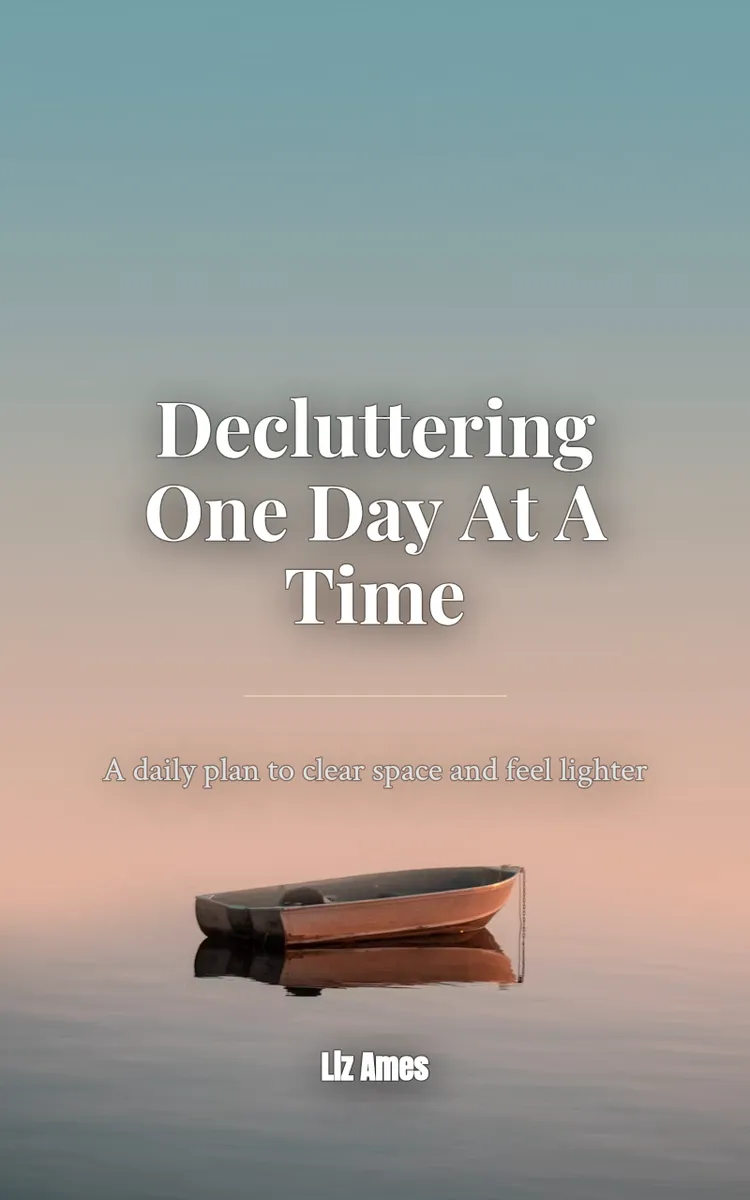
"Decluttering One Day At A Time" is a day challenge book by Liz Ames with 5 chapters and approximately 9,488 words. Daily decluttering routine to reduce clutter over time.
This book was created using Inkfluence AI, an AI-powered book generation platform that helps authors write, design, and publish complete books.
Frequently Asked Questions
What is "Decluttering One Day At A Time" about?
Daily decluttering routine to reduce clutter over time
How many chapters are in "Decluttering One Day At A Time"?
The book contains 5 chapters and approximately 9,488 words. Topics covered include Days 1-5: Declutter Foundations, Days 6-10: Daily Sorting Routine, Days 11-15: Keep, Donate, Trash Mastery, Days 16-20: Reset for Relapse-Proof Habits, and more.
Who wrote "Decluttering One Day At A Time"?
This book was written by Liz Ames and created using Inkfluence AI, an AI book generation platform that helps authors write, design, and publish books.
Write your own day challenge book with AI
Describe your idea and Inkfluence writes the whole thing. Free to start.
Start writingCreated with Inkfluence AI


