
Read the first chapter
The whole of chapter one, free. About 12 min. Turn the pages with the arrows, your keyboard, or a swipe.
Chapter 1
When Everyone Gives Orders
About This Topic
A finance manager receives two instructions about the same payment: the Executive Director says release it, while a Board committee member says hold it. The manager is capable, careful, and still stuck. This chapter covers the three breakdown patterns behind moments like that: the Board reaching into operations, management stretching beyond its mandate, and staff going around the reporting line.
Questions and Answers
Q1: Why can capable people still bring an organization to a standstill?
A: Capable people can stall an organization when they receive unclear, conflicting, or unauthorized instructions. Skill doesn’t solve a structure problem.
Take the finance manager facing one payment and two orders. The Executive Director says, “Release it.” A Board committee member says, “Put it on hold.” Both may believe they’re protecting the organization. The manager still has no safe way to decide. Follow one instruction, and the other person may object. Wait for clarity, and the payment may miss its deadline.
This is why organizational health depends on more than good intentions. It depends on four working parts:
• Clear roles - Firm boundaries - Reliable communication - Accountability for decisions
When those parts are missing, people spend time guessing who has authority instead of doing the work.
The practical takeaway is simple: when a decision freezes, look first for a broken line of authority - not a lack of effort.
Related: See also Q2 about the three breakdown patterns | Q5 for handling conflicting instructions
---
Q2: What are the three recurring ways authority breaks down?
A: The three patterns are:
1. The Board reaches down into operations. 2. Management stretches beyond its mandate. 3. Staff go around the reporting line.
These patterns look different, but they create the same trouble: decisions start moving through unofficial channels.
A Board member may contact a staff person directly to change a schedule, approve a purchase, or question a routine process. A manager may make a major policy or strategic decision that belongs to the Board. A staff member may skip a supervisor and appeal directly to a senior manager or Board member.
None of these actions automatically comes from bad motives. A Board member may be trying to help. A manager may be trying to move quickly. A staff member may feel ignored. But once authority becomes a matter of personal access, the organization loses a dependable way to decide.
Use the three patterns as a quick diagnostic. Ask: Who is giving the instruction? Who normally owns this decision? Who is accountable for the result? Those answers often reveal the blockage.
Related: See also Q3 about Board involvement | Q7 about staff bypassing supervisors
---
Q3: What does it mean when the Board reaches down into operations?
A: It means Board members start directing day-to-day work that belongs to management and staff.
A Board’s role is to provide governance, oversight, and direction at the proper level. It may approve major policies, set broad priorities, monitor results, and hold the Executive Director accountable. It usually shouldn’t tell a finance clerk which invoice to process or tell a program employee how to arrange a routine event.
The problem isn’t only that one task gets disrupted. Direct contact can quietly create a second chain of command. Staff may begin treating individual Board members as supervisors, especially when those members control access to important decisions.
| Healthy Board involvement | Operational overreach | |---|---| | Approving a financial policy | Ordering a specific payment released | | Reviewing program results | Reassigning a staff member | | Holding the Executive Director accountable | Directing staff without management’s knowledge |
A Board can ask for information without taking over the work. The key is to send operational requests through the Executive Director or the agreed reporting line.
The takeaway: oversight asks whether the organization is doing the right work; operations decide how today’s work gets done.
Related: See also Q4 about direct staff contact | Q8 about boundaries between roles
---
Q4: Is it always wrong for a Board member to speak directly with staff?
A: No. Direct contact isn’t automatically wrong; unannounced direction is the danger.
Board members and staff may naturally meet at events, answer questions, or share useful information. A Board member might ask, “How did the workshop go?” That’s different from saying, “Cancel next month’s workshop and use the money elsewhere.”
Healthy direct contact has a few safeguards:
• The conversation doesn’t create a new assignment. - The staff member knows who remains responsible for the work. - Sensitive concerns move through the Executive Director. - The Board and management communicate what contact is appropriate.
If a Board member has a concern about a staff member’s performance, the concern should normally go to the Executive Director, not become a private investigation. Otherwise, the staff member may receive mixed messages and the Executive Director may be held accountable for work they weren’t allowed to manage.
A friendly conversation can be harmless. A hidden instruction changes the structure. Keep that distinction clear.
Related: See also Q3 about Board overreach | Q6 for separating oversight from management
---
Q5: How should a staff member handle two contradictory instructions?
A: Pause the action, document the conflict, and bring it to the person who owns the reporting line.
Don’t quietly choose the instruction that feels safer. Don’t play messenger between powerful people. Use a short, neutral process:
1. Write down what was requested, by whom, and when. 2. Check the organization’s policy or delegation for that decision. 3. Tell the relevant manager that the instructions conflict. 4. Ask for one confirmed direction. 5. Keep the confirmation with the payment, purchase, or project record.
For the finance manager, that might sound like: “I have instructions from the Executive Director to release the payment and from a Board committee member to hold it. Please confirm which direction governs.”
That wording avoids taking sides. It also puts the decision back with the person responsible for operations or with the body authorized to decide.
If the conflict involves the Executive Director’s own authority, the Board Chair or the full Board’s agreed process may need to address it. The important point is that the staff member shouldn’t be forced to invent the organization’s hierarchy in the middle of a deadline.
Related: See also Q1 about stalled decisions | Q9 about documenting authority
---
Q6: What’s the difference between Board oversight and Board management?
A: Board oversight checks whether the organization is properly directed and accountable. Board management controls the daily work. The first is governance; the second reaches into operations.
Here’s a practical comparison:
• Oversight: “Are expenses staying within the approved budget?” - Management: “Tell the finance manager to stop this payment.” - Oversight: “Is the program meeting its approved goals?” - Management: “Change the program schedule today.” - Oversight: “Is the Executive Director handling responsibilities effectively?” - Management: “Tell a staff member how to complete a task.”
The boundary can feel uncomfortable. Board members often care deeply about the mission and may have valuable experience. But expertise doesn’t automatically grant operational authority. A person can know a great deal about finance and still not be the person authorized to approve a particular payment.
The Board should make sure the organization has sound systems and that management follows them. It shouldn’t replace those systems with individual instructions.
The useful test is this: Is the Board evaluating direction and results, or personally directing the next move?
Related: See also Q3 about reaching into operations | Q10 about management’s mandate
---
Q7: Why do staff members go around their supervisors?
A: Staff usually bypass the reporting line because they believe it will get a faster, safer, or more favorable answer.
Sometimes they’re right in the short term. A supervisor may be unavailable, slow to respond, or known for blocking information. A staff member may also feel that a senior leader or Board member is easier to approach. But the shortcut creates a bigger problem: the supervisor remains accountable without having control over the work.
Going around the reporting line can look like:
• Taking a complaint directly to a Board member - Asking another manager to approve work - Copying senior leaders to pressure a supervisor - Seeking a second answer after receiving an inconvenient one
There are legitimate exceptions. Serious misconduct, safety concerns, conflicts of interest, or a complaint about the supervisor may require another reporting path. That path should be known and documented, not improvised through personal connections.
Managers must also examine why bypassing happens. If staff can’t get timely answers, the reporting line may exist on paper but fail in practice.
The takeaway: protect the reporting line, but make sure it’s responsive enough that people don’t feel forced to escape it.
Related: See also Q8 about management’s role | Q11 about preventing bypasses
---
Q8: What happens when management stretches beyond its mandate?
A: Management overreach happens when an Executive Director or manager makes decisions that belong to the Board or changes direction without proper authority.
A manager may approve a major commitment, alter a governing policy, or pursue a new direction because the opportunity seems urgent. The motive may be practical: “If we wait for the next meeting, we’ll lose the chance.” But speed doesn’t create authority.
This pattern causes two kinds of damage. First, the Board may discover that an important decision has already been made. Second, staff may receive instructions that conflict with approved priorities. The organization then has to spend time undoing, defending, or repairing a decision that should have followed a clear process.
A useful boundary is:
• Management handles implementation, administration, and approved operations. - The Board handles governance, broad direction, and accountability. - Both must follow the organization’s governing documents and agreed delegations.
When an urgent matter falls near the boundary, management should state what decision is needed, what authority exists, and what approval is missing. “We need a Board decision by Friday” is far healthier than quietly acting first and explaining later.
Related: See also Q6 about oversight and management | Q9 about delegated authority
---
Q9: How can an organization make authority clear before a conflict occurs?
A: Put decision rights in writing and connect them to real work.
A vague statement such as “management runs operations” won’t settle much when a payment is disputed. People need to know who approves spending, who changes policy, who supervises staff, and who handles urgent exceptions.
A simple authority map can help:
| Decision | Primary owner | Consultation | Final accountability | |---|---|---|---| | Routine payment within budget | Management | Finance staff | Executive Director | | Major policy change | Board | Executive Director | Board | | Staff assignment | Supervisor or manager | Relevant manager | Executive Director | | Executive Director performance | Board | Board Chair or committee | Board |
The exact assignments depend on the organization’s governing documents. The point is not to create a beautiful chart that nobody uses. It’s to remove guesswork from ordinary decisions.
Review the map when leadership changes, the budget grows, or responsibilities shift. A role that made sense for a small organization may become unsafe when the organization has more programs, staff, or financial commitments.
The practical takeaway: write down who decides, then make sure everyone uses the same map.
Related: See also Q5 about conflicting instructions | Q10 about boundaries
---
Q10: What’s the best way to repair a broken reporting line?
A: Start by naming the break without turning it into a personal accusation.
A repair conversation should focus on the work: “The finance manager received two different instructions about one payment. We need one route for resolving that.” That is more useful than “You keep interfering” or “Staff can’t be trusted.”
A workable repair usually follows this sequence:
1. Identify the decision that became confused. 2. Trace who gave instructions and who was accountable. 3. Confirm the proper authority for that type of decision. 4. Tell affected people what changes now. 5. Record the rule in a policy, meeting note, or delegation document. 6. Check after a few weeks to see whether the confusion returned.
The Board may need to agree that operational requests go through the Executive Director. Management may need to clarify which decisions require Board approval. Staff may need a safe way to raise concerns without skipping supervisors.
Repair is not complete when people apologize. It’s complete when the next similar decision has a clear route.
Related: See also Q9 about authority maps | Q12 about accountability
---
Q11: Is a strong hierarchy enough to keep an organization healthy?
A: No. A hierarchy helps only when roles, communication, boundaries, and accountability work together.
A rigid structure can still fail. If information is hidden, staff may bypass managers. If the Board never reviews management’s work, authority may drift. If managers refuse to explain decisions, people may seek answers elsewhere. The answer isn’t simply “follow the chain of command” and move on.
Think of the organization like a body - not as a blueprint, but as a lens for understanding relationships. Different parts have different jobs, and the whole system suffers when one part tries to do another part’s work. The metaphor is useful only if it helps people notice connection and responsibility. It shouldn’t be used to pretend that an organization is mechanical or that every role has a fixed biological equivalent.
Healthy hierarchy includes communication in both directions:
• Instructions move down clearly. - Concerns move up safely. - Information moves across when coordination requires it. - Accountability remains attached to authority.
So don’t ask only, “Who is above whom?” Ask, “Can the right person decide, and can others see how that decision was made?”
Related: See also Q7 about bypassing supervisors | Q12 about accountability
---
Q12: What should leaders check when the same authority problem keeps returning?
A: Leaders should check whether the structure is unclear, the communication is weak, or accountability is detached from authority.
Repeated confusion around payments, hiring, programs, or Board requests is rarely just a personality clash. Look for patterns:
• The same Board member gives staff instructions. - Managers make commitments without required approval. - Staff repeatedly seek a second answer. - Meeting decisions aren’t communicated to the people doing the work. - Someone is held responsible for results but lacks control over the relevant decisions.
Then ask three direct questions:
1. Where does this decision officially belong? 2. How does that person communicate the decision? 3. What happens when someone disagrees or needs an exception?
If the answers are different depending on whom you ask, the organization has a design problem. Fix the route, not just the latest incident.
A short review of recent disputed decisions can be revealing. Examine the last three or five cases, note who instructed whom, and compare the actual path with the intended one. Practical evidence beats assumptions.
The takeaway: recurring confusion is a signal. Treat it as information about the hierarchy, not proof that the people involved are incompetent.
Related: See also Q2 about the three breakdown patterns | Q10 about repairing reporting lines
---
Capable people don’t need more competing orders. They need a clear place to stand, a reliable way to communicate, and accountability that matches authority. Once those pieces are in place, the finance manager can process the payment, the Board can govern, management can manage, and staff can do their jobs without guessing who is really in charge.
End of chapter one. 7 more chapters and about 21,021 words in the full book.
Swipe or use the arrows to turn the page


What's inside: 8 chapters
- 1. When Everyone Gives Orders
- 2. Authority Is Not the Same as Responsibility
- 3. What the Board Should—and Shouldn’t—Do
- 4. How Management Turns Plans into Work
- 5. The Documents Must Agree
- 6. Keep the Signals Moving
- 7. Controls That Protect Without Stalling
- 8. Make Healthy Habits Last
About this book
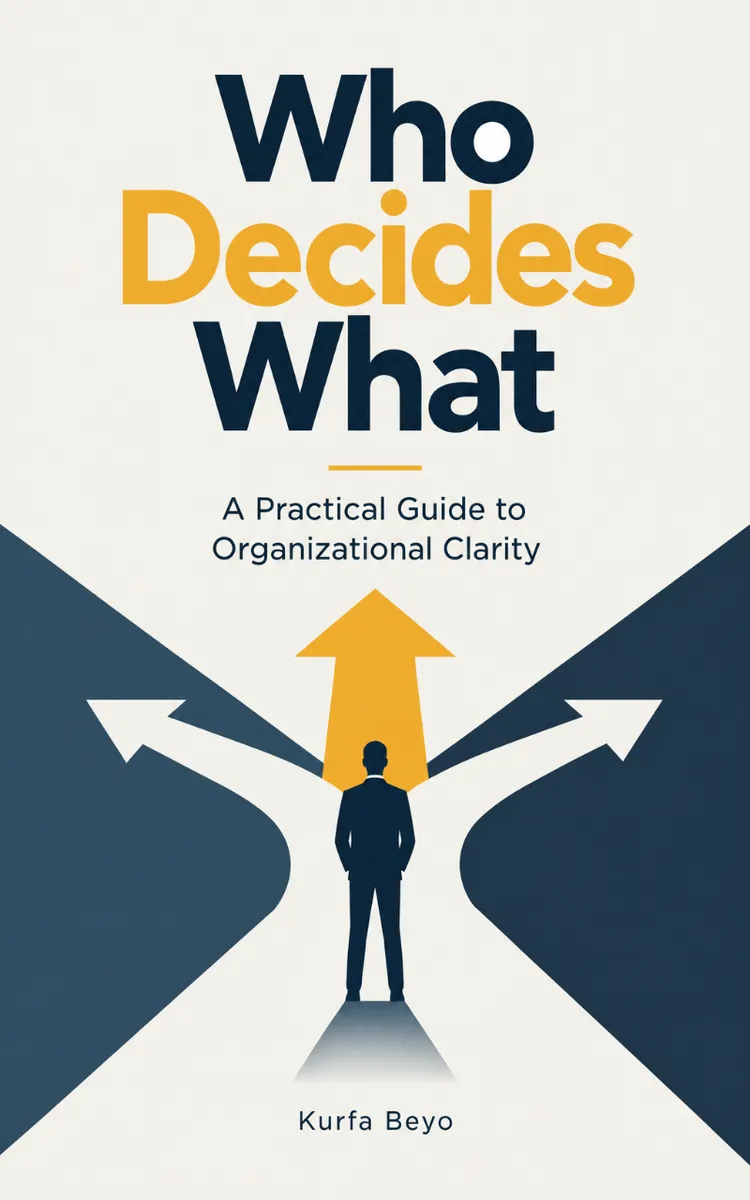
"Who Decides What" is a q&a book by Kurfa Beyo with 8 chapters and approximately 21,021 words. A conversational guide to understanding how boards, managers, and staff can share authority, communicate clearly, and keep an organization accountable to its mission..
This book was created using Inkfluence AI, an AI-powered book generation platform that helps authors write, design, and publish complete books.
Frequently Asked Questions
What is "Who Decides What" about?
A conversational guide to understanding how boards, managers, and staff can share authority, communicate clearly, and keep an organization accountable to its mission.
How many chapters are in "Who Decides What"?
The book contains 8 chapters and approximately 21,021 words. Topics covered include When Everyone Gives Orders, Authority Is Not the Same as Responsibility, What the Board Should—and Shouldn’t—Do, How Management Turns Plans into Work, and more.
Who wrote "Who Decides What"?
This book was written by Kurfa Beyo and created using Inkfluence AI, an AI book generation platform that helps authors write, design, and publish books.
Write your own q&a book with AI
Describe your idea and Inkfluence writes the whole thing. Free to start.
Start writingCreated with Inkfluence AI


