

Read the first chapter
The whole of chapter one, free. About 9 min. Turn the pages with the arrows, your keyboard, or a swipe.
Chapter 1
Refugees at the Open Gates
The gate chains groaned through the stone above Alys’s head, shedding rust in reddish flakes across the threshold. Morning poured beneath the rising portcullis, pale and cold, touching the road beyond before it touched her face.
“Slowly,” she called. “No one enters until Hobb has counted the wagons.”
The first wagon lurched forward anyway. Its wheel struck a rut, throwing a child against the sideboard. Alys stepped into the road and caught the little girl by the arm before she fell beneath the horse’s hooves.
“Back!” Beran shouted.
His spear came down across the horse’s chest. The animal reared, iron shoes scraping sparks from the stones. Behind it, three more wagons jammed together, their drivers cursing as frightened people pressed toward the open gate.
Alys held the child against her skirts until the horse settled. The girl’s face was gray with dust, her fingers clutching a wooden spoon as if it were a sword.
“Are you hurt?”
The child shook her head.
“Your mother?”
A woman pushed through the crowd, stumbled, and dropped to her knees. She seized the girl, then bowed over both hands.
“Lady, please. We have nowhere else.”
Alys looked past her. The road was crowded as far as the bend: families with bundles tied in torn blankets, old men leaning on staffs, merchants guarding carts beneath patched canvas. Some had walked through the night. Others bore the marks of flight - mud-blackened hems, blood on a sleeve, a boy with one shoe and no cloak despite the morning frost.
Behind Alys, Avenholt waited in uneasy silence. The castle’s towers rose above the gatehouse, their stones washed clean by the rain that had broken the curse. For the first time in years, the road ran openly toward them.
She wanted the gates to mean what she had promised. Shelter without secret bargains. Judgment spoken where all could hear it. No hand taking payment in darkness.
“Bring the child inside,” she said. “Hobb, clear the west yard for the families. Merchants to the lower court. No one is turned away for lack of coin.”
Hobb, broad as a door and twice as weathered, stared at the mass beyond the gate.
“No one?” he asked.
“No one who comes unarmed and peaceful.”
“That leaves a great many hands to feed.”
“Then we will count the hands and find the bread.”
Hobb rubbed his jaw. “And if the stores do not stretch?”
Alys felt the ancestral signet pressing against her finger, the falcon carved over its cracked shield. It had been used to bind the castle. Now every order she gave seemed to tug at the old claim it carried.
“Then we will say so before witnesses,” she answered. “But we will not close the gates on people who have reached them.”
Hobb bent his head and turned toward the yard. His shout rolled beneath the archway, ordering the stable boy to lead the horses aside and the refugees to keep moving.
The order lasted less than a minute.
A merchant’s cart broke from the line, its mule plunging toward the gatehouse. The stable boy darted after it, too young and too quick, and seized the bridle. The mule dragged him three paces before Beran caught the harness and hauled both animal and boy to a halt.
“Are you trying to be trampled?” Beran demanded.
The stable boy’s eyes flashed. “I was trying to keep the cart from crushing the old woman.”
Beran glanced at the wagon. An old woman had fallen beneath its rear wheel. Alys ran forward, crouched in the mud, and helped pull her free. The woman’s ankle was twisted, but the wheel had missed her.
“Physician,” Alys called. “And clear this road.”
The merchant climbed down, pale beneath his beard. “My goods are worth more than the old woman’s life.”
Alys rose, mud streaking her gray cloak. “Then you may carry them back out.”
The merchant swallowed.
Beran’s mouth tightened, though whether in approval or concern she could not tell. “You heard her.”
The merchant lowered his gaze. His men began unloading the cart.
That was how the morning went: one knot after another, each pulled tight by fear. A family from the eastern villages claimed the road had been taken by armed men. A woman with two infants insisted her husband had vanished at the river. Three merchants argued over the space beneath the gatehouse roof until Hobb threatened to put their goods in the rain. Alys listened, decided, and sent each person onward.
She placed the refugees in the west yard, where the kitchens could give them broth. She ordered the empty stable loft swept for sleeping space. She had the merchants’ names entered into the new record book and required them to leave their weapons with Hobb before passing into the inner court.
Each command cost her something. The castle had food for perhaps a week if the household remained small. The refugees had brought sickness, grief, and rumors with them. The merchants brought coin, but also sharp eyes and sharper questions.
They watched her as she moved through the gatehouse. Some bowed because she wore the falcon ring. Others bowed because Beran stood beside her. A few did neither.
Near midday, her younger brother appeared at the stair beneath the gatehouse tower, leaning on the physician’s arm. His face was still thin from the curse, but color had returned to his cheeks.
“You should be in bed,” Alys said.
“So should you.”
“I am not the one who nearly fainted beside the hearth.”
“I did not faint. I sat down without warning.”
Alys almost smiled. Then a horn sounded beyond the road.
The note was low and measured, not the frantic blast of frightened travelers. Conversation faltered. Heads turned toward the bend.
A rider came into view beneath a red-and-gold pennon. Six mounted men followed him, all in polished mail, their horses stepping high through the mud. The rider wore no helm. A silver chain rested over his dark surcoat, and from it hung a narrow case sealed in red wax.
Hobb moved to bar the gate.
Alys raised her hand. “Let them approach.”
Beran looked at her. “They are armed.”
“So are we.”
“They have come prepared.”
“So have I.”
His gaze held hers for a moment. Then he shifted his spear and stood half a pace ahead of her, close enough to shield her if the need arose.
The rider halted before the gatehouse. His eyes moved over the refugees, the merchant carts, and the open road behind them. He seemed less interested in the people than in the fact that the gates stood wide.
“I bear a message from Lord Veyr of Dunmorrow,” he said.
Alys had heard the name. Every child of the borderlands knew Dunmorrow’s lord held three river forts and collected tolls from roads he had not built.
“Give it to Hobb,” she said.
The herald’s brows lifted. “It is addressed to the lady of Avenholt.”
“You are speaking to her.”
His glance dropped to the falcon ring. “Then you are Alys.”
“I am.”
He dismounted with deliberate care. Mud touched the edge of his boot, and irritation crossed his face before courtesy covered it.
“I am Herald Cale,” he said. “By order of Lord Veyr, I require entry to present a lawful claim.”
“You may present it here.”
“A claim concerning the castle cannot be shouted over a crowd.”
“Then speak loudly.”
Behind her, someone laughed nervously. The herald’s expression hardened.
Beran leaned toward Alys. “Do not let him set the place of judgment.”
Alys kept her eyes on the herald. “You heard him. Present the claim.”
Herald Cale opened the sealed case. Inside lay a parchment rolled around a black rod. He unbound it and spread the document across the gatehouse table Hobb had dragged into the open.
The parchment was yellowed, its edges dark with age. A royal seal hung from the bottom, green wax cracked but unbroken. Beneath it ran lines of cramped script and a painted falcon whose wings were spread over a shield.
Alys’s hand closed around her ring.
“The Charter of First Grant,” said Cale. “Issued in the reign of King Othmar, witnessed by the crown and entered into the royal archive. It grants the lands of Avenholt, the castle, its roads, mills, fields, and tolls to the House of Veyr should the Avenholt line fail to maintain lawful rule.”
“My family has ruled here for generations,” Alys said.
“Your family’s steward bound the castle to a curse. Your household was abandoned. Your gates were shut. No court would call that lawful rule.”
The words struck harder because they were spoken before the people she had just admitted. A refugee woman pulled her child closer. One of the merchants bent over the parchment, pretending interest in the seal while listening to every word.
“My household was held under that curse,” Alys said. “And I broke it.”
“After the failure.”
“After surviving it.”
Cale’s eyes flicked toward the towers. “The charter does not require your agreement.”
“Nor does it give your lord the right to enter my gate with armed men.”
“Lord Veyr has no wish for bloodshed. He offers pardon to those who accept the charter and withdraw from false authority.”
A silence opened around them.
Alys thought of Corvin in the bell tower, weakened and under guard. She thought of the curse parchment beneath her bodice, its brittle edges brushing her skin whenever she moved. False authority. The phrase had been chosen carefully. It could be used against Corvin, against her, against the witch, against anyone who had stood beside her when the castle’s stones were trying to swallow them.
Her younger brother gripped the stair rail. Beran’s hand tightened around his spear.
“Who witnessed this charter?” Alys asked.
Cale smiled faintly. “The royal seal is witness enough.”
“No. Under my order, every claim against Avenholt is entered before three living witnesses.”
“You cannot impose rules upon a lord whose right predates your house.”
“I can impose them upon anyone standing at my gate.”
The herald’s smile vanished.
Alys turned to Hobb. “Enter the charter into the record. Write down the seal, the wording, the names of every man who came with it, and the hour it was presented.”
Hobb reached for the parchment.
Cale snatched it away. “You will not touch a royal document.”
“Then hold it still while he copies it,” Alys said.
For the first time, uncertainty moved through the herald’s men. They had expected a frightened lady, perhaps one willing to bargain before the crowd. Instead, the gatehouse had become a court, and every refugee, merchant, servant, and soldier had become a witness.
Cale rolled the parchment shut.
“Lord Veyr demands recognition of the charter before these witnesses,” he said. “If you refuse, he will regard Avenholt as unlawfully held.”
Alys looked beyond him, toward the road. More people were approaching: a mother carrying a sleeping infant, two old men with a handcart, a merchant leading a string of packhorses. The gates had opened, and the world had answered.
She had wanted to bring them safely inside. She had done that. The west yard was filling. Fires were being lit. Bread was being cut. For one brief moment, Avenholt had become what she had promised.
Now the promise stood beneath a lord’s seal.
Alys stepped to the table and placed her hand beside the charter.
“Before these witnesses,” she said, her voice carrying beneath the stone arch, “I recognize that Lord Veyr has presented a claim.”
Cale inclined his head.
“I do not recognize the claim itself.”
The herald’s face went still.
Alys looked to Hobb. “Record that as well.”
Then she turned toward the open road, where the first refugees were crossing fully into Avenholt, and felt the falcon ring grow cold against her finger.
“Let them in,” she ordered. “Close nothing.”
End of chapter one. 4 more chapters and about 10,262 words in the full book.
Swipe or use the arrows to turn the page


What's inside: 5 chapters
- 1. Refugees at the Open Gates
- 2. The Witch at the Council Table
- 3. The Charter’s Living Seal
- 4. Banners Beyond the Walls
- 5. Alys Refuses the Summons
About this book
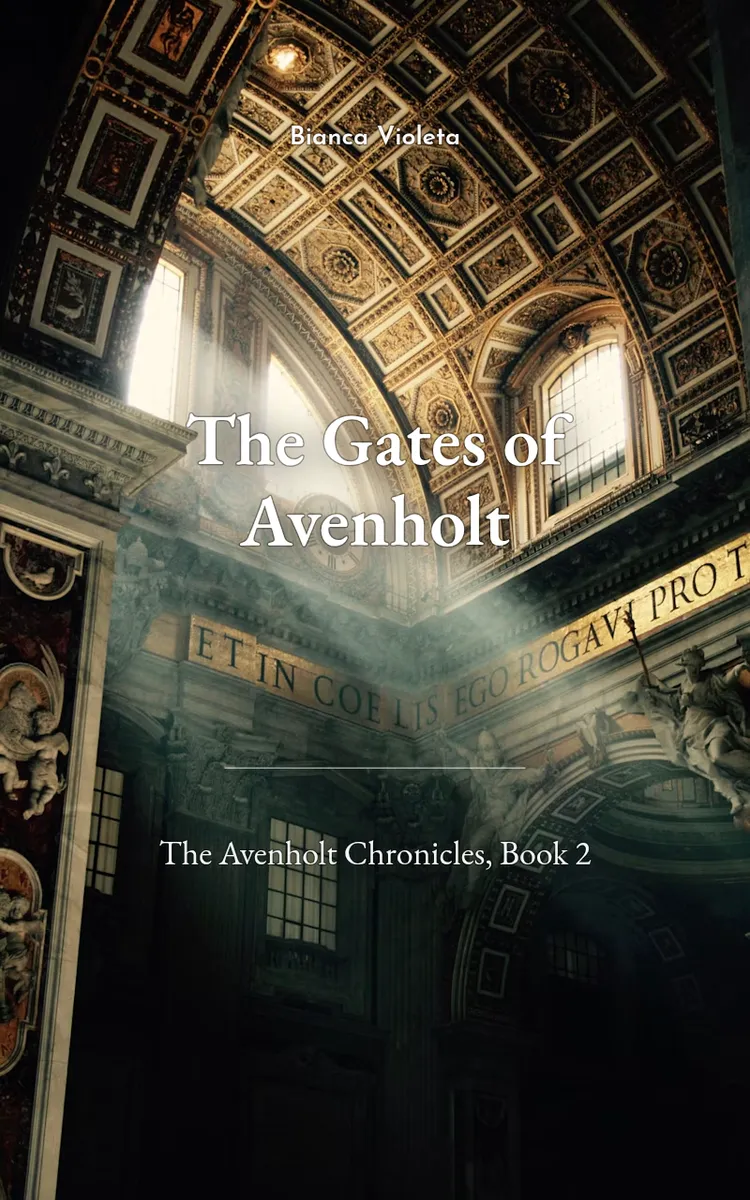
"The Gates of Avenholt" is a fiction book by Bianca Violeta with 5 chapters and approximately 10,262 words. Alys opens Avenholt’s gates to refugees, and an old charter opens a claim to her castle. The road fills with families and wagons, while inside the great hall a hostile herald brings a sealed document and nobles watch the witch’s thorn-shaped clasp at Alys’s throat.
This book was created using Inkfluence AI, an AI-powered book generation platform that helps authors write, design, and publish complete books. It was made with the AI Novel Writer.
Frequently Asked Questions
What is "The Gates of Avenholt" about?
Alys opens Avenholt’s gates to refugees, and an old charter opens a claim to her castle. The road fills with families and wagons, while inside the great hall a hostile herald brings a sealed document and nobles watch the witch’s thorn-shaped clasp at Alys’s throat. Lord Veyr’s claim may be lawful. It may also be built on evidence planted in the castle’s records chamber. With the refugees crowding her walls, Alys must find out what the Charter of First Grant can take from her before Veyr’s soldiers arrive. The answer lies in old records, uneasy loyalties, and a living seal. At Avenholt’s open gate, every welcome could become a weakness.
How many chapters are in "The Gates of Avenholt"?
The book contains 5 chapters and approximately 10,262 words. Topics covered include Refugees at the Open Gates, The Witch at the Council Table, The Charter’s Living Seal, Banners Beyond the Walls, and more.
Who wrote "The Gates of Avenholt"?
This book was written by Bianca Violeta and created using Inkfluence AI, an AI book generation platform that helps authors write, design, and publish books.
How can I create a similar fiction book?
You can create your own fiction book using Inkfluence AI. Describe your idea, choose your style, and the AI writes the full book for you. It's free to start.
Write your own fiction book with AI
Describe your idea and Inkfluence writes the whole thing. Free to start.
Start writingCreated with Inkfluence AI


