

Read the first chapter
The whole of chapter one, free. About 9 min. Turn the pages with the arrows, your keyboard, or a swipe.
Chapter 1
A Cemetery No One Mentions
The county ledger left a gray rectangle of dust on Julie’s fingertips.
She rubbed her thumb against the page’s brittle edge and leaned closer beneath the coffee house’s yellow pendant lights. Outside, Blackwood’s morning traffic hissed over wet pavement, and somewhere behind the counter a spoon struck porcelain again and again.
“Julie,” Scott said, “if I don’t leave in ten minutes, the mill will decide I’ve quit.”
She looked up. Scott had folded his work schedule beside his mug, one broad hand resting over Monday through Friday as if he could hold the week in place. Sawdust-colored hair fell across his forehead. His jacket was still damp from the rain, and a dark drop slid from the cuff onto the table.
“I found something,” she said.
“That sounds worse than being late.”
“It might be.”
He glanced at the ledger. “What is it?”
Julie turned the book so he could see the entry. The handwriting slanted sharply across the page, faded brown beneath a line of newer ink.
“Cemetery,” she said. “Near Blackwood.”
Scott’s eyes moved over the words. “There are three cemeteries in Blackwood.”
“Four, according to this.”
He read silently. The coffee house carried on around them - chairs scraping, the hiss of steaming milk, a burst of laughter near the front window - but Julie felt the little table narrow between them.
“Cemetery of what?” he asked.
“Nothing. That’s the strange part.”
She placed her finger beneath the entry. “It says, ‘Burial ground near the old Echo road, beyond the second creek, under the eastern timber.’”
Scott looked toward the window, where rain silvered the roofs and blurred the dark wall of woods beyond town.
“Echo,” he said.
“An early settlement. I told you about it.”
“You told me people in Blackwood say it never existed.”
“People say a lot of things when records are inconvenient.”
He lifted his mug, found it empty, and set it down again. “And this record is convenient?”
“No. It’s vague, incomplete, and written by someone who expected the person reading it to know where the eastern timber was.”
“Which means?”
“Which means I want to find out if the cemetery is real.”
Scott gave her a look that was almost a smile. “Before breakfast?”
“We’ve been here twenty minutes.”
“You’ve been here twenty minutes. I’ve been trying to plan my work week.”
Julie glanced at the schedule beneath his hand. “You have Tuesday off.”
“I have half of Tuesday off.”
“Then we start Tuesday.”
He leaned back. The wooden chair creaked beneath him. “Start what?”
“Looking.”
“For a cemetery no one has seen?”
“For a cemetery listed in county records.”
“That’s not much better.”
Julie closed the ledger carefully. It belonged to the local history collection at the library, and she had spent the previous afternoon turning pages until her neck ached. She had come to Blackwood after finishing her history degree because she wanted a teaching job, not because she expected the town to hand her a mystery. But the entry had been waiting among tax notes and road surveys, its single line refusing to disappear.
“I checked the cemetery records twice,” she said. “The page was copied from an older register. The name Echo appears beside it.”
Scott’s expression changed, though only slightly. “You’re sure?”
“I know what I read.”
“I didn’t mean that.”
The question settled between them. Julie understood it. Scott had always been willing to listen to her discoveries, but he disliked anything that required stepping into the woods without a clear trail. He hunted and fished, knew how quickly daylight vanished beneath the trees, and had learned not to trust a place simply because it looked quiet.
She lowered her voice. “There may be graves out there.”
“There may be a story about graves.”
“Stories begin somewhere.”
“Some end there, too.”
The counter bell rang. A woman called Scott’s name, and he rose to refill their mugs. Julie watched him cross the room, boots leaving faint dark prints on the tile. He moved with the steady caution he brought to everything, as if every doorway had to be measured before he passed through it.
When he returned, he set her cup down first.
“Ask someone,” he said.
“I did.”
“And?”
“Mrs. Hanley at the library said the entry was probably a mistake.”
“That sounds promising.”
“She also said her grandmother called Echo a place where people got lost.”
Scott stirred sugar into his coffee. “My neighbor says the same thing about the north woods.”
“Your neighbor says that about every road he doesn’t want people using.”
“That’s because he’s eighty.”
“That doesn’t make him wrong.”
“It makes him experienced.”
Julie opened the ledger again. The page crackled beneath her hand. “There’s more.”
Scott stopped stirring.
“Not in the entry. In the margin.” She pointed to a faint notation nearly swallowed by the binding. “A date. Eighteen twenty-four. And initials.”
“Whose?”
“I don’t know.”
“Then we know less than we did five minutes ago.”
“Not exactly.”
She pulled a folded sheet from her satchel. She had copied the surrounding entries before leaving the library: road maintenance, a land transfer, a list of household names. One name appeared repeatedly.
“Morris Martin,” she said. “He owned the general store in Echo.”
Scott’s gaze sharpened. “Martin?”
“Yes.”
“Any relation?”
“Not that I know of.”
He looked at her for a moment. Julie felt the familiar discomfort of being examined and tried to ignore it. Her last name had followed her into Blackwood before she had made any friends, but no one had ever connected it to an abandoned settlement. She had never heard of Morris Martin or Bess Martin in her family’s stories.
“I’m not saying there is,” she added. “It’s just another thread.”
“Threads can lead nowhere.”
“So can work schedules.”
He glanced at the clock above the counter. “That one leads to my paycheck.”
“And this could lead to a cemetery.”
“Or wet socks, ticks, and a hole in the ground.”
Julie folded the paper. “You don’t have to come.”
His jaw tightened. “I didn’t say that.”
“You’re acting like it.”
“I’m acting like a man who has to spend the morning lifting feed sacks.”
“You’re acting like a man who thinks I’ll walk into the woods alone.”
Scott’s spoon stopped against the rim of his mug.
The rain ticked against the window. For a moment, the old story neither of them mentioned seemed to enter the space with them - the three days in jail, the man Scott had struck after finding him with his fiancée, the shame that had stayed long after the bruises faded. Scott rarely spoke of it. Julie had never asked for details. Still, she knew anger frightened him more than it frightened anyone else.
“I know what you’re thinking,” he said.
“I’m not thinking about that.”
“You are.”
“I’m thinking that you don’t have to protect me from a muddy path.”
His eyes dropped to his hands. “I’m not good at watching people walk into trouble.”
“Then help me decide whether it is trouble.”
He breathed out through his nose, slow and controlled. “You said two weeks.”
Julie blinked. “What?”
“You said Tuesday. How long are you planning to look?”
She hesitated. The answer had formed before she could make it sensible. “Two weeks.”
“That’s a lot of searching for something that might be a line in a damaged book.”
“Two weeks is enough to cover the roads and timber near the old route.”
“After work?”
“Whenever we can.”
“Your teaching applications can wait?”
“They already have.”
He studied her face. “You’re serious.”
“I am.”
Scott folded his schedule and slipped it into his jacket pocket. The movement was neat, final. “Then we need better directions.”
Julie reached into her satchel and removed the photocopy she had made at the county records office. The machine had cut off part of the margin, leaving a black strip along one edge.
“This is all they had,” she said. “The cemetery was recorded, but there’s no map. The clerk said the original survey might be in storage.”
“Might be?”
“He said the storage room floods.”
Scott stared at the page. “And people wonder why history disappears.”
“Exactly.”
He traced the road description with one finger. “Old Echo road. Second creek. Eastern timber. That could be anywhere beyond the mill.”
“Not anywhere. The road would have followed the settlement.”
“Unless the road was moved.”
“Then we find the old route.”
“By asking who?”
Julie looked past him at the rain-dark window. Blackwood had grown around the college and the feed mill, a town of newcomers with no shared memory older than a few decades. Dense woods crowded its edges, concealing the land beneath a green wall. Everyone knew where the roads were now. Few people cared where they had been.
“People who have lived here longest,” she said.
Scott gave a short laugh. “That’ll take all morning.”
“Then we start with the people who like telling stories.”
“That narrows it down to everyone at the diner and no one at the mill.”
Julie smiled despite herself. “You can ask your neighbor.”
“He’ll tell us Echo was built by ghosts.”
“Maybe he knows where the ghosts lived.”
Scott looked again at the copy. The corner had begun to curl from the damp.
“Tuesday,” he said.
Julie held still. “Tuesday?”
“I can meet you here at seven. We ask around first. We don’t go charging into the woods because one clerk couldn’t keep a map dry.”
“And Wednesday?”
“If we have a place to start, we search.”
“And Thursday?”
He shook his head. “You’re making a contract out of coffee.”
“You said two weeks.”
“I said we’ll see.”
“That’s not a commitment.”
“It’s what I can give you before I’ve seen the weather, the ground, or the amount of poison ivy waiting out there.”
Julie gathered the papers and slid them into her satchel. Her fingers trembled - not from fear, exactly, but from the sudden weight of the decision. Until that moment, Echo had belonged to ink and rumor. Now it had a time, a place, and Scott’s reluctant promise attached to it.
She stood. “Tuesday at seven.”
Scott rose as well. “If we find nothing by the end of two weeks, we stop.”
Julie met his eyes. “If we find nothing, we stop.”
“That isn’t what I said.”
“It’s what I agreed to.”
The corner of his mouth moved, but the smile never arrived. “You’re stubborn.”
“Determined.”
“Those are cousins.”
“They live in the same house.”
Outside, the rain had weakened to a fine mist. Julie pushed open the coffee house door, and cold dampness touched her face. Scott followed, pulling his jacket closed.
At the curb, he paused. Beyond the buildings, the woods stood dark and unbroken, their branches dripping steadily into the ditches.
“Julie,” he said.
She turned.
“If this place is real, it may not be safe. Old graves can be unstable. Land can be private. People may not want us there.”
“Then we’ll ask permission.”
“And if no one knows who owns it?”
“Then we find out.”
He watched her for another second. “You may be chasing a myth.”
Julie looked at the photocopy tucked inside her satchel, at the faded words that had survived damp storage rooms and careless years.
“Maybe,” she said. “But it left a record.”
Scott nodded toward the road. “Tuesday. Seven.”
He headed toward the mill, shoulders hunched against the mist. Julie remained on the sidewalk until he disappeared between the parked cars. Then she turned toward the library, already thinking of county maps, forgotten roads, and the first creek they would cross.
Behind the rain-blurred town, the woods kept their answer.
End of chapter one. 9 more chapters in the full book.
Swipe or use the arrows to turn the page


What's inside: 10 chapters
- 1. A Cemetery No One Mentions
- 2. Scott’s Quiet Promise to Help
- 3. Following Echo’s Hollow Clues
- 4. When the Brush Won’t Move
- 5. The First Stone That Stands
- 6. Julie Chooses Secrecy Over Proof
- 7. The Martins’ Names Surface
- 8. The County Records Door Closes
- 9. Letters Found After the Last House
- 10. Honoring Echo Without Losing It
About this book
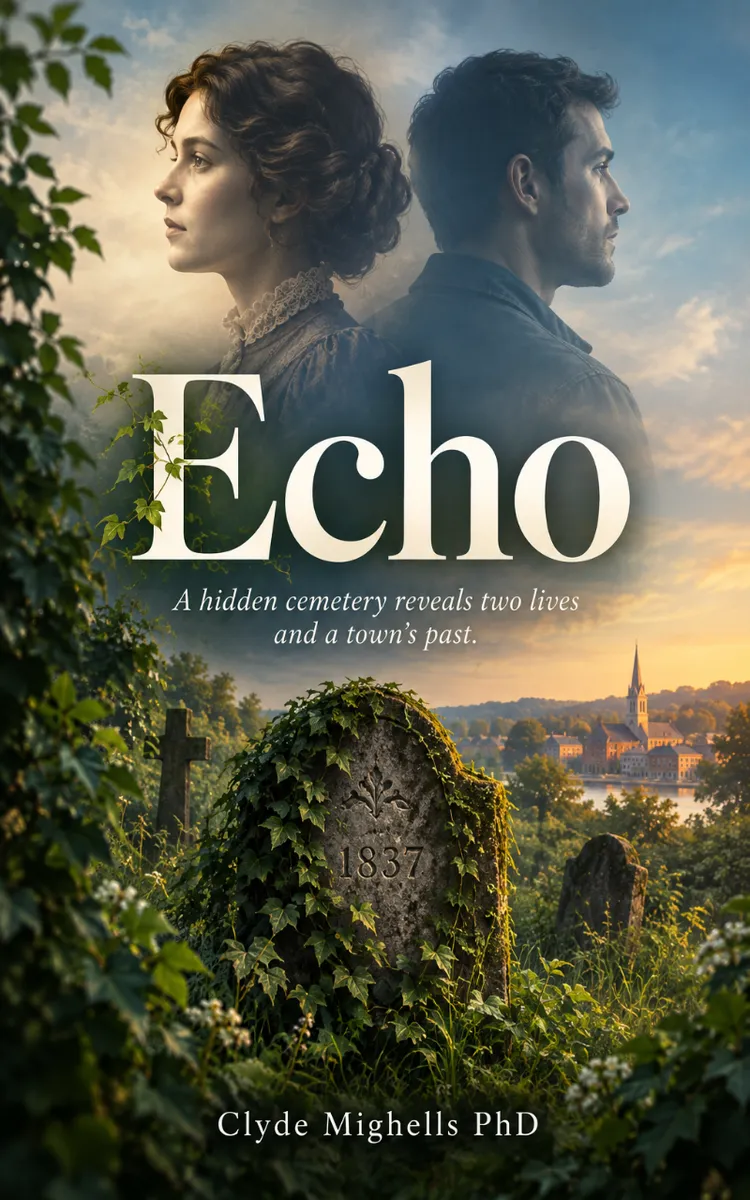
"Echo" is a fiction book by Clyde Mighells PhD with 10 chapters and approximately 21,602 words. A cemetery no one mentions is the first clue, and it is already pulling Julie and Scott into something Blackwood wants forgotten. When a brittle county ledger points to a “cemetery near Blackwood” with no name attached, the search begins as history.
This book was created using Inkfluence AI, an AI-powered book generation platform that helps authors write, design, and publish complete books. It was made with the AI Novel Writer.
Frequently Asked Questions
What is "Echo" about?
A cemetery no one mentions is the first clue, and it is already pulling Julie and Scott into something Blackwood wants forgotten. When a brittle county ledger points to a “cemetery near Blackwood” with no name attached, the search begins as history. Then the ground starts to move, the landmarks stop matching, and every step feels like it is leading deeper into a secret the living refuse to remember. As Tuesday’s trail turns into Echo’s Hollow, Julie’s careful curiosity and Scott’s quiet promise collide with the kind of danger that does not announce itself. In a town built on ordinary routines, what happens when the past finally answers back?
How many chapters are in "Echo"?
The book contains 10 chapters and approximately 21,602 words. Topics covered include A Cemetery No One Mentions, Scott’s Quiet Promise to Help, Following Echo’s Hollow Clues, When the Brush Won’t Move, and more.
Who wrote "Echo"?
This book was written by Clyde Mighells PhD and created using Inkfluence AI, an AI book generation platform that helps authors write, design, and publish books.
How can I create a similar fiction book?
You can create your own fiction book using Inkfluence AI. Describe your idea, choose your style, and the AI writes the full book for you. It's free to start.
Write your own fiction book with AI
Describe your idea and Inkfluence writes the whole thing. Free to start.
Start writingCreated with Inkfluence AI


