
Read the first chapter
The whole of chapter one, free. About 4 min. Turn the pages with the arrows, your keyboard, or a swipe.
Chapter 1
Salt Called by God
Scripture Focus
Isaiah 43:1 > “But now, this is what the LORD says - > he who created you, Jacob, > he who formed you, Israel: > ‘Do not fear, for I have redeemed you; > I have summoned you by name; you are mine.’”
God doesn’t start your calling by measuring your performance - He starts by naming you.
You can almost hear the weight of that line: “I have summoned you by name.” Before you ever get it all together, before you ever prove anything, God speaks your name with ownership and purpose. Not “maybe you’ll be useful.” Not “try harder and we’ll see.” He says, “You are mine.” That’s where saltiness begins - not in frantic self-improvement, but in a settled identity.
And if you’ve ever tried to earn approval - through your work, your faithfulness, your quiet suffering, your good intentions - this verse gently but firmly interrupts that loop. Because when God calls you by name, you don’t have to chase worthiness like it’s hiding behind the next achievement. You respond.
Reflection
Salt doesn’t lose its saltiness overnight. It dulls when the source is forgotten. For Christians, that “source” is identity - who God says you are in Christ. When you start living as if your value depends on people’s reactions, you’ll eventually water down what God meant to season your life. You’ll still show up, sure. But you’ll show up drained, trying to be approved instead of being obedient.
Here’s the daily struggle: you wake up with a mind full of questions - “Do they respect me?” “Did I mess it up?” “Am I doing enough?” Then life crowds in: deadlines, family needs, church responsibilities, the stuff nobody posts. And somewhere in the middle of all that, you forget the kind of God who “formed you” and “summoned you by name.” You begin to treat your purpose like a job you have to earn. But God’s purpose isn’t something you chase. It’s something you receive.
Receiving God’s purpose changes the way you respond to setbacks. If your identity is tied to performance, a bad conversation can feel like a verdict. If your identity is tied to Christ, the same conversation becomes an invitation - “Lord, shape me. Teach me. Lead me.” That’s why Jesus talks about salt in the same breath as usefulness: salt is meant to work. Not to impress. Not to be admired. To be faithful where it’s placed. Chosen people don’t chase approval; they carry God’s assignment.
So let’s name the takeaway plainly: Your calling starts with being claimed, not with being impressive. When God says “you are mine,” He’s not just comforting you - He’s commissioning you. He’s saying, “I have a place for you. I have a reason for you. And I will meet you there.” The journey begins with receiving God’s purpose for your life, not running after the approval that never satisfies.
Practice for Today
1. Write your name the way God speaks it. Grab a journal (or the Notes app on your phone) and write: “Lord, You called me by name when You said…” Then finish the sentence using Isaiah 43:1 in your own words. If you want a concrete starting point, pick one identity phrase and circle it: redeemed, summoned, you are mine. Journaling prompt: Where have I been trying to earn approval instead of receiving purpose? What would change today if I believed I’m claimed before I’m impressive?
2. Do a 7-minute “name-and-purpose” prayer. Set a timer for 7 minutes. Don’t rush it. Pray slowly, using this pattern: - Minute 1-2: Thank God that you’re redeemed and not starting from fear. - Minute 3-4: Ask God to show the “place” He’s summoning you to right now - your home, your workplace, your neighborhood, your church. - Minute 5-6: Confess the approval-chasing. Keep it simple: “Lord, I’ve been looking for worth in people.” - Minute 7: Receive your assignment: “God, lead me into obedience today as Your chosen one.”
3. Take one visible step of “sent” obedience. Saltiness isn’t only internal; it’s active. Choose one small, real action connected to your current season. For example: - If your life is heavy with family needs, send a short encouragement text to someone you’ve been neglecting. - If your work is stressful, pray for one coworker before your first meeting and offer one honest, gentle kindness. - If your church life feels routine, volunteer for one practical task you usually avoid (even 15 minutes counts - tidying, calling, setting up, welcoming). Keep it specific to today. Identity becomes clear when you move in obedience, not when you wait to feel “ready.”
Closing Prayer
Lord, I receive Your claim on my life. You have summoned me by name, and I don’t have to chase approval to feel steady. Teach me to live as Your chosen one, sent with purpose right where I am. When fear rises, remind me I’m redeemed, not rejected. Give me the courage to obey today - small steps, faithful words, and a life that seasons what You place in my hands. Amen.
End of chapter one. 19 more chapters in the full book.
Swipe or use the arrows to turn the page


What's inside: 20 chapters
- 1. Salt Called by God
- 2. What Salt Is For
- 3. Salt’s Source: God’s Grace
- 4. The Danger of Losing Saltiness
- 5. Surrendering What Dilutes You
- 6. Prayer That Re-Salts the Heart
- 7. Trust Over Taste
- 8. Hope for the Restored Salt
- 9. The Word That Preserves
- 10. Confession: Returning to True Saltiness
- 11. Forgiveness That Keeps You From Spoiling
- 12. Obedience in Small Things
- 13. Lighted by Prayer, Guided by Wisdom
- 14. Endurance When Saltiness Is Tested
- 15. The Community That Strengthens Salt
- 16. Saying Yes to God’s Timing
- 17. Salt That Blesses: Serving With Joy
- 18. Made Salty Again: A Life of Ongoing Renewal
- 19. Practical Tools for Staying Salty
- 20. Key Takeaways
About this book
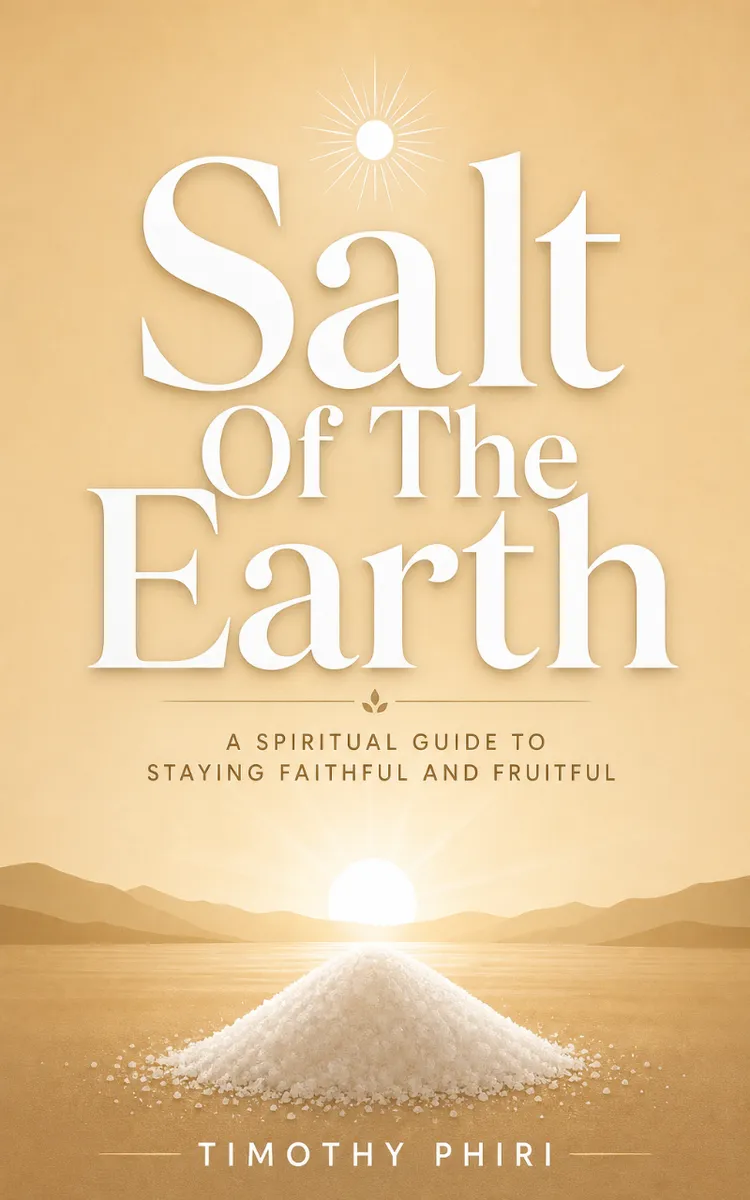
"Salt Of The Earth" is a religious devotional book by Timothy Phiri with 20 chapters and approximately 17,768 words. Christian reflection on saltiness, faithfulness, and spiritual renewal.
This book was created using Inkfluence AI, an AI-powered book generation platform that helps authors write, design, and publish complete books.
Frequently Asked Questions
What is "Salt Of The Earth" about?
Christian reflection on saltiness, faithfulness, and spiritual renewal
How many chapters are in "Salt Of The Earth"?
The book contains 20 chapters and approximately 17,768 words. Topics covered include Salt Called by God, What Salt Is For, Salt’s Source: God’s Grace, The Danger of Losing Saltiness, and more.
Who wrote "Salt Of The Earth"?
This book was written by Timothy Phiri and created using Inkfluence AI, an AI book generation platform that helps authors write, design, and publish books.
Write your own religious devotional book with AI
Describe your idea and Inkfluence writes the whole thing. Free to start.
Start writingCreated with Inkfluence AI


