
Read the first chapter
The whole of chapter one, free. About 6 min. Turn the pages with the arrows, your keyboard, or a swipe.
Chapter 1
The Town Without a Name
The last photograph of Lorn was nailed to a post at the line where the railway once ended, though the rails themselves had been taken. Mara touched its warped corner and watched the station bloom in the silver emulsion: a narrow platform, a water tower, six people under a clock frozen at 4:17. The nearest face softened - not gone, but breathing inward, as if someone had pressed a palm against the paper from the far side. “Don’t read it aloud,” Peter warned. Mara’s mouth moved anyway. “Lorn.” Pressure gathered behind her eyes. It did not hurt the way flesh does; it was not a wound she could name. It was a hand laid against the inner curve of her skull, firm and patient. The world thinned around it. The post seemed to tilt. The road beyond the photograph bled into the weeds and lost its edges. “Lorn,” she said again. Her voice came back to her from the empty street, fragile and slightly wrong. “Lorn.” Sam Whitaker stood by the rusted station sign, his hand tight on his satchel strap. He looked absurdly small - the boy they had found centuries ago - untouched by time in face though not in something inside him. His eyes flicked toward the houses. “Which one?” he asked. Mara kept her fingers on the image. The paper was cold and damp under her skin despite the dry afternoon. “The town,” she said. The road answered, “The town.” Peter lifted the lantern he carried as if habit could ward off rot; its tiny glass held a white flame that did not shudder in the wind. He had been trapped two hundred years and more, and he moved like a man who expects doors to snap shut behind him. His eyes never left the photograph. “Names,” he said. “Not places.” Mara turned the print. On the back, beneath a brown smear of water, someone had scored a date and a list. The first three names had sunken into faint scratches. The fourth, still black against damp paper, read: Ellen Voss. She spoke it aloud. The Silence answered, and the answer wore Ellen Voss’s voice. “I’m here.” Sam flinched. Peter’s fingers tightened around the lantern handle. Mara looked toward the houses - windows like patient eyes, walls furred with lichen. The road into Lorn was a line of hollow shops, their signs scrubbed white; a barber pole twined above a door that had no name. “Ellen Voss,” she said again. “I’m here,” came the reply, this time from just behind them. She turned. The photograph had altered. The six people beneath the clock were five. The woman next to the water tower had gone, and where she had stood the paper was darker, as if the absence had weight. Peter stepped between Mara and the lane. “It knows you are looking,” he said. “It always has.” “Not like this,” she whispered. The pressure deepened into a steady, intimate insistence. Mara shut one eye; then the other. Behind her lids the town filled in: lit windows, laundry trembling on lines, a steeple beyond the station. Every window held a face and none of those faces stayed quite still. She opened her eyes and the street had drawn in - houses nearer than they were a breath ago, the distance stolen. Mara folded the photo into the ledger sleeve and slipped it beneath her coat as if hiding a wound. “We go to the station,” she said. “The station is there,” Sam answered, pointing. A brick building stood at the road’s end where there had been nothing moments before; LORN UNION STATION proclaimed itself in clean, newly painted letters. Peter looked from the sign to the blank post where the photograph had hung and his voice tightened. “Do not trust anything that arrives after you name it.” Mara crossed the road. Silence in Lorn was not absence of sound but a kind of crowding: loose boards striking walls, a gutter tapping a drainpipe at a slow, exact tempo, water running beneath the street in its hidden channel. The noises made a cadence that almost shaped words. At the station door Mara took out Elias’s county index - its cover swollen with use, margins cramped with his clipped hand. Lorn sat under a county heading that had been crossed and rewritten three times.
The penciled entry for Lorn had been reduced to a faint scar of graphite and Elias’s cramped marginalia. His handwriting tilted at the line where his hand had trembled; beneath it someone - perhaps Elias - had written, correction: Orison basin? The county index smelled of old rain and lamp oil. Mara pressed the page flat with her thumb. The names were islands; the ink that held them was the only reef between recollection and the sea.
“Read me the list,” Peter said, voice low as if speaking any louder might loosen mortar from the walls. The lantern between us threw an even, small circle of light that did not reach the houses. Beyond it, the station clock’s glass was opaque with dust and something like salt.
Mara exhaled. She drew the ledger from her coat and opened to the sleeve where she had tucked the photograph. Her fingers found the brown smear and the scored names. “Ellen Voss,” she said, and then, because the ledger demanded it and because she owed Elias every stubborn syllable he had left behind, she read the rest: “Daniel Voss, Ruth Calder, Clara Bell - ”
At Clara Bell the pressure swelled, a thumb pressing from the inside of her skull. The sound of Clara’s voice came not from the street but from the ledger itself, thin and threadbare. “Clara,” it said, and in the syllable was the bell-chime that had echoed through Elias’s articles, the same hollow ring that used to make Mara’s chest ache with recognition.
Sam’s hand closed on her sleeve. “Stop,” he whispered. His mouth went dry. He had not learned the way Elias had - to anchor and to list without flinching. He had, rather, the brittle courage of childhood that kept stepping toward things adults folded away.
Peter leaned in until the lantern softened the planes of his face into map lines. He was patient with names; patience had kept him alive for two centuries. “We are not here to feed it with town names,” he said. “We are here to see what else it takes.”
“What else?” Sam asked. The boy’s voice held an edge Mara did not like - the old, small wrath that had once rung the bell in a village square and refused to stop.
Peter’s hand found the cross-shaped key beneath his coat where he had worn it since Orison. His fingers closed around familiar metal. “Time,” he said. “Memory that is not only spoken but kept. Witnesses. And anchors.” He looked at Mara then with an honesty she had come to accept as the only currency between us. “We must find the record here, if there is one. If Lorn was finished more cleanly than Bellweather, the ledger will be thin. It may be hidden in the ledgers of others. Look for omission, for lists that stop.”
Mara slid the photograph back into its sleeve and, without meaning to, traced the place where Ellen Voss had been. The echo of her voice in the ledger felt less like comfort than a bruise. Around us the town held its breath with the patience of old things, as if waiting to see whether we would fold its names into our mouths or leave them to the next quiet.
“We search the station,” Mara said. “We do not speak any name that is not already in ink.” Her own voice surprised her with its steadiness. It had to be enough for the next small hour.
Peter nodded and pushed the lantern toward the ticket window where a rusted ledger lay half-buried under grime. Sam moved to the platform edge as if drawn by a line only he could see. The station doors sighed as we entered; the white flame made new shadows that did not shift when we moved. Outside, the photograph’s six faces held their angles as if waiting to be proofed against us. Inside, the silence waited as well - patient, listening, and learning.
End of chapter one. 29 more chapters and about 51,514 words in the full book.
Swipe or use the arrows to turn the page


What's inside: 30 chapters
- 1. The Town Without a Name
- 2. Peter’s Unfinished Roll Call
- 3. The Ledger of Empty Places
- 4. Below the Survey Line
- 5. Sarah in the Lamplight
- 6. The Names Go Quiet
- 7. The Bellweather Omission
- 8. The Road That Ends
- 9. What Sam Cannot Recall
- 10. The Bell Without a Tower
- 11. The Map Beneath the Waterline
- 12. Orison’s Flooded Archive
- 13. The Cost of Remembering
- 14. The Archive Opens
- 15. A Trap Made of Records
- 16. The Chamber of Names
- 17. Peter’s Missing Years
- 18. Elias Answers from Within
- 19. The Witness in the Margin
- 20. The Stair That Forgets
- 21. The Name Peter Keeps
- 22. The Vault Unseals
- 23. The Last Blank Leaf
- 24. The Bellweather Witness
- 25. The Chamber Under Orison
- 26. The Silence Bound
- 27. Peter’s Last Memory
- 28. Elias Leaves the Anchor
- 29. The Names That Survived
- 30. Six Months of Vigil
About this book
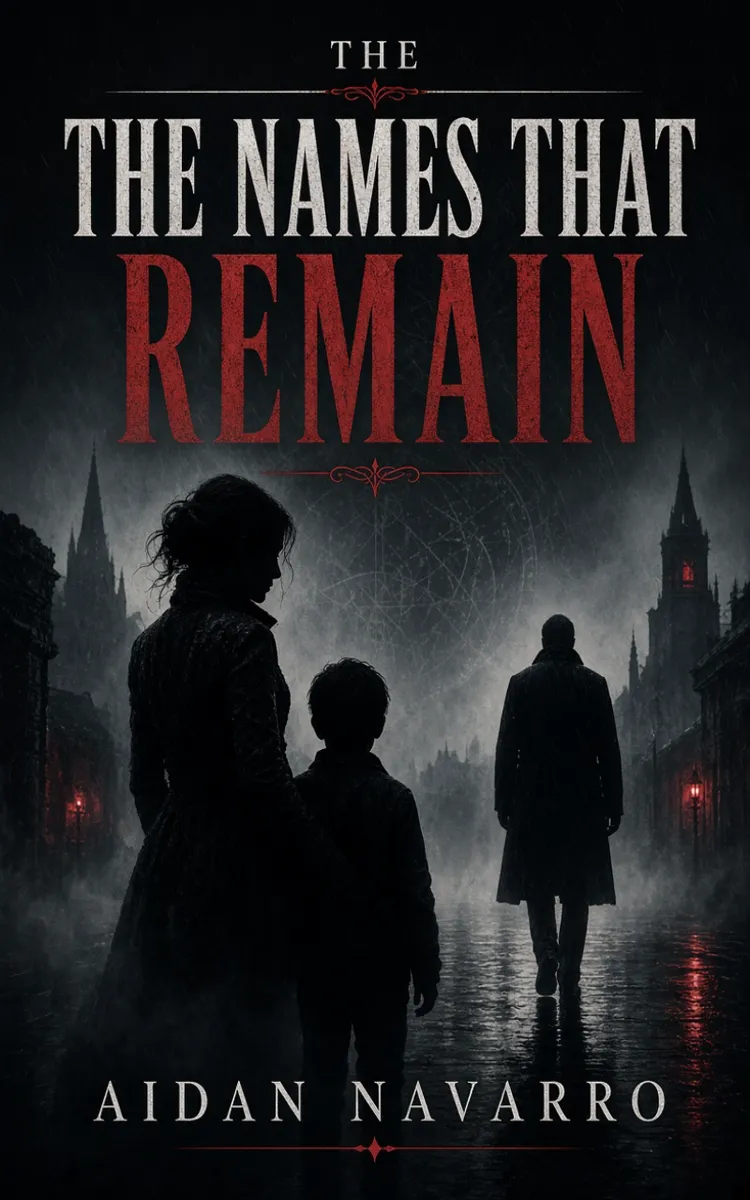
"The Names That Remain" is a fiction book by Aidan Navarro with 30 chapters and approximately 51,514 words. A resistance traps an entity that erases people and memories.
This book was created using Inkfluence AI, an AI-powered book generation platform that helps authors write, design, and publish complete books. It was made with the AI Novel Writer.
Frequently Asked Questions
What is "The Names That Remain" about?
A resistance traps an entity that erases people and memories
How many chapters are in "The Names That Remain"?
The book contains 30 chapters and approximately 51,514 words. Topics covered include The Town Without a Name, Peter’s Unfinished Roll Call, The Ledger of Empty Places, Below the Survey Line, and more.
Who wrote "The Names That Remain"?
This book was written by Aidan Navarro and created using Inkfluence AI, an AI book generation platform that helps authors write, design, and publish books.
How can I create a similar fiction book?
You can create your own fiction book using Inkfluence AI. Describe your idea, choose your style, and the AI writes the full book for you. It's free to start.
Write your own fiction book with AI
Describe your idea and Inkfluence writes the whole thing. Free to start.
Start writingCreated with Inkfluence AI


