
Read the first chapter
The whole of chapter one, free. About 7 min. Turn the pages with the arrows, your keyboard, or a swipe.
Chapter 1
The Covenant of Melanin
The Promise Beneath the Skin
At the community archive, the oldest record sat inside a black clay vessel sealed with red thread. Its surface carried one sentence in careful lettering: “What lives in our bodies is not a treasure for taking.” That sentence guarded more than a substance. It guarded memory, survival, and the right of a people to remain whole.
Melanin held sacred power because the ancestors had tied it to responsibility. It could strengthen the body, extend life, sharpen health, and open the mind to thoughts others tried to hide. Yet none of those gifts belonged to one person alone. The covenant declared that melanin served the survival of the Black community. Anyone who treated it like ordinary property invited theft, betrayal, and destruction.
The covenant solved a dangerous problem: it gave the community clear rules when outsiders offered money, protection, or promises of peace. After reading, you should be able to explain why melanin remains sacred, identify who may share its power, record a covenant decision, and respond when someone tries to break the rules. Ask yourself: if a gift can save one person but endanger an entire people, who has the right to decide how it moves?
The answer begins with the covenant, not with fear.
Reading the Ancestral Covenant Lens
The Ancestral Covenant Lens provides the community’s method for judging every request involving melanin. It asks four questions in a fixed order. The order matters because a desperate need can make a harmful offer look honorable.
1. Origin: Who carries the power, and does that person belong to the protected bloodline? This question prevents strangers from claiming authority simply because they discovered, studied, or purchased access to melanin.
2. Purpose: What does the requested gift protect or repair? A gift that saves a child from a deadly illness carries a different purpose from a gift that grants an outsider longer life, mind-reading, or control.
3. Permission: Has a chosen member of the Black royal bloodline approved the transfer? Only a Black member of the royal bloodline selected by the ancestral power may gift an outsider. Consent from a healer, ruler, guard, or relative cannot replace that choice.
4. Cost: What will the community lose if the power leaves one body? The council must count more than immediate benefits. It must consider exposure, future attacks, stolen blood, forced experiments, and the danger of revealing the royal line.
These four questions turn a sacred belief into a working safeguard. Write each answer on a covenant record before anyone begins a transfer. The record should include the date, the person requesting power, the chosen giver, the purpose, the witnesses, and the limits placed on the gift. Keep one copy in the archive and one copy with the community’s appointed guard.
The covenant also separates care from ownership. Community members may receive healing, instruction, and protection, but they do not own another person’s melanin. An outsider may receive a gift only under the covenant’s conditions. The gift does not make that person royal, Black, or entitled to demand more. It grants one defined power for one defined purpose.
For example, an outsider who helps defend a village from an invading force might receive enough power to read hostile thoughts during a single night watch. The covenant record must state the exact time the gift ends, what thoughts the recipient may read, and who can withdraw the power. Without those limits, gratitude can turn into dependence, and dependence can turn into control.
Use this test before approving any request: Does the action protect the people, honor the giver, and preserve the future? If one answer remains unclear, pause the transfer. Sacred power needs a clear record because memory changes under pressure, while written terms give the community something firm to defend.
Applying the Lens at the Boundary Gate
Consider a protection request involving an outsider named Mara, a skilled mapmaker whose knowledge could help the community find a hidden route away from an approaching army. Mara asks for mind-reading power so she can detect ambushes. The request sounds useful, but usefulness alone cannot authorize a gift.
Follow these steps:
1. Confirm the origin. The council checks the royal archive and verifies that Amara, a Black royal descendant, has received the ancestral choosing. Two archive keepers compare the seal on Amara’s record with the seal held by the royal guardian. Expected outcome: the council confirms that the only person authorized to gift Mara is Amara.
2. State the purpose in one sentence. The council writes: “Mara will read hostile intent while guiding twenty-four defenders through the eastern ravine.” Expected outcome: the gift serves a specific defense task rather than Mara’s private ambition.
3. Set the limits. The record gives Mara three hours of mind-reading power, limits the gift to immediate hostile intent, and forbids her from reading the private thoughts of community members. Expected outcome: Mara gains the protection she needs without receiving open access to the community’s minds.
4. Name the cost. The council records the risks: Mara could reveal the ravine, identify Amara, or return later with enemies who want another gift. The guard assigns two watchers and keeps the route map separate from the covenant record. Expected outcome: the community protects both its people and its knowledge.
5. Receive spoken consent. Amara reads every condition aloud. Mara repeats the limits in her own words and signs the record with a thumbprint in ash. Three witnesses sign below her. Expected outcome: no one can later claim confusion about the agreement.
6. Complete and close the transfer. Amara gives Mara the power only after the guard confirms that the defenders have entered the ravine. At the end of three hours, the guardian checks Mara’s eyes for the silver ring that marks active mind-reading. When the ring fades, the guard records the time. Expected outcome: the gift ends when promised.
7. Review the result before dawn. The council asks whether the gift protected the group, whether Mara obeyed the limits, and whether any new danger appeared. It stores the review with the original record. Expected outcome: future councils gain a clear example instead of relying on rumor.
Quick checklist
• Confirm the chosen giver’s royal authorization. - Write one precise purpose for the gift. - Set a start time, end time, and exact power. - Ban access to protected community thoughts. - Name at least two risks and assign guards. - Record consent from the giver and recipient. - Use witnesses who understand the covenant. - Check that the power ended as promised. - Review the outcome and store the record safely.
This process may seem careful when danger presses close, but speed creates openings for enemies. A written limit can stop a frightened council from granting immortality when it meant to grant one night of protection.
Mistakes That Put the Covenant at Risk
Treating melanin like a trade good
A council may accept gold, weapons, medicine, or political protection in exchange for a gift. That choice breaks the covenant because payment changes a sacred responsibility into a sale. Once someone buys access, that person will likely demand more.
Do this: Ask whether the gift protects the community without creating a debt that outsiders can collect later. Record every benefit separately from the power transfer.
Not this: “They helped us, so we owe them melanin.”
A favor can earn thanks, shelter, or a future alliance. It cannot purchase authority over ancestral power.
Confusing royal blood with royal permission
A person may descend from the royal family without receiving the ancestral choosing. Another person may carry royal blood but lack the wisdom, discipline, or permission required to gift an outsider.
Do this: Check the archive for the choosing mark before discussing the transfer. Require the chosen giver to approve the exact purpose and limits.
Not this: “The family name proves they can give.”
The covenant protects the community from both outsiders and careless insiders. Bloodline identifies a possible connection; the ancestral choosing grants authority.
Leaving the terms unwritten
Verbal promises fail when fear, greed, or memory enters the room. An outsider may remember “protection” while the council remembers “three hours of limited warning.” Those different memories can start a war.
Do this: Write the purpose, limits, witnesses, start time, end time, and consequence for breaking the agreement. Store the record where fire, water, and enemy hands cannot reach it.
Not this: “Everyone heard the promise, so we do not need a record.”
A covenant survives through clear practice. Each careful record teaches the next generation how to protect what the ancestors placed in their keeping. The power under Black skin remains sacred not because the community hides it from the world, but because the community refuses to let survival become another name for surrender.
End of chapter one. 40 more chapters and about 68,691 words in the full book.
Swipe or use the arrows to turn the page
What's inside: 41 chapters
- 1. The Covenant of Melanin
- 2. The Royal Bloodline
- 3. Melanin’s Hidden Gift
- 4. The First Mind-Reading
- 5. Longevity’s True Cost
- 6. Choosing an Outsider
- 7. The Gifted Transformation
- 8. The Price of Consent
- 9. The First Theft Attempt
- 10. Reading the Enemy’s Motives
- 11. Guarding the Ancestral Archive
- 12. The Council’s Warning Signs
- 13. Building a Community Watch
- 14. Concealing the Sacred Source
- 15. Escaping the First Raid
- 16. Healing After the Attack
- 17. Testing the Outsider’s Loyalty
- 18. When Immortality Tempts
- 19. The Royal Heir’s Doubt
- 20. A Treaty with Rivals
- 21. The Betrayal Inside
- 22. Breaking the Extraction Machine
- 23. Protecting Children First
- 24. Keeping the Gift Secret
- 25. Mind-Reading Under Pressure
- 26. The Limits of Royal Authority
- 27. The Enemy’s Public Deception
- 28. Restoring a Fractured Alliance
- 29. The Ancestral Warning
- 30. Preparing the Final Sanctuary
- 31. Choosing Mercy or Retaliation
- 32. The Heir Claims the Crown
- 33. The Outsider’s Final Choice
- 34. The Siege of the Sanctuary
- 35. Turning the Enemy’s Power
- 36. The Covenant’s Final Test
- 37. Ending the Extraction Threat
- 38. Rebuilding After the Siege
- 39. Teaching the Next Generation
- 40. Chapter 41
- 41. Renewing the Melanin Covenant
About this book
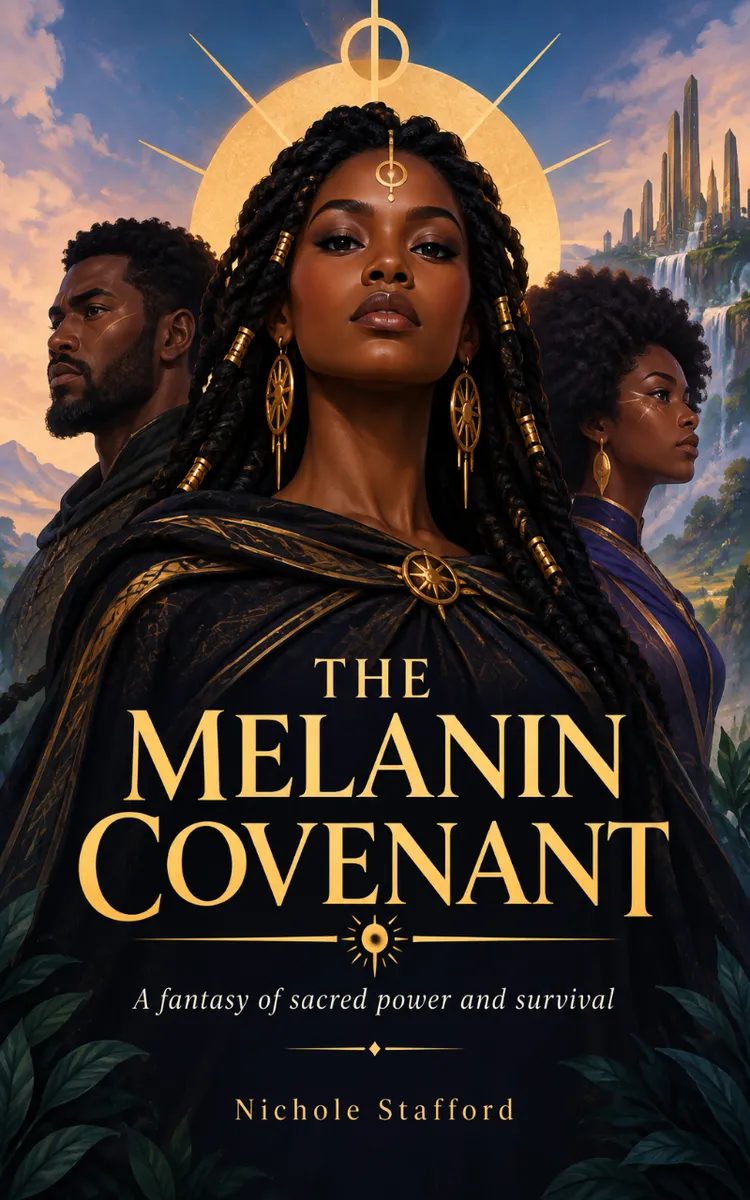
"The Melanin Covenant" is a fantasy book by Anonymous with 41 chapters and approximately 68,691 words. A royal bloodline protects melanin’s magical powers from those seeking immortality.
This book was created using Inkfluence AI, an AI-powered book generation platform that helps authors write, design, and publish complete books.
Frequently Asked Questions
What is "The Melanin Covenant" about?
A royal bloodline protects melanin’s magical powers from those seeking immortality
How many chapters are in "The Melanin Covenant"?
The book contains 41 chapters and approximately 68,691 words. Topics covered include The Covenant of Melanin, The Royal Bloodline, Melanin’s Hidden Gift, The First Mind-Reading, and more.
Who wrote "The Melanin Covenant"?
This book was written by Anonymous and created using Inkfluence AI, an AI book generation platform that helps authors write, design, and publish books.
Write your own fantasy book with AI
Describe your idea and Inkfluence writes the whole thing. Free to start.
Start writingCreated with Inkfluence AI

