
Read the first chapter
The whole of chapter one, free. About 10 min. Turn the pages with the arrows, your keyboard, or a swipe.
Chapter 1
The Name in the Archive
The catalog card had been pulled from the drawer and left beneath Elias Mercer’s hand, its edges softened by decades of handling. In the county archive’s reading room, the air smelled of dust, paste, and the faint metallic chill of old radiators. Outside the tall windows, evening had begun to flatten the last light over the courthouse square.
Elias read the line again.
Tom - laborer, witness, and petitioner.
The entry contained no explanation. It offered only a box number, a date, and a notation in a clerk’s narrow handwriting: “See restricted materials.”
He had found the reference twenty minutes earlier while searching for records connected to freedom petitions from the county. At first, he had assumed Tom was a familiar name attached to an unrelated document, one of the many names that disappeared into ledgers and inventories. But the date had unsettled him. It belonged to the period when the historical Tom, if the scattered references were trustworthy, had lived and worked in the region.
Elias turned the card toward the archivist.
“Could this be a misfile?” he asked.
Miriam Cole stood behind the desk, sorting folders into a metal cart. She was in her late sixties, with silver hair gathered at the nape of her neck and the patient caution of someone who had spent a lifetime around fragile things.
“It could be,” she said. “Most unexplained references have ordinary explanations.”
“Most?”
“Some do not.”
Her answer did not satisfy him. He glanced toward the clock above the service counter. The hands had moved past five. The archive closed at six.
Miriam noticed his look. “You have time to request the box. You may not have time to examine it.”
“I only need to confirm whether the name is there.”
“That depends on what ‘there’ means.”
Elias slid the catalog card across the desk. “A record naming Tom as a laborer, witness, and petitioner. If the original document exists, it could establish that Uncle Tom was not merely a later literary figure or a name borrowed from oral tradition. It could connect the name to a specific man.”
Miriam’s expression changed, though only slightly. Her fingers rested on the card without lifting it.
“People have made that claim before,” she said.
“Without this reference.”
“References can mislead.”
“So can silence.”
For a moment, the room held only the ticking of the wall clock and the soft scrape of a cart wheel. Then Miriam reached for a request slip.
“Write the number.”
Elias took the pencil. The wood was worn smooth, and its graphite left a pale gray mark on the paper. He wrote the collection number, the box, and the date. His hand was steadier than he felt.
Miriam carried the slip through a locked door at the rear of the room. Elias watched the narrow window in that door until her figure disappeared. Around him, other researchers began closing notebooks and returning pencils to their trays. A woman at the far table wrapped a photograph in tissue. Someone coughed near the microfilm machines. The ordinary sounds of closing time made the request feel less important than it was.
He had spent years studying the way Uncle Tom’s name had been used after his life. The name had become a weapon, a shorthand imposed on a man who had never consented to it. In books, speeches, and popular memory, Uncle Tom had been reduced to a false character: obedient where he had been courageous, passive where he had chosen resistance, detached from freedom when freedom had shaped his decisions.
Elias had learned to distrust easy corrections. A myth could not be undone by indignation alone. It required names, dates, handwriting, and documents that had survived the people who wanted certain lives forgotten.
Miriam returned carrying a flat archival box.
“This is the last request I can bring out tonight,” she said. “You will not remove anything from the folder. No leaning on the table. No pens. And you will turn only one page at a time.”
“I understand.”
“You may not photograph it.”
Elias looked at the box. “Why not?”
“The collection is under review.”
“That was not marked on the catalog.”
“Catalogs are not always current.”
She placed the box on a foam cradle and unlocked its lid. The paper inside had darkened at the edges. A faint odor of leather and mildew rose from the folder, mingling with the dry heat of the room. Miriam put on cotton gloves, then paused.
“For paper this old, gloves can make handling worse,” she said. “Clean, dry hands. Touch the margins only.”
Elias removed his watch and set it beside his notebook. He understood the ritual, but understanding did not lessen the pressure gathering behind his ribs. The archive had granted him access, yet every instruction reminded him that access could be withdrawn.
The folder was thin. Its label read: County Petitions and Testimony, 1840-1848.
He lifted the first sheet by its corner. The paper trembled slightly beneath his fingers. It contained a list of names, occupations, and marks. Some names were crossed out. Others had been written over in darker ink.
Then he saw it.
Tom.
The name appeared in a clerk’s hand beneath the heading “Witnesses.” Beside it was a notation identifying him as a laborer attached to the Mercer property. Elias stared at his own surname and felt the room narrow around the page.
He read the line twice before continuing.
Tom had testified concerning a man who had attempted to leave the county. The language was formal and guarded. It did not describe Tom’s feelings, and it did not use the language of heroism. It recorded only that Tom had refused to affirm a claim against the man and had stated that he had “knowledge of his intention to seek freedom.”
Elias looked toward Miriam.
“Is this the whole statement?”
“For tonight, perhaps.”
“His name is here.”
“Yes.”
“Not as a symbol. Not as a nickname. A witness.”
Miriam leaned closer without touching the page. “Read the date.”
He did. The date matched the period attached to other references he had collected: a church register, a property ledger, and a later account describing Tom’s efforts to help others reach safety. None had been sufficient on its own. Each could be questioned. Together, they had begun to form a pattern.
This document did more than repeat the name. It placed Uncle Tom in a legal record and gave him a decision. He had been asked to support an accusation. He had refused.
Elias felt the first sharp movement of certainty - not the excitement of discovery, but the weight of responsibility that followed it. The document did not tell the entire story. It did not explain where Tom had been born, who had taught him to read, or how he had learned to measure danger against conscience. But it fixed him in time. It made him answerable to history as a person.
Miriam spoke quietly. “You should stop.”
“I have not reached the signature.”
“You have six minutes.”
Elias looked down at the page. “If the signature is there, it matters.”
“Everything matters to someone who has been looking too long.”
The remark might have been a rebuke, but her voice carried sympathy. Elias turned the sheet, slowly, keeping his fingers on the margins. The paper gave a faint crackle.
At the bottom stood the clerk’s certification. Beneath it, in a different hand, was a mark followed by the name Tom. The ink had faded to brown, but the strokes remained distinct. The first letter was tall and uneven. The remaining letters had been formed with care.
Elias did not speak.
He had seen many signatures in his work, including marks made by people denied formal education. This one held him because it suggested effort. Tom had not simply been entered into the record by another person. He had placed his name there, or had learned enough to make the mark that represented it.
“Can you verify the ink?” Elias asked.
“Not tonight.”
“The paper?”
“I can compare it with the rest of the folder.”
She examined the document under the reading lamp. The light revealed a watermark faintly embedded in the fibers. Miriam checked the surrounding sheets, then the folder’s accession note. Her movements were careful, but her face had lost its earlier neutrality.
“It belongs here,” she said.
“Could it have been added later?”
“The paper, ink, and handwriting are consistent with the period. The folder was processed in 1912, but the contents were gathered before then. There is no sign of substitution.”
“Then it is authentic.”
“It appears authentic.”
Elias closed his notebook. “That is enough to say that Uncle Tom was real.”
Miriam looked at him. “It is enough to say that a man named Tom stood in this county, gave testimony, and declared knowledge of another person’s wish for freedom. You will have to decide how much more the record can bear.”
The distinction was important. Elias knew that evidence could be damaged by the claims built upon it. He had spent years watching people turn fragments into certainty because certainty was easier to publish. Yet the restraint did not diminish what lay before him. The document gave Uncle Tom a place in the world and a choice within it.
A bell sounded in the corridor.
Miriam closed the folder.
“Wait,” Elias said. “I need the box number and accession information.”
“You have the catalog reference.”
“I need a formal request for continued access.”
“You can submit one tomorrow.”
“Tomorrow?”
“The collection is being sealed at the end of the day.”
He stood. “For how long?”
“I do not know.”
“Who ordered it?”
“The county review committee.”
“Why?”
Miriam placed the sheet back into its folder. “Because the collection contains records that may involve disputed ownership histories, private family material, and documents not previously cleared for public use.”
“Does that include this?”
“It includes the box.”
Elias felt the cost of the discovery settle into place. He had come to verify a reference. He had found the primary source, but the source would no longer be available for ordinary examination. The evidence was real, and access to it had become uncertain.
“Can I request a scan?”
“Not while the box is under review.”
“Can I cite the document?”
“You can cite what you saw, but you should distinguish between your observation and the archive’s formal authentication.”
“That could take months.”
“It could.”
The bell sounded again, followed by the scrape of a key in the outer lock. Researchers gathered their coats. The reading room’s warm air seemed suddenly temporary.
Miriam returned the folder to the box and secured the lid. “Write down everything you remember.”
“I have notes.”
“Write the shape of the handwriting. The condition of the page. The order of the documents. Memory changes once other people begin telling you what you saw.”
Elias opened his notebook. He wrote the collection title, box number, folder label, date, page position, and the exact wording of the entry. Then he described the signature, the watermark, the clerk’s certification, and the notation connecting Tom to the Mercer property.
His surname appeared on the page again. This time, he did not overlook it.
Looking back, Elias understood that the archive had not given him a complete life. It had given him something more demanding: a point from which the life could no longer be dismissed. Uncle Tom had not existed only in the stories later told about him. He had stood before a clerk, faced a question that could have harmed another person, and attached his name to the truth as he knew it.
The record did not make him heroic by ornamenting his actions. It made his courage visible through the risk embedded in a simple refusal.
Miriam carried the box toward the locked door. Elias followed with his notebook pressed against his chest.
At the threshold, she turned. “When the collection reopens, you will need to request permission again.”
“And if it does not reopen?”
“Then you will need to preserve the account of what you saw.”
The door closed between them. A key turned in the lock.
Elias remained in the reading room, listening to the archive settle into silence. He had arrived as a researcher intrigued by an unexplained catalog entry. He left as the holder of a difficult obligation: to defend a document he could no longer reach, and to recover the man whose name had survived by being falsified.
The first proof of Uncle Tom’s life was now sealed away. The fact of it remained with Elias, written in his notes and fixed in his memory, while the locked collection waited beyond the door.
End of chapter one. 39 more chapters and about 96,362 words in the full book.
Swipe or use the arrows to turn the page


What's inside: 40 chapters
- 1. The Name in the Archive
- 2. Tom’s Childhood on the Farm
- 3. Learning to Read in Secret
- 4. The Teacher’s Abandoned School
- 5. Choosing the Dangerous Lesson
- 6. A Sale Splits the Family
- 7. Letters Across County Lines
- 8. The River Crossing Escape
- 9. Freedom Beyond the Crossing
- 10. The Capture Warrant
- 11. The Neighbor Who Hid Him
- 12. The Safe House Search
- 13. Refusing the False Testimony
- 14. The Raid on the Meetinghouse
- 15. Tracing the Abolitionist Network
- 16. Across the Mountain Pass
- 17. The Cost of Trust
- 18. The Arrest at the Depot
- 19. The Jailhouse Petition
- 20. Who Wrote the First Lie?
- 21. The Shame of Being Misread
- 22. The Petition Vanishes
- 23. The Editor’s Hidden Correspondence
- 24. The Pressroom’s Locked Door
- 25. Tom’s Refusal to Perform
- 26. The Pamphlet Campaign Begins
- 27. Following the Money Trail
- 28. The Society’s Sealed Archive
- 29. The Stereotype Reaches the Stage
- 30. The Record Goes Silent
- 31. A Descendant’s Box of Papers
- 32. The Courthouse Basement Flood
- 33. Choosing Evidence Over Legend
- 34. The Editor’s Final Letter
- 35. Tom’s Freedom Claim Prevails
- 36. Rebuilding Life After Release
- 37. The Reunion That Stayed Uncertain
- 38. Tom’s Work for His Community
- 39. The Stereotype Across Generations
- 40. Restoring the Man Behind the Myth
About this book
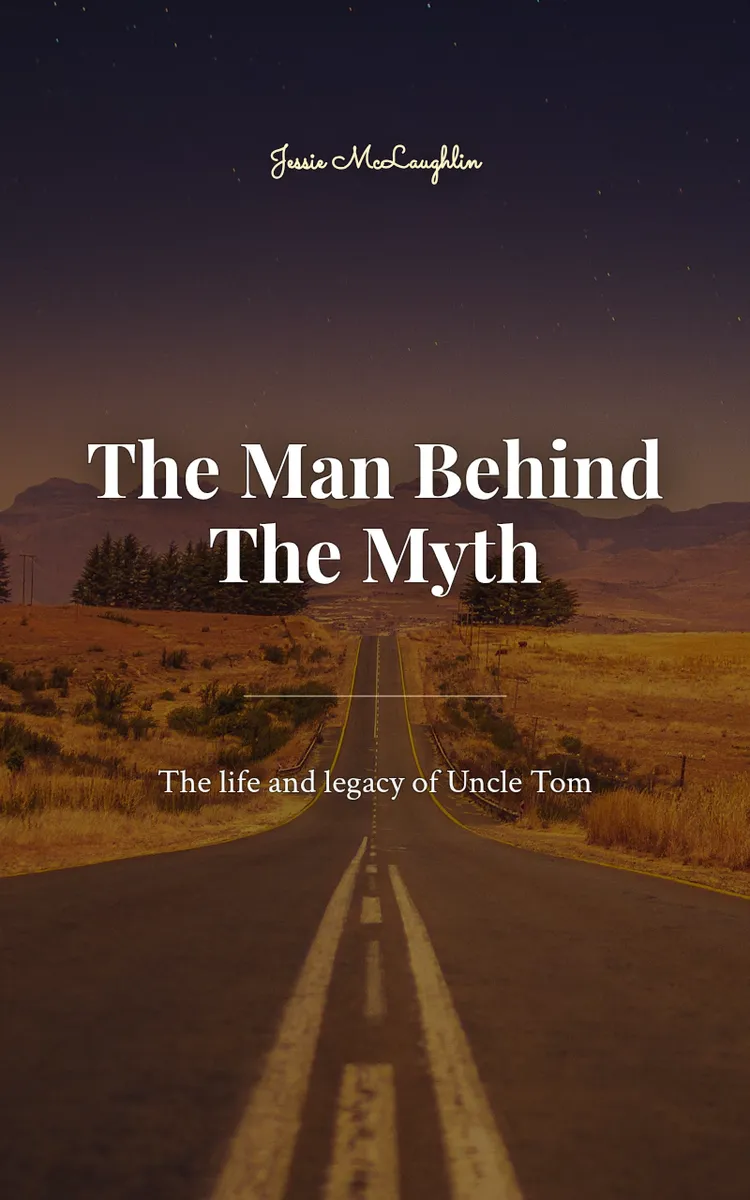
"The Man Behind The Myth" is a nonfiction book by Jessie McLaughlin with 40 chapters and approximately 96,362 words. Uncle Tom’s life, struggles, heroism, and contested historical legacy.
This book was created using Inkfluence AI, an AI-powered book generation platform that helps authors write, design, and publish complete books.
Frequently Asked Questions
What is "The Man Behind The Myth" about?
Uncle Tom’s life, struggles, heroism, and contested historical legacy
How many chapters are in "The Man Behind The Myth"?
The book contains 40 chapters and approximately 96,362 words. Topics covered include The Name in the Archive, Tom’s Childhood on the Farm, Learning to Read in Secret, The Teacher’s Abandoned School, and more.
Who wrote "The Man Behind The Myth"?
This book was written by Jessie McLaughlin and created using Inkfluence AI, an AI book generation platform that helps authors write, design, and publish books.
Write your own nonfiction book with AI
Describe your idea and Inkfluence writes the whole thing. Free to start.
Start writingCreated with Inkfluence AI


