
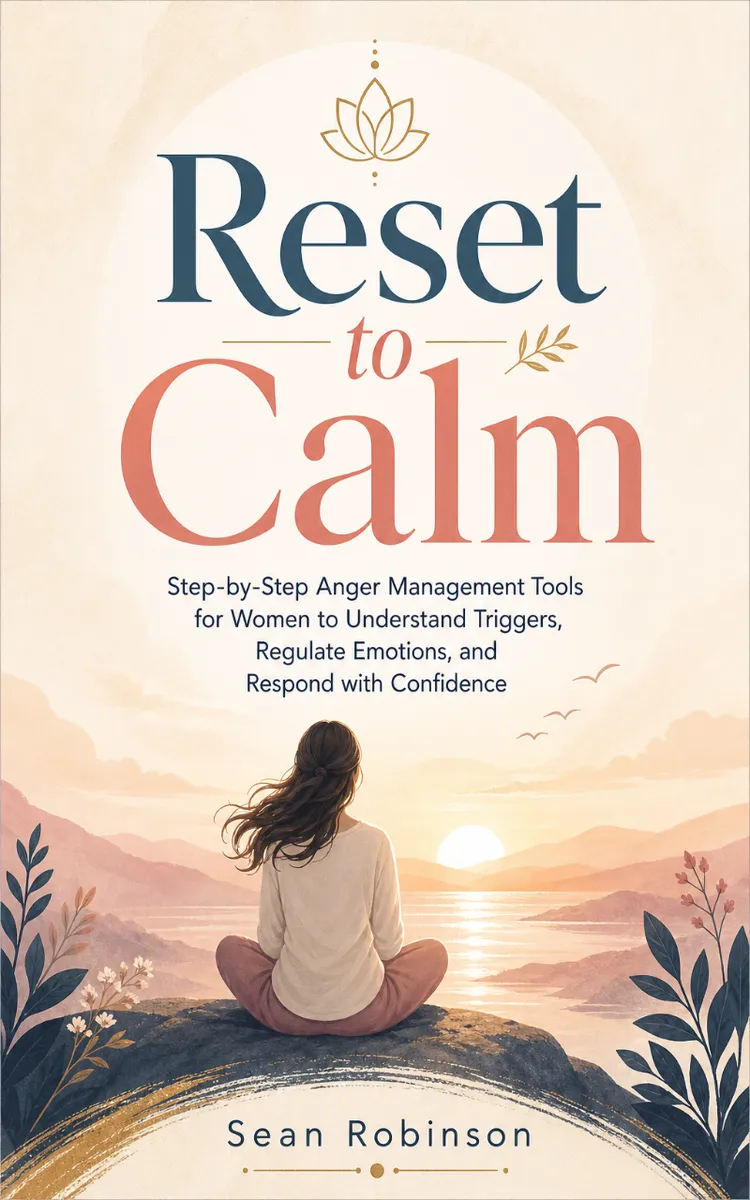
Read the first chapter
The whole of chapter one, free. About 6 min. Turn the pages with the arrows, your keyboard, or a swipe.
Chapter 1
Naming Your Anger Signals Early
The Moment Before You Snap
Have you ever noticed the exact moment your anger stops being a small irritation and starts taking over the whole room?
Maybe it begins while you’re reading a message that feels dismissive. Your jaw tightens. You reread the last line. Your shoulders creep toward your ears, and suddenly you’re typing a reply with both thumbs moving faster than your judgment. Or perhaps it happens in the kitchen: someone leaves a mess after you’ve already cleaned, and you feel heat rise into your face. You slam a cupboard, speak sharply, then wonder why such a small thing touched such a large nerve.
Often, anger doesn’t arrive like a fire alarm. It starts more quietly. You get restless. Your breathing becomes shallow. You stop listening and begin preparing your defense. You tell yourself, “I’m fine,” while your body is clearly voting no. By the time you notice the anger, you may already be halfway into the argument.
You’ve learned to spot the explosion. What if the real skill is noticing the spark?
The Question Beneath the Reaction
What if your anger isn’t asking you to fight yet - it’s asking you to pay attention?
That question can feel strange, especially if anger has usually been treated as a problem to hide or a force to unleash. But anger often sends early signals before it becomes loud. These signals aren’t proof that you’re unreasonable. They’re information. Your body may be telling you that you feel ignored, cornered, overworked, disrespected, or afraid of being blamed.
The shift is from “Why am I like this?” to “What is happening in me right now?” That small change creates space. You don’t have to approve of every angry thought. You don’t have to act on it. You simply notice the first clues while you still have choices.
Take a tense conversation about household responsibilities. Before using the Early Signal Scan, you might hear, “You never help,” and immediately fire back, “Because you never notice anything I do!” The conversation becomes a contest, and both of you leave feeling unheard.
After practicing the scan, you catch the first signs: a clenched jaw, hot cheeks, and the urge to interrupt. You silently name them: “My body is getting activated. I feel taken for granted.” Then you say, “I want to talk about this, but I need ten minutes to calm down so I don’t make it worse.” The problem hasn’t vanished. You haven’t swallowed your feelings. You’ve prevented the first spark from becoming a room full of flames.
How the Early Signal Scan Changes the Chain
Anger usually follows a pattern. Seeing the pattern makes it easier to interrupt.
1. When you receive a sharp text, face a sudden demand, or hear criticism... 2. You feel heat, tension, pressure, or a rush of defensive thoughts. 3. So you assume the other person is being careless, unfair, or deliberately hurtful. 4. Which leads to a fast reply, a raised voice, sarcasm, shutting down, or bringing up every old grievance.
That chain can happen in less than a minute. It feels automatic because your body reacts before your thoughtful mind catches up. The danger isn’t that you feel anger. The danger is missing the early signals and treating the first angry interpretation as a complete fact.
Now try the alternative chain:
1. When you notice the trigger... 2. You pause and scan your body for three early cues. 3. So you name the feeling and the need underneath it: “I’m tense and I need a clearer answer,” or “I feel dismissed and need a respectful conversation.” 4. Which leads to a deliberate choice: ask a question, request a pause, set a boundary, or return to the conversation when you can speak without attacking.
The Early Signal Scan is simple: Body, Story, Need, Choice. First, notice what your body is doing. Next, identify the story your mind is telling. Then ask what you need. Finally, choose the next helpful action. The pause may take only thirty seconds, but thirty seconds can protect a relationship, a workday, or your own peace.
You don’t have to stop anger from appearing; you have to meet it before it takes the wheel.
Your Honest Anger Check-In
Use these questions when you’re calm, not in the middle of a heated exchange. Rate yourself honestly. There’s no prize for choosing a higher number.
1. On a scale of 1 to 10, how quickly do you notice physical signs of anger? A 1 may mean you only notice after you’ve shouted or sent the message. A 10 means you can identify signs such as jaw tension, a tight chest, hot skin, or restless hands early.
2. Yes or no: Can you name the thought that appears just before you react? A “yes” suggests you’re beginning to separate facts from the story your anger adds. A “no” may mean your reaction feels so fast that you need to slow down and write the thought afterward.
3. On a scale of 1 to 10, how often do you pause before responding when you feel provoked? A low number points to a useful practice area. A higher number means you already have some control to build on, even if the pause is brief.
4. Yes or no: Can you state what you need without blaming the other person? “I need ten minutes before we continue” is a need. “You always make everything impossible” is an accusation. A “no” doesn’t mean you’re failing; it shows where a new sentence could help.
For a quick interpretation, look for the lowest score or the “no” that feels most uncomfortable. That’s your starting point. If body awareness is low, focus on physical cues. If naming the story is difficult, keep a short note after tense moments. If pausing is hard, practice one prepared phrase: “I’m too activated to answer well right now.” Small improvements matter because anger is changed through repeated moments, not one perfect performance.
The Five-Minute Early Signal Challenge
Action title: Catch the Spark Before You Speak
1. Morning setup - Easy. Choose one situation likely to test you today: a difficult coworker, a family request, a crowded commute, or a message you’ve been avoiding. Write this sentence in your phone: “My early signs may be,, and ___.” Pick three body signals, such as tight shoulders, faster speech, or a hot face.
2. Real-time scan - Medium. When you notice even one signal, stop for thirty seconds. Breathe out slowly, then complete the four parts: “My body feels. The story in my head is. I need. My next choice is.” Your choice might be asking for clarification, taking a ten-minute break, or waiting before replying.
3. Evening review - Medium. Spend five minutes answering three questions: “What was my first signal?” “What did I do next?” and “What would I try earlier tomorrow?” Don’t turn the review into a courtroom. You’re collecting useful information, not proving that you’re a bad person.
You’ll know it’s working when...
• You notice tension before your voice changes. - You can delay a reply, even for thirty seconds. - You describe your need more clearly than you describe the other person’s fault.
Some days, you’ll catch the spark early. Other days, you’ll recognize it only after the argument. Both moments count. The first teaches prevention; the second teaches you where your signals were hiding.
A Quieter Kind of Control
Anger becomes easier to manage when you stop treating early warning signs as interruptions and start treating them as guidance.
• Your body often signals anger before your words reveal it. - Naming the story in your mind helps you avoid confusing an assumption with a fact. - Identifying the need beneath the anger gives you more useful choices. - A short pause can change the entire direction of a conversation.
You’re not trying to become a woman who never gets angry. That would mean ignoring real problems and pretending everything is fine. You’re becoming a woman who can notice, “Something is shifting in me,” before the shift becomes a decision you regret.
Once you can spot the signal, the next question becomes important: when anger rises, how can you steady your body quickly enough to stay connected to what matters?
End of chapter one. 7 more chapters in the full book.
Swipe or use the arrows to turn the page
What's inside: 8 chapters
- 1. Naming Your Anger Signals Early
- 2. Rewriting the Story Behind Your Rage
- 3. Breathing That Lowers Your Heat Fast
- 4. Using the 90-Second Pause Script
- 5. Setting Boundaries Without Guilt
- 6. Communicating Needs With the CARE Method
- 7. Breaking the Vicious Loop of Triggers
- 8. Building Resilience After You Slip
About this book
"Reset To Calm" is a self-help book by Sean Robinson with 8 chapters and approximately 12,225 words. You can manage anger without suppressing yourself or walking on eggshells. Reset To Calm gives you a repeatable, eight-chapter process to notice anger signals early, calm your body fast, and choose responses that protect your relationships and your self respect.
This book was created using Inkfluence AI, an AI-powered book generation platform that helps authors write, design, and publish complete books. It was made with the AI Self-Help Book Writer.
Frequently Asked Questions
What is "Reset To Calm" about?
You can manage anger without suppressing yourself or walking on eggshells. Reset To Calm gives you a repeatable, eight-chapter process to notice anger signals early, calm your body fast, and choose responses that protect your relationships and your self respect. You will learn a simple Story Check to separate facts from the worst meaning your mind creates. Instead of reacting to an interpretation as if it is proof, you will slow down, ground yourself, and pick a response that matches what is actually true. With fast, body based calming strategies, including breathing that lowers your heat before your feelings catch up, you will gain practical steps you can use right when it matters.
How many chapters are in "Reset To Calm"?
The book contains 8 chapters and approximately 12,225 words. Topics covered include Naming Your Anger Signals Early, Rewriting the Story Behind Your Rage, Breathing That Lowers Your Heat Fast, Using the 90-Second Pause Script, and more.
Who wrote "Reset To Calm"?
This book was written by Sean Robinson and created using Inkfluence AI, an AI book generation platform that helps authors write, design, and publish books.
How can I create a similar self-help book?
You can create your own self-help book using Inkfluence AI. Describe your idea, choose your style, and the AI writes the full book for you. It's free to start.
Write your own self-help book with AI
Describe your idea and Inkfluence writes the whole thing. Free to start.
Start writingCreated with Inkfluence AI


