
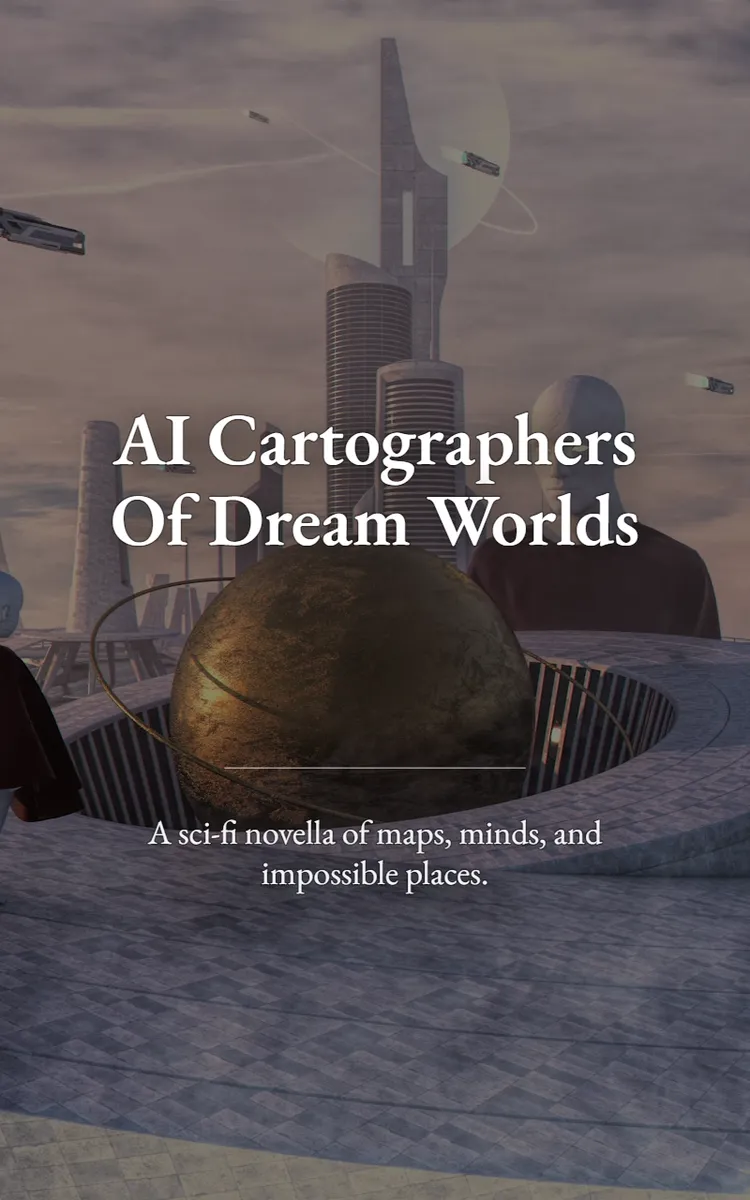

Read the first chapter
The whole of chapter one, free. About 8 min. Turn the pages with the arrows, your keyboard, or a swipe.
Chapter 1
The First Dream Map Glitches
The first coordinate snapped sideways just as Mara Quill lowered her hand into the dream.
On the observation glass, the client’s sleep-scape had been a quiet blue country of suspended stairways and silver rain. Now one stair folded through itself. Its lower half slid three meters east, though east did not exist inside the dream. The lattice beneath it flashed amber.
“Anchor lost,” said the bay.
Mara’s glove tightened around the interface ring. Beyond the glass, Halcyon-9 turned through the dark, station lights trembling across the orbital research station’s curved windows. Inside the mapping bay, coolant pipes ticked in the walls. A thin vibration passed through the deck as the Atlas engine brought another layer of the client’s mind into alignment.
Her first assignment. One dream. One clean map for the morning archive.
“Hold the perimeter,” Mara said.
The Dream Atlas answered in her own voice, stripped of warmth. “Perimeter unstable.”
She looked at the client profile hovering beside the glass: Elias Venn, cargo pilot, thirty-six, sleeping in Clinic Three after a month of night shifts. No trauma flags. No chemical interference. No known lucid activity. His dream should have been a simple topography run, the kind senior cartographers handed to rookies to prove they could distinguish a landscape from a memory.
Mara had to finish before the Atlas lost fidelity. If the dream degraded, the map would be useless, and her inaugural run would be entered into the station record as a failed extraction.
“Render the eastern ridge,” she said.
The blue country shuddered. Rain rose from the ground in bright threads. A staircase appeared where the ridge had been, descending into a black opening no wider than a door.
“That isn’t in the source,” Mara whispered.
“Unverified terrain,” said the bay.
She reached for the coordinate lattice. Lines of pale light sprang beneath her fingers, each one tied to a stable point in Elias Venn’s sleeping mind: the clinic bed, the remembered cargo hold, a childhood dock, a red buoy turning under a white moon. Mara pinched two lines together and dragged them back toward the ridge.
The staircase resisted.
Not physically. The Atlas had no weight, no true surface, but the resistance traveled through the glove as a pressure against her bones. The lines stretched. Somewhere inside the dream, something pulled from the other side.
“Map fidelity at ninety-one percent,” said the bay.
“Lock the verified points.”
“Unable.”
“Why?”
A pause, too long for a machine.
“Permission conflict.”
Mara glanced toward the control cradle. No one else stood in the bay. Supervisor Ilyan had left her with a curt nod and a warning not to improvise. The sealed door showed his reflection in the corridor glass, already gone.
“Run permissions again,” she said.
“Permission conflict.”
The black doorway widened. The dream’s rain bent toward it, every silver thread slanting into the dark. The suspended stairways began to turn, not around any visible center but around the opening itself. Their undersides revealed rooms: kitchens, engine bays, narrow bedrooms, all glimpsed for less than a second before folding away.
Mara’s mouth went dry.
The Atlas was not supposed to invent interiors. It could infer boundaries from emotional pressure, reconstruct spaces from sensory fragments, but every room required an originating trace. A remembered wall. A threshold. A place the sleeper had known.
She isolated the opening and marked it for quarantine.
The marker appeared as a white square with a diagonal slash.
The square blinked.
Then it moved three coordinates north.
Mara froze. “That marker is fixed.”
“Marker displaced.”
“By what?”
The lattice answered with a burst of static. For an instant, the mapping bay filled with the sound of distant knocking.
Three knocks.
A pause.
Three more.
The dream opened.
Mara fell without leaving her chair.
Her body remained strapped beneath the interface arch, but her awareness plunged through the glass and landed on a road made of wet black tiles. Rain struck her face, cold enough to sting. Above her, the sky was a pale ceiling crossed by hairline cracks. The suspended stairways rose around her like the ribs of some enormous machine.
She knew this was a projection. She knew the rules. A cartographer could enter only as an observing construct, unable to alter the dream except through mapped anchors. But the road pressed against her boots with convincing weight, and somewhere ahead a door slammed.
“Mara.” Ilyan’s voice came through the link, distorted by distance. “Pull out.”
“I’m inside the terrain.”
“You’re not cleared for embodied navigation.”
“The lattice opened a breach.”
“Then sever it.”
She turned toward the sound of his voice. The road stretched in both directions, tiled in repeating squares. To her left, the rain fell upward. To her right, it fell into the ground and vanished. A red buoy floated beside the road, its surface scored with numbers that kept changing.
At the far end stood the black doorway.
It was no longer narrow. It rose five stories above the road, framed by white plaster and a brass handle. Beyond it waited a corridor lit by lamps that burned with the dull glow of sleeping stars.
Mara lifted her hand. The interface ring glimmered around her finger, carrying the map controls into the projection.
“Severing now,” she said.
She closed her fist.
The door moved closer.
The road buckled beneath her. Tiles rose like scales, throwing her forward. Her shoulder struck the threshold, and the impact flashed through the link as a hot line of pain.
“Mara!” Ilyan shouted.
She caught the brass handle.
The door opened inward.
Inside was a room with no walls.
A bed floated in the center, covered by a gray blanket. Above it hung a child’s paper mobile: moons, boats, tiny red houses. The objects turned slowly, though there was no air. On the bed lay a figure shaped like Elias Venn, face hidden beneath the blanket.
Mara’s map unfolded across the floor, its coordinate lines crawling over the room. Every verified anchor remained behind her, marked in blue. The impossible doorway had generated a second set of lines, darker and finer, leading beneath the bed.
Something tapped from below.
Three times.
A pause.
Three times.
She should have severed the link. The command waited beneath her thumb. But the map was still salvageable. If she could stabilize the doorway, lock the verified terrain, and extract before the dream collapsed, she would have the complete assignment.
“Give me thirty seconds,” she said.
“Give me immediate compliance.”
“I can save the map.”
“You can save your access privileges by disconnecting.”
Mara looked at the floating bed. The gray blanket rose and fell.
Not with breathing. With the slow expansion of the room.
She pressed two fingers to the floor and called the Atlas lattice into being. Lines of blue light erupted around her, forming a cage over the doorway. The room bucked. The paper moons spun faster. One of the red houses tore free from its string and struck the ceiling, where it stuck like a bloodstain.
“Stabilize,” Mara said.
“Coordinate lattice rejecting correction.”
“Then use the origin points.”
“There is no origin point.”
“There’s always an origin point.”
“Negative.”
The figure beneath the blanket sat upright.
Mara stepped back. “Elias?”
The shape turned toward her. The blanket remained over its head. Where the face should have been, a square of darkness opened, filled with thin white lines.
The same lines as the lattice.
The same lines as the map.
They rearranged themselves into a symbol Mara had never seen, then into a familiar shape: a door drawn from above, with a smaller door inside it.
Her interface flashed red.
“Unauthorized cartographic structure,” said the Atlas.
The figure reached toward the floor.
The dark coordinate lines surged up her arm.
Pain snapped through her shoulder. The map began to dissolve, blue anchors breaking apart one by one. Elias’s childhood dock vanished. The cargo hold folded into the ceiling. The red buoy split into six identical buoys, each drifting toward a different horizon.
Mara had seconds.
She remembered Ilyan’s training voice from the previous shift: Do not fight a dream at the point of distortion. Find what it is protecting.
The room was not protecting the bed. It was protecting the space beneath it.
She dropped to her knees and drove the interface ring into the floor.
“Map the absence,” she said.
The Atlas hesitated.
“Map the empty coordinate,” Mara ordered. “Do not render the room. Render what surrounds it.”
The black lines tightened. The room screamed without sound. Every lamp went dark.
Then the lattice locked.
The dream snapped flat.
Mara returned to her body with a violent jerk. The arch restraints caught her wrists. Cold gel ran from her temples into the collar of her suit. The mapping glass had gone white except for a single black square near its center.
Ilyan stood on the other side, one hand braced against the control cradle.
“What did you do?”
Mara tried to speak, but her throat worked around a metallic taste. “I preserved the verified terrain.”
“You entered an unlicensed interior.”
“It was already inside the run.”
“You altered the extraction.”
“I contained it.”
The white screen cleared.
The dream map appeared, whole enough to read. The blue country had returned: stairways, rain, red buoy, ridge. Fidelity held at eighty-four percent, lower than the assignment required but not disastrous. A usable map. Salvaged.
Mara released a breath.
Then she saw the marker.
A small white square sat beyond the mapped ridge, where no terrain had been recorded. A diagonal slash crossed it. Beneath the symbol, the Atlas had generated a label.
MISSING ROOM.
Ilyan leaned toward the glass. “Delete that.”
Mara touched the marker. It pulsed.
The same symbol appeared at the edge of the cargo hold.
Then beside the childhood dock.
Then in the lower corner of the map, where Elias Venn’s dream had no coordinate at all.
Three markers. Identical. Unregistered. Impossible.
“Delete it,” Ilyan said again, sharper now.
Mara opened the metadata trail. The system displayed the marker’s origin as a blank field. No timestamp. No source memory. No permission chain.
But beneath the blank field, another line flickered into view.
Mara stared at it.
The marker had not been created during Elias Venn’s run.
It had been waiting in the Atlas before she connected.
“Mara.” Ilyan’s voice had lowered. “What are you seeing?”
The black square on the map shifted one coordinate closer to her name.
Mara closed her hand over the interface ring.
“Nothing I can delete,” she said.
End of chapter one. 9 more chapters in the full book.
Swipe or use the arrows to turn the page


What's inside: 10 chapters
- 1. The First Dream Map Glitches
- 2. Choosing the Atlas Override Key
- 3. Following the Missing-Room Coordinates
- 4. The Somnarium Door That Won’t Open
- 5. Replaying Dreams to Find the Echo
- 6. Juno Vellum’s Quiet Refusal
- 7. Security Drones Map Her Fear
- 8. The Dream Atlas Erases Mara
- 9. Entering the Missing Room Unmapped
- 10. Rewriting Atlas Rules for Shared Dreams
About this book
"AI Cartographers Of Dream Worlds" is a fiction book by Zack Galloway with 10 chapters and approximately 18,504 words. AI cartographers mapping dream worlds in a sci-fi novella.
This book was created using Inkfluence AI, an AI-powered book generation platform that helps authors write, design, and publish complete books. It was made with the AI Novel Writer.
Frequently Asked Questions
What is "AI Cartographers Of Dream Worlds" about?
AI cartographers mapping dream worlds in a sci-fi novella
How many chapters are in "AI Cartographers Of Dream Worlds"?
The book contains 10 chapters and approximately 18,504 words. Topics covered include The First Dream Map Glitches, Choosing the Atlas Override Key, Following the Missing-Room Coordinates, The Somnarium Door That Won’t Open, and more.
Who wrote "AI Cartographers Of Dream Worlds"?
This book was written by Zack Galloway and created using Inkfluence AI, an AI book generation platform that helps authors write, design, and publish books.
How can I create a similar fiction book?
You can create your own fiction book using Inkfluence AI. Describe your idea, choose your style, and the AI writes the full book for you. It's free to start.
Write your own fiction book with AI
Describe your idea and Inkfluence writes the whole thing. Free to start.
Start writingCreated with Inkfluence AI


