
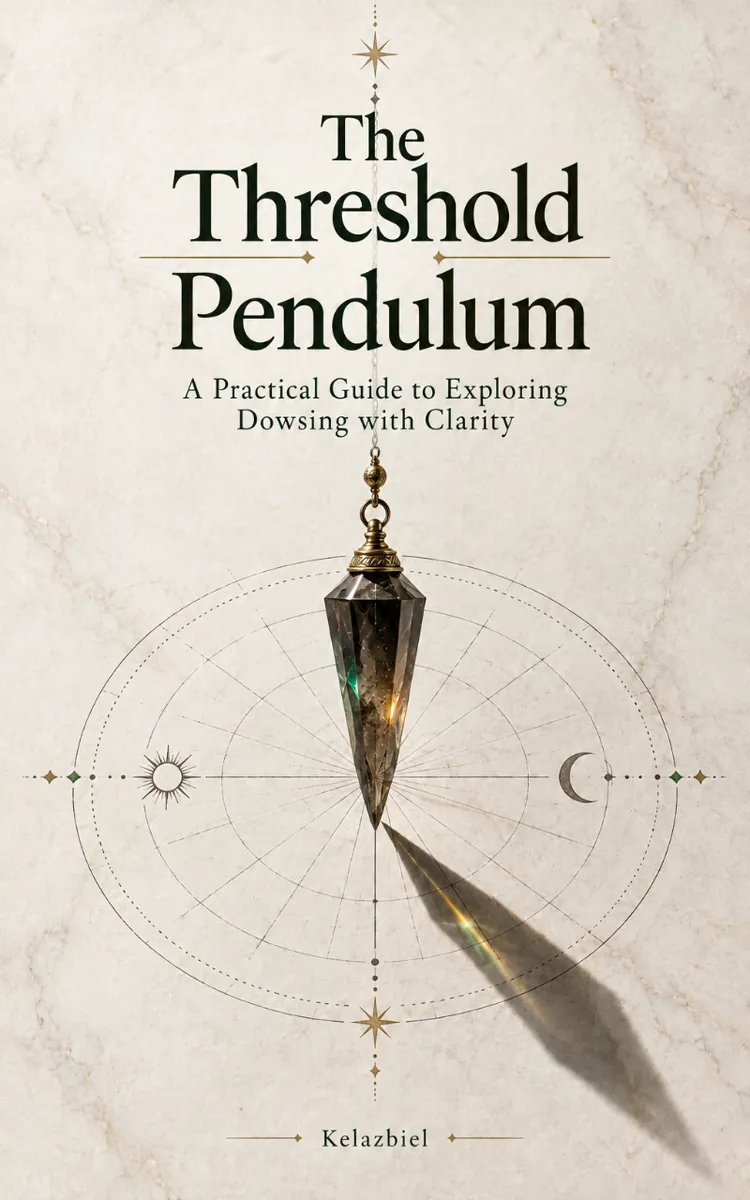

Read the first chapter
The whole of chapter one, free. About 8 min. Turn the pages with the arrows, your keyboard, or a swipe.
Chapter 1
Anatomy and Selection of the Pendulum
Pendulum Anatomy and Selection
A tool that should suit your purpose
A reader arrived at a practice session with three pendulums: one made of clear quartz, another of brass, and one of dark wood. She did not know which one to hold. She chose the shiniest, but for several minutes its movement was weak and irregular. Then she switched to the wooden one, asked the same question, and got a steadier swing. The difference did not prove that one material had greater power; it showed something simpler: the instrument’s shape, weight, and feel influenced her concentration.
Choosing a pendulum matters because each piece produces a different physical response in your hand. Weight affects speed; chain length changes the amplitude; surface and temperature alter how it feels to the touch. In addition, the meaning you attribute to the material may help or hinder your attention. A beautiful but uncomfortable pendulum is distracting. A simple, well-balanced, clean one makes for a more orderly reading.
By the end of these pages, you will be able to compare quartz, metal, wood, and obsidian; choose a tool according to your purpose; check its physical condition; clean it without damaging it; and perform a symbolic consecration - that is, clearly establish how it will be used. The pendulum will not decide for you or offer absolute certainty. It will serve as an aid for observing your reactions, symbols, and intuition with greater discipline.
The first practical question is this: can you hold it for ten minutes without pain, tension, or distraction? If the answer is no, the material is no longer suitable, however attractive it may look.
The Material Affinity Method
The Material Affinity Method connects three elements: the purpose of the session, the pendulum’s physical characteristics, and the subjective response it produces in you. It does not claim that a material works the same way for everyone. It aims to help you choose according to concrete criteria.
1. Examine the quartz
Quartz usually has a smooth surface, a medium weight, and a shape that makes its movement easy to observe. Many people associate it with clarity, focus, and general readings. That association may help when you want to work with simple questions, symbols, or attention exercises.
Choose quartz if you want a versatile tool to start with. Check that it has no deep cracks or sharp edges, and that its chain is not too fine. A quartz piece between 3 and 5 centimeters is usually manageable for a beginner. If the piece is too heavy, the swing will take longer to start, and you might mistake its slowness for a lack of response.
Clean it with a dry cloth. Avoid submerging it if it has delicate metal parts or if you do not know how the setting will react.
2. Observe the metal
Pendulums made of brass, copper, steel, or other alloys feel solid and produce a distinct movement. Metal withstands frequent use and is easy to clean, though it can heat up or cool down quickly depending on the surroundings. This variation may affect how it feels in your hand.
Choose metal when you need a durable tool for frequent practice or precise movement comparisons. Check its balance: hold the chain by the end and see whether the body hangs centered. If it consistently tilts, the movement may veer off course.
To clean it, wipe it with a soft, slightly damp cloth and dry it immediately. Do not use abrasive products. Contact with harsh substances can stain it and leave residue on your fingers.
3. Consider wood
Wood is lightweight, feels warmer to the touch, and is often less intense in the hand. It may be suitable for long sessions, introspective exercises, and people who are distracted by the shine or coldness of metal.
Choose a well-sealed wooden piece with no splinters or cracks. Its lightness means that any movement of your hand will have a visible effect, so it requires a steady grip. Do not wet it or expose it to direct sunlight. To clean it, use a dry cloth and, if the manufacturer allows it, a minimal amount of oil suitable for wood.
Wood does not need to look old to be useful. A new, well-balanced, well-cared-for pendulum can offer a clearer experience than a damaged piece laden with meaning.
4. Handle obsidian with care
Obsidian is a dark, heavy-looking volcanic glass. Many people symbolically associate it with shadow, boundaries, and inner observation. This symbolic weight may make it suitable for exploring difficult emotions or subjects that call for caution, but it can also increase suggestibility.
Choose it only if you can work with it without treating its color or origin as proof of authority. Check each edge with your fingers, without pressing. Some pieces have sharp areas or fractures. If you find a crack, replace it to avoid cuts and unpredictable movement.
Clean obsidian with a soft cloth. If the setting allows, you can briefly rinse it with lukewarm water and dry it completely; if you do not know what the setting is made of, use only a cloth. Do not knock it against other stones.
5. Compare before deciding
Place two or three pendulums on a clean cloth. Hold each one for a minute without asking any questions. Notice its weight, comfort, stability, and how easily it starts a small movement.
| Material | Typical feel | Recommended use | Main care | |---|---|---|---| | Quartz | Balanced and luminous | General practice and symbols | Avoid impacts and check the setting | | Metal | Solid and precise | Frequent use and comparison | Dry to prevent stains | | Wood | Light and warm | Calm, extended sessions | Protect from water and moisture | | Obsidian | Dense and subdued | Symbolic work with boundaries and shadow | Check for sharp edges and fractures |
After comparing them, ask: “Can I use this piece without giving it absolute authority?” If you cannot answer yes, choose another. Affinity includes both physical comfort and mental clarity.
A first choice, step by step
Suppose you want to buy a single pendulum to practice with over the next four weeks. You are not looking to resolve medical, legal, or financial matters; you want to become familiar with the instrument and explore personal symbols responsibly.
1. Define the purpose in one sentence. Write: “I will use the pendulum for observation exercises, simple questions, and symbolic readings.” This sentence keeps you from buying a piece based on exaggerated promises.
2. Set a size limit. Look for a body 3 to 5 centimeters long and a chain approximately 15 to 20 centimeters long. These measurements are not mandatory, but they make the pendulum easier for a beginner to control with one hand.
3. Try three materials. Hold quartz, metal, and wood for one minute each. If you have obsidian, include it only after checking its edges. Notice which one maintains a smooth movement when you relax your fingers.
4. Record your response. Make a table and note perceived weight, comfort, stability, and distraction. Use a simple scale from 1 to 5, where 1 means “very uncomfortable” and 5 means “very comfortable.”
5. Choose the piece with the best balance. Do not consider beauty alone. If quartz scores 5 for comfort and 3 for stability, while metal scores 4 and 5, metal may serve you better for daily practice.
6. Clean the tool. Remove dust, grease, and traces of handling. Use the method appropriate to the material and dry any metal parts completely.
7. Consecrate it symbolically. Place the pendulum on a dark cloth. Hold the chain without moving it and say a specific statement: “This tool helps me observe my attention and my symbols. It does not decide for me or replace professional judgment.” Repeat the sentence three times and remain silent for one minute.
8. Put it away overnight. Place it in a cloth bag or clean box, away from moisture and objects that could scratch it. The next day, hold it again for two minutes without asking anything. The expected result is not a supernatural sign; it is to check whether the tool is still comfortable and your intention remains clear.
Quick checklist
• [ ] I defined a limited and responsible purpose. - [ ] I checked the weight, size, chain, and balance. - [ ] I compared at least two materials. - [ ] I chose comfort and stability over appearance. - [ ] I cleaned the piece using a safe method. - [ ] I performed a symbolic consecration without promising results. - [ ] I stored the pendulum away from impacts, moisture, and heat. - [ ] I confirmed that I do not attribute to it the ability to decide for me.
If the pendulum moves erratically after cleaning, do not interpret it right away. First check for drafts, a trembling table, tension in your hand, and the condition of the chain. Observation begins before any reading.
Mistakes that cloud your choice
Choosing for appearance rather than balance
A pendulum can look magnificent and still be heavy, crooked, or uncomfortable. An obsidian piece with an uneven setting may swing irregularly; a metal pendulum that is too light may react to every vibration.
Do this: hang the piece by its chain, see whether it hangs centered, and hold it for five minutes.
Not this: buy the first pendulum because its color matches your aesthetic or because someone presents it as superior.
Using water on delicate materials or settings
Moisture can affect wood, stain certain metals, or loosen a joint. Even a durable stone can be damaged if its chain contains sensitive parts.
Do this: check the manufacturer’s care instructions; if you do not have them, use a soft, dry cloth.
Not this: submerge any pendulum in salt, water, or oils without knowing what it is made of.
Turning consecration into a promise
Consecration does not create special authority. It simply establishes a conscious relationship with the tool and sets a boundary for its use. If you expect the pendulum to always confirm your wishes, you will end up interpreting every movement as approval.
Do this: state what you will observe, what you will not ask, and when you will end the session. For example: “I will use it for symbolic exercises; I will not use it to diagnose, invest money, or replace a necessary conversation.”
Not this: hand an important decision over to an object, even if you have cleaned it, put it away, or consecrated it solemnly.
The right material is not the rarest or most expensive. It is the one you can hold comfortably, care for without damaging, and use without abandoning your judgment. When the tool stops being an object of fascination and becomes a well-chosen instrument, the threshold grows clearer: it does not lead to absolute truth, but to a more honest observation of what is already moving within you.
End of chapter one. 5 more chapters and about 10,669 words in the full book.
Swipe or use the arrows to turn the page


What's inside: 6 chapters
- 1. Anatomy and Selection of the Pendulum
- 2. Calibrating yes and no
- 3. Formulate verifiable questions.
- 4. Everyday Dowsing Applications
- 5. Avoid suggestion and biased interpretations.
- 6. End the session with clarity
About this book
"The Threshold Pendulum" is a how-to guide book by Kelazbiel with 6 chapters and approximately 10,669 words. Dowsing, use of the pendulum, formulating questions, and symbolic exploration of energies.
This book was created using Inkfluence AI, an AI-powered book generation platform that helps authors write, design, and publish complete books. It was made with the AI Ebook Generator.
Frequently Asked Questions
What is "The Threshold Pendulum" about?
Dowsing, use of the pendulum, formulating questions, and symbolic exploration of energies
How many chapters are in "The Threshold Pendulum"?
The book contains 6 chapters and approximately 10,669 words. Topics covered include Anatomy and Selection of the Pendulum, Calibrating yes and no, Formulate verifiable questions., Everyday Dowsing Applications, and more.
Who wrote "The Threshold Pendulum"?
This book was written by Kelazbiel and created using Inkfluence AI, an AI book generation platform that helps authors write, design, and publish books.
How can I create a similar how-to guide book?
You can create your own how-to guide book using Inkfluence AI. Describe your idea, choose your style, and the AI writes the full book for you. It's free to start.
Write your own how-to guide book with AI
Describe your idea and Inkfluence writes the whole thing. Free to start.
Start writingCreated with Inkfluence AI


