
Read the first chapter
The whole of chapter one, free. About 6 min. Turn the pages with the arrows, your keyboard, or a swipe.
Chapter 1
The Receipt for a New Life
Mara wished she could take the sentence back, but the book was still between them, and some sentences became harder to retrieve once another person had heard them.
“I’ve been looking for something to do for three days,” she said again, quieter this time.
The man’s hand loosened on the paperback.
Outside, rain ticked against the shop windows. It had been doing that since Mara arrived, turning the street into a blurred ribbon of headlights and wet brick. She had come in because the apartment felt too full of things she had not said. She had stayed because the poetry aisle was narrow, warm, and nobody there expected her to explain why she had stopped answering messages.
Not even him.
He looked at the book, then at her. “You can have it.”
“I don’t want your charity.”
“It isn’t charity.” He released the bottom edge. “I wanted to find it. You found it.”
That was how Mara ended up carrying The Geography of Small Things to the counter, with the man in the green overshirt following at a respectful distance. His name, she learned when the bookseller asked, was Elias. He worked at a bicycle repair shop two streets over. The grease on his knuckle was not a dramatic detail. It was simply grease.
Before she left, Elias wrote the name of the shop on the back of an old receipt.
“If the book disappoints you,” he said, “bring it back.”
“Do you refund disappointment?”
“Depends how carefully you can describe it.”
She kept the receipt.
That was months ago. Since then, Mara and Elias had learned that a life could change without announcing itself. There had been no single grand promise, no clean before-and-after line. There had been rides through rain, conversations that stopped and restarted, and the difficult work of asking without begging. There had been the privacy they protected, the wrong maps they abandoned, and the promises that slipped before they learned to tie them more carefully.
They had also learned that commitment was less like a declaration and more like maintenance.
What Counts as Proof
People often talk about commitment as if it lives in the future.
We will move in together. We will be honest. We will make this work. We will never do that again.
Promises matter. Mara had spent enough time with broken ones to know that. But a promise is a direction, not a record of travel. The record appears in ordinary places: the message sent when someone is running late, the appointment kept, the difficult subject brought up before it becomes a crisis. It appears in whether a person remembers what you asked for when there is no reward for remembering.
Trust has paperwork, even when nobody uses a pen.
There are entries. Dates. Corrections. Small signatures made by behavior.
Elias showed commitment by calling when a repair took longer than expected instead of waiting for Mara to ask. Mara showed it by saying, “I need an hour before we talk,” and then actually returning to the conversation. They both practiced checking in before resentment had time to dress itself up as certainty.
None of this looked romantic from a distance. It looked like calendar reminders, grocery lists, and sentences that began with, “Can we go back to what happened yesterday?”
But that was the point. A shared life was not built from its most beautiful moments alone. It was built from what happened on Tuesday afternoon when one person was tired, the other was defensive, and neither had the energy to perform a better version of themselves.
The Quiet Paperwork of Trust
At the bicycle shop, Elias kept a folder for every long-term repair. Customers sometimes laughed when he explained this. They wanted a quick fix, not a file.
But the folder helped him remember what had been replaced, what still needed attention, and what the owner had agreed to do next. A bicycle could look fine and still carry a loose bearing. A relationship could sound fine and still be wobbling under pressure.
Mara began to think of their check-ins as repair notes.
Not accusations. Not evidence for a future trial. Just a way to ask:
• What is working?
• What is wearing down?
• What needs attention before it fails?
• What are we each responsible for?
They did not hold these meetings every time something felt strange. That would have turned love into an inspection. But once a week, usually on Sunday evening, they took twenty minutes without phones. Sometimes they talked about practical things: money, errands, the next ride, Elias’s late shifts. Sometimes they talked about the less visible things: whether either of them felt alone, whether an old fear had returned, whether they were asking for closeness or merely testing whether the other person would chase them.
The check-in did not prevent every hurt. It prevented some hurts from becoming mysterious.
That distinction mattered.
A Receipt Practice
One Sunday, after a difficult conversation about privacy and shared plans, Mara took a blank page from the notebook she carried in her coat pocket.
“I want to try something,” she said.
Elias looked wary. “That usually means paperwork.”
“It is paperwork.”
She drew a line down the middle of the page. At the top of one column she wrote: We are building. At the top of the other, she wrote: We are no longer paying for.
The practice was simple. Name the life you are creating, then name the costs you refuse to keep treating as normal.
Under the first heading, Elias wrote:
• Reliable communication.
• Room for separate lives.
• Repair after conflict, not punishment after conflict.
• Plans that can survive an ordinary bad day.
Mara added:
• Truth told early.
• Money discussed without shame.
• Affection that does not have to be earned through exhaustion.
• A home that feels like somewhere both people can arrive.
Under the second heading, she wrote:
• Guessing games.
• Silence used as leverage.
• Promises made only to end an argument.
• Being grateful for the bare minimum.
Elias held the pen for a long time. Then he added one more line.
“We are no longer paying for peace with honesty,” he said.
Mara looked at him.
“That one stays,” she said.
The receipt practice was not a contract guaranteeing they would never fail. It was a way to make their values visible enough to revisit. Every few months, they could look at the page and ask whether their daily choices matched what they claimed to be building.
A receipt does not prove that a purchase was wise. It tells you what was exchanged.
That was useful information.
The Cost of the Old Life
For a while, Mara had believed that moving forward meant leaving the old life behind without carrying any of its language. She thought healing would make certain needs disappear. She thought being loved well would mean she would no longer need reassurance, boundaries, or time to think.
Instead, she learned that a new life still required her to bring the truth with her.
She still became quiet when she was afraid. Elias still tried to solve problems too quickly. They still had days when the wrong map looked tempting because it was familiar. The difference was that they noticed sooner. They had habits now that helped them return.
That was honest momentum.
Not speed. Not perfection. The repeated choice to face the direction they had named.
On the evening they finished their receipt, Mara folded the page and placed it inside the poetry book. The original receipt from the bookshop was still there, faded at the edges. Two small pieces of paper, months apart, pressed between the same pages.
“You kept it,” Elias said.
“I keep important evidence.”
“Evidence of what?”
Mara looked at the list they had written together.
“That we’re not just talking about a life,” she said. “We’re paying attention to the one we’re making.”
Outside, the rain had stopped. Their bicycles waited beneath the shop awning, tires dark with water, lights blinking patiently into the evening.
Mara put the book in her bag. Elias checked the straps on the rear rack. Then they started home, not because home was a place where nothing went wrong, but because they had finally learned how to keep choosing it.
End of chapter one. 7 more chapters in the full book.
Swipe or use the arrows to turn the page


What's inside: 8 chapters
- 1. The Receipt for a New Life
- 2. When the Bike Becomes a Mirror
- 3. Riding Through Repair Without Running
- 4. The Map That Updates Itself
- 5. Community Without the Performance
- 6. Consent to Grow, Together
- 7. The Last Ride, the First Day
- 8. The Receipt for Tomorrow
About this book
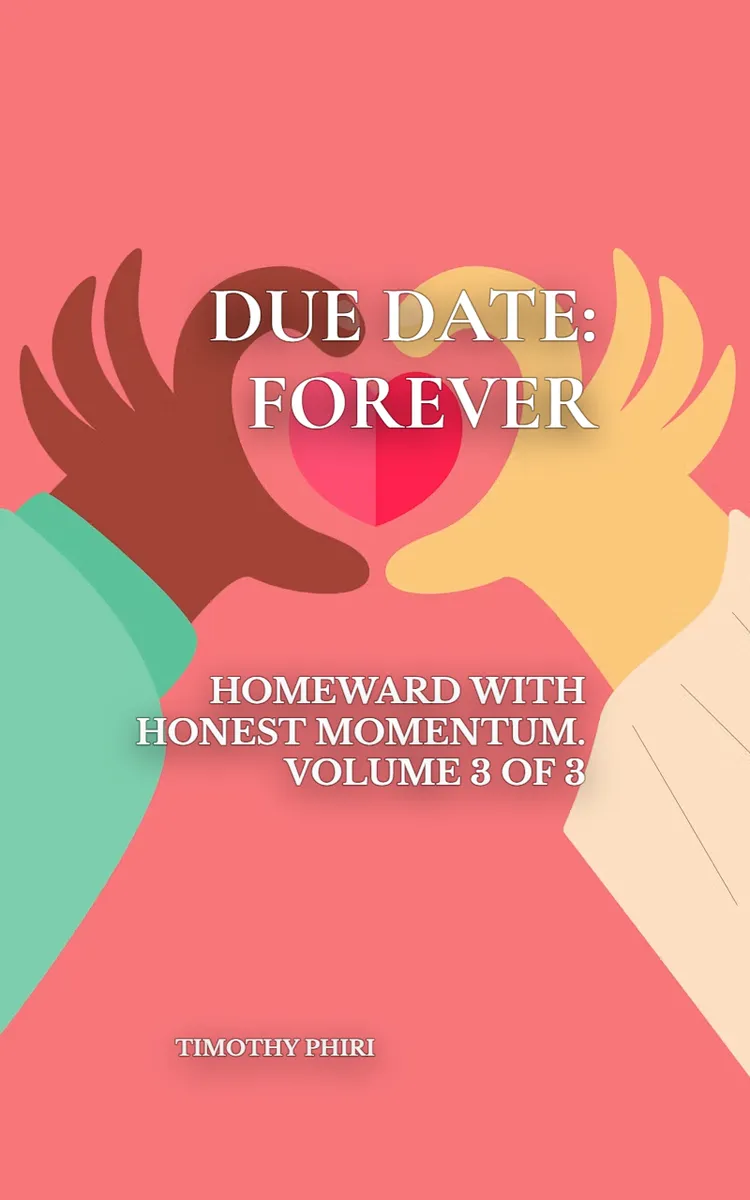
"Due Date: Forever" is a romance book by Timothy Phiri with 8 chapters and approximately 12,240 words. A final deep dive into what it means to keep choosing each other—after the fixes, the boundaries, and the brave rides—until love becomes a practiced, everyday kind of freedom..
This book was created using Inkfluence AI, an AI-powered book generation platform that helps authors write, design, and publish complete books. It was made with the AI Romance Novel Writer.
Frequently Asked Questions
What is "Due Date: Forever" about?
A final deep dive into what it means to keep choosing each other—after the fixes, the boundaries, and the brave rides—until love becomes a practiced, everyday kind of freedom.
How many chapters are in "Due Date: Forever"?
The book contains 8 chapters and approximately 12,240 words. Topics covered include The Receipt for a New Life, When the Bike Becomes a Mirror, Riding Through Repair Without Running, The Map That Updates Itself, and more.
Who wrote "Due Date: Forever"?
This book was written by Timothy Phiri and created using Inkfluence AI, an AI book generation platform that helps authors write, design, and publish books.
How can I create a similar romance book?
You can create your own romance book using Inkfluence AI. Describe your idea, choose your style, and the AI writes the full book for you. It's free to start.
Write your own romance book with AI
Describe your idea and Inkfluence writes the whole thing. Free to start.
Start writingCreated with Inkfluence AI


