
Read the first chapter
The whole of chapter one, free. About 9 min. Turn the pages with the arrows, your keyboard, or a swipe.
Chapter 1
The Draft That Never Came
On the morning of January 27, 1973, the United States ended the draft. The last American conscripts entered the Army that year; after that, military service became a choice made by a much smaller share of the population. Generation X, born roughly between the mid-1960s and early 1980s, grew up in the shadow of a war machine they were unlikely to join.
That absence mattered. Earlier generations encountered military power through draft notices, uniforms on neighbors, and the possibility that a government letter could reorder an entire life. Gen X encountered it differently: through an all-volunteer force, television, movies, video games, school policy, and a widening civilian market for weapons modeled on military designs. The state did not disappear from their lives when conscription ended. It changed the way it appeared.
The Volunteer Force Lens follows that change. It asks not only who carried the nation’s weapons, but how military habits, images, technologies, and policies moved outward into ordinary counties and households.
What happens when a generation is raised beside military power but is rarely required to touch it?
From Citizen Army to Volunteer Force
The draft had never been a permanent feature of American life. The nation used conscription during the Civil War, both world wars, the Korean War, and the Vietnam War, with interruptions between conflicts. Its most controversial modern form began in 1940, when Congress passed the Selective Training and Service Act before the United States entered World War II. For decades afterward, military service remained a shared possibility, even for people who never served.
That possibility created a peculiar civic relationship. A young man might receive a draft classification, report for a physical examination, or watch a friend leave for basic training. Families learned the vocabulary of deferments and exemptions. Communities saw military service not simply as a profession but as an interruption that could arrive at the address of an ordinary citizen.
Vietnam damaged the legitimacy of that arrangement. The draft distributed risk unevenly, and the system became a central target of protest. The lottery introduced in 1969 made selection more visibly random, but randomness did not make the war feel fair. By the early 1970s, the political cost of conscription had become difficult to separate from the war itself.
President Richard Nixon signed the legislation that ended the draft call in 1973, and the United States moved toward an all-volunteer military. The change was practical and political. A professional force could train longer, retain specialized personnel, and avoid the public resistance generated by compulsory service. It also created distance. The armed forces became more capable in some ways while becoming less socially representative in daily life.
The distinction is important. An all-volunteer force is not a force without public support, and it is not a force without civilian oversight. It is a force whose personnel are selected through employment rather than compulsion. That difference alters what the rest of society sees. Military service becomes one occupation among many, even when the institution itself remains enormous, technologically advanced, and deeply involved in national policy.
For Gen X, the draft was mostly history by the time they reached adulthood. The generation associated with MTV, home computers, and the late Cold War did not grow up expecting a government lottery to determine whether it would fight. Its members encountered military power as spectacle, career, consumer product, and political language.
The War on the Screen
The all-volunteer force did not make war less visible. It made war easier to watch at a distance.
Television had already changed the relationship between Americans and combat. Vietnam brought the conflict into living rooms through nightly news reports, though the idea that television single-handedly turned public opinion against the war is too simple. By the 1980s, the culture had absorbed Vietnam through a different set of images: veterans returning from a morally confused war, elite soldiers moving through hostile terrain, and American firepower restored to cinematic confidence.
Films such as Top Gun, released in 1986, presented military skill as sleek, competitive, and technologically thrilling. Rambo: First Blood Part II turned the Vietnam veteran into a figure of national correction. Television news presented military operations with maps, satellite images, and carefully managed briefings. The 1991 Gulf War added another layer: precision weapons and live coverage made combat look both immediate and strangely clean.
Gen X children also met military logic in entertainment designed for them. G.I. Joe, originally a toy line and later an animated series, translated military units into colorful characters and vehicles. Video games turned weapons systems into interfaces. The player did not need to understand logistics, trauma, or civilian consequences to understand the central grammar: identify a target, select a tool, overcome resistance.
The culture did not simply glorify violence. It also produced skepticism. Films such as Platoon, Full Metal Jacket, and Born on the Fourth of July offered harsh portraits of military training, institutional pressure, and damaged veterans. Yet even criticism kept military power at the center of the imagination. The armed forces remained the reference point, whether the story admired them, questioned them, or used them as a source of dramatic authority.
A striking fact sits beneath this cultural saturation: most viewers could recognize the shape of a military rifle long before they had ever met a service member.
The image of the weapon traveled more widely than the experience of carrying it. That imbalance helped separate military technology from military obligation. A young person could become familiar with assault-rifle silhouettes, camouflage patterns, tactical language, and special-operations mythology without having any direct relationship to the institution that produced them.
The Volunteer Force Lens
The Volunteer Force Lens treats this separation as a form of social distance. It does not claim that popular culture causes people to become violent, or that every civilian firearm is a military weapon. It asks a narrower question: what happens when military design and language become familiar to civilians while military service becomes less common among them?
The answer can be seen in the changing meaning of the rifle. The AR-15, developed from the military AR-10 and later adopted in military form as the M16, was not originally designed as a civilian cultural object. Its civilian versions entered a market shaped by legal changes, advertising, shooting sports, self-defense claims, and the appeal of military appearance. The rifle’s importance was not only mechanical. It carried a visual and political vocabulary.
That vocabulary expanded during the 1980s and 1990s. Federal firearms law restricted certain features of semiautomatic weapons through the Public Safety and Recreational Firearms Use Protection Act of 1994, commonly called the federal assault-weapons ban. The law expired in 2004. Its history showed how difficult it was to regulate a category defined partly by appearance and configuration rather than by one simple mechanical feature.
Meanwhile, the military itself was becoming more distant and more present at once. Service members deployed repeatedly after the attacks of September 11, 2001, while many civilians encountered the wars in Afghanistan and Iraq through embedded reporting, briefings, and televised images. The country asked a relatively small force to sustain long campaigns. Military families carried much of the direct burden; the broader public often experienced the wars through politics, fundraising, entertainment, and consumer choice.
Policy helped shape the civilian environment. The Law Enforcement Officers Safety Act of 2004, for example, expanded the ability of qualified retired and off-duty officers to carry concealed firearms across state lines under specified conditions. State-level concealed-carry laws also changed over time, making the public presence of firearms more common in some places. These developments did not arise from one unified plan to militarize society. They emerged from separate arguments about crime, rights, policing, public safety, and government authority.
That is precisely why the pattern is easy to miss. Military influence did not arrive as a single program. It accumulated through procurement, media, law, advertising, training, and political language. The volunteer force supplied the institution. Popular culture supplied the images. Policy supplied the pathways by which those images and technologies entered civilian life.
The Unexpected Trade: Less Service, More Military Familiarity
The counterintuitive finding is this: ending conscription reduced the number of civilians directly exposed to military service, but it did not reduce military influence in civilian culture. In some respects, it helped concentrate and intensify that influence.
A conscript army made the military socially broad but personally disruptive. An all-volunteer force made it more professional and more specialized, while entertainment and commerce carried its symbols to people who would never enlist. The result was not a civilian population free from military culture. It was a population that could consume military identity without sharing military obligation.
This matters because familiarity is not the same as understanding. A person may know the profile of a carbine, the language of tactical gear, or the choreography of a raid without knowing what sustained deployment does to a family, a body, or a community. Military power becomes legible as style before it becomes legible as institution.
The trade also changed public debate. Arguments over firearms increasingly used the language of personal sovereignty, preparedness, and resistance to government control. Those ideas drew on older American traditions, but they gained new visual force from the weapons and uniforms associated with modern combat. The rifle could be presented simultaneously as a consumer product, a constitutional symbol, and a small-scale version of national power.
A Generation Raised Beside the Barracks
Consider Fort Bragg, renamed Fort Liberty in 2023, in North Carolina. For decades it was one of the largest military installations in the United States and a central home of the Army’s airborne and special-operations communities. The surrounding region did not experience the all-volunteer force as an abstraction. Its roads, schools, housing markets, churches, businesses, and family calendars were shaped by deployments and transfers.
Yet the nearby civilian population was not identical to the force stationed there. Military families moved in and out. Contractors and veterans formed durable connections. Many residents worked in an economy tied to defense. Others lived close to the installation without serving or knowing anyone who served closely. The base was both part of the landscape and a separate world, marked by gates, uniforms, restricted areas, and specialized language.
That arrangement captures Gen X’s broader encounter with military power. The generation could grow up near installations, watch military stories on television, play combat games, and later buy civilian versions of military-style equipment, all without facing the draft. In counties far from bases, the same influence arrived through retail shelves, political campaigns, police equipment, and media. The physical distance changed, but the symbols traveled.
The county became the useful scale for observing this process. National policy set the boundaries, but local conditions determined how military influence appeared: a gun shop near a highway, a police department receiving surplus equipment, a veterans’ organization beside a courthouse, a school responding to a threat, or a household keeping a rifle whose design originated in a government arsenal. The weapon did not arrive alone. It came with a history of service, entertainment, law, and identity.
The draft that never came was therefore not an empty space. It was a missing personal encounter, filled by other forms of contact. Gen X learned about military power through images, institutions, markets, and policies that made it familiar without making it universal.
A society can move military power outward without moving military duty with it. The result is a strange civic landscape: fewer people serve, while more people recognize the tools, symbols, and language of service. Somewhere between the barracks and the county line, the weapon changes meaning - and the question of who it belongs to becomes harder to answer.
End of chapter one. 39 more chapters and about 70,330 words in the full book.
Swipe or use the arrows to turn the page


What's inside: 40 chapters
- 1. The Draft That Never Came
- 2. Growing Up Under the Nuclear Shadow
- 3. The Arcade’s War Lessons
- 4. Hollywood’s Soldier Factory
- 5. Recruiters at the School Door
- 6. The Promise of a Paycheck
- 7. Who Gets the Uniform
- 8. Boot Camp’s Remade Self
- 9. The Rifle as National Symbol
- 10. The Machine Gun’s Long Reach
- 11. The Pentagon’s Research Engine
- 12. Learning to Fight by Screen
- 13. The Gulf War’s Television Lesson
- 14. Precision’s Human Blind Spots
- 15. The Drone Operator’s Distance
- 16. The Intelligence Analyst’s War
- 17. Special Operations, Hidden in Plain Sight
- 18. The Medic Between Worlds
- 19. Women Enter the Combat Story
- 20. The Guard at the Home Front
- 21. The Weapons Market Goes Global
- 22. When Military Gear Comes Home
- 23. The County’s Deadliest Arsenal
- 24. The Second Amendment’s Local Meaning
- 25. The Gun Show’s Quiet Economy
- 26. The Home as an Armory
- 27. The County Sheriff’s Discretion
- 28. The School’s Security Dilemma
- 29. The Veteran After the Uniform
- 30. The Wounds Nobody Sees
- 31. The Contractor in the Combat Zone
- 32. The Lobby Behind the Arsenal
- 33. The Budget That Buys a Future
- 34. The Law of Lethal Force
- 35. The Myth of the Invincible Soldier
- 36. The Generation That Watched War
- 37. What the Numbers Cannot Say
- 38. The Policy Choices Still Open
- 39. Who Owns the Machine
- 40. The Future We Choose to Arm
About this book
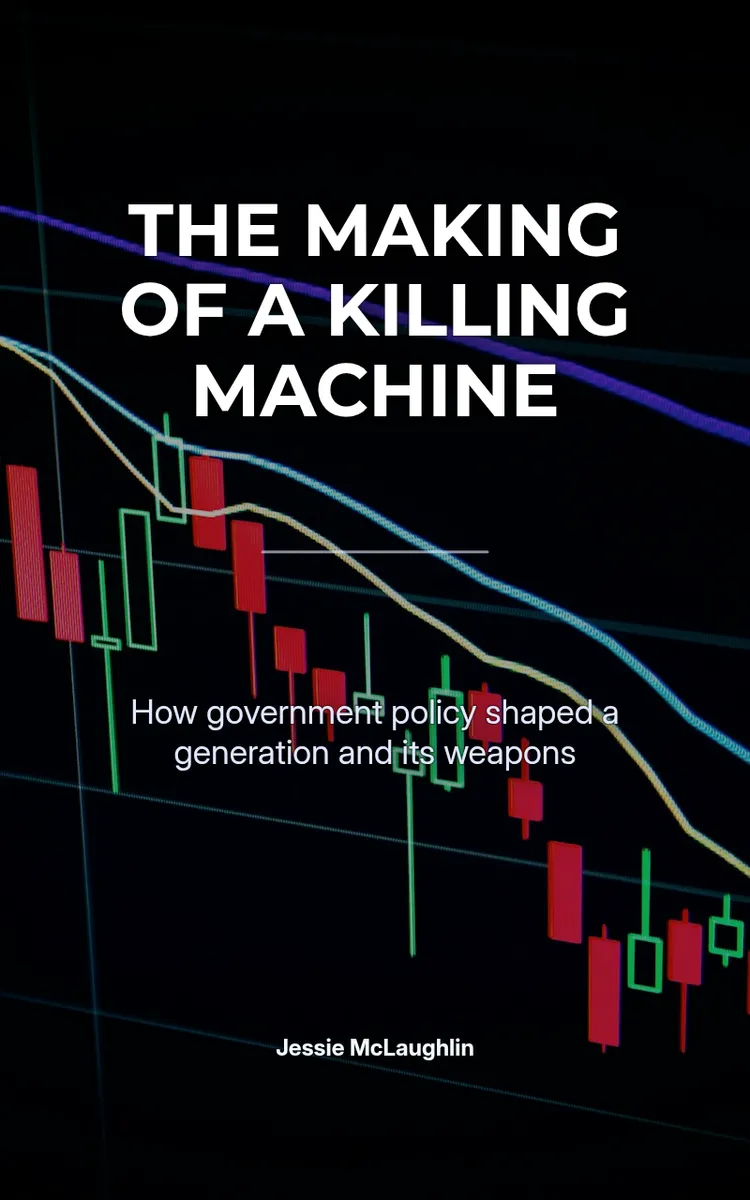
"The Making Of A Killing Machine" is a curiosity book by Jessie McLaughlin with 40 chapters and approximately 70,330 words. Government influence on Generation X and the deadliest weapons in U.S.
This book was created using Inkfluence AI, an AI-powered book generation platform that helps authors write, design, and publish complete books.
Frequently Asked Questions
What is "The Making Of A Killing Machine" about?
Government influence on Generation X and the deadliest weapons in U.S. counties
How many chapters are in "The Making Of A Killing Machine"?
The book contains 40 chapters and approximately 70,330 words. Topics covered include The Draft That Never Came, Growing Up Under the Nuclear Shadow, The Arcade’s War Lessons, Hollywood’s Soldier Factory, and more.
Who wrote "The Making Of A Killing Machine"?
This book was written by Jessie McLaughlin and created using Inkfluence AI, an AI book generation platform that helps authors write, design, and publish books.
Write your own curiosity book with AI
Describe your idea and Inkfluence writes the whole thing. Free to start.
Start writingCreated with Inkfluence AI


