

Read the first chapter
The whole of chapter one, free. About 9 min. Turn the pages with the arrows, your keyboard, or a swipe.
Chapter 1
Why “Just Sold” Posts Fail
How to Turn a Closed Sale Into Proof of Your Work
Imagine you have just closed a sale that took more work than anyone outside the transaction will ever know. The home sold in 21 days, the photo looks good, the clients are relieved, and the result is worth sharing. So, you write the usual “Just Sold” post. You add the sale result, thank the people involved, mention teamwork, and send it into the feed.
For a short while, the post seems to do its job. Other agents congratulate you, a past client may leave a like, and someone may comment that the house looks beautiful. Then the post moves down the feed, and the real work behind the sale disappears with it.
That is where the post falls short. The people reading it do not see the inspection report that almost slowed everything down. They do not see the buyer getting nervous, the lender asking for more paperwork, the seller needing a clear explanation, or the repair request that had to be narrowed before it turned into a fight. They see that the deal closed, but they do not see the hurdles you had to clear to get it there.
A case study brings that hidden work into view. It turns a completed sale into a clear story about what happened, what had to be solved, what decisions were made, how people were kept informed, and what follow-through helped the deal reach closing. The story does not need to be long or dramatic. It only needs to help a future client understand why your work mattered.
That is how a sale becomes proof.
What a “Just Sold” Post Usually Leaves Out
Most “Just Sold” posts follow the same pattern. There is a property photo, a sale result, a thank-you line, and maybe a sentence like “great teamwork got this one to closing.” None of that is wrong, and in many cases it is true, but it does not give a future client much to hold onto. A seller who does not already know you may still be asking, “What did the agent actually do?”
The first thing usually missing is the problem. Every transaction has something that had to be handled. Sometimes the appraisal comes in low, the inspection report scares the buyer, the seller wants a price the market will not support, the title work gets confusing, or the lender asks for more documents at the worst possible time. When the problem is left out, the deal can look easy, lucky, or carried by the property itself.
The second missing piece is the strategy. Strategy is not simply saying, “We priced it right.” It is what you did with the facts in front of you. It is how you positioned the home, handled feedback, guided the client, negotiated terms, protected the timeline, and kept the deal from drifting when it could have gone off course.
The third missing piece is the decision-making, and this is where your value often shows up most clearly. What did you do when the buyer pushed back? What did you tell the seller when the repair list came in? What did you put in writing so everyone understood the next step? If the post skips those parts, it skips the proof.
Before you publish your next sold post, ask yourself one simple question: would a future client understand what I did to help this deal close? If the answer is no, the post needs more of the deal behind the deal.
The Trust Gap Checklist
You do not need to write a long case study every time a property sells. You only need to show the parts the photo cannot show. A good case study gives the reader five things: the real problem, the strategy, the key decisions, the communication, and the follow-through.
Start with the real problem. Do not begin with the result, because “Sold in 18 days” is not the problem. The problem is the thing that could have slowed, weakened, or broken the deal. For example, you might write, “We had to overcome a $12,000 appraisal gap after the first offer came in under the revised value.” That sentence gives the reader a real situation instead of a flat result.
Once the problem is clear, explain the strategy. You might write, “We guided the seller through a repair plan tied to the inspection findings so we could protect the appraisal and keep the buyer’s loan on track.” Now the reader can see that you were not just reacting to events. You were choosing a path and helping the client understand why that path made sense.
Then show the key decisions. Every deal has moments where you could have gone one way or another, and those choices show judgment. For example, “We requested a concession instead of a price reduction, then adjusted the deadline after the lender flagged the title timing.” You do not need every detail from the file. Two or three clear decisions are usually enough.
After that, show how you communicated. Do not simply say you kept everyone informed, because almost every agent says that. Show what it looked like. A sentence like, “I sent a decision-ready summary within two hours of each counteroffer and confirmed the next steps the same day,” gives a future client a clear picture of what it may feel like to work with you when things are moving quickly.
Finally, show the follow-through. This is what you kept doing after the main agreement was reached. You might write, “We tracked lender conditions, confirmed document receipt, and handled the final walkthrough checklist with the buyer’s agent two days before closing.” That kind of detail matters because clients want to know you stay with the file until the end, not just until the deal looks safe.
This checklist is not asking you to make the story bigger than it was. It is asking you to tell the truth clearly enough for the reader to see the work.
A team leader, I’ll call Tanya, once described this exact problem after her team sold a condo. The post had the usual pieces - sold, happy clients, great teamwork, strong result. It looked fine until a local referral partner sent a short message: “Congrats - what was the hang-up?” That question told her what the post had missed. It had not mentioned the inspection issue, the lender timing, or the repair choice that kept the deal together.
Later, when Tanya posted a short follow-up explaining those details, the same referral partner replied, “That makes sense. Now I see why you’re worth calling.” She did not need a louder post. She needed a clearer one.
Turning a Sale Into a Case Study
Let’s use a common deal. A home goes under contract quickly, and at first everything feels steady. Then the inspection comes back with repair items, the buyer gets nervous, and the lender asks for more documents. The seller wants the deal to stay on track, but nobody wants the repair conversation to turn into a fight.
The public post says, “Sold in 21 days.” That may be true, but it is not the full story.
A case study starts with the problem: “The inspection turned up repair items that the buyer’s lender flagged, and we needed to keep the buyer’s loan moving without turning the deal into a fight.”
Then it explains the strategy: “We set repair priorities based on lender concerns and buyer risk, then proposed a plan that kept costs predictable and reduced surprises.”
After that, it shows the decisions: “After the first repair request, we negotiated specific scope instead of agreeing to broad repairs. When the lender asked for updated documents, we coordinated the vendor paperwork the same week and adjusted the closing schedule by a short, agreed window to protect the financing.”
Then it shows the communication: “I delivered a decision summary the day we received the inspection report and confirmed the next steps in writing after each counteroffer.”
Finally, it shows the follow-through: “We tracked each lender condition, confirmed document receipt, and walked both sides through the final walkthrough checklist two days before closing.”
Now the sale has shape. The reader can see what happened, what you did, and why the closing was not just luck.
A Better “Just Sold” Post
Here is how that same deal could appear as a short post:
Sold in 21 days.
This one moved quickly at first, but the inspection created repair questions that also mattered to the buyer’s lender. To keep the deal on track, we focused on the repairs tied to lender requirements, negotiated specific scope instead of broad requests, and coordinated the needed paperwork before timing became a bigger problem.
After each counteroffer, we sent the seller a clear summary of the decision in front of us and confirmed the next step in writing. Once the repair plan was agreed on, we tracked the lender conditions, checked document receipt, and worked through the final walkthrough items before closing.
The result was a smooth closing and a handoff that matched the repair plan both sides had accepted.
That post still announces the sale, but it also shows the work. A future client can now understand more than the result. She can understand how the deal was handled.
Mistakes That Keep Sold Posts Thin
The first mistake is hiding the work behind a phrase like “great teamwork.” That line sounds pleasant, but it does not tell the reader what happened. Instead of writing, “Great teamwork got us to closing,” write, “We negotiated repair scope after inspection to keep the lender approval moving.”
The second mistake is leaving out the problem because it feels negative. A problem in the deal does not make you look bad. It gives you a chance to show how you protect the client. Instead of writing, “Everything went smoothly,” write, “Inspection findings required lender-sensitive repairs, so we adjusted the plan quickly.”
The third mistake is letting one number carry the whole story. “Sold in 21 days” may be worth sharing, but it does not explain what you did during those 21 days. Instead of writing, “Sold in 21 days. Call me for results,” show the work behind the number: “This sale moved quickly, but the inspection created repair questions that could have slowed the closing. We narrowed the repair request, kept the lender’s timeline in view, and helped both sides stay on track.”
Before you post, ask yourself whether the update would help a future client understand what you do when a deal gets complicated. If the answer is no, add one clear sentence about the problem, the decision, or the follow-through.
What to Watch After You Publish
After you post a stronger case-study-style update, do not only count likes. Watch the questions people ask. If someone says, “What happened with the appraisal?” or “How did you handle the repair issue?” or “What did you ask for in the negotiation?” the post is doing useful work because it is helping people understand your process.
Also watch for quieter signs. A seller may say, “That sounds like what we are dealing with.” A referral partner may send someone with a similar problem. A past client may comment that they never realized how much happens after an offer is accepted. Those responses matter because they show that people are not only reacting to the sale. They are seeing the work behind it.
A “Just Sold” post should do more than mark the end of a transaction. It should help the next client understand what kind of agent they would be hiring. When you show the problem, the strategy, the decision, the communication, and the follow-through, you stop asking people to trust you just because the deal closed.
You give them a reason.
End of chapter one. 7 more chapters in the full book.
Swipe or use the arrows to turn the page


What's inside: 8 chapters
- 1. Why “Just Sold” Posts Fail
- 2. The Deal-Behind-Deal Fact Map
- 3. Interview Questions That Reveal Work
- 4. Protecting Privacy Without Killing Clarity
- 5. The Case Study Story Spine
- 6. Turning Strategy Into Plain-English Steps
- 7. The Obstacle-to-Decision Loop
- 8. Publishing Case Studies Across Channels
About this book
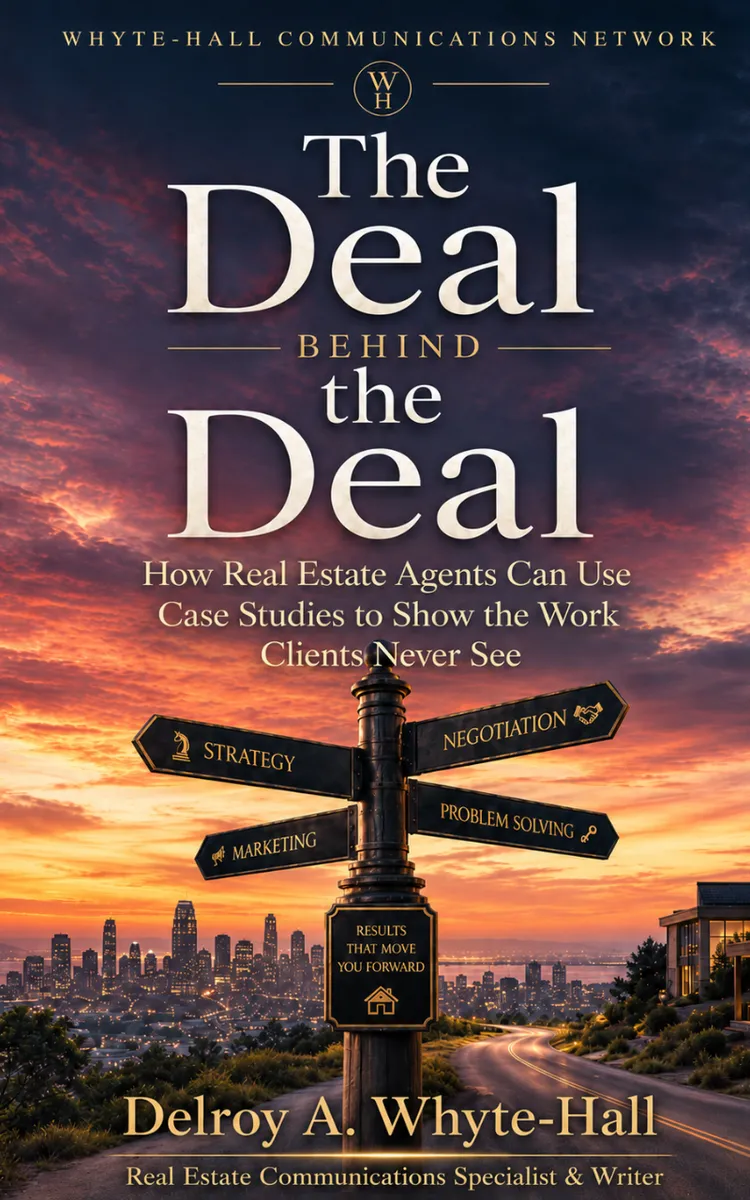
"The Deal Behind The Deal" is a how-to guide book by Delroy A. Whyte-Hall with 8 chapters and approximately 18,730 words. Using real estate case studies to explain transaction work.
This book was created using Inkfluence AI, an AI-powered book generation platform that helps authors write, design, and publish complete books. It was made with the AI Ebook Generator.
Frequently Asked Questions
What is "The Deal Behind The Deal" about?
Using real estate case studies to explain transaction work
How many chapters are in "The Deal Behind The Deal"?
The book contains 8 chapters and approximately 18,730 words. Topics covered include Why “Just Sold” Posts Fail, The Deal-Behind-Deal Fact Map, Interview Questions That Reveal Work, Protecting Privacy Without Killing Clarity, and more.
Who wrote "The Deal Behind The Deal"?
This book was written by Delroy A. Whyte-Hall and created using Inkfluence AI, an AI book generation platform that helps authors write, design, and publish books.
How can I create a similar how-to guide book?
You can create your own how-to guide book using Inkfluence AI. Describe your idea, choose your style, and the AI writes the full book for you. It's free to start.
Write your own how-to guide book with AI
Describe your idea and Inkfluence writes the whole thing. Free to start.
Start writingCreated with Inkfluence AI


