
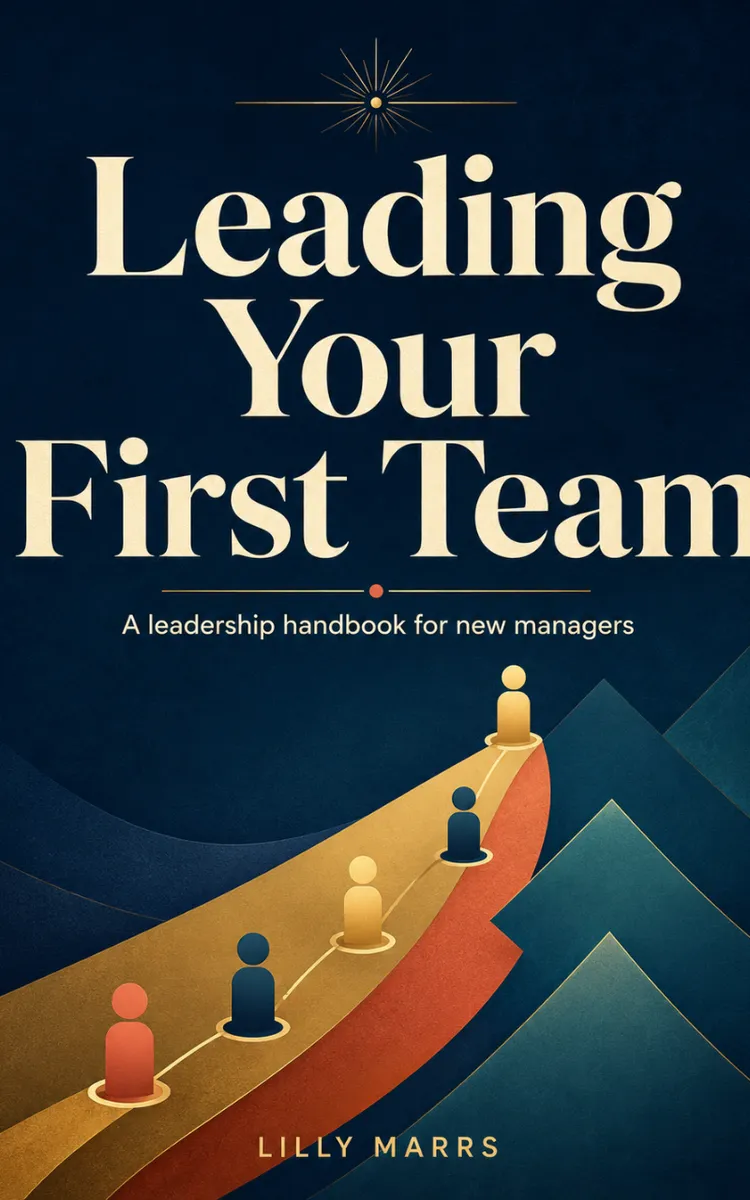

Leadership skills and practical guidance for first-time managers
Table of Contents
- 1. Your First-Team Mindset Shift
- 2. Writing Team Goals with SMART
- 3. Running Effective One-on-Ones
- 4. Delegation That Builds Ownership
- 5. Weekly Planning and Work Tracking
- 6. Giving Feedback Without Damaging Trust
- 7. Handling Conflict and Difficult Conversations
- 8. Coaching Performance with Growth Plans
- 9. Building Psychological Safety on Your Team
- 10. Leading Through Change and Scale
Preview: Your First-Team Mindset Shift
A short excerpt from “Your First-Team Mindset Shift”. The full book contains 10 chapters and 17,870 words.
When the Work Changes Overnight
On Friday, you were the person fixing the scheduling problem, answering the customer’s question, and finishing the job. On Monday, you became the manager - and people still brought every problem straight to you. The work did not simply add a new title. It changed what your time, decisions, and relationships needed to accomplish.
Many new managers struggle because they keep measuring themselves by their old job. They jump in first, correct every detail, and take back tasks when someone needs help. That approach may protect today’s result, but it prevents the team from learning and leaves the manager exhausted. The Role Reframe Ladder gives you a practical way to move from “I must do the work” to “I must help the team do good work consistently.”
By the end of this section, you will know which responsibilities belong to your new role, how to set boundaries without becoming distant, and how to make decisions with less second-guessing. Start by asking yourself one useful question: “What must happen because I am the manager, not because I am the most experienced person in the room?” Write down your answer before you continue. That answer becomes your starting point.
Climb the Role Reframe Ladder
The Role Reframe Ladder has four levels. You do not abandon your practical knowledge; you change how you apply it. A skilled technician may solve a problem in ten minutes. A manager asks why the same problem keeps appearing and helps the team prevent it.
1. Doer: Complete the task.
At this level, you focus on your own output. You measure success by whether you finished the repair, served the customer, closed the sale, or completed the shift. This level still matters when the team faces an emergency or needs a demonstration. It cannot remain your main job because your personal capacity limits the whole team.
2. Coach: Help someone else complete the task.
Instead of taking over, explain the standard, ask the employee to describe their plan, and watch enough work to give useful feedback. For example, if a new employee mislabels stock, show one correct label, explain why the details matter, and have the employee relabel the remaining items. Coaching builds skill without making you the permanent backup worker.
3. Builder: Create repeatable ways to work.
A repeatable way to work tells people what to do, when to do it, and how to check the result. This might include a closing checklist, a three-step customer handoff, or a clear rule for reporting equipment problems. Write the process in plain language and test it with someone who did not create it. If that person cannot follow it, simplify it.
4. Owner: Protect the team’s priorities and standards.
At the top level, you decide what deserves attention, explain trade-offs, and address problems early. You may need to choose between covering a shift yourself and spending an hour training two employees. If the absence creates an immediate safety risk, cover it. If the team can operate safely, use the time to strengthen the team instead of hiding the staffing problem.
The ladder helps you choose the right response. When a customer complaint arrives, do not automatically jump to the Doer level. Ask whether the employee needs a quick answer, coaching, a better process, or a decision about the team’s priorities. The right level depends on the situation.
Your new role also needs boundaries. A boundary states what you will do, what you expect from others, and when you will step in. For example: “Bring urgent safety issues to me immediately. Bring routine scheduling questions to the shared schedule before asking me. I will review unresolved items at 3:00 p.m.” This boundary protects your attention while giving the team a clear route for help.
Confidence grows from visible decisions, not from pretending to know everything. When you do not know, say, “I need to check the information before I decide. I will give you an answer by 2:00 p.m.” Keep that promise. Ask yourself at the end of each day: “Did I solve a problem, or did I help the team solve it next time?” Your answer shows which rung you used.
A First-Week Role Reframe
Consider a first-time manager taking responsibility for a six-person service team. The team has missed two morning start times, customers have waited too long for updates, and employees interrupt the manager throughout the day for small decisions. The manager wants to prove competence by handling more work personally. That choice would keep the pattern alive.
Use the following sequence during the first week.
1. List your new responsibilities on Monday morning.
Write five items that only the manager can reliably own: setting daily priorities, assigning coverage, checking safety, giving feedback, and reporting results. Then write five tasks that trained team members can handle. Expected outcome: you separate management work from work that others can perform.
2....
About this book
"Leading Your First Team" is a how-to guide book by Lilly Marrs with 10 chapters and approximately 17,870 words. Leadership skills and practical guidance for first-time managers.
This book was created using Inkfluence AI, an AI-powered book generation platform that helps authors write, design, and publish complete books. It was made with the AI Ebook Generator.
Frequently Asked Questions
What is "Leading Your First Team" about?
Leadership skills and practical guidance for first-time managers
How many chapters are in "Leading Your First Team"?
The book contains 10 chapters and approximately 17,870 words. Topics covered include Your First-Team Mindset Shift, Writing Team Goals with SMART, Running Effective One-on-Ones, Delegation That Builds Ownership, and more.
Who wrote "Leading Your First Team"?
This book was written by Lilly Marrs and created using Inkfluence AI, an AI book generation platform that helps authors write, design, and publish books.
How can I create a similar how-to guide book?
You can create your own how-to guide book using Inkfluence AI. Describe your idea, choose your style, and the AI writes the full book for you. It's free to start.
Write your own how-to guide book with AI
Describe your idea and Inkfluence writes the whole thing. Free to start.
Start writingCreated with Inkfluence AI


