
Read the first chapter
The whole of chapter one, free. About 2 min. Turn the pages with the arrows, your keyboard, or a swipe.
Chapter 1
Recognizing Social Engineering Tricks
Why Is This Cool?
Social engineering is like learning how people trick others — but you get to be the detective who spots the tricks first. When you know the common tricks, you can protect your passwords, accounts, and even your friends.
People who use social engineering rely on emotions, urgency, or trust to get information. Fun fact: many scams work because they make you act fast — panic makes good decision-making harder! Learning to recognize these tricks helps you stay calm and safe online and in real life.
Let's Practice!
Activity: Spot the Trick (10 minutes)
Quick example: 1. Message: "URGENT: Your game account will be deleted in 10 minutes! Click here to save it." Trick to spot: Creates urgency to make you click without thinking.
Now your turn: 1. Materials: paper, pencil, and a highlighter or colored pen. 2. Step 1 — Read three short messages below and highlight the phrase that feels like a trick (use your highlighter): a. "Hi, I'm from your school tech team. We need your password to fix your account." b. "You won a $50 gift card! Click to claim now." c. "Your friend sent you a private photo. Log in to view it." 3. Step 2 — For each message, write the trick type next to it (circle one): Fake authority / Urgency / Curiosity / Prize. 4. Step 3 — Decide the safe action (circle one): Reply with info / Ignore and tell a parent/teacher / Click the link / Report to platform. 5. Check your answers: a. Trick: Fake authority. Safe action: Ignore and tell a parent/teacher. b. Trick: Prize (scam). Safe action: Report to platform. c. Trick: Curiosity bait. Safe action: Ignore and tell a parent/teacher. 6. Completion: You are done when all three messages are highlighted, each trick type is written, and a safe action is chosen.
Great job if you highlighted at least one tricky phrase correctly and picked the safe action each time!
Try Something New!
• Use different colors: Highlight each trick type in a different color so you can see patterns. - Try it faster: Set a 3-minute timer and see how many trick phrases you can find without losing accuracy. - Team up: Work with a friend and compare answers, then discuss any differences.
How Did You Do?
• Did you highlight a phrase in all three messages? Yes / No - Did you name the trick type for each message? Yes / No - Did you choose a safe action for each message? Yes / No - Circle the one you did best: Highlighting / Naming tricks / Choosing safe actions
Give yourself a star if you chose the safe action for every message! ⭐
End of chapter one. 6 more chapters in the full book.
Swipe or use the arrows to turn the page

Cybersecurity Workbook For Grade 12

Cybersecurity Workbook For 11th Graders

Cybersecurity Workbook For 10th Grade
What's inside: 7 chapters
- 1. Recognizing Social Engineering Tricks
- 2. Spotting Online Scams and Frauds
- 3. Creating Strong, Secure Passwords
- 4. Protecting Your Online Privacy
- 5. Understanding Basic Cyber Ethics
- 6. Responding to Cybersecurity Threats
- 7. Evaluating Online Information Critically
About this book
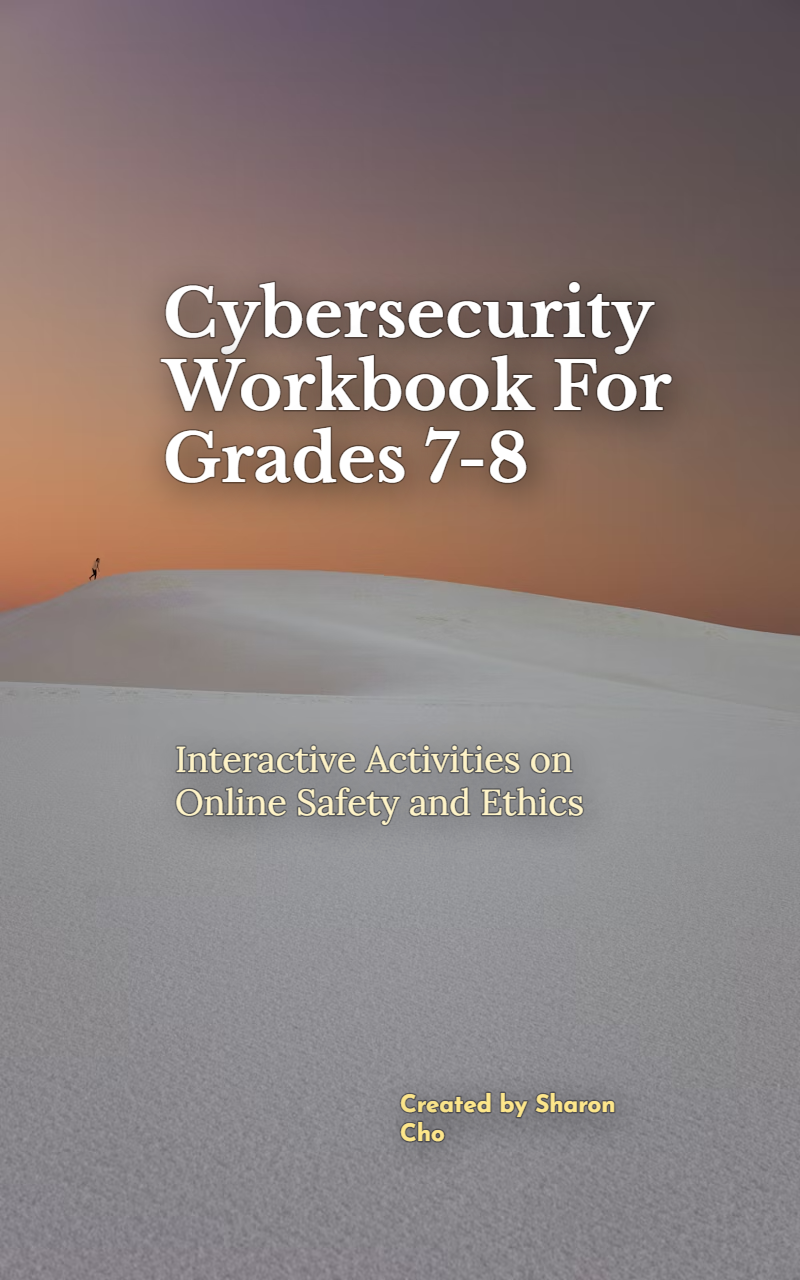
"Cybersecurity Workbook For Grades 7-8" is a workbook by Created by Sharon Cho with 7 chapters and approximately 3,241 words. Cybersecurity concepts including social engineering, scams, account security, privacy, and ethics.
This book was created using Inkfluence AI, an AI-powered book generation platform that helps authors write, design, and publish complete books. It was made with the Workbook Generator.
Frequently Asked Questions
What is "Cybersecurity Workbook For Grades 7-8" about?
Cybersecurity concepts including social engineering, scams, account security, privacy, and ethics
How many chapters are in "Cybersecurity Workbook For Grades 7-8"?
The book contains 7 chapters and approximately 3,241 words. Topics covered include Recognizing Social Engineering Tricks, Spotting Online Scams and Frauds, Creating Strong, Secure Passwords, Protecting Your Online Privacy, and more.
Who wrote "Cybersecurity Workbook For Grades 7-8"?
This book was written by Created by Sharon Cho and created using Inkfluence AI, an AI book generation platform that helps authors write, design, and publish books.
How can I create a similar workbook?
You can create your own workbook using Inkfluence AI. Describe your idea, choose your style, and the AI writes the full book for you. It's free to start.
Write your own workbook with AI
Describe your idea and Inkfluence writes the whole thing. Free to start.
Start writingCreated with Inkfluence AI


