
Read the first chapter
The whole of chapter one, free. About 4 min. Turn the pages with the arrows, your keyboard, or a swipe.
Chapter 1
Protecting Personal Data Online
Why This Matters
Your personal data is valuable. Names, birthdays, school IDs, shopping histories, location logs, and social media posts can be combined to steal identities, open fake accounts, or target you with scams. In real-world terms: a leaked email and password can let someone access your bank app within minutes, or a few location-tagged photos can reveal when your house is empty. Learning to protect personal data now saves time, stress, and money later.
This chapter builds practical habits you’ll use beyond school: creating and managing strong passwords, tightening privacy settings on apps you actually use (Instagram, Snapchat, Google), and spotting when a website or app is collecting more data than it needs. These skills fit into your larger cybersecurity journey by turning passive internet habits into active defenses — and they’re measurable. By the end, you’ll be able to audit three accounts, create a password strategy using a manager (e.g., Bitwarden), and spot at least two data-collection red flags.
Skill Builder
Goal: Audit and secure three online accounts (email, social media, and one shopping/service account) in 45–60 minutes using a password manager and privacy settings.
Materials: device you normally use, access to three accounts, a password manager (e.g., Bitwarden — free plan), and a notebook or digital notes.
Steps: 1. Install and set up a password manager (Bitwarden recommended). Create a strong master password: at least 14 characters, mix of words and symbols, one memorable sentence works. 2. For Account 1 (email): Go to Security or Account settings. Turn on two-factor authentication (2FA) using an authenticator app (Google Authenticator or Authy). Record whether 2FA is enabled. 3. For Account 2 (social media): Open Privacy settings. Set posts to “friends only” or the closest equivalent. Turn off location tagging for new posts. Record what you changed. 4. For Account 3 (shopping/service): Check saved payment methods and active devices/sessions. Remove any unknown devices and delete expired cards. Turn on purchase alerts if available. 5. For each account, generate a new unique password with your password manager and save it there. Use the manager’s generator set to at least 16 characters for banking, 12–16 for other accounts. 6. Run a quick data-collection check: on each account, find the permissions page (apps connected, data shared) and list at least one permission you revoked. 7. Record results in your notes: account name, old password strength (weak/medium/strong), 2FA status, privacy change made, permissions revoked.
Worked example: > Account: school email > Action: Enabled 2FA via Authy. Password manager created 18-character password saved to Bitwarden. Removed “Connected App: StudyTracker” which requested contact list. Completed.
What good looks like: - You enabled 2FA on your email account and authenticated at least once. - All three accounts use unique passwords stored in the password manager. - Social media privacy set to restrict public access; location tagging disabled. - At least one unnecessary third-party permission revoked per account. - You can log into each secured account using the password manager within 5 minutes.
Going Deeper
Explore variations and advanced options to match different needs:
• Strong Passwords (advanced): Use a passphrase strategy (four unrelated words + symbol + number) for accounts you access frequently. Use 20+ random characters for financial and school portal accounts. - 2FA Methods (comparison): Authenticator apps (recommended) vs. SMS (less secure) vs. hardware keys (YubiKey—most secure). Choose hardware keys for high-risk accounts like banking or college portals. - Privacy Settings by Context: For public-facing profiles (artist portfolio), allow more visibility but disable contact info and location. For dating apps, hide work and school.
Adaptation examples: - If you share a family computer, set 2FA to use an authenticator app on your phone and log out after each session. - If you organize a student club, use a dedicated email and a password manager entry specifically for club accounts to avoid cross-contamination.
Self-Check
1. Have I enabled two-factor authentication on my primary email account and verified it with an authenticator app? ________________________________________________ ______________________________________________ ________________________________________________
2. Do all three audited accounts have unique passwords saved in my password manager, and can I log in using it? ________________________________________________ ______________________________________________ ________________________________________________
3. Did I remove at least one unnecessary third-party permission from each account (name the app/service removed)? ________________________________________________ ______________________________________________ ________________________________________________
4. Is my social media privacy set so that strangers cannot see personal contact details or location-tagged posts? ________________________________________________ ______________________________________________ ________________________________________________
Criteria for success: - All answers above have specific entries (dates, app names, or “yes”) rather than vague notes. - Two-factor authentication is active on your primary email and at least one other account. - Password manager holds unique passwords for all three audited accounts and you successfully logged into one account using it during this session.
End of chapter one. 6 more chapters in the full book.
Swipe or use the arrows to turn the page

Cybersecurity Workbook For 11th Graders

Cybersecurity Workbook For 10th Grade

Cybersecurity Workbook For 9th Grade
What's inside: 7 chapters
- 1. Protecting Personal Data Online
- 2. Recognizing and Avoiding Financial Scams
- 3. Securing Devices in the Workplace
- 4. Understanding Cybersecurity Policies
- 5. Navigating Global Cybersecurity Risks
- 6. Implementing Multi-Factor Authentication
- 7. Responding to Cybersecurity Incidents
About this book
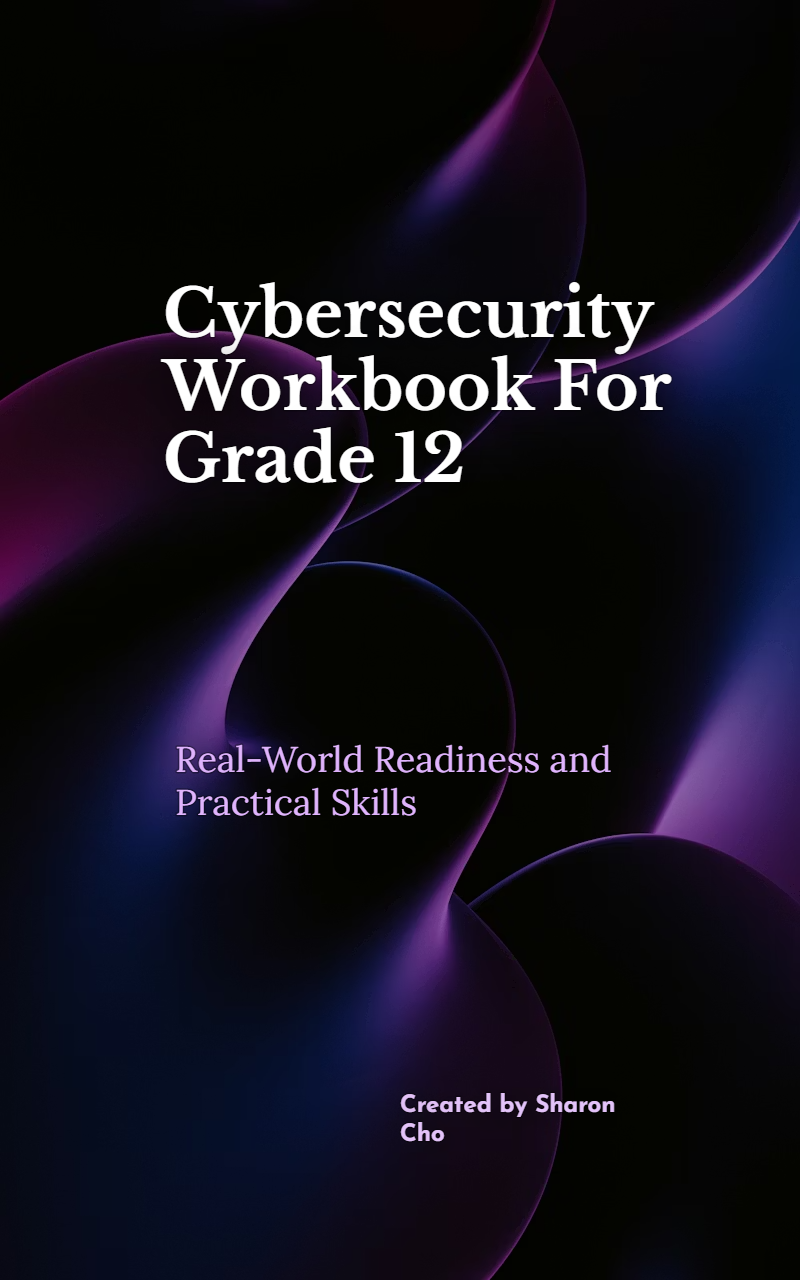
"Cybersecurity Workbook For Grade 12" is a workbook by Created by Sharon Cho with 7 chapters and approximately 5,460 words. Personal data protection, financial scams, workplace security, policy, global risk.
This book was created using Inkfluence AI, an AI-powered book generation platform that helps authors write, design, and publish complete books. It was made with the Workbook Generator.
Frequently Asked Questions
What is "Cybersecurity Workbook For Grade 12" about?
Personal data protection, financial scams, workplace security, policy, global risk
How many chapters are in "Cybersecurity Workbook For Grade 12"?
The book contains 7 chapters and approximately 5,460 words. Topics covered include Protecting Personal Data Online, Recognizing and Avoiding Financial Scams, Securing Devices in the Workplace, Understanding Cybersecurity Policies, and more.
Who wrote "Cybersecurity Workbook For Grade 12"?
This book was written by Created by Sharon Cho and created using Inkfluence AI, an AI book generation platform that helps authors write, design, and publish books.
How can I create a similar workbook?
You can create your own workbook using Inkfluence AI. Describe your idea, choose your style, and the AI writes the full book for you. It's free to start.
Write your own workbook with AI
Describe your idea and Inkfluence writes the whole thing. Free to start.
Start writingCreated with Inkfluence AI


