
Read the first chapter
The whole of chapter one, free. About 5 min. Turn the pages with the arrows, your keyboard, or a swipe.
Chapter 1
Breath Counting for Focus
Core Concept
If your mind feels like a radio that won’t stop scanning stations, breath counting is a simple way to give it one job. You count your breaths in a quiet, steady pattern while you notice the breath moving in and out. When your attention wanders (it will), you gently reset back to the next count. That “reset” part is where the focus muscle actually grows.
Here’s the core idea, broken into steps you can reuse any time: 1) Pick a counting pattern (we’ll use 1-10). 2) Count only on the exhale (this keeps things clean and measurable). 3) If you lose the count, restart at 1 when you’re ready-no scolding, just a fresh start. 4) After you reach 10, go back to 1 again.
Key takeaway: Focus isn’t “never getting distracted”-it’s noticing the slip and resetting the count quickly.
Why does this work? Counting gives your attention a border. Without a border, your mind freewheels. With counting, you still think, but your job is clear: feel the breath, count the exhale, move on. You’ll also notice mental noise changing from “loud and chaotic” to “present but not in charge.” (Also: counting is nice because it’s something you can do with almost zero setup-no bells, no incense, no special chair.)
Guided Practice
Time required: 5-8 minutes Materials needed: None (a timer is optional)
Settle somewhere you can sit or stand comfortably. Keep your posture simple-upright enough to breathe easily, relaxed enough to not feel like a human paperweight.
Breath Counting (1-10) - Your Turn 1) Take one normal breath in and one normal breath out. 2) On your next exhale, count 1 (quietly in your head). 3) Continue: exhale = 2, next exhale = 3, and so on, until you reach 10. 4) When you hit 10, pause for a single breath cycle (inhale + exhale), then restart at 1. 5) If you lose track-maybe you realize you skipped a number or your mind went on a side quest-don’t hunt for where you “left off.” Just return to the next exhale and start at 1. 6) Keep going for a total of 10 counting cycles (that’s “1-10” once, then “1-10” again is two cycles-aim for one full “1-10” plus a bit more, or two full “1-10” if you want).
Completed example (so you can copy the rhythm) > Inhale (don’t count) > Exhale: 1 > Inhale (don’t count) > Exhale: 2 > Inhale > Exhale: 3 > … > Exhale: 9 > Inhale > Exhale: 10 > (Next exhale after a reset) Exhale: 1 > …
If you want a tiny extra support, you can pair the count with a short feel cue: “exhale = the breath leaving.” That’s it-no extra steps.
Quick check (so you know you’re done) When you’ve completed either: - two full runs of 1-10 (that’s 20 counted exhalations), or - one full run of 1-10 and your timer hits 5-8 minutes,
…you’re finished with the practice part for this section.
Reset Speed (micro-skill) Now do it again, same pattern, but with one goal: notice the moment you drift, and reset sooner than last time.
1) Start the same 1-10 breath counting. 2) When you realize you’re off-count, make the reset at the next exhale (start at 1 again). 3) Count for the same length: one full 1-10 (or 5 minutes if you prefer time).
Your Turn: Write the number you reached before you first noticed you were off-count. - First lost count happened at: ______________________________
Real-World Application
You can use breath counting as a “mental pause button” in moments where your attention tends to scatter. Try it once while you’re waiting for something that normally feels annoying-like a kettle coming to a boil or a red light that turns green eventually anyway. Sit or stand still for just 60 seconds, then do 1-10 once, counting only exhalations. Expected outcome: you’ll feel your body settle first, then your thoughts stop sprinting quite as fast. You might still have thoughts, but they’ll feel farther away.
Another good spot: before a task that requires focus, like answering emails, setting up a workout plan, or starting a small project at home. Here’s a specific scenario: you’re about to open your inbox and your mind is already jumping to “what’s on fire.” Instead, do three counted exhales-count 1, 2, 3-then begin. Expected outcome: less mental clutter at the start. The first few emails or steps may still be tricky, but you’ll start with a calmer “on-ramp” instead of a chaotic launch.
And if you’re in a noisy environment, breath counting still works because it doesn’t depend on silence. At the grocery store checkout, for example, you can count exhalations quietly while you wait. You’re not trying to become a monk in public. You’re just anchoring attention. Expected outcome: fewer “lost minutes” where you realize you’ve been thinking about something else for a while. Even one completed “1-10” during a wait can help you feel more present before you move on.
Apply It (pick one real moment today): - Scenario I’ll use breath counting in: ____________________________ - I’ll do it for: ____ counted exhales (try 3 or 10) - Expected outcome (one sentence): _____________________________
Reflection
After you practice, your answers don’t need to be poetic. They just need to be honest.
1) What did you notice about your mind when you counted only on the exhale? ________________________________________________ ______________________________________________ ________________________________________________
2) When you lost the count, what did you do next-and how fast did you reset? ________________________________________________ ______________________________________________ ________________________________________________
3) Where in your day would a “1-10 reset” be most useful-start-of-task, waiting, or stressful moment? Write one specific plan. ________________________________________________ ______________________________________________ ________________________________________________
If you want momentum: in the next chapter, we’ll take this same breath-anchor idea and make it even more practical for when your attention gets pulled hard. We’ll keep it simple, measurable, and doable-even when life is doing its usual thing.
End of chapter one. 4 more chapters in the full book.
Swipe or use the arrows to turn the page
What's inside: 5 chapters
- 1. Breath Counting for Focus
- 2. Body Scan for Present Awareness
- 3. Mindful Observation of Thoughts
- 4. Loving-Kindness for Self-Compassion
- 5. Creating a Daily Mindfulness Routine
About this book
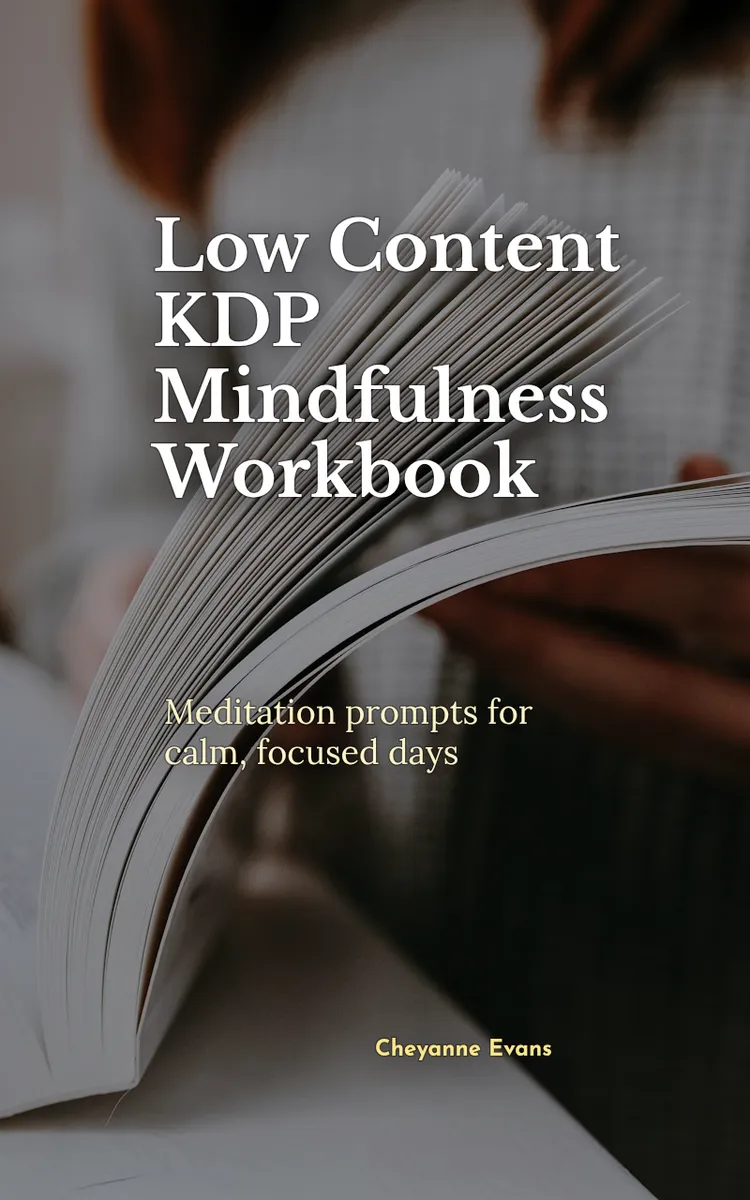
"Low Content KDP Mindfulness Workbook" is a workbook by Cheyanne Evans with 5 chapters and approximately 6,409 words. Mindfulness and meditation exercises in a workbook format.
This book was created using Inkfluence AI, an AI-powered book generation platform that helps authors write, design, and publish complete books. It was made with the Workbook Generator.
Frequently Asked Questions
What is "Low Content KDP Mindfulness Workbook" about?
Mindfulness and meditation exercises in a workbook format
How many chapters are in "Low Content KDP Mindfulness Workbook"?
The book contains 5 chapters and approximately 6,409 words. Topics covered include Breath Counting for Focus, Body Scan for Present Awareness, Mindful Observation of Thoughts, Loving-Kindness for Self-Compassion, and more.
Who wrote "Low Content KDP Mindfulness Workbook"?
This book was written by Cheyanne Evans and created using Inkfluence AI, an AI book generation platform that helps authors write, design, and publish books.
How can I create a similar workbook?
You can create your own workbook using Inkfluence AI. Describe your idea, choose your style, and the AI writes the full book for you. It's free to start.
Write your own workbook with AI
Describe your idea and Inkfluence writes the whole thing. Free to start.
Start writingCreated with Inkfluence AI


