

Read the first chapter
The whole of chapter one, free. About 9 min. Turn the pages with the arrows, your keyboard, or a swipe.
Chapter 1
The Palmer Turnoff
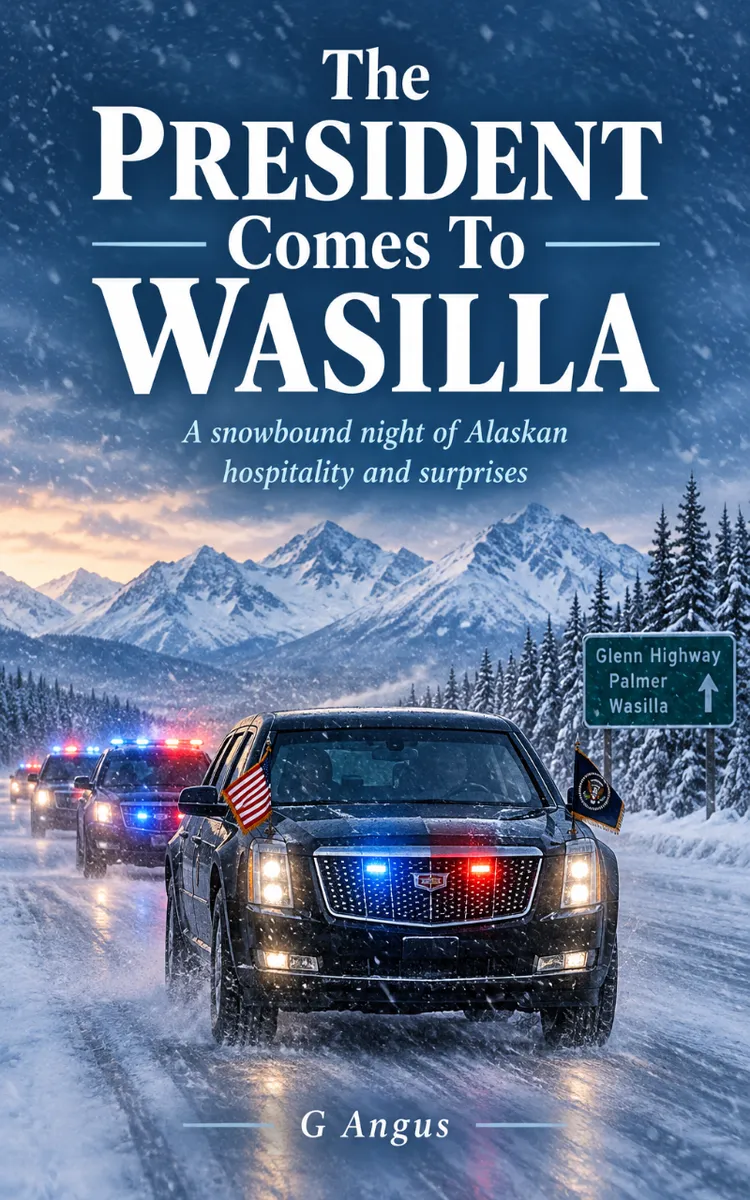
Snow struck the windshield sideways, turning the highway into a white wall with headlights.
Clifton Rodgers leaned forward in the back seat of the armored SUV, though the extra six inches gained by leaning did nothing except bring his nose closer to the glass. Ahead, the lead vehicle had become two red blurs and a revolving blue light. Behind him, the rest of the motorcade followed like a cautious line of beetles trying to cross a bathtub.
“Are we still on the road to Wasilla?” Clifton asked.
The driver, whose name Clifton had forgotten twice and was too polite to ask a third time, kept both hands on the wheel. “Technically.”
Clifton looked out at the snow. “That word has ruined many an afternoon.”
They had left Elmendorf Air Force Base less than an hour earlier, after Air Force One had delivered Clifton to Alaska beneath a sky the color of old dishwater. He was headed to Wasilla for an event supporting a United States Senate candidate, and the campaign had promised him a warm hall, a clean microphone, and a plate of something described as “regional.”
The weather had supplied none of those things.
October in Alaska had apparently decided to skip autumn and go straight to January with the enthusiasm of a man who had misplaced his coat. Snow piled along the highway shoulders. Wind shoved at the vehicles. The wipers slapped back and forth with the exhausted rhythm of a diner cook scraping a grill.
In the front passenger seat, a security agent studied a map glowing on a tablet.
“Take the next right,” he said.
The driver glanced toward the lead car. “That’s what they’re doing.”
The lead car turned.
Clifton watched the blue lights vanish into the snow.
“Wasilla?” he asked.
The agent squinted at the tablet. “That is the current intention.”
“Good. I like an intention with a destination.”
The SUV followed the turn, and the highway narrowed almost immediately. Snow swallowed the lane markings. A wooden sign appeared on the right, half-buried and tilted at an angle suggesting it had lost an argument with the wind.
The driver slowed.
“Palmer,” he read.
Clifton waited.
The driver looked at him in the mirror. “That’s not Wasilla.”
“No,” Clifton said. “But it is nearby.”
“How nearby?”
The agent tapped the tablet. The screen went dark.
“That depends,” he said.
“On what?”
“On whether the map is still with us.”
The convoy continued downhill. The road curved between snow-covered spruce, and the tires began to slide. The lead vehicle fishtailed, corrected, and stopped broadside across the lane. The SUV stopped behind it. The vehicle behind them stopped a few feet short of the SUV’s bumper.
For a moment, nobody spoke.
Then the radio crackled.
“Everybody hold position.”
The wind hammered the doors.
Clifton looked at the agent. “That sounds official.”
“It is.”
“Does it mean we’re safe?”
“It means nobody knows what else to say.”
The lead driver climbed out into the storm. He disappeared almost at once, swallowed by snow and darkness. Clifton could see only the faint shape of a man moving toward the front vehicle, one hand pressed to his hat. The hat blew away before he reached the hood.
“His hat has left the operation,” Clifton said.
The security agent opened his door.
Clifton caught his sleeve. “Where are you going?”
“To retrieve him.”
“Retrieve the man or the hat?”
The agent paused. “Both, if possible.”
He stepped out. Snow rushed into the vehicle, sharp and cold against Clifton’s face. The door slammed. Within seconds, the agent was gone too.
Clifton sat alone in the rear seat with the soft hum of the heater and the smell of wool, leather, and the emergency crackers somebody had put in the center console. He took one out. It tasted like compressed furniture.
The radio came alive again.
“Road ahead is blocked by a drift,” someone said. “We can’t continue down this grade.”
“Can we go back?” asked another voice.
A pause.
“Not safely.”
Clifton looked through the windshield at the road they had just traveled. Snow had already filled their tire tracks. The storm erased the past with impressive efficiency.
The agent returned, bringing the driver and half a hat. Snow clung to all three of them.
“Sir,” the agent said, shaking ice from his shoulders, “we need to get off the highway.”
Clifton held up the cracker. “I have supplies.”
The agent stared at it.
“I admit they’re not inspiring,” Clifton said.
The lead driver pointed through the snow. “There’s a business down the road. Lights.”
Everyone looked.
Far ahead, a yellow glow flickered behind the curtain of snow. It might have been a building. It might have been a reflection. It might have been a very determined porch light belonging to somebody who had no idea the President of the United States was approaching.
The convoy began moving again.
The lead vehicle crawled forward, tires churning. The SUV followed. Twice, it slid toward the ditch. Each time the driver corrected with a quiet curse. The vehicles behind them moved in careful fits, their engines growling and their tires throwing gray slush.
Clifton had traveled through war zones, campaign rallies, and one hotel elevator with a goat. He had never seen a road disappear so politely.
The yellow light grew brighter. A sign emerged above it, letters rimmed with snow:
THE MATSU HOTEL.
Clifton read it twice.
“That sounds promising,” he said.
The driver glanced at him. “It’s a diner.”
“Then the name is doing a lot of work.”
The Matsu Hotel stood beside the road with a broad porch, a red neon sign, and a parking lot full of snowdrifts. A pickup truck sat near the entrance with its hood raised, as if it had surrendered. The convoy pulled in crookedly. The lead car stopped at the porch. The second vehicle stopped behind it. The third vehicle attempted to stop beside them and settled at an angle that made the whole motorcade resemble a badly arranged wedding party.
A woman in a red parka burst through the diner door.
“Don’t block the plow path!” she shouted.
The lead driver stepped out. “We’re with the presidential - ”
“The plow path!” she shouted again.
He looked behind him at the vehicles.
“Which one is that?” he asked.
The woman pointed.
Everyone moved at once.
The lead car reversed three feet and slid sideways. The SUV followed, its rear tires spinning. One of the security vehicles bumped a snowbank and sent a white wave over its hood. A man in a knit cap came out of the diner carrying a shovel, saw the convoy, and immediately went back inside.
Clifton opened his door.
“Sir,” said the agent beside him, “please remain in the vehicle.”
“I’m getting out.”
“The conditions are hazardous.”
“I’ve noticed. Also, I’m hungry.”
“That is not a security justification.”
“It is a presidential one.”
He stepped onto the porch. The wind grabbed his coat, and the snow found every gap around his collar. The woman in the red parka stared at him.
“Are you Clifton Rodgers?” she asked.
“I am.”
She looked past him at the vehicles, then back at his face.
“Really?”
“I’ve been asking myself that since the last election.”
She opened the diner door wider. Warm air rolled over him, carrying coffee, onions, fried potatoes, and the deep, comforting smell of a kitchen that had been working since before daylight.
“Get inside,” she said. “Before you freeze to the porch.”
“I’m sorry to arrive without a reservation.”
“Palmer doesn’t take reservations during a blizzard.”
Inside, the Matsu Hotel was narrow and bright, with cracked vinyl booths, a counter lined with stools, and a row of framed photographs showing Palmer in years when everyone looked younger and the snow looked less personal. A woodstove ticked in the corner. Three customers sat at the counter, all of them turning to watch the President enter.
The woman in the parka shut the door against the storm.
“I’m Ruth Kalluk,” she said. “I own the place.”
“Clifton Rodgers.”
“I know who you are.”
“Good. That saves time.”
She pointed toward a booth. “Sit down.”
The President of the United States sat down.
His security detail spread through the diner with the solemn efficiency of men attempting to make a restaurant look less crowded while occupying every available corner. One agent stood beside the pie case. Another took position near the restroom. A third inspected the coat rack.
An old man at the counter watched him.
“Checking for assassins?” the old man asked.
“Coats,” the agent said.
“Same thing in October.”
Ruth came over with mugs. “Coffee?”
Clifton wrapped both hands around the cup. Heat soaked through his fingers.
“Yes, please.”
“That wasn’t a question.”
“I’m learning.”
She poured. The coffee was strong enough to stand up without furniture. Clifton took a sip and felt it remove several hours from his age.
“What can I get you?” Ruth asked.
“Whatever is easiest.”
“Nothing is easy tonight.”
“Then whatever is hardest.”
She considered him. “Moose stew.”
“I’ll have that.”
“Comes with biscuits.”
“I’ll take those too.”
“Everybody takes those too.”
The diner filled slowly as stranded motorists came through the storm. A mechanic with snow in his beard stopped at the door, saw Clifton in the booth, and backed out.
Ruth caught him by the sleeve. “You’re already here.”
“I thought this was a diner.”
“It is.”
“Why is the President in it?”
“Because the road is bad.”
The mechanic looked at Clifton. “You lost?”
“Temporarily,” Clifton said.
“Palmer’ll do that.”
Dinner arrived in mismatched bowls. The stew was hot and thick, with tender meat, carrots, potatoes, and enough pepper to make Clifton’s nose run. Ruth set down a basket of biscuits. One of the security agents took a biscuit, inspected it, and placed it back.
Clifton noticed.
“You can eat it,” he said.
The agent looked embarrassed. “I was checking it.”
“For what?”
“Unknown contents.”
“It’s a biscuit.”
“That’s what it wants you to think.”
Clifton picked up the biscuit and handed it to him. “I’ll take responsibility.”
The agent ate it in two bites.
Ruth returned with a second pot of coffee. “Road’s worse.”
“Can we get to Wasilla?” Clifton asked.
She looked toward the window. Snow streaked the glass sideways. “Not tonight.”
“I have an event.”
“You have a blizzard.”
“The event has chairs.”
“The blizzard has more.”
Clifton glanced at the clock. The campaign event was already slipping away, along with the clean microphone and the regional plate. Outside, the motorcade sat in the lot with snow gathering over its hoods. Inside, the diner’s heater rattled and the old man at the counter had begun explaining to a security agent why the agent’s boots were unsuitable for Alaska.
Ruth brought the bill.
Clifton reached for it.
“I’ve got it,” he said.
“You’ve got what?”
“The bill.”
“You don’t have to pay.”
“I insist.”
“You’re the President.”
“I still eat stew.”
Ruth pushed the bill closer. “Then sign here.”
Clifton took the pen. The paper was damp at one corner from the coffee pot. He signed quickly, using the short, practiced version of his name he used on official documents.
Ruth stared at the signature.
“That says Clifton Rodger,” she said.
“It’s a family tradition.”
“There’s an s missing.”
“It may be under the table.”
She turned the bill around and held it beneath the light. “This doesn’t look like your signature.”
“It was a difficult biscuit.”
Ruth folded her arms. “You’re telling me the President of the United States just signed my bill with a name he forgot how to spell?”
Clifton looked at the paper.
The old man leaned over from the counter. “Could be a Canadian president.”
“No,” said Ruth. “Canadian spelling would be more organized.”
The diner grew quiet. Even the security agent stopped chewing.
Clifton placed the pen down. “Ruth, I assure you, I am Clifton Rodgers.”
She studied him for a long moment, then looked through the window at the convoy, the flashing lights, and the agent standing guard over the pie case.
“Maybe,” she said. “But until I see proof, you’re still paying for the biscuits.”
Clifton smiled and reached for his wallet.
Outside, a deep mechanical groan rolled through the storm. Everyone turned toward the window.
The snowplow had arrived.
It stopped at the edge of the parking lot, raised its blade, and began pushing snow directly toward the motorcade.
End of chapter one. 32 more chapters in the full book.
Swipe or use the arrows to turn the page


What's inside: 33 chapters
- 1. The Palmer Turnoff
- 2. The Diner Door Jam
- 3. The Name on the Check
- 4. The Coat-Rack Collapse
- 5. The Moose-Sausage Question
- 6. The Soup-Tureen Spill
- 7. Who Called the Radio?
- 8. The Boot-Sized Puddle
- 9. The Presidential Napkin
- 10. The Coffee-Pot Avalanche
- 11. The Missing Plow Report
- 12. The Freezer Door Freeze
- 13. The Speech He Didn’t Give
- 14. The Campaign Banner Tangle
- 15. The Unanswered Plow Call
- 16. The Snowbanked Side Door
- 17. The Road Map’s Blank Corner
- 18. The Unsent Campaign Message
- 19. The Pancake Griddle Parade
- 20. The Wrong Road Bulletin
- 21. The Plow-Blocked Front Steps
- 22. The Borrowed Parka Problem
- 23. The Microphone Feedback Squeal
- 24. The Duplicate Route Flyers
- 25. The Quiet Table
- 26. The Drifted Access Lane
- 27. The Borrowed Mittens
- 28. The Pie-Box Route Clue
- 29. The Great Flyer Sweep
- 30. The Unamplified Thank-You
- 31. The Motorcade Mudroom
- 32. The Mittens in the Motorcade
- 33. The Pancake on Air Force One
About this book
"The President Comes To Wasilla" is a comedy book by G Angus with 33 chapters and approximately 83,145 words. A president’s snowbound motorcade finds unexpected hospitality in Palmer, Alaska.
This book was created using Inkfluence AI, an AI-powered book generation platform that helps authors write, design, and publish complete books. It was made with the AI Novel Writer.
Frequently Asked Questions
What is "The President Comes To Wasilla" about?
A president’s snowbound motorcade finds unexpected hospitality in Palmer, Alaska
How many chapters are in "The President Comes To Wasilla"?
The book contains 33 chapters and approximately 83,145 words. Topics covered include The Palmer Turnoff, The Diner Door Jam, The Name on the Check, The Coat-Rack Collapse, and more.
Who wrote "The President Comes To Wasilla"?
This book was written by G Angus and created using Inkfluence AI, an AI book generation platform that helps authors write, design, and publish books.
How can I create a similar general book?
You can create your own general book using Inkfluence AI. Describe your idea, choose your style, and the AI writes the full book for you. It's free to start.
Write your own comedy book with AI
Describe your idea and Inkfluence writes the whole thing. Free to start.
Start writingCreated with Inkfluence AI


