
Read the first chapter
The whole of chapter one, free. About 8 min. Turn the pages with the arrows, your keyboard, or a swipe.
Chapter 1
The Police Call at Dusk
The red traffic wand on Main Street blinked twice before the officer lowered it and let Gail Kampka pass.
Dusk had turned the shop windows the color of old tin, and the yellow police tape stretched from the courthouse railings to the darkened bakery door. Beyond it, a patrol car sat crooked against the curb, one front wheel pressed into the gutter. Its engine ticked as it cooled.
Gail stopped at the tape, one gloved hand resting on the handle of her cane.
“Miss Kampka?”
The officer approaching her looked younger than the worry in his face. Rain had darkened the shoulders of his uniform, though the pavement was dry. He glanced toward the patrol car, then back at her.
“Sergeant?” Gail asked.
“Sergeant Vale. Thank you for coming.”
“You said it was urgent.”
“It is.”
“That usually means someone has either disappeared or lied.”
Vale’s mouth tightened. “We have both possibilities.”
Gail looked past him. The street was empty except for two parked cruisers, a white utility van, and three people standing under the awning of the closed pharmacy. One of them was crying quietly into a folded scarf. Another kept staring at the upper windows of the brick building opposite the station.
“What happened?” Gail asked.
Vale lifted the tape for her. “Inside first. It’s warmer.”
“I want to see the street.”
His hand remained raised. “The scene hasn’t been cleared.”
“I’m not asking you to clear it.”
For a moment, the only sound was the thin hiss of the traffic signal changing at the corner.
Vale let the tape fall. “You’re not going to touch anything.”
“I rarely do.”
“You’ve been called in because we have no useful answer. That doesn’t make you police.”
“No,” Gail said, stepping beneath the tape. “It makes me the person you call when the police have no useful answer.”
The station’s front door stood open. Warm light spilled across the sidewalk, carrying the smell of wet wool, burnt coffee, and the sharp chemical trace of floor cleaner. Gail entered slowly, placing her cane where the rubber tip would not cross the chalk marks on the threshold.
Inside, the lobby had been emptied of its usual clutter. A row of plastic chairs leaned against the wall. The public counter was covered with evidence bags, notebooks, and a portable radio that muttered bursts of static. Near the holding-room door, a uniformed officer watched Gail as if she might steal something.
Vale led her through a narrow corridor.
“What disappeared?” she asked.
“A person?”
“Something.”
He did not answer.
Gail stopped.
Vale took two more steps before realizing she was no longer behind him. He turned.
“You called me here to look at a dead end,” she said. “If you want me to understand the dead end, start with the missing piece.”
His eyes flicked toward the officer by the holding room. “Not in the hall.”
“Then find a room.”
His jaw moved once. He opened the door to a small interview room. A metal table occupied most of it, with two chairs on one side and one on the other. The fluorescent tube overhead buzzed like an insect trapped in glass.
Gail chose the chair nearest the door. She set her handbag on the floor and kept her cane across her knees.
Vale remained standing.
“At six-twelve,” he said, “the alarm company received a silent alarm from the Marlowe Building.”
Gail knew the building. Everyone in town did. It stood across from the station, four stories of brick and narrow windows, once a hotel and now divided into offices. The top floor had been empty for years.
“Which office?”
“Fourth floor. Suite four-oh-two.”
“Who owns it?”
“Elias Venn. Attorney. He was out of town.”
“Was?”
“He says he left yesterday morning. His secretary says he did not.”
Gail watched him carefully. “What was in the office?”
“That is the problem.”
“People don’t call the police because a room is untidy.”
“There was a break-in. The lock was undamaged. The windows were latched from inside. No alarm code was used, but the alarm registered entry.”
“Entry by whom?”
“We don’t know.”
“Cameras?”
“Street camera caught nothing. The building camera went dark for eleven minutes.”
“Convenient.”
“Very.”
Vale pulled a photograph from a folder and laid it on the table. It showed a narrow office with a desk, two filing cabinets, and a large window overlooking Main Street. A section of carpet beside the desk had been cut away, exposing wooden floorboards. On the desk sat an open metal box.
“What was taken?” Gail asked.
“Nothing we can prove.”
“Then what was cut out?”
“The carpet was hiding a floor safe.”
Gail leaned closer to the photograph. The safe’s door stood open. Its interior was empty except for a torn strip of blue paper.
“Who found it?”
“The building’s caretaker. He heard a noise upstairs, came down to the station, and reported it.”
“He came down instead of calling from his phone?”
“He says his phone was dead.”
“And the office?”
“Locked when we arrived. We opened it with a master key.”
Gail looked up. “So the person who entered did not leave through the door.”
Vale’s expression hardened. “That is our working assumption.”
“Working assumptions are often just comfortable places to sit.”
“We searched the fire escape. Nothing. Roof access was locked. The adjoining offices are empty.”
“Empty offices still have walls.”
“We checked the walls.”
“Did you?”
His silence answered before he did.
Gail slid the photograph back toward him. “What was in the safe?”
“Venn won’t tell us.”
“Because he’s embarrassed?”
“Because he says he doesn’t know.”
“And you believe him?”
“No.”
The word came out flat and immediate. It was the first honest thing Vale had said.
A knock sounded at the door. The officer from the corridor leaned in.
“Sergeant, the caretaker is asking to leave.”
“Tell him he can wait.”
“He’s been here two hours.”
“Then he can wait two hours and five minutes.”
The officer withdrew.
Gail looked at Vale. “You have witnesses.”
“Three. The caretaker, the woman from the pharmacy, and a delivery driver who was parked outside. Their statements don’t match.”
“About what?”
“The sound.”
“What sound?”
“All three heard something from the Marlowe Building. The caretaker heard glass breaking. The woman heard a man shout. The driver heard a heavy object fall.”
“Three sounds.”
“One event, according to the clock.”
“Or three events.”
Vale rubbed his forehead. “That is what we cannot place. The alarm says someone entered at six-twelve. The caretaker says the noise came at six-fifteen. The street camera shows the building’s front door opening at six-seventeen, but no one comes out.”
Gail felt the familiar tightening behind her ribs - not fear, exactly, but the alertness that arrived when facts refused to stand in the order people had given them.
“Who opened the door?”
“We don’t know.”
“Then the camera does show someone.”
“It shows the door opening.”
“Those are not the same thing.”
Vale stared at her.
Gail stood. Her knees complained, but she ignored them. “Take me to the street.”
“You can’t go inside the perimeter.”
“Then I’ll look from outside.”
“We need to preserve the scene.”
“You need to stop treating the scene as if it ends at the tape.”
He escorted her back through the lobby. The officer near the holding room shifted aside. Gail caught the faint smell of cigarette smoke on his jacket, though smoking was prohibited inside. She filed it away without comment.
Outside, the temperature had fallen. The tape trembled in the evening breeze. Across the street, the Marlowe Building rose above the storefronts, its fourth-floor windows black and reflective.
Vale pointed to one. “Suite four-oh-two.”
Gail crossed to the edge of the taped perimeter. The pavement was gritty beneath her shoes. A small shard of glass glittered near the curb, though no window on the building appeared broken.
“Where did you find that?” she asked.
“Near the patrol car.”
“Was it bagged?”
“No. It’s outside the scene.”
“Everything outside the scene is still somewhere.”
Vale crouched and examined the shard without touching it. “It could have been there for months.”
“Then it should be easy to prove.”
He straightened. “You said you wanted to understand what we couldn’t.”
“I do.”
“Then understand this: we have no suspect, no confirmed theft, no point of entry, and a building full of locked rooms. We have a safe that was opened without a key and a camera that watched an empty doorway. That is the entire case.”
“No,” Gail said. “That is the part you’re willing to tell me.”
A patrol car radio crackled behind them.
Vale’s face changed - not much, but enough. His gaze shifted toward the station, toward the lit windows on the second floor.
Gail saw it.
“What is in the safe?” she asked.
“Nothing we can confirm.”
“That wasn’t my question.”
“Miss Kampka - ”
“What did Venn say was in it?”
Vale stepped closer, lowering his voice. “You asked whether you would take the case. I need that answer before I give you information restricted to the investigation.”
Gail looked up at the Marlowe Building. One fourth-floor window reflected the red pulse of the station sign. For an instant, the glass seemed to show a pale figure standing inside. Then the reflection shifted, and there was only an empty room.
“You want an answer before you give me the facts,” she said.
“I want to know whether you’re here to help or to make a spectacle.”
“At seventy-one, Sergeant, I have no use for spectacles. I have a use for the truth.”
“Then decide.”
Gail turned toward the taped entrance. The street had gone quiet. Somewhere behind the pharmacy, a delivery truck groaned into gear and rolled away, leaving the pavement trembling under its weight.
She thought of the photograph, the open safe, the blue paper, the door that opened for no one. She thought of the caretaker waiting inside, the three witnesses carrying three different sounds, and the shard of glass lying where no one had bothered to look.
“Give me the case file,” she said. “I’ll help.”
Vale exhaled, almost with relief. “Good.”
“But I want access to the building, the witness statements, and every recording from the cameras.”
“You’ll get what we can release.”
“No. You’ll get me what you have.”
His relief vanished.
Gail held out her hand. “The detail you’re withholding.”
Vale did not move.
“What was in the safe?” she asked.
For several seconds, the traffic signal painted his face green, then amber, then red.
Finally he said, “That is the one thing I cannot tell you.”
Gail lowered her hand.
Across the street, high above the tape, the fourth-floor window went dark. Not dim. Dark - as if someone inside had drawn a curtain across the glass.
Gail looked at Vale. “Then you haven’t asked me to solve your case.”
“What have I asked?”
She tightened her grip on her cane and stepped toward the Marlowe Building.
“To solve the part of it you’re afraid to name.”
End of chapter one. 7 more chapters and about 17,742 words in the full book.
Swipe or use the arrows to turn the page


What's inside: 8 chapters
- 1. The Police Call at Dusk
- 2. Gail’s Rules for Listening
- 3. The Locked Room That Isn’t
- 4. The Missing Detail in the Report
- 5. A Note Gail Can’t Ignore
- 6. When Gail Doubts Her Own Sight
- 7. The Evidence Swap in Plain View
- 8. Gail’s Final Clue and Closure
About this book
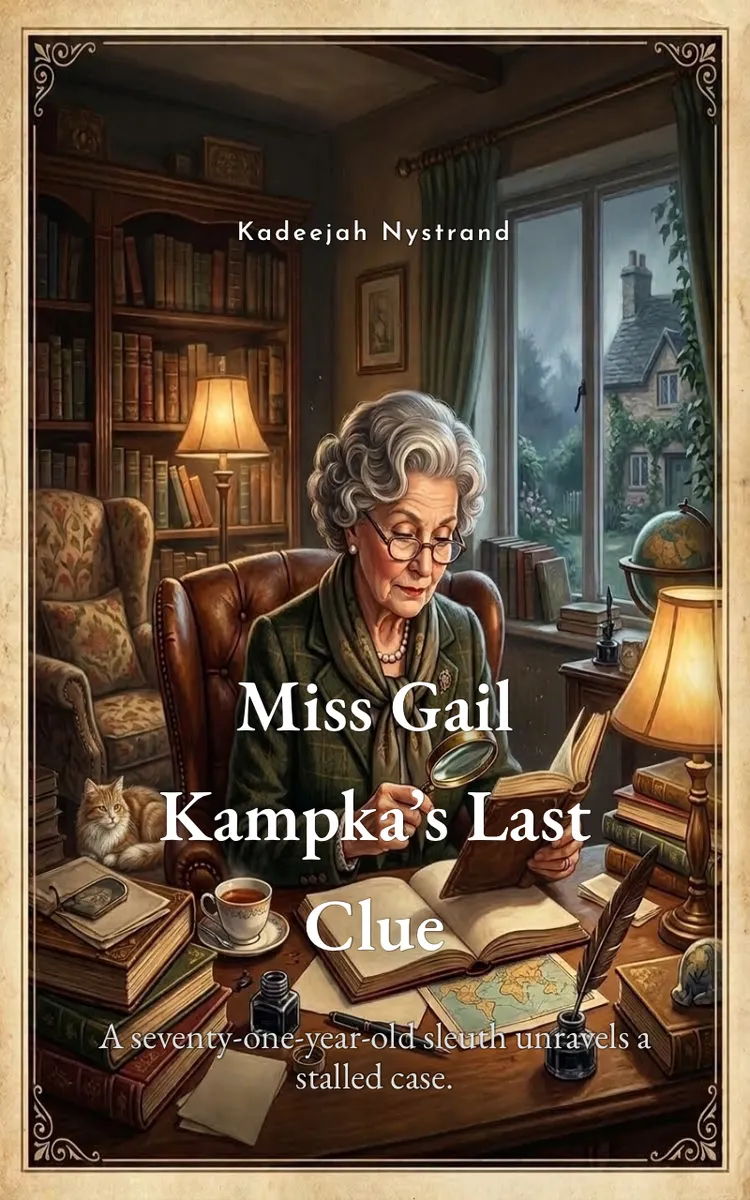
"Miss Gail Kampka’s Last Clue" is a fiction book by Kadeejah Nystrand with 8 chapters and approximately 17,742 words. An elderly amateur detective solves a police dead-end mystery.
This book was created using Inkfluence AI, an AI-powered book generation platform that helps authors write, design, and publish complete books. It was made with the AI Novel Writer.
Frequently Asked Questions
What is "Miss Gail Kampka’s Last Clue" about?
An elderly amateur detective solves a police dead-end mystery
How many chapters are in "Miss Gail Kampka’s Last Clue"?
The book contains 8 chapters and approximately 17,742 words. Topics covered include The Police Call at Dusk, Gail’s Rules for Listening, The Locked Room That Isn’t, The Missing Detail in the Report, and more.
Who wrote "Miss Gail Kampka’s Last Clue"?
This book was written by Kadeejah Nystrand and created using Inkfluence AI, an AI book generation platform that helps authors write, design, and publish books.
How can I create a similar fiction book?
You can create your own fiction book using Inkfluence AI. Describe your idea, choose your style, and the AI writes the full book for you. It's free to start.
Write your own fiction book with AI
Describe your idea and Inkfluence writes the whole thing. Free to start.
Start writingCreated with Inkfluence AI


