
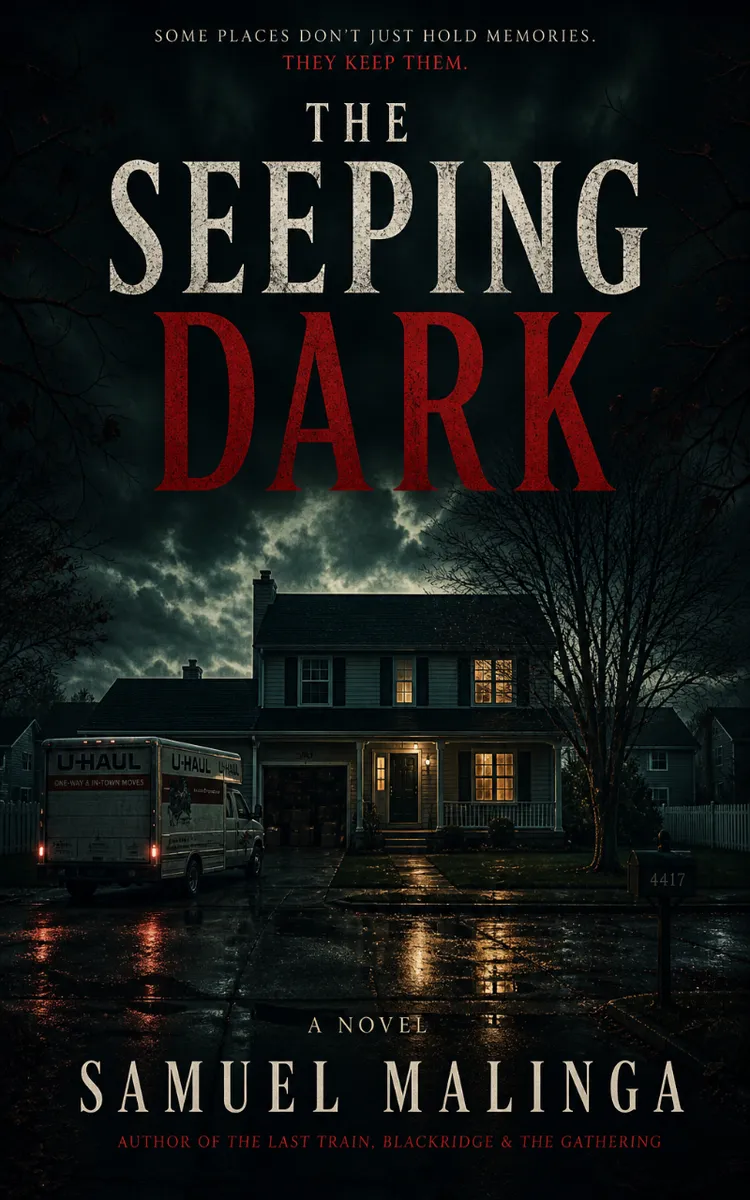

Read the first chapter
The whole of chapter one, free. About 12 min. Turn the pages with the arrows, your keyboard, or a swipe.
Chapter 1
The Day They Arrived
Tuesday, October 14th —
The U-Haul hit the pothole on Miller's Creek Road at exactly forty-one miles an hour, and Claire Pendelton heard the coffee maker shatter against the inside of the truck's aluminium wall. She didn't turn around. She didn't need to. She had packed that coffee maker herself—wrapped it in three towels and two bedsheets, tucked it into a corner behind the boxed-up winter coats—and she had known, the moment Arthur swung the wheel to avoid the hole, that it was gone.
"That was the Cuisinart," she said quietly, staring out the passenger window at the bare, brown fields rolling past.
Arthur didn't take his eyes off the road. His hands were at ten and two on the steering wheel of their 1978 Ford LTD, the way he always drove, the way his father had taught him back in Homestead before the mills started closing.
"I'll buy you a new one," he said.
"It was a wedding gift. From your mother."
"I'll buy you two new ones."
Claire laughed. She actually laughed. It came out before she could stop it—a short, surprised sound, like a hiccup—and Arthur grinned, and for a moment the two of them were just people in a truck, moving toward something, and the coffee maker didn't matter.
"Your mother's going to kill you," Claire said.
"My mother's going to kill me anyway. She still hasn't forgiven me for selling the Camaro."
"You didn't sell the Camaro. You traded it."
"Same thing."
"Arthur, you traded a 1969 Camaro for a station wagon."
"A station wagon with a V8."
Claire shook her head and looked out the window. The fields were giving way to something else now—neat rows of nearly identical houses, each one a muted shade of beige or grey or pale yellow, each one sitting on a flat rectangle of green lawn that looked like it had been laid down with a ruler. Sycamore Ridge Development. The signs were everywhere, nailed to wooden posts at every intersection: white background, green lettering, a small drawing of a tree that looked like it had been drafted by someone who had never actually seen a tree.
"Mommy, I have to pee."
Lily's voice came from the back seat, small and urgent, the way it always did when she had been holding it too long because she didn't want to interrupt whatever was happening in the front seat. She was sitting in her car seat—which was too small for her now but which Claire couldn't bring herself to replace because Lily had slept in it as a baby and it still smelled faintly of the Johnson's baby lotion they used to use before they switched to the cheaper brand from the Giant Eagle on Route 22.
"Honey, we're almost there. Five minutes."
"But I have to pee now."
"You can hold it. You're a big girl."
"I'm six."
"Six is very big."
"It's not that big."
Ethan didn't look up from his Walkman. He had the foam headphones clamped over his ears, the cord disappearing into the pocket of his army jacket—a real army jacket, not a fashion one, that he'd found at the Goodwill in Monroeville for three dollars. He was fourteen and had recently decided that speaking to his family was a form of collaboration with the enemy. The Ramones were playing at a volume that Claire could hear through the headphones, a thin, tinny buzzing that sounded like angry wasps trapped in aluminum foil. She didn't ask him to turn it down. She had learned, over the past six months, to choose her battles with Ethan the way a general chooses terrain: very carefully, and only when the advantage was hers.
Arthur slowed the truck as they entered the development proper. The street widened, and suddenly there was more to see than sky and field. The first house on the right was a pale yellow ranch with a blue minivan in the driveway and a Big Wheel tricycle upside down on the lawn. Next to it, a grey two-story with American flags in the front window—not one flag, but three, different sizes, arranged in the window like a patriotic still life. After that, a beige house with a wind chime on the porch that was moving in the breeze, making a thin, scattered sound like someone dropping coins on a glass table.
There were people. That was the thing Claire noticed—not the houses, not the lawns, but the people. A man in khaki shorts and knee pads was edging his sidewalk with a half-moon tool, working his way down the concrete in slow, careful strokes. A young woman in a jogging suit was pushing a stroller along the sidewalk on the opposite side of the street, and the stroller had one of those little plastic rain hoods on it, even though it wasn't raining. A kid on a red bicycle came out of a driveway without looking, wobbled across the street, and disappeared around a corner. A blue pickup truck passed them going the other direction, and the driver—a man with a bushy moustache and a Pittsburgh Pirates cap—gave them a nod that Arthur returned.
This was not the country. Claire had grown up in Swissvale, which was a neighborhood, a real neighborhood with row houses and corner stores and Mrs. Kowalski on the first floor who played Polish music on Sundays with her windows open. This was not that. But it was not nothing, either. It was not the empty nowhere she had been afraid of when Arthur first showed her the listing and she'd said there's nothing out there and he'd said there's going to be something, that's the whole point, we're getting in before it's finished.
He was right. He'd been right. There was something here. It was new, and it was thin, and it didn't have the weight of a place that had been lived in for fifty years—but it was there. A mail truck—white, with the USPS eagle on the side—was stopped at the end of the block, and the mail carrier, a heavy woman with a ponytail, was shoving letters into a box with the mechanical efficiency of someone who had done this ten thousand times. A dog—a tan mutt with floppy ears—was watching her from behind a chain-link fence two houses down, its tail going back and forth in a slow, lazy rhythm. Someone's radio was playing, somewhere behind one of the houses, too faint to identify the song but close enough to hear the bass line thumping through the walls.
They passed a woman kneeling in her front yard, planting tulip bulbs. She looked up as the U-Haul went by and raised one gloved hand and called out, "Welcome to Sycamore Ridge!" Her voice was bright and automatic, the kind of voice that had said the same thing to other moving trucks, other families, other people who were new and didn't know anybody yet.
Claire waved back and said, "Thank you!" and the woman smiled and went back to her bulbs, and that was the whole thing. Nothing more to it.
"What did she say?" Arthur asked.
"She said welcome."
"Oh. That was nice."
"It was."
Lily whimpered again. Claire turned around in her seat. "Lily, honey, I know. Two more minutes."
"I don't have two more minutes."
"One more minute."
"You said two a minute ago."
"I know. I'm estimating."
"I don't know what estimating means."
"It means I'm guessing and I might be wrong."
"You're definitely wrong."
Claide looked at Arthur. Arthur looked at Claire. They both suppressed the same smile, because laughing at Lily when she was in distress—even the small, non-emergency distress of a full bladder—was the kind of thing that felt cruel in the moment but hilarious in retrospect, and they both knew it.
"This is us," Arthur said, turning onto Sycamore Lane.
The street curved gently to the left. The houses here were slightly more spread out, the lots a little wider, as if the developer had started running out of room and decided to space things out so it didn't look cramped. Number 4409 had a swing set in the backyard—a metal one, the kind with the yellow plastic seats that burned your legs in the summer. Number 4413 had a birdbath shaped like a mushroom, and the birdbath was empty but had a layer of leaves and twigs in the bottom of it, which meant someone hadn't cleaned it out in a while, which meant someone was busy, which meant someone was living a life that had nothing to do with the Pendeltons, and Claire found that strangely comforting.
A station wagon—a tan Chevy Malibu, late seventies, with wood panelling on the sides—pulled out of a driveway across the street and went past them in the opposite direction. The driver was an older man with glasses, and he glanced at the U-Haul with the brief, incurious look that people give to moving trucks, the look that says new neighbors and then moves on to something else.
Number 4417 was the fourth house on the left.
Arthur pulled the truck to a stop in the driveway, and Claire looked at the house, and she felt it—the thing she hadn't expected to feel. Not relief, exactly. Something wider than that. Something that started in her chest and spread outward through her arms and into her fingertips. It was the feeling of looking at something and thinking this is ours. Their house. Their lawn. Their maple tree in the front yard with the leaves half-turned, orange bleeding into green at the edges. Their two-car garage with the door that actually worked. Their porch with the rocking chair that someone had left behind.
It was a two-story colonial, white siding, green shutters, black shingled roof. It looked exactly like the photograph in the listing. Exactly like the photograph in the brochure. Exactly like every other house on the street.
And Claire did not care. Not even a little. Because it was theirs, and Arthur had found it, and they could afford it, and she was going to make it into something that didn't look like a brochure at all.
"It's nice," she said.
Arthur killed the engine. He sat there for a moment, both hands still on the wheel, staring at the house through the windshield. He had a way of doing that—staring at things he was proud of without saying anything, as if the act of looking was a kind of prayer. Claire had seen him do it with the bookshelf he built for Ethan's room when Ethan was four, and with the turkey he deep-fried for Thanksgiving in 1979, and with Lily the night she was born, standing in the hospital corridor looking through the nursery window at this red-faced, screaming creature wrapped in a white blanket, and Claire had known, in that moment, that Arthur Pendelton loved things the way some people love God: silently, completely, and with the understanding that the object of that love could be taken away at any moment.
"Dad," Ethan said, pulling one side of his headphones off. "Are we there, or are we just sitting in the driveway for the rest of our lives?"
Arthur blinked. He looked at Ethan in the rearview mirror. "We're here, buddy."
"I'm not your buddy."
"Right. Sorry."
Claire opened her door and stepped out onto the sidewalk. The air was cool and clean, carrying the smell of cut grass and damp earth and, faintly, someone's dinner—something with garlic, simmering somewhere close by. Down the block, a lawnmower started up, then sputtered, then caught, and then settled into the steady, familiar putter that Claire had heard every Saturday of her childhood, her father pushing the old Lawn-Boy around the tiny square of grass behind their row house on Chatham Street.
She took a breath and let it go.
Lily scrambled out of the back seat, Mr. Buttons dangling from her fist, and did a little dance on the sidewalk.
"Mommy. Mommy. Bathroom."
"Inside, sweetheart. Door's unlocked. It should be on the—"
Lily was already gone, pushing through the front door, her small feet slapping the floor. Claire heard her run across the living room, heard her fumble with a door, heard the toilet seat clatter up, and then—blessed silence.
Ethan opened his door and stepped out. He stood next to the truck for a moment, one headphone off, looking at the house. Then he reached into the back seat, grabbed his duffel bag—army green, monogrammed with his initials that Claire had sewn on herself the Christmas before last—and slung it over his shoulder without a word.
"Ethan," Arthur said. "There are boxes in the back that need—"
"I'm gonna find my room."
He walked past the rocking chair, past the front door, and disappeared inside. His footsteps went up the stairs. A door opened. A door closed.
Arthur looked at Claire.
"He'll come around," she said.
"Sure."
"He will."
"Sure."
They stood there for a moment, the two of them, in the driveway of their new house, with the U-Haul humming behind them and the kid down the street still bouncing his basketball and the lawnmower running and someone's garlic dinner filling the air and the whole ordinary Tuesday afternoon of Sycamore Ridge unfolding around them like it had been unfolding long before they got there and would go on unfolding long after.
"Alright," Arthur said, clapping his hands together once. "Let's get the mattresses in first. Then the kitchen stuff. Then we can figure out the rest."
"Coffee maker's in pieces."
"I know."
"It's in pieces, Arthur."
"I know. I heard it. Tonight I'll go to the Hills and get a new one. The one you wanted—the Mr. Coffee with the timer."
"We can't afford the one with the timer."
"We can now."
Claire looked at him. "What do you mean, we can now?"
Arthur shrugged. He was already walking to the back of the truck. "Turns out the school district pays a little more than I thought. Got the adjusted scale in the mail last week. It's not a lot. But it's enough for a coffee maker with a timer."
Claire stood there on the driveway, watching him lower the ramp. She wanted to say something. She wanted to say why didn't you tell me or are you serious or I love you, you ridiculous man. What she said was: "I want the white one, not the avocado."
"There is no white one."
"There's a white one in the catalog. Page fourteen."
Arthur pulled the first box—mattresses, wrapped in heavy plastic—onto the dolly. "Fine. The white one."
They carried the mattresses in together, Claire walking backward up the porch steps, Arthur guiding the dolly from behind, both of them grunting and laughing when the box caught on the doorframe and they had to shove it through. The living room was bright with late afternoon sun, and the carpet was the color of sand, and there were no curtains on the windows yet, and the neighbors across the street could see straight in, and none of that mattered because they were carrying mattresses into their own house and Lily was upstairs somewhere and Ethan was upstairs somewhere and this was happening, it was actually happening, the thing they had talked about for six months was now a thing that was happening on a Tuesday in October.
Arthur set his end of the box down and wiped his forehead with the back of his hand.
"Not bad," he said, breathing hard. "Two more of these, the couch, the kitchen boxes, and we're done for the day."
"It's four o'clock."
"So?"
"So it's four o'clock and we have an entire house to unpack."
"So we'll do some today and some tomorrow and some the next day. It's not a race, Claire."
Claire looked around the empty living room. The walls were white. The carpet was sand-colored. The windows were big and let in a lot of light. There was an electrical outlet on the far wall with nothing plugged into it. There was a small scuff mark on the baseboard near the stairs that looked like it had been made by a shoe.
It was perfect. Not because it was beautiful—it wasn't, not yet—but because it was blank, and blank meant possibility, and possibility was something Claire Pendelton had not had enough of in the last few years.
"Okay," she said. "Let's get the other mattresses."
And they did.
End of chapter one. 10 more chapters in the full book.
Swipe or use the arrows to turn the page


What's inside: 11 chapters
- 1. The Day They Arrived
- 2. The First Night
- 3. First Day
- 4. The Basement
- 5. The Shop
- 6. Chapter 6
- 7. The Hallway
- 8. The News
- 9. The Women
- 10. The Afternoon
- 11. Two-Seventeen A.M.
About this book
"THE SEEPING DARK" is a general book by Malinga Protea with 11 chapters and approximately 42,060 words. It covers key insights and practical takeaways on the topic.
This book was created using Inkfluence AI, an AI-powered book generation platform that helps authors write, design, and publish complete books.
Frequently Asked Questions
What is "THE SEEPING DARK" about?
"THE SEEPING DARK" is a general book by Malinga Protea covering key insights and practical takeaways on the topic.
How many chapters are in "THE SEEPING DARK"?
The book contains 11 chapters and approximately 42,060 words. Topics covered include The Day They Arrived, The First Night, First Day, The Basement, and more.
Who wrote "THE SEEPING DARK"?
This book was written by Malinga Protea and created using Inkfluence AI, an AI book generation platform that helps authors write, design, and publish books.
Write your own book with AI
Describe your idea and Inkfluence writes the whole thing. Free to start.
Start writingCreated with Inkfluence AI


