
Read the first chapter
The whole of chapter one, free. About 7 min. Turn the pages with the arrows, your keyboard, or a swipe.
Chapter 1
Rewriting Your Identity After Gaslighting
self-image—youWhen His Voice Follows You Into the Library
At 10:47 p.m., after a full shift and a two-hour lecture, Tasha sat in her car with her laptop balanced on the steering wheel. Her son was asleep in the back seat. On the screen was a draft for school, and in her phone were three messages from her former partner: You always ruin everything. You’re not smart enough to finish. Your son deserves better.
Her finger hovered over the delete button. Not for the messages. For her assignment.
Then she noticed what was happening. His words had followed her from the relationship into her car, her classroom, her paycheck, and the way she looked at herself. She opened the document again and changed one sentence. Not because she suddenly felt confident, but because the sentence was hers.
The crossroads wasn’t between failure and success. It was between living from his story and beginning to write from her own.
Three Lives, One Stolen Mirror
The Missed-Drop-Off Trap. Nia worked mornings and took evening classes. When her former partner arrived late to collect their son, she missed a quiz while trying to sort out the chaos. He called her “irresponsible” afterward. For days, she treated one missed quiz like proof that she couldn’t manage college.
The Performance Review Echo. Carmen received a fair review at work with two areas to improve. Her manager’s words were specific and useful. Still, Carmen heard her ex saying, “You can’t do anything right.” She spent the weekend rewriting every email before sending it, afraid a normal mistake would expose her as a fraud.
The Quiet-Success Problem. Jada completed a difficult course while working full-time and parenting alone. She earned a strong grade but brushed it off: “The class was easy.” She could remember every criticism from her former partner, yet struggled to remember one thing she had done well.
• Each woman measured herself through someone else’s judgment.
• Ordinary setbacks became evidence of a permanent flaw.
• Their real accomplishments felt smaller than the abuse.
• The narcissist’s narrative had become an automatic inner narrator.
What these women needed wasn’t a prettier version of the same old mirror. They needed a new way to decide what counted as evidence about who they were. That’s the purpose of the Identity Reclaim Map: separating his narrative, the facts, your values, and your next choice.
The map doesn’t ask you to pretend the relationship didn’t hurt. It helps you stop using the person who hurt you as the official source of your identity. A late assignment may be a late assignment. It isn’t a character verdict. A difficult workday may need a plan. It doesn’t mean you’re incapable.
Your worth was never a grade, a paycheck, a calm co-parenting exchange, or his approval. Those things can matter deeply. They still don’t get to define the whole of you.
Why His Story Feels Like Your Own
Gaslighting works by making you question your memory, judgment, and emotional responses. Over time, your mind may begin checking his version before checking reality. You hear, “You’re too sensitive,” and then apologize for being hurt. You hear, “You’re lazy,” and push through exhaustion until your body forces a stop.
This is why rebuilding your self-image can feel strangely uncomfortable. A stable identity requires repetition. If criticism was repeated every day, your brain learned to expect it. A single positive thought may feel fake at first—not because it’s untrue, but because it’s unfamiliar.
Your life also gives you very little quiet space to sort this out. You’re clocking in, answering discussion posts, packing lunches, paying bills, and trying to remember whether the permission slip is due tomorrow. When you’re tired, the harshest explanation often arrives fastest. “I’m failing” takes less energy than carefully asking, “What actually happened, and what does it mean?”
The Identity Reclaim Map slows that rush. When shame appears, write four short lines:
• His narrative: What did he say or imply about me?
• The facts: What can I verify about what happened?
• My values: What kind of woman and mother am I trying to be?
• My next choice: What is one action that matches those values?
You may need this work if:
• You hear his insults in your head while studying or working.
• One mistake makes you question your entire ability.
• You dismiss achievements but collect criticism like evidence.
• You make decisions mainly to avoid being called selfish, difficult, or incapable.
His voice may be familiar, but familiarity is not truth; your worth must be measured by reality, values, and repeated choices—not by the person who tried to shrink you.
Put Your Experience on Paper Without Editing Yourself
Use these prompts in a notebook, a notes app, or the back of a printed class schedule. Don’t aim for beautiful answers. Aim for honest ones.
• What exact message about yourself did he repeat most often, and where does it show up now?
You might write, “He said I was unreliable. Now, when my son is late for school, I feel like a bad mother even if I handled the problem responsibly.” Naming the message helps you recognize it as something learned, not something born inside you.
• What happened recently, and what did you decide it meant about you?
Separate the event from the identity judgment. “I missed a deadline because my childcare canceled” is different from “I can’t handle anything.” The first statement can lead to a plan. The second only creates shame.
• Which three facts prove you are functioning under pressure, even imperfectly?
Be specific: “I worked an eight-hour shift, submitted my paper late but completed it, and made dinner for my son.” Facts matter because gaslighting trained you to overlook them.
• What value do you want your next decision to show?
Maybe it’s honesty, stability, patience, courage, or responsibility. If your value is stability, your next choice might be turning off a hurtful message and finishing twenty minutes of schoolwork instead of arguing.
• What accomplishment have you minimized because celebrating felt unsafe?
Write the accomplishment without adding “but.” You finished the semester. You found a new job. You created a peaceful bedtime routine. Let the sentence stand on its own.
The Seven-Day Identity Reclaim Map Challenge
Challenge name: Seven Days of Evidence
Difficulty level: Gentle but emotionally challenging—about 10 minutes a day.
For seven days, you’ll collect proof from your real life. Not proof that you’re perfect. Proof that the narcissist’s description was incomplete and often untrue.
• Day 1 - Catch the voice. Write down one self-critical thought exactly as it appears. Add: “This sounds like his narrative, not a verified fact.”
• Day 2 - Record the facts. Choose one stressful event from work, school, or parenting. Write only what happened, without labels such as lazy, crazy, or incapable.
• Day 3 - Name your value. Pick one value that guided you today. Maybe you kept your promise, asked for help, or protected your study time.
• Day 4 - Credit the effort. List three tasks you completed, including ordinary ones. Packing lunches and attending class count. Your life is built from ordinary things.
• Day 5 - Make one aligned choice. Do one small action your values support, such as submitting an assignment, setting a communication boundary, or resting instead of proving yourself.
• Day 6 - Answer the old accusation. Write the accusation on one side of the page. On the other, write a calm response based on evidence. “I’m not careless. I’m overloaded, and I’m creating better systems.”
• Day 7—Draw your map. Review the week and write one sentence for each part: his narrative, the facts, your values, and your next direction.
Celebrate when...
• You notice an insult before accepting it as truth.
• You describe a problem without attacking your identity.
• You name at least one accomplishment without minimizing it.
• You make one decision from your values instead of fear.
Some days, the win may be opening the notebook while your son watches cartoons and your laundry waits. That still counts. You’re practicing a new way to see yourself in the middle of a very full life.
Your Worth Belongs to You
Your identity is not the story the narcissist told about you; it is the pattern of truthful choices you keep making while rebuilding your life.
• You learned to separate his narrative from verifiable facts.
• You saw why repeated criticism can feel like an inner truth.
• You used the Identity Reclaim Map to connect facts, values, and action.
• You began gathering daily evidence of your strength without demanding perfection.
You don’t have to feel completely confident before you trust yourself again. Trust grows each time you notice the old voice, check the facts, and choose what reflects who you are becoming. With that steadier ground beneath you, you can begin reclaiming more than your self-image - you can reclaim your decisions, your boundaries, and the future you’re building for yourself and your son.
End of chapter one. 4 more chapters in the full book.
Swipe or use the arrows to turn the page
What's inside: 5 chapters
- 1. Rewriting Your Identity After Gaslighting
- 2. Building Boundaries Without Guilt
- 3. Escaping the Trauma-Perfection Trap
- 4. Rebuilding Trust Through Self-Advocacy
- 5. Choosing Purpose Over Hypervigilance
About this book
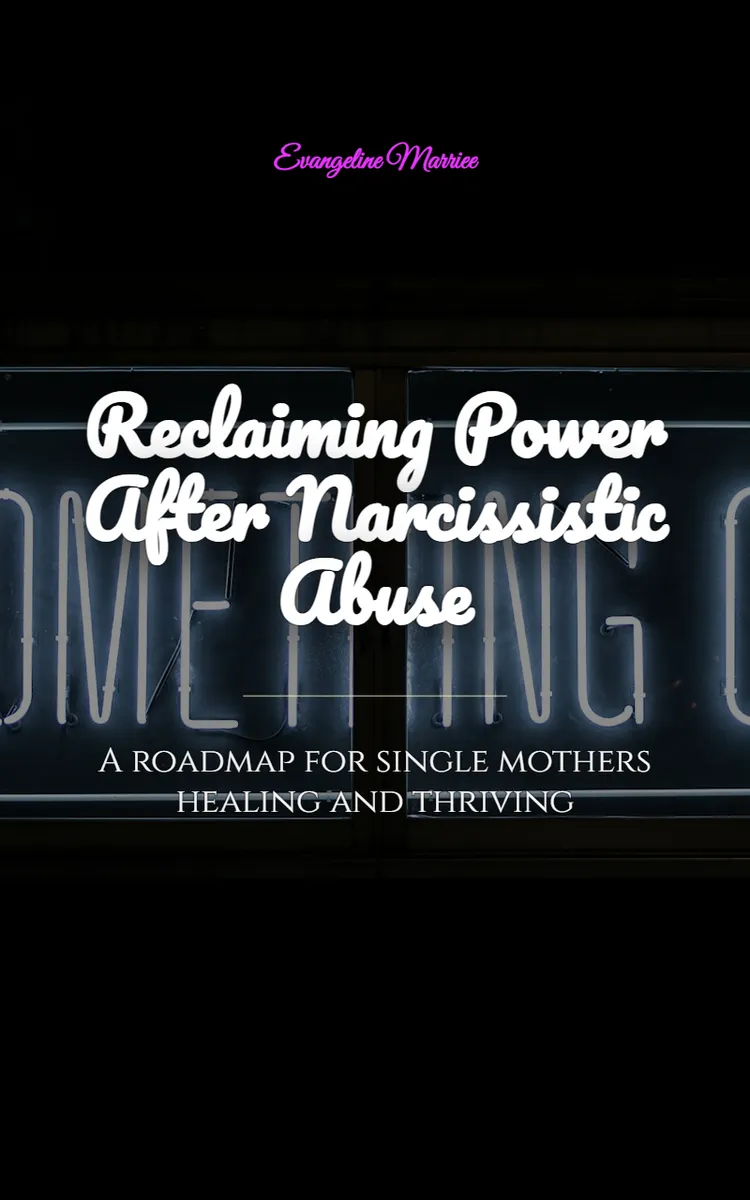
"Reclaiming Power After Narcissistic Abuse" is a self-help book by Evangeline Marriee with 5 chapters and approximately 7,394 words. Healing from narcissistic abuse while rebuilding life as a single mother.
This book was created using Inkfluence AI, an AI-powered book generation platform that helps authors write, design, and publish complete books. It was made with the AI Self-Help Book Writer.
Frequently Asked Questions
What is "Reclaiming Power After Narcissistic Abuse" about?
Healing from narcissistic abuse while rebuilding life as a single mother
How many chapters are in "Reclaiming Power After Narcissistic Abuse"?
The book contains 5 chapters and approximately 7,394 words. Topics covered include Rewriting Your Identity After Gaslighting, Building Boundaries Without Guilt, Escaping the Trauma-Perfection Trap, Rebuilding Trust Through Self-Advocacy, and more.
Who wrote "Reclaiming Power After Narcissistic Abuse"?
This book was written by Evangeline Marriee and created using Inkfluence AI, an AI book generation platform that helps authors write, design, and publish books.
How can I create a similar self-help book?
You can create your own self-help book using Inkfluence AI. Describe your idea, choose your style, and the AI writes the full book for you. It's free to start.
Write your own self-help book with AI
Describe your idea and Inkfluence writes the whole thing. Free to start.
Start writingCreated with Inkfluence AI


