
Read the first chapter
The whole of chapter one, free. About 11 min. Turn the pages with the arrows, your keyboard, or a swipe.
Chapter 1
The Locked Courtyard
The gate slammed shut just as Kate reached it.
Her suitcase struck the iron bars with a hollow clang, its wheels skidding sideways over the wet stones. She caught the handle before it tipped, then turned and seized the latch.
It did not move.
“No,” she said, breathless. “No, no - ”
On the other side of the gate, the narrow passage led back toward the Marais, toward the street she had left less than five minutes earlier. The man who had closed it was already gone. Kate could hear his footsteps fading beneath the first low roll of thunder.
She pulled the latch again. The metal bit into her palm.
Across the courtyard, an archway opened onto another lane, but its wooden door stood shut. High walls surrounded her on every side, their pale plaster stained with age and rain. A fig tree leaned over one corner, its leaves trembling in the warm wind. Somewhere nearby, a radio played a bright, tinny song, absurdly cheerful against the darkening sky.
Kate looked at her watch.
Her rented room was twelve minutes away - if she found the right street. The woman who had given her the key had warned her twice not to be late. The courtyard gates closed at nine, she had said, with the severe patience of someone accustomed to foreigners arriving with maps and optimism.
Kate had nodded as though she understood Paris already.
Now the first drops of rain struck the stones.
She dragged the suitcase away from the gate and tried the archway. The door held fast. She pushed harder, then braced one shoulder against it. Damp wood pressed into her collarbone.
“Open,” she muttered. “Come on.”
The door did not open.
Rain thickened, tapping against the leaves and darkening the shoulders of her blouse. Kate stepped back, looking up. The walls were too high to climb in the rain, but not impossible. A drainpipe ran beside the archway, ending just above a stack of old wooden crates.
She set her suitcase beneath it and tested the first crate with her foot. It shifted dangerously.
“Excellent,” she whispered. “A fatal first evening.”
“Planning to sue the courtyard?”
The voice came from behind her.
Kate spun around.
A man stood beneath the covered passage by the locked gate, one hand resting on the iron bars. He had appeared so quietly that for a second she wondered whether the rain had made him. He wore a white shirt with the sleeves rolled to his forearms, dark trousers, and an expression that suggested he found the whole situation mildly entertaining.
His hair was wet at the edges. A loose strand had fallen across his forehead.
Kate straightened. “Do you have a better suggestion?”
“Several.”
“Then I’m sure you’ll enjoy keeping them to yourself.”
His mouth moved - not quite a smile. “You’re welcome.”
“I didn’t thank you.”
“No. That was the problem.”
The irritation in his voice should have made him less attractive. Instead, it sharpened him. Kate noticed the small crease beside his mouth, the rain shining on his wrist, the way he looked at her as if she were a puzzle he had not decided whether to solve.
She folded her arms. “Can you open the gate?”
“If I could, I would have done it before you began attacking the door.”
“I wasn’t attacking it.”
“You were negotiating aggressively.”
“Perhaps it responds to confidence.”
“Perhaps it responds to a key.”
He reached into his pocket and drew one out.
Kate stared at it.
“You have a key.”
“Yes.”
“To this gate.”
“Yes.”
“And you waited while I tried to break through the door?”
“I arrived during the negotiation.”
“You arrived before I turned around.”
His gaze flicked toward the crates. “You were busy.”
Rain ran from the edge of the roof and struck the ground in a silver curtain. Kate held out her hand. “Give me the key.”
He did not move.
“Why?”
“Because I’m the one who knows which way it turns.”
“That is not a compelling reason.”
“It’s the only one I have.”
For one suspended moment, neither of them spoke. The courtyard smelled of wet stone, crushed leaves, and the faint sweetness of someone’s evening cooking. Kate became aware of how close he was, though the gate remained between them. His eyes were darker than she had first thought, and far too attentive.
Then he inserted the key.
The lock clicked, but the gate did not open.
He frowned and tried again, twisting harder. “It’s jammed.”
“Of course it is.”
“Do you always offer such useful commentary?”
“Only when I’m trapped.”
He leaned his shoulder against the bars. The gate groaned, inching inward. Kate grabbed the opposite side and pushed with him. Their hands met around the iron.
His fingers were warm.
“On three,” he said.
“I can count.”
“Then this should be easy.”
“One.”
“Wait - ”
“Two.”
“Kate - ”
She pushed on three. The gate shuddered open with a violent scrape. Henry stumbled forward, and Kate lost her grip. The gate swung back toward them, catching her suitcase handle and wrenching it from her hand.
The suitcase rolled through the opening.
Kate reached for it, but Henry caught her around the waist.
Not tightly. Not carelessly, either. His hand settled at her side, stopping her before she fell against the gate.
For a moment, the rain, the locked courtyard, and the approaching darkness seemed to narrow around the place where his palm touched her.
“You’re all right?” he asked.
His voice had changed. The teasing edge was gone.
Kate looked down at his hand, then up at him. “I was until you grabbed me.”
He released her at once.
The absence of his hand was immediate and irritating.
“I’m sorry.”
She hated that he sounded sincere. “You should be.”
He bent to retrieve the suitcase. The wheels had caught in a crack between the stones. He tugged once, then again, freeing it with a sharp jerk.
“Where are you going?” he asked.
“To my room.”
“Where is that?”
“Near the Rue de Bretagne.”
He glanced toward the open gate. “That’s not this way.”
“I know.”
“You were going the wrong direction.”
“I had gathered that.”
“And you came through here because - ”
“Because I was following a map.”
He looked at the folded paper protruding from her pocket, then at the suitcase. “The map betrayed you?”
“It was printed by a person who believes streets should be allowed to change names halfway through.”
“That is a very Parisian thing to do.”
Kate took the suitcase from him. “I’ll manage.”
“You’re bleeding.”
She looked at her palm. A thin red line crossed it where the latch had cut her. She closed her fingers.
“It’s nothing.”
“That’s what people say when they don’t want help.”
“And what do people say when they want to give it?”
“Usually, they say thank you.”
She gave him a flat look.
This time he smiled, and the expression unsettled her more than his irritation had. It softened his face without making him gentler. “There’s a pharmacy on the next street.”
“I don’t need a pharmacy.”
“You need a handkerchief.”
“I have one.”
“Then you need to use it.”
Kate pulled a folded handkerchief from her bag and pressed it to her palm. “Satisfied?”
“Not particularly.”
The rain had become steady now, warm against her neck. Beyond the gate, the passage had emptied into a narrow street strung with balconies and blue-gray shadows. Paris was close enough to touch: scooters whining past, glasses clinking behind open windows, voices rising and falling in the dusk.
Kate pulled her suitcase after her.
Henry remained beside the gate.
She took three steps before he said, “Your room is still not that way.”
She stopped without turning. “You could have mentioned that before.”
“I did.”
“You said the Rue de Bretagne was not this way.”
“You didn’t ask which way it was.”
Kate turned then. “You are remarkably difficult for someone offering directions.”
“I’m not offering directions.”
“Then what are you doing?”
His gaze moved over her face, lingering just long enough to make the question feel dangerous.
“Trying to keep you from getting lost again.”
“I’m not lost.”
Behind her, the locked courtyard gave a heavy metallic click.
Kate looked back.
Her suitcase was no longer beside her.
It stood just inside the gate.
She had left it behind.
For a moment she could only stare. The gate had swung shut while she argued with Henry, and the lock had caught. Her suitcase rested on the other side, rain stippling its canvas, the brass tag from home glinting beneath the courtyard lamp.
“No,” she said.
Henry followed her gaze. “You left it.”
“I know that.”
“You walked away from it.”
“I know.”
He glanced at her hand, her damp blouse, the empty street behind them. “You’re having a difficult evening.”
“Don’t.”
“I didn’t say anything.”
“You were about to.”
He stepped closer to the gate. “The key won’t turn from this side.”
“Then find another key.”
“I live across the courtyard.”
Kate looked at him. “You live here?”
“Sometimes.”
The answer was strange enough to hold her attention, but not long enough to satisfy it.
He crouched beside the gate, examining the latch. “There may be a way over.”
“I can climb.”
“I’m sure you can.”
The words carried the same irritating warmth as before. Kate set her bag down and approached the wall.
“Kate.”
She glanced back. “What?”
“Let me go first.”
“I don’t need permission.”
“No. You need someone to tell you that the stones are slick.”
She hated the concern in his voice because it made refusal feel childish. Still, she placed one foot on the low ledge beside the gate.
Henry caught her wrist.
This time she looked directly at his hand.
“Let go.”
He did, but slowly enough that the warmth remained after his fingers left her skin. “The wall slopes toward the courtyard. If you fall, you’ll land on the crates.”
“Then I’ll avoid the crates.”
“You could also let me help.”
“I barely know you.”
“That’s true.”
“And you keep touching me.”
His expression tightened. “Twice.”
“Twice is enough.”
For the first time, he looked chastened. Not offended - something more careful.
“You’re right,” he said. “I’m sorry.”
The apology landed harder than it should have. Kate looked away, suddenly aware of the rain cooling her face and the sharp, inconvenient attraction moving beneath her anger.
Henry stepped onto the ledge. He climbed with practiced ease, gripping the ironwork and swinging one leg over the top. From there, he lowered himself into the courtyard and turned back to her.
“Your turn.”
Kate put her hand on the gate. The metal was cold and wet. She climbed, skirt catching briefly on a hinge, then felt Henry’s hands close around her forearms.
“May I?” he asked.
The question came too late to prevent the contact, but not too late to give her a choice.
Kate looked down at him. “Don’t drop me.”
“I won’t.”
She swung her leg over. For one breath she was balanced above the gate, rain in her eyes, Paris beyond the walls and Henry below her.
Then her foot slipped.
Henry caught her against him.
Her body struck his chest. His arms closed around her, solid and immediate, and her hands landed against his shoulders. She could feel his breath near her temple. The smell of rain clung to him, mixed with soap and something darker, warmer.
“Are you hurt?” he murmured.
“No.”
“Sure?”
Kate lifted her face. They were close enough that she could see the tiny flecks of amber in his eyes.
“Yes.”
Neither moved.
The rain whispered through the fig leaves. Somewhere beyond the wall, a church bell marked the hour.
Henry’s gaze dropped to her mouth.
Kate felt the shift between them - not a promise, not even an invitation, but the unmistakable pressure of wanting. It moved through her with frightening speed, touching the loneliness she had carried across the ocean and giving it a face.
She stepped back first.
“Help me with the suitcase,” she said.
His arms fell away. “Of course.”
He climbed back over the gate and landed beside her. Together they dragged the suitcase toward the opening. Henry reached through the bars, but the case was too wide to pass at that angle.
“Open the gate,” Kate said.
“I told you, the key won’t turn from here.”
“Then we’ll lift it.”
They wrestled the suitcase toward the narrow gap. Henry gripped the handle while Kate pushed from behind. The case scraped against the iron, catching on the frame.
“Wait,” he said. “The side pocket is stuck.”
“It’s fine.”
“It’s not.”
“Henry.”
He looked at her sharply. “You know my name?”
“You told me when you caught me.”
“I told you my name?”
“You said, ‘Kate,’ as if we had already met. I assumed you were Henry.”
A surprised laugh escaped him. “That’s your method?”
“It worked.”
“It did.”
The suitcase wedged tighter.
Kate shoved harder. The canvas split near the bottom with a tearing sound. A pair of sandals slipped into the rain, followed by a paperback and a blue scarf.
She closed her eyes.
Henry crouched to gather them. “You packed for the weather?”
“I packed for summer.”
“It is summer.”
“Exactly.”
He handed her the scarf. His fingers brushed hers, and the same unwanted current passed between them.
At last the suitcase came free. Henry lifted it through the gap and set it on the street.
Kate checked the broken pocket, then looked at the rain-soaked book in his hand.
He held it out.
“Thank you.”
“You’re welcome.”
She took the book, but he did not release it immediately.
“You should let someone repair that suitcase,” he said.
“You should stop giving orders.”
“I’m not ordering you.”
“You are very nearly ordering me.”
His eyes met hers. “You’re very nearly impossible.”
The words should have ended the exchange. Instead, they settled between them with a heat that had nothing to do with the weather.
Kate pulled the book free. “Good night, Henry.”
“Good night, Kate.”
She wheeled the suitcase into the street. The broken pocket dragged against the stones, the blue scarf trailing like a small flag behind her.
After a few steps, she looked back.
Henry stood inside the courtyard, one hand on the gate, watching her with an expression she could not read. The iron bars divided them cleanly now. He belonged to the locked place; she did not. Yet the sight of him there made the street ahead feel less certain than it had before.
Kate turned away and walked toward the Marais, carrying her ruined suitcase and the knowledge that Paris had already given her something she had not come here seeking.
Not safety.
Not yet.
Something far more unsettling.
End of chapter one. 37 more chapters and about 87,020 words in the full book.
Swipe or use the arrows to turn the page
What's inside: 38 chapters
- 1. The Locked Courtyard
- 2. A Table for Two
- 3. The Unanswered Invitation
- 4. The Metro After Midnight
- 5. The Photograph She Keeps
- 6. The Rain-Soaked Apology
- 7. The Name on the Envelope
- 8. The Staircase at Montmartre
- 9. Wanting Without Asking
- 10. The Dinner That Breaks
- 11. The Hospital Visitor Log
- 12. The Empty Riverbank
- 13. The Letter She Never Sent
- 14. The Festival Blackout
- 15. The Message in the Margins
- 16. The Locked Museum Wing
- 17. The Fear Beneath Desire
- 18. The Call at Dawn
- 19. The Truth at the Footbridge
- 20. The Crowded Summer Market
- 21. A Room of Her Own
- 22. The Unplanned Departure
- 23. The Postcard from Lyon
- 24. The Storm at Père Lachaise
- 25. The Boundary in Ink
- 26. The Festival Stage Collapse
- 27. The Reply He Withheld
- 28. The Last Ferry Across
- 29. The Summer She Reclaims
- 30. The Train He Misses
- 31. The Address on the Ticket
- 32. The Closed Concert Hall
- 33. The Promise at First Light
- 34. Learning to Stay
- 35. The Summer’s Last Argument
- 36. The Answer in His Notebook
- 37. The Last Evening in Paris
- 38. A Key She Keeps
About this book
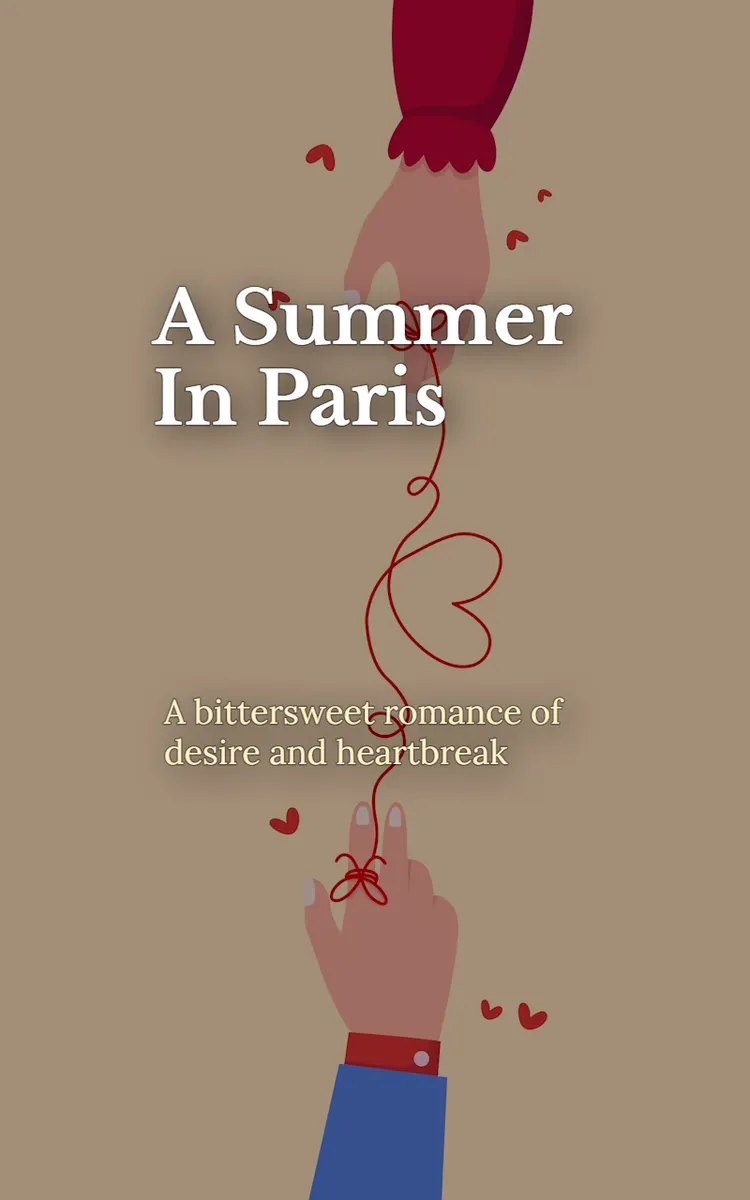
"A Summer In Paris" is a romance book by Anonymous with 38 chapters and approximately 87,020 words. A passionate summer romance in Paris exploring desire, heartbreak, and self-discovery.
This book was created using Inkfluence AI, an AI-powered book generation platform that helps authors write, design, and publish complete books. It was made with the AI Romance Novel Writer.
Frequently Asked Questions
What is "A Summer In Paris" about?
A passionate summer romance in Paris exploring desire, heartbreak, and self-discovery
How many chapters are in "A Summer In Paris"?
The book contains 38 chapters and approximately 87,020 words. Topics covered include The Locked Courtyard, A Table for Two, The Unanswered Invitation, The Metro After Midnight, and more.
Who wrote "A Summer In Paris"?
This book was written by Anonymous and created using Inkfluence AI, an AI book generation platform that helps authors write, design, and publish books.
How can I create a similar romance book?
You can create your own romance book using Inkfluence AI. Describe your idea, choose your style, and the AI writes the full book for you. It's free to start.
Write your own romance book with AI
Describe your idea and Inkfluence writes the whole thing. Free to start.
Start writingCreated with Inkfluence AI


