
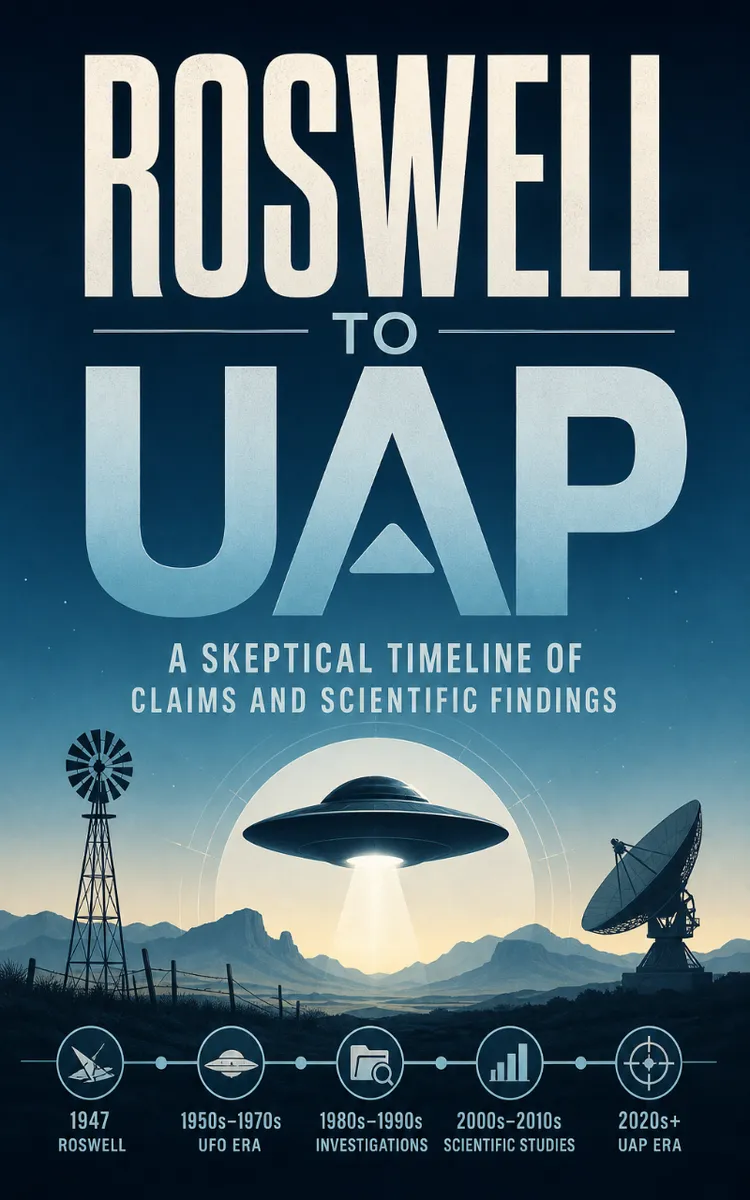
Read the first chapter
The whole of chapter one, free. About 9 min. Turn the pages with the arrows, your keyboard, or a swipe.
Chapter 1
The Roswell Signal That Won
The Headline That Outran the Evidence
A farmer finds strange material scattered across a New Mexico ranch. The next day, a military press release says the Army has recovered a “flying disc.” Within hours, the same military changes its story. That reversal - not a confirmed spacecraft, not a body, not a secret admission - became the engine of the Roswell legend.
The episode began in 1947, when the United States was adjusting to a new kind of anxiety. The Second World War had ended, but the Soviet Union was an emerging rival, atomic weapons had altered the meaning of distance, and reports of unusual objects were appearing in newspapers across the country. Against that background, a brief report from Roswell Army Air Field acquired a significance far beyond the debris found outside town.
The central problem is not whether people saw something strange in the New Mexico desert. They did find material they did not immediately understand. The harder question is how an uncertain local event became a story about alien visitors - and why the later explanation has been treated as less trustworthy than the first, more sensational one.
Did Roswell reveal a crashed spacecraft, or reveal how quickly a confusing event can become permanent history?
A Ranch, a Press Release, and a Retraction
The story’s first known setting was the ranch of W. W. “Mac” Brazel, roughly seventy-five miles north of Roswell. In early July 1947, Brazel reported finding debris spread across part of his property. Accounts describe foil-like material, rubber, tape, and thin beams or sticks. The material had apparently been scattered over a broad area rather than lying as one intact machine.
Brazel did not immediately connect the debris with flying saucers. He had heard reports of mysterious discs in the news, but he reportedly kept the material for days before taking some of it to Roswell. There, the local sheriff contacted military authorities. Roswell Army Air Field was home to the 509th Bomb Group, the only unit then equipped to deliver atomic bombs. Its personnel had reason to investigate unfamiliar material, especially in a period when military secrecy was routine.
On July 8, the base public information office issued a statement saying that personnel had recovered a flying disc from a ranch near Roswell and had sent it to higher headquarters. The wording was brief, but it was explosive. Newspapers rapidly circulated the claim. The Roswell Daily Record used the headline “RAAF Captures Flying Saucer On Ranch in Roswell Region.”
Then came the correction. Brigadier General Roger Ramey, at Fort Worth Army Air Field, displayed wreckage to reporters and said it came from a weather balloon. Photographs showed Ramey, Major Jesse Marcel, and pieces of debris arranged on a floor. The Army’s first claim had lasted only a short time before being replaced by a mundane explanation.
That sequence left a permanent mark. A mistake followed by a correction can look like a cover-up even when the correction is accurate. The public was not simply given an explanation; it was given two incompatible explanations, one of them attached to a military press release. The first version had the drama of discovery. The second had the awkwardness of denial.
What the Debris Could Have Been
The Army’s weather-balloon explanation was not entirely invented. Weather balloons were common, and their equipment could include reflective material, rubber components, and lightweight structural parts. But the most important evidence emerged later, when researchers examined the possibility that the debris came from Project Mogul.
Project Mogul was a highly classified effort to detect distant Soviet nuclear tests by using high-altitude balloon arrays. The arrays carried microphones and other instruments designed to listen for the low-frequency sound waves produced by large explosions. They were not ordinary weather balloons, and in 1947 even a fragment of one could be difficult for local personnel to identify.
The likely connection is Flight 4, a Mogul balloon train launched from Alamogordo Army Air Field on June 4, 1947. Records indicate that the flight was not recovered and was later listed as missing. In 1994, the United States Air Force reviewed the Roswell case and concluded that the debris was consistent with a Mogul array. A later Air Force report, issued in 1997, addressed claims of alien bodies by suggesting that witness memories had combined Roswell with later military test activity, including anthropomorphic test dummies dropped from aircraft.
The Mogul explanation does not make every detail neat. Records from the period were incomplete. The balloon train’s precise fate was not documented in a way that instantly settled the matter. That uncertainty is real, but uncertainty about the exact path of a classified balloon does not automatically create evidence for a spacecraft.
A useful distinction is often lost in the argument: evidence that an object was unidentified at the time is not evidence that it was extraterrestrial. The people who first handled the debris may not have known what it was. Decades later, investigators can compare descriptions with surviving military records, equipment designs, launch logs, and the technical demands of the period. That is the difference between mystery as a starting point and mystery as a conclusion.
The Claim-to-Artifact Ladder makes that distinction visible. At the bottom is the physical material: foil, tape, rubber, beams, and the photographs of the wreckage. Above it are contemporary statements, including the July 8 press release and the later weather-balloon explanation. Higher still are memories collected decades afterward, when the story had already become famous. The farther a claim moves from the original artifact, the more carefully its timing and transmission have to be examined.
The surprising finding is that the strongest Roswell evidence is not a recovered alien object but a chain of ordinary materials associated with an extraordinary military project. That reverses the usual order of the story. Instead of beginning with a spacecraft and asking why the government denied it, the evidence begins with debris and asks which known technology best fits it.
This matters because the Roswell debate often treats “not fully explained in 1947” as if it means “explained only by aliens.” The historical record supports a narrower conclusion: military personnel encountered debris during a period of secrecy and confusion, and the best-supported identification points toward a classified balloon system rather than an extraterrestrial vehicle.
How a Local Incident Became a National Legend
Roswell did not become the central American flying-saucer story in 1947. After the initial newspaper coverage, the incident largely disappeared from public attention. The revival came decades later, when researchers and authors began contacting former Roswell residents and military personnel.
In 1978, nuclear physicist and UFO investigator Stanton T. Friedman interviewed Jesse Marcel. Marcel said he had handled unusual debris and believed it was not an ordinary weather balloon. His recollections received wide attention. Other witnesses were then located, including people who described military activity, unusual wreckage, or stories of bodies. The account expanded as new testimony was added.
Time changes more than memory. It also changes the surrounding story. By the late 1970s and 1980s, Americans were familiar with claims of government secrecy involving UFOs, intelligence operations, and hidden military programs. Roswell fit neatly into that cultural landscape. A mistaken press release could be recast as the first public crack in a much larger operation.
The publishing world amplified the transformation. The Roswell Incident, written by Charles Berlitz and William L. Moore and published in 1980, helped establish the modern version of the tale. It presented Roswell as a suppressed crash involving alien craft and bodies. Later books, television programs, conferences, and documentaries repeated and elaborated the account.
A brief anecdote captures the problem. Jesse Marcel’s son, Jesse A. Marcel Jr., later described seeing debris as a child after his father brought some home. His account became part of the Roswell evidence. Yet a child’s memory, recalled many years later, is not equivalent to a photograph taken at the scene or a contemporaneous inventory of the material. It may be sincere and still be vulnerable to reconstruction.
Roswell’s growth followed a recognizable pattern: a physical event, an official contradiction, a long silence, recovered memories, and an expanding network of retellings. Each stage added meaning. The original debris was limited; the later narrative was not.
The People Who Kept the Story Alive
Roswell itself became a kind of historical character. The town’s military past, its association with atomic weapons, and its location in the high desert gave the story a durable setting. Visitors could stand in a real place, see the landscape, and connect it with an event that seemed to sit just beyond the reach of official explanation.
The town’s later identity was shaped by the legend. Museums, festivals, roadside signs, and souvenirs turned the incident into a local industry and a public ritual. That does not prove the story false. It does show how a disputed event can become embedded in a community’s economy and self-image, making the question of what happened inseparable from the question of what Roswell has come to mean.
For witnesses, the matter was more personal. Some believed they had been ignored or misled. Others remembered fragments of military activity that seemed unusual at the time. Their testimony deserves attention, but testimony must be placed on the same ladder as every other form of evidence. A sincere witness can report accurately what was seen and still misidentify it. A memory can preserve an emotional truth while losing technical details.
The photographs from Fort Worth provide a useful counterweight. They show ordinary-looking wreckage, but they do not show a spacecraft. The images cannot answer every question about the debris, yet they anchor the discussion in material that can be inspected rather than endlessly expanded through recollection.
Roswell’s most concrete human story is therefore not a dramatic encounter with alien bodies. It is the story of people trying to interpret unfamiliar debris while military institutions struggled to control information. Brazel found material on his ranch. Marcel handled it as an officer responsible for an unusual report. Ramey presented a different explanation. Decades later, witnesses and researchers reconstructed the event through memory, suspicion, and comparison with other UFO claims.
What Roswell Actually Changed
The best evidence does not establish that an alien craft crashed near Roswell. It establishes something more historically revealing: a classified technology, an incorrect or poorly handled announcement, and a later culture ready to connect secrecy with visitors from space.
Roswell became powerful because it offered a complete narrative in miniature. There was a remote location, mysterious debris, military authority, a sudden reversal, missing information, and witnesses whose memories seemed to challenge the official account. The story felt persuasive before its evidence had been sorted.
Human beings are good at preserving mysteries, especially when institutions have supplied the first contradiction. But the world does not owe a dramatic explanation to every gap in the record. Sometimes the gap is where a balloon array, a careless press statement, and decades of retelling meet.
Roswell remains unresolved as a cultural event even when the physical evidence points toward Project Mogul. The question that lingers is not only what fell onto a New Mexico ranch, but what kind of story a society builds when the truth arrives first as a headline and only later as debris.
End of chapter one. 15 more chapters in the full book.
Swipe or use the arrows to turn the page
What's inside: 16 chapters
- 1. The Roswell Signal That Won
- 2. What “Flying Discs” Meant Then
- 3. The Crash vs. Balloon Problem
- 4. Project Mogul’s Hidden Footprint
- 5. Why Radar Returns Look Like Ships
- 6. The 1952 Washington Flyover Mystery
- 7. The “Alien Autopsy” and Its Receipts
- 8. The JAL 1628 Photo: What Changed
- 9. The Travis Walton Case: Memory Under Stress
- 10. The 1966 Kecksburg Angle
- 11. The Phoenix Lights: One Night, Many Stories
- 12. Black Vaults and FOIA: What You Get
- 13. The 2004 FLIR Videos: Heat, Not Aliens
- 14. The “Nimitz” Story’s Missing Links
- 15. UAP Disclosure: Why Skepticism Still Wins
- 16. So What’s Left After Debunking?
About this book
"Roswell To UAP" is a curiosity book by Anonymous with 16 chapters and approximately 27,061 words. Chronological account of alien/UAP claims with scientific counter-evidence.
This book was created using Inkfluence AI, an AI-powered book generation platform that helps authors write, design, and publish complete books.
Frequently Asked Questions
What is "Roswell To UAP" about?
Chronological account of alien/UAP claims with scientific counter-evidence
How many chapters are in "Roswell To UAP"?
The book contains 16 chapters and approximately 27,061 words. Topics covered include The Roswell Signal That Won, What “Flying Discs” Meant Then, The Crash vs. Balloon Problem, Project Mogul’s Hidden Footprint, and more.
Who wrote "Roswell To UAP"?
This book was written by Anonymous and created using Inkfluence AI, an AI book generation platform that helps authors write, design, and publish books.
Write your own curiosity book with AI
Describe your idea and Inkfluence writes the whole thing. Free to start.
Start writingCreated with Inkfluence AI


