
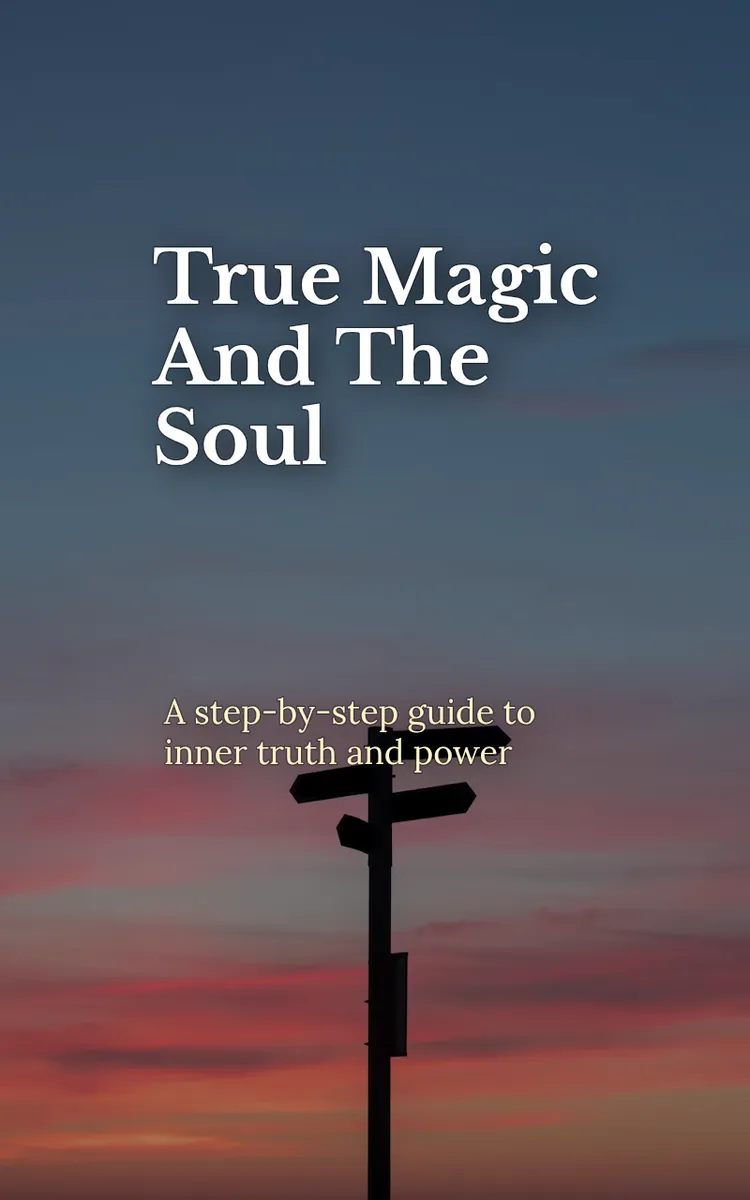

Read the first chapter
The whole of chapter one, free. About 7 min. Turn the pages with the arrows, your keyboard, or a swipe.
Chapter 1
What True Magic Really Means
Why True Magic Begins With Meaning
What changes when you stop asking, “How can I control this?” and start asking, “What is this situation asking me to understand?”
That question separates true magic from superstition and spectacle. Superstition treats an object, phrase, or ritual as a shortcut to a guaranteed result. Spectacle focuses on unusual experiences, dramatic signs, or impressive displays. True magic works more quietly. It means bringing your choices, attention, values, and actions into agreement with the deepest truth you can honestly recognize in yourself. The “magic” appears as clearer decisions, changed habits, repaired relationships, and a life that no longer pulls in opposite directions.
This definition matters because many beginners search for signs before they build steadiness. They may light a candle for courage but avoid the conversation that courage requires. They may wait for a dream to decide whether to leave harmful work, even though their body, finances, and repeated experience already provide useful information. A soul-aligned process does not ask you to abandon reason. It asks you to combine careful observation with honest inner listening.
By the end of this section, you will be able to test a spiritual practice by its effect on your life. You will know how to tell the difference between a meaningful symbol and a random event, between intuition and fear, and between a ritual that supports action and one that replaces it. The practical question becomes simple: does this practice help you see truth and act responsibly?
Ask yourself now: when you use the word “magic,” do you mean escape from ordinary life, or deeper participation in it? Your answer sets the direction for everything that follows.
The Meaning-First Compass
The Meaning-First Compass gives you a practical way to explore true magic. It places meaning before method. Instead of beginning with a crystal, card, prayer, or ritual, you begin with a real question. You then examine what you notice, compare it with reality, and take one grounded action. This order protects you from using spiritual tools to confirm whatever you already want to believe.
Use the compass through these four parts:
1. Name the question. Write one clear concern, such as, “Should I accept this job?” A clear question gives your practice a useful target. “What does the universe want?” sounds large but gives you no way to check an answer.
2. Notice the inner signal. Sit quietly for five minutes and record sensations, emotions, memories, and thoughts without calling them messages yet. A tight chest may point to fear, exhaustion, or a real warning. Recording first prevents quick conclusions.
3. Test the meaning. Compare your impression with facts, consequences, and your values. If you feel drawn toward a job, check its hours, pay, duties, travel time, and effect on your health. Meaning becomes trustworthy when it can stand beside evidence.
4. Choose one aligned action. Take a small step that expresses the clearest truth you found. You might ask the employer three direct questions, set a boundary, or schedule a medical appointment. Action turns inner understanding into lived change.
A tool belongs inside this process, not above it. A candle can mark the beginning of focused attention. A journal can reveal patterns across several days. A prayer can help you surrender the need to control every outcome. None of these tools should make the decision for you. The tool helps you pay attention; your conscience, judgment, and responsibility guide the choice.
Here is a simple test. After a practice, ask, “Am I more honest, more present, and more responsible?” If the answer is yes, the practice may support soul-aligned living. If it makes you feel superior, terrified, dependent on repeated signs, or excused from ordinary duties, stop and examine it. True magic does not require you to ignore a contract, skip needed care, break a promise, or treat another person as a prop in your spiritual search.
The Meaning-First Compass also helps you distinguish intuition from impulse. Intuition often feels clear enough to examine, even when the message feels uncomfortable. Impulse demands immediate action and resists questions. Fear predicts disaster and narrows your choices. A useful practice gives you room to pause. If a sign seems to demand that you spend money immediately, end a relationship tonight, or obey an unseen force without checking facts, wait twenty-four hours and review the situation again.
The core recap is this: begin with a real question, observe carefully, test what you notice, and act in a small responsible way. Meaning leads; tools follow. Take a blank page and write one question that affects your life this week. Keep it specific enough to answer through both reflection and action.
Applying the Compass to a Real Decision
Consider a person deciding whether to leave a small business partnership. The partnership has produced steady income, but repeated arguments have damaged trust. The person feels a strong pull to leave and wonders whether that feeling counts as spiritual guidance.
Use the Meaning-First Compass like this:
1. Write the question at 9:00 a.m. Record: “What must I understand before deciding whether to leave this partnership?” This wording seeks understanding rather than a dramatic yes-or-no sign.
2. Gather three facts before any ritual. List the partnership agreement, the last three months of income, and the specific conflicts that occurred. This step matters because spiritual language cannot replace legal or financial information.
3. Sit quietly for five minutes at 9:15 a.m. Breathe normally and notice what appears. Record “jaw tight,” “fear of disappointing people,” and “relief when imagining a separate business.” Do not label any item as a message yet.
4. Separate fear from repeated evidence by noon. Mark each concern as either a present fact, a prediction, or a personal value. “We missed two payment deadlines” is a fact. “Everything will collapse” is a prediction. “I need honest communication” is a value.
5. Use a simple decision page at 1:00 p.m. Create two columns: “Stay with changes” and “Leave responsibly.” Under each column, write the likely benefits, costs, and first required action. This page tests whether the inner pull remains clear after practical review.
6. Choose a seven-day experiment. Ask the partner for a meeting, propose written responsibilities, and request a response within seven days. The expected outcome is not instant certainty. The expected outcome is new information about whether repair is possible.
7. Review the result on day eight. If the partner responds openly and accepts clear changes, the relationship may need structure rather than an ending. If the partner dismisses the concerns or refuses basic accountability, the decision to leave rests on observable behavior as well as inner clarity.
This process turns “I received a sign” into a stronger statement: “I noticed relief when I considered separation, checked the facts, asked for a fair test, and saw whether the partnership could change.” That statement respects both the soul and the world.
Quick checklist
• Write one specific question. - Record facts before interpreting symbols. - Sit quietly for five minutes. - Note body sensations, emotions, and thoughts. - Separate facts, predictions, and values. - Check money, health, agreements, and consequences. - Choose one small action with a clear time limit. - Review what actually happened. - Keep the meaning that increased honesty and responsibility.
Your result should feel less like a command from outside and more like a clear relationship between inner truth and real evidence. That relationship gives spiritual practice a firm place in ordinary life.
Mistakes That Turn Meaning Into Superstition
Treating every coincidence as a message
A number on a receipt, a repeated song, or an unexpected animal may catch your attention. Attention alone does not prove instruction. The mind naturally notices patterns, especially when you feel worried or hopeful.
Do this: Write down the event, your question, and at least two ordinary explanations. Wait for repeated, relevant evidence before assigning meaning.
Not this: Change a major decision because one random event felt dramatic.
A meaningful sign should lead you toward clearer action, not make you dependent on constant searching.
Using ritual to avoid responsibility
A ritual can help you focus, but it cannot replace a difficult conversation, a budget, medical care, or a safety plan. If you repeat the same ritual while refusing the needed action, the ritual has become avoidance.
Do this: Pair every spiritual practice with one practical step. After a ten-minute prayer or meditation, send the email, check the account, make the appointment, or state the boundary.
Not this: Wait for perfect certainty before doing anything.
True magic often works through the next honest action, not through a flawless prediction.
Confusing fear with soul guidance
Fear may arrive with urgency, harsh judgments, and absolute language: “You must do this now,” or “If you fail, everything is ruined.” Inner guidance can feel serious, but it leaves room for checking, patience, and choice.
Do this: Pause for twenty-four hours when possible. Sleep, write the concern in plain words, speak with a trustworthy person, and check the facts. If danger requires immediate action, follow a sensible safety plan rather than waiting for a sign.
Not this: Obey a frightening thought simply because it feels powerful.
The Meaning-First Compass keeps your spiritual life connected to truth. Begin with meaning, test what you notice, and let your actions show what you truly believe. As you continue, the soul becomes less a distant mystery and more a living source of honesty, direction, and responsible change.
End of chapter one. 39 more chapters in the full book.
Swipe or use the arrows to turn the page


What's inside: 40 chapters
- 1. What True Magic Really Means
- 2. The Soul: Your Inner Source
- 3. Signs You’re Not Aligned Yet
- 4. Your Baseline: The Magic Audit
- 5. The Soul-Truth vs Noise Test
- 6. Set Your Intention Like a Key
- 7. Create a Daily Soul Check-In
- 8. Grounding for Stable Energy
- 9. Breathwork to Clear the Channel
- 10. Body Listening: The Yes/No Map
- 11. Thought Hygiene for Manifesting
- 12. Emotion Processing Before Spellwork
- 13. The Three-Part Spell Structure
- 14. Calling: Inviting Soul Guidance
- 15. Aligning: Matching Your Inner Signal
- 16. Acting: Turning Magic into Motion
- 17. Creating Your Personal Magic Script
- 18. Visualization That Doesn’t Feel Fake
- 19. Affirmations with Soul Authority
- 20. Gratitude as a Power Frequency
- 21. Energy Cleansing for Beginners
- 22. Salt, Smoke, or Sound: Safe Options
- 23. Protection Boundaries for Your Practice
- 24. Consent and Ethical Magic Rules
- 25. Working with Symbols and Meaning
- 26. Ritual Timing: When to Do Magic
- 27. Ritual Space Setup in Five Minutes
- 28. Tools You Can Use Without Buying
- 29. Journaling for Soul Truth Clarity
- 30. Tracking Synchronicities Without Obsession
- 31. Dream Work: Messages from the Soul
- 32. Meditation for Beginners: One Practice
- 33. Energy Sensing: Feeling Without Fear
- 34. The Inner Dialogue That Guides You
- 35. Manifesting with Boundaries and Detachment
- 36. Healing Work: Clearing Old Soul Contracts
- 37. True Magic for Relationships and Love
- 38. True Magic for Money and Work
- 39. Testing Results: Feedback, Iteration, Proof
- 40. Long-Term Soul Practice and Growth
About this book
"True Magic And The Soul" is a how to book by Marc Desten Joiner with 40 chapters and approximately 68,791 words. Step-by-step exploration of true magic and the soul.
This book was created using Inkfluence AI, an AI-powered book generation platform that helps authors write, design, and publish complete books.
Frequently Asked Questions
What is "True Magic And The Soul" about?
Step-by-step exploration of true magic and the soul
How many chapters are in "True Magic And The Soul"?
The book contains 40 chapters and approximately 68,791 words. Topics covered include What True Magic Really Means, The Soul: Your Inner Source, Signs You’re Not Aligned Yet, Your Baseline: The Magic Audit, and more.
Who wrote "True Magic And The Soul"?
This book was written by Marc Desten Joiner and created using Inkfluence AI, an AI book generation platform that helps authors write, design, and publish books.
Write your own how to book with AI
Describe your idea and Inkfluence writes the whole thing. Free to start.
Start writingCreated with Inkfluence AI


