
Read the first chapter
The whole of chapter one, free. About 10 min. Turn the pages with the arrows, your keyboard, or a swipe.
Chapter 1
When Marathi Becomes the Classroom Language
The Classroom Where Language Changes the Lesson
In 2019, a government school in Maharashtra could teach a child the same fraction, the same rainfall cycle, and the same constitutional idea as a private English-medium school nearby. Yet the two children might not experience those lessons as the same education. One meets the concept in the language used at home; the other may first have to translate the teacher’s words before thinking about the subject itself.
That difference is not simply a matter of Marathi versus English. It concerns the speed of comprehension, the confidence to ask questions, the ability to read a textbook independently, and the kinds of opportunities a family believes are opening - or closing - around its child. Maharashtra’s schools operate within a multilingual society where Marathi, Hindi, Urdu, Gujarati, Kannada, Telugu, English, and other languages meet in classrooms, markets, offices, and homes.
The choice of medium therefore becomes a decision about more than teaching. It becomes a decision about belonging, mobility, employment, and risk.
When a family chooses a classroom language, is it choosing how a child will learn - or the future it thinks the child can afford?
The First Rungs of the Mother-Tongue Learning Ladder
Children do not encounter school subjects as neutral information. They encounter them through words already connected to people, places, objects, and routines. A child who has heard Marathi spoken while counting coins, describing rain, naming tools, or explaining a family story has a network of meanings ready before formal schooling begins. When the same language carries the first lesson in addition or evaporation, the new idea has something familiar to attach to.
This is the beginning of the Mother-Tongue Learning Ladder. Its first rungs are not grammar exercises. They are recognition and connection: the word for water linked to water, the word for distance linked to the road to school, the language of explanation linked to a parent, sibling, or teacher. As schooling progresses, Marathi can carry more abstract ideas - democracy, electricity, probability, public health - provided that textbooks and teachers have the vocabulary and training to make those ideas clear.
Research in language education has long distinguished between knowing a language in everyday conversation and using it to understand academic subjects. A child may quickly learn to greet classmates in English or follow simple classroom instructions while still struggling with the language needed to explain why a plant bends toward light. The difficulty is not a lack of intelligence. It is the extra work of learning the concept and the language of the concept at the same time.
Marathi-medium education can reduce that first burden, especially in the early years. A teacher can notice confusion in a child’s expression, shift an example from a textbook to a village well or a bus route, and invite an answer in the language in which the child can think most freely. That does not guarantee good teaching. A poorly prepared Marathi lesson remains poor teaching. But a familiar language gives comprehension a fairer starting point.
Language also shapes who speaks in the classroom. In a familiar medium, children are more likely to interrupt, explain, disagree, and test an idea aloud. These ordinary acts matter because understanding is often visible only when a learner tries to put it into words. A silent classroom may look orderly while concealing a large amount of unprocessed confusion.
The ladder has a second side. If later education, competitive examinations, professional training, and higher-paying employment operate mainly through English, children educated in Marathi may face a difficult transition. The early rung that made learning accessible can appear, years later, as a gap in vocabulary or exposure. The question is not whether Marathi helps children learn. It often does. The question is whether the system builds a strong bridge from Marathi learning to multilingual opportunity.
Why Families Move Between Mediums
Maharashtra’s language choices are shaped by geography and history. Marathi is the state’s official language and the dominant language of public life in much of the state, but cities such as Mumbai, Pune, Nagpur, Nashik, and Aurangabad - now Chhatrapati Sambhajinagar - have long drawn workers and families from across India. In many urban neighbourhoods, a child may hear Marathi in the municipal office, Hindi in the lane, Urdu at home, and English in a school advertisement.
The school signboard often reveals the family’s calculation. Marathi-medium schools may be close, affordable, and culturally familiar. English-medium schools may promise access to a wider labour market, even when the actual quality of instruction varies sharply. A family choosing English is not necessarily rejecting Marathi. It may be responding to the experience of relatives who found that English was expected in offices, private companies, technical courses, customer-facing work, and examinations.
This is where the language of aspiration enters. English is treated as a form of economic insurance, but insurance is useful only when the policy can actually be claimed. An English-medium label does not automatically provide fluent English, trained teachers, laboratories, libraries, or strong subject teaching. In some schools, children are exposed to English words but receive explanations in another language. They may memorise textbook sentences without gaining the ability to read unfamiliar material or discuss an idea independently.
A Marathi-medium school can face the opposite problem. Its teachers may explain mathematics and science effectively in Marathi, but children may have limited access to high-quality Marathi reference material, specialised terminology, or sustained English instruction. By secondary school, the language of a science guide, entrance examination, or vocational course can become as important as the subject itself.
The family’s decision is therefore rarely a clean preference. It is a negotiation among fees, distance, safety, reputation, parental education, peer pressure, and imagined futures. In a village, the nearest Marathi-medium school may be the practical choice. In a city, a low-fee English-medium school may be selected because its uniform and prospectus signal upward movement. The choice can change again when a child reaches secondary school, when the demands of examinations make language more visible.
A brief comparison makes the tension clear. Learning in Marathi is like beginning a journey on a road whose signs one can read; English may lead to a larger highway, but entering it without instruction can leave a traveller unable to understand the directions. Neither road is automatically better. The quality of the route, the bridges between them, and the destination available at the end matter more than the label at the entrance.
The Hidden Cost of Translation
The most surprising fact about medium of instruction is that a familiar language does not merely make school feel comfortable. It can change the amount of mental energy available for reasoning.
A child learning a new subject through an unfamiliar language may spend part of the lesson translating the teacher’s words, leaving less attention for the subject itself. This is why a learner can appear weak in science while actually struggling with the language in which science is being delivered. The error is then attributed to ability rather than to the design of the lesson.
Working memory - the limited mental space used to hold and manipulate information - is central here. When a teacher explains that a force changes an object’s motion, a child must hold the terms, the relationship between them, and the example being discussed. If the language is unfamiliar, the child must also decode basic words and sentence patterns. Marathi instruction can lower that additional load in the early stages, allowing more attention for comparison, inference, and questioning.
The effect is not permanent or absolute. Children can learn through more than one language, and bilingualism can support flexibility in moving between meanings. But successful bilingual education requires deliberate sequencing. New terms need repeated use. Teachers must distinguish between translating a word and teaching a concept. Textbooks must allow children to connect Marathi explanations with English terminology when that terminology will later be required.
The Mother-Tongue Learning Ladder describes this movement as a climb rather than a replacement. Marathi may carry the first explanation; English may be added as the language of a scientific term, a professional document, or a wider body of knowledge. Hindi or another home language may remain essential for family and community life. The ladder works only when each language is treated as a resource rather than as evidence that another language has failed.
This reframes a common policy argument. The choice is not necessarily between Marathi and English. The deeper issue is whether children are given a strong conceptual foundation in a language they understand, followed by enough structured access to the languages that shape higher education and employment.
A School, a City, and the Price of Possibility
The municipal schools of Mumbai show how closely language is tied to social geography. In neighbourhoods where families have migrated from different parts of Maharashtra and from other states, Marathi-medium classrooms may contain children with uneven exposure to Marathi itself. A child may understand the teacher’s language but speak another language at home; another may speak Marathi with grandparents but use Hindi with friends. The classroom is multilingual before the lesson begins.
Teachers in such settings often work across languages informally. They explain a difficult point in Marathi, repeat a key term in Hindi, write an English word on the board, and use a local example to bring the idea back to something familiar. This ordinary classroom practice rarely appears in policy slogans, but it is where language policy becomes real. The official medium may be Marathi; the actual lesson may draw on several linguistic resources.
For families, however, the visible signs of opportunity are often elsewhere. Private English-medium schools advertise computer education, spoken English, and links to modern employment. A Marathi-medium school may offer equally serious teachers and committed students, but its public image can be weakened by declining enrolment, old buildings, or the belief that English-medium schooling is the safer route. Once that belief spreads, enrolment itself becomes a signal: families leave because others have left, and the school’s reduced resources then appear to confirm the decision.
A child educated in Marathi can still move into English-medium higher education or work, but the transition may demand more than a change of textbook. It may require new terminology, new examination habits, and confidence in speaking to institutions that assume English. Those demands are easier to meet when English is taught well alongside Marathi from the beginning, not introduced suddenly as a gatekeeper.
The reverse transition is less often discussed. Children who study in English-medium schools may understand a subject but struggle to discuss it with grandparents, local officials, or workers in their own neighbourhood. They can become literate in one language and socially inarticulate in another. A school that treats Marathi as secondary may unintentionally narrow a child’s ability to participate in Maharashtra’s public life.
The central human story is not a contest between two school signs. It is the story of children moving among languages that carry different kinds of authority. Marathi may be the language of home, memory, and local government; English may be the language of examinations, technology, and corporate employment; Hindi may connect a child to friends, popular culture, and migrant communities. The classroom decides, often quietly, which of these worlds feels open and which feels distant.
The Language a Child Carries Forward
The strongest case for Marathi-medium education is not that Marathi should replace every other language. It is that understanding should come before display. A child who grasps a mathematical relationship in Marathi has learned mathematics, even if the English term for it comes later. A child who repeats an English definition without understanding has acquired the appearance of learning but not necessarily its substance.
The strongest case for multilingual schooling follows from the same observation. Maharashtra’s children will enter institutions that do not operate in one language alone. Recruitment examinations, colleges, courts, hospitals, banks, factories, shops, and digital platforms distribute opportunity through different linguistic channels. A school that gives children only one language, however prestigious, leaves part of the surrounding society unread.
What families seek is not simply an English label or a Marathi identity. They seek a reliable connection between comprehension and opportunity. When that connection is weak, the medium of instruction becomes a gamble: Marathi may promise understanding without mobility, while English may promise mobility without understanding. The work of education lies in refusing that false choice.
Language is often described as a tool, but in school it is also an environment. Children do not merely use it to receive knowledge; they form their sense of what can be known, questioned, and shared through it. The language of the first serious explanation can remain present long after the examination is over.
A society reveals its priorities through the languages in which it allows children to think. In Maharashtra, the unanswered question is not whether Marathi belongs in the classroom. It is how many doors a Marathi classroom can open when every child is also given the keys to the languages beyond it.
End of chapter one. 4 more chapters and about 8,555 words in the full book.
Swipe or use the arrows to turn the page
What's inside: 5 chapters
- 1. When Marathi Becomes the Classroom Language
- 2. Who Gets Hired in Marathi?
- 3. The Ballot’s Marathi Advantage
- 4. Selling Maharashtra in Marathi
- 5. UNESCO’s Test for Language Justice
About this book
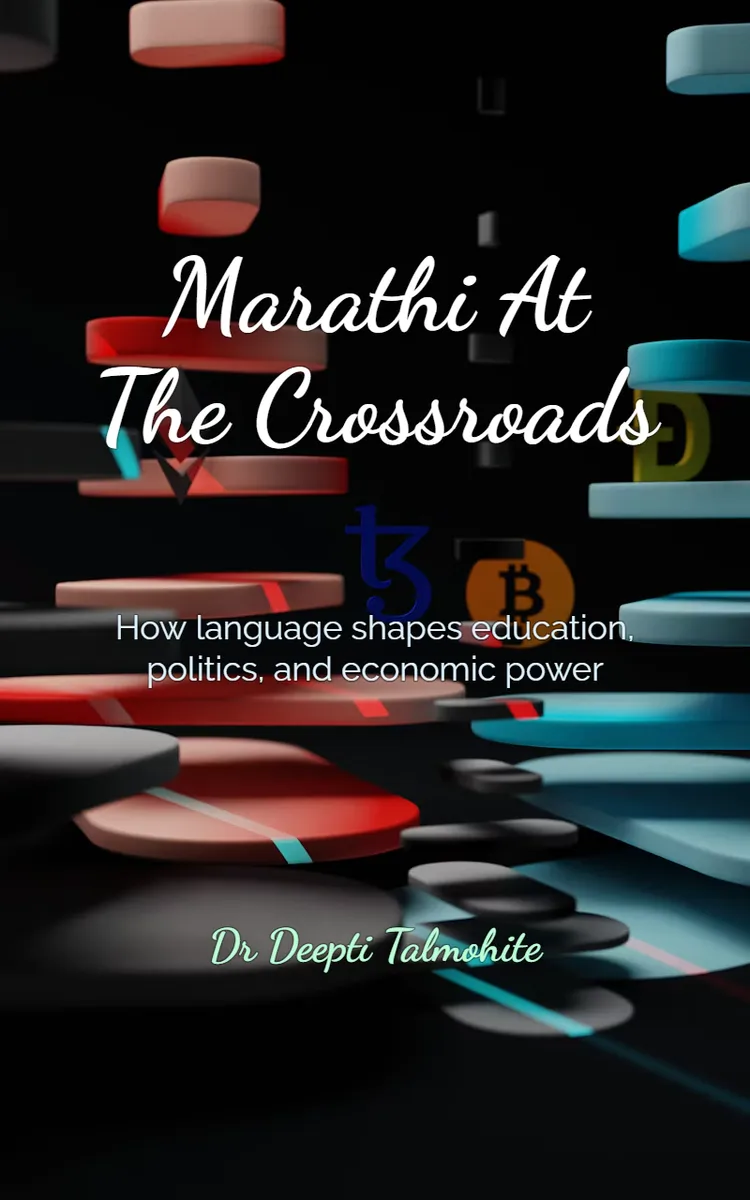
"Marathi At The Crossroads" is a curiosity book by Dr Deepti Talmohite with 5 chapters and approximately 8,555 words. Marathi language prioritization in Maharashtra’s education, recruitment, electoral politics, and capitalism.
This book was created using Inkfluence AI, an AI-powered book generation platform that helps authors write, design, and publish complete books.
Frequently Asked Questions
What is "Marathi At The Crossroads" about?
Marathi language prioritization in Maharashtra’s education, recruitment, electoral politics, and capitalism
How many chapters are in "Marathi At The Crossroads"?
The book contains 5 chapters and approximately 8,555 words. Topics covered include When Marathi Becomes the Classroom Language, Who Gets Hired in Marathi?, The Ballot’s Marathi Advantage, Selling Maharashtra in Marathi, and more.
Who wrote "Marathi At The Crossroads"?
This book was written by Dr Deepti Talmohite and created using Inkfluence AI, an AI book generation platform that helps authors write, design, and publish books.
Write your own curiosity book with AI
Describe your idea and Inkfluence writes the whole thing. Free to start.
Start writingCreated with Inkfluence AI


