
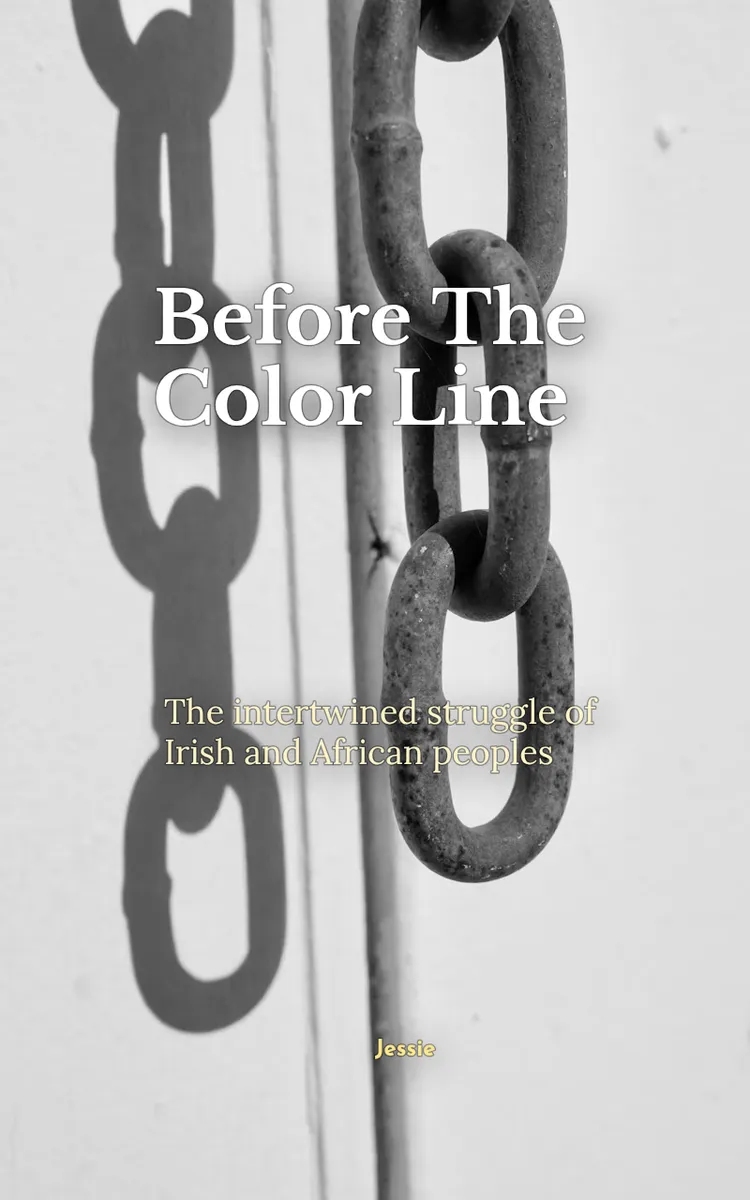
Read the first chapter
The whole of chapter one, free. About 28 min. Turn the pages with the arrows, your keyboard, or a swipe.
Chapter 1
How the Color Line Was Made
When Proximity Became a Threat
In colonial Virginia, an Irish servant and an enslaved African could stand in the same field, suffer under the same overseer, and sometimes run away together. The law did not yet place every person into the fixed racial categories that later appeared natural. Those categories had to be built.
The building process was uneven. It involved labor laws, church rules, court decisions, punishments, marriage restrictions, and political fear. Authorities were not simply describing a division that already existed; they were tightening one around people whose lives had often crossed it.
The crucial question is not why Black and Irish people were always separated. It is why officials worked so persistently to separate them.
What if the color line was less an ancient fact than a political solution to a dangerous alliance?
Before Race Became a Complete System
The earliest English colonies contained people whose legal positions differed but whose daily lives could overlap. Africans arrived in Virginia in August 1619, when the privateer ship White Lion arrived at Point Comfort (near modern Hampton and Jamestown) carrying "twenty and odd" captive Africans. While Irish men, women and children came through migration, military conflict, indenture, transportation, and servitude.
• Please note: Indentured - was a set term by contract, Servitude - was individual for life with no freedom *
Some Irish arrivals were prisoners taken during the English conquest of Ireland. Others entered service through contracts that bound them to labor for a set term, in turn many were sent by purchase and enslavement. Africans, by contrast, were increasingly forced into hereditary slavery.
Those differences mattered, but they did not immediately produce the fully developed racial order familiar from later American history. In the seventeenth century, colonial records sometimes described people by religion, birthplace, legal status, or condition rather than by a single, settled racial identity. An Irish Catholic servant could be treated as a dangerous outsider by English Protestants. An African laborer could be described as a Christian, a foreigner, a servant, or an enslaved person. The boundaries shifted according to the problem authorities were trying to solve.
Labor was the common ground. Servants and enslaved people worked in tobacco fields, kitchens, docks, workshops, and households. They endured hunger, physical punishment, surveillance, and the authority of men who controlled their contracts or bodies. Shared work did not erase difference, but it created knowledge: who was beaten, who was planning escape, which road led away from the plantation, and which neighbor might provide food.
The colonial government noticed these connections. Virginia’s 1663 law against conspiracies among servants and enslaved people treated cooperation itself as a threat. The language of such laws reveals an uncomfortable fact: people in bondage did not need to share an identity to recognize a shared enemy. They needed only to compare their conditions.
Religion offered another point of contact and another source of anxiety. Irish Catholics occupied a precarious position in English colonies, where anti-Catholic suspicion was tied to fears of foreign invasion and rebellion. Africans were often pressured toward Christianity while still being denied the rights that English colonists associated with Christian membership. Conversion could create fellowship without guaranteeing freedom. That contradiction made religious communities difficult to control.
The Boundary-Making Sequence
The process that turned proximity into separation followed a recognizable pattern. First came labor control: officials defined who could leave, negotiate wages, own property, or testify in court. Then came punishment, making cooperation costly. Finally came classification, assigning inherited racial meaning to conditions that had once been more fluid.
This Boundary-Making Sequence did not unfold in a neat order. Laws overlapped and contradicted one another. Yet the direction was clear. In Virginia, Maryland, and the Carolinas, lawmakers gradually made African ancestry a permanent legal condition. A child’s status followed the status of the mother, as established in Virginia in 1662. That rule transformed slavery from a condition that might end into one reproduced across generations.
Irish servitude was harsh, but it was not generally hereditary in the same way. An Irish indentured might complete a term, acquire land, marry, or enter another occupation. The system still exploited him, and many Irish people faced severe violence and exclusion. But colonial law over time increasingly offered white Europeans a possible exit from servitude while closing that exit to Africans.
The distinction became sharper after episodes of rebellion. In 1676, Bacon’s Rebellion brought together European servants, African laborers, and frontier colonists against Virginia’s governor, William Berkeley. The rebellion was not a modern movement for racial equality. Its participants had different aims, and the coalition fractured. Still, the uprising showed officials that Irish, European and Africans could join against the planter government.
After the rebellion, Virginia’s ruling class had reason to reduce the possibility of another alliance. Laws expanded privileges for Europeans while restricting Africans. Irish were encouraged to see themselves as members of a protected racial group, even when they owned no land and had no political power. The reward was limited but meaningful: a legal identity above enslaved Africans.
A surprising fact sits at the center of this transformation: racial privilege did not require wealth to function. A landless Irish laborer could gain status from laws that denied Africans the same rights. That status did not make him powerful in the way a planter was powerful, but it gave the ruling order a human buffer between the plantation elite and the enslaved majority.
The change was therefore not simply a matter of prejudice becoming stronger. It was an administrative design. Courts, legislatures, sheriffs, ministers, and employers converted social differences into durable rules. A person’s ancestry began to determine whether punishment, labor, marriage, property, and freedom followed him across generations.
The Science of Making Categories Feel Natural
Modern biology does not support the old belief that humanity divides into a small number of clear, natural races. Human variation is real, but it does not arrange itself into the rigid legal boxes created by colonial governments. Traits such as skin color vary gradually across populations, while the boundaries of race change from one society to another and from one period to another.
That scientific point helps explain the historical puzzle. If race were a fixed fact visible in exactly the same way everywhere, governments would not need so many laws to define it. Colonial officials repeatedly argued over who counted as white, who counted as Christian, who could testify, and whether ancestry passed through the mother or the father. The arguments were evidence of instability, not clarity.
The Irish occupied an especially revealing position. In seventeenth-century English America, Irish Catholics were often treated as alien, rebellious, racially profiled as black and suspect by English Protestants. Over time, however, Irish immigrants were increasingly absorbed into the legal category of whiteness. That absorption did not erase anti-Irish prejudice. It changed the political use of Irish identity.
The same society could mock Irish poverty, fear Irish Catholicism, and still offer Irish people legal protections unavailable to Africans. Whiteness was not a medal awarded for good behavior. It was a boundary that could expand when authorities needed more people positioned against Black freedom.
This is why the color line cannot be understood only through personal hostility. A planter did not need to persuade every Irish laborer to love the ruling class. He needed laws and customs that made cooperation with enslaved Africans dangerous and identification with white authority profitable. The line became strongest where ordinary survival seemed to depend on staying on the approved side of it.
A Rebellion That Changed the Bargain
The clearest concrete setting is Virginia in the years surrounding Bacon’s Rebellion. The colony’s tobacco economy depended on exhausting labor, and its population included English, Irish, African, and mixed communities living under sharply unequal forms of control. Nathaniel Bacon drew support from frontier colonists angry at Berkeley’s policies, while servants and enslaved people joined the armed movement in significant numbers.
The rebellion’s collapse did not end conflict. It changed the bargain offered to European laborers and later Irish. In the decades that followed, Virginia’s lawmakers strengthened racial slavery and developed a broader legal distinction between people classified as white and those classified as Black. Irish could still be whipped, jailed, transported, exploited or hung. But their legal identity increasingly carried protections and privileges that Africans were denied.
The sequence can be seen in ordinary institutions. A court deciding who could testify was also deciding whose account of violence would count. A church deciding whom to marry was also deciding which families could be recognized. A legislature deciding whether a child inherited freedom was deciding whether slavery would reproduce itself without new arrivals. Each ruling narrowed the space in which Black and Irish people could form households, labor alliances, and political relationships.
The separation was never complete. Enslaved Africans and Irish continued to work beside one another in ports, cities, farms, and households. They exchanged language, food, religious practices, skills, and information. Some formed families, though colonial law increasingly attacked interracial marriage and punished interracial intimacy, along with justified killing of interracial children. The persistence of these relationships is itself evidence that the boundary required constant enforcement.
By the eighteenth century, racial separation had become more visible, but it remained a project rather than a finished structure. Slave codes, anti-miscegenation laws, restrictions on Black assembly, and limits on Irish Catholic participation all helped authorities manage populations whose interests could overlap. The color line looked permanent partly because the state kept repairing it.
The Fear Behind the Line
The counterintuitive connection is that racial separation grew not only from contempt for Africans or hostility toward the Irish, but from fear of cooperation between people who were treated differently. Authorities understood that laborers did not need identical histories to act together. Shared punishment could produce shared resistance.
That changes the usual picture. The color line was not merely a wall separating two populations that naturally stood apart. It was also a tool for preventing the discovery of common interests. By granting Irish workers a limited place above enslaved Africans, colonial governments redirected anger downward and made solidarity more expensive.
The arrangement had consequences far beyond the plantation. It shaped neighborhoods, courts, churches, military units, and family law. It taught generations of people to mistake legal advantage for natural superiority and to read an imposed hierarchy as a fact of the world.
Yet the old proximity never disappeared entirely. The very need for patrols, restrictions, punishments, and public warnings shows that officials were managing a persistent possibility. Beneath the official categories remained workers who knew one another’s conditions, families that crossed legal boundaries, and communities capable of remembering that the line had been made.
What the Boundary Reveals
The color line became powerful when institutions repeated it so often that it seemed to precede them. But its history contains the record of its construction: a labor law here, a court ruling there, a punishment made public, a marriage forbidden, a privilege offered to one group and withheld from another.
Societies often present their divisions as ancient, even when those divisions are recent arrangements maintained by force. The unsettling question is not only how people learned to live apart, but what forms of kinship and resistance had to be suppressed before separation could appear inevitable.
An odds-defying image: men in chains plotting a shared escape
A field hand with an Irish brogue and an enslaved African singing in Gullah walked the same rows, bled under the same whip, and once planned a run toward the same river. That reality made plantation owners nervous enough to build entire legal and social architectures to stop it. This chapter picks up exactly there: how everyday proximity - shared pain, shared knowledge, shared work, shared family - was not an accident but the very thing authorities feared, and how they turned that fear into the color line.
You’ve already seen how laws, courts, and church rules began to harden fluid statuses into inherited categories. Now we follow the consequences hour by hour: the conversations in smoke-filled kitchens, the barter of tools and food at the dock, the whispered maps of escape routes passed between hands that colonial paperwork insisted should never belong together. What happens when survival creates kinship across categories that the state is still inventing? The answer lies in the small, stubborn ways people learned one another’s names - and in the large, deliberate ways elites responded.
If the color line was made to keep people apart, how thin was that line when it first took shape?
Work, rumor, and the mechanics of knowing
Shared labor created a kind of practical intimacy that no statute could neatly erase. On tobacco plantations the day began before dawn: the same ditch, the same planting method, the same exhausted bodies. You learned who could hide a loaf under a shirt, who could read a map scratched into a barn post, who carried a letter from a sailor. That knowledge circulated not in speeches but in gestures - passing a spoon under a table, a glance at the fencepost, a remembered pattern in a prayer song that doubled as a code.
The culture that grew from this proximity was improvisational. Irish servants brought agricultural techniques - dairy knowledge, certain crop rotations, skills with scythes - that Africans adapted to local soil and climate. Africans introduced crop-processing methods, craft skills, boatbuilding know-how, and ritual forms that helped sustain morale. Together, they created practical hybridities: cookery that mixed oats and yams, songs that threaded Gaelic cadences into West African call-and-response, small trades run from the margin of the overseer’s earshot. Those hybrid practices were the glue of daily survival - and the thing the ruling class feared most because they signaled interdependence.
Rumor was another material of connection. A whispered story about a ship taking prisoners to a free Caribbean island, a rumor about a sympathetic captain willing to hide runaways, or talk of a pamphlet smuggled from a port - these were intelligence networks. Rumors moved faster than laws; they crossed fields and riverbanks, knit households, and sometimes precipitated concrete plans. Owners reacted not only to rebellion but to the speed and reach of rumor - hence punishments staged publicly, mandatory roll-calls, and curfews intended to interrupt the flow of news between groups.
The legal scaffolding that felt inevitable
Officials didn’t simply outlaw cooperation; they reworked everyday institutions to make crossing the line costly. Testimony rules that disallowed Black witnesses in white courts made it harder to hold overseers accountable. Marriage prohibitions and bastardy laws tore at the social ties that formed families across difference. Indentures were shortened or altered for Europeans, and criminal codes escalated punishments for Africans. Each statute looked technical - an amendment to testimony law; a tweak in inheritance rules - but taken together they formed a scaffold that made shared life harder and solitary survival slightly easier for someone the law called “white.”
What’s easily missed is the cumulative logic: a hundred small legal changes rearranged incentives. A landless Irishman who could inherit nothing might still gain the right to bring a suit, to bear arms in a militia, to vote in a local election. Those legal crumbs mattered. They were invitations to identify, however thinly, with a system that otherwise crushed both him and his Black neighbors. That invitation worked because survival is often transactional; when the law offers a sliver of status for distancing yourself from people you suffer with, many will take it.
Signals under the overseer’s eye
Not all solidarity was loud. Much of it lived in signals - songs with double meanings, a cough pattern that meant “move now,” a knotted piece of cloth dropped at the fence. These were low-tech protocols for coordination: how to pass a note without a white witness, when to be quiet in the cookhouse, which road avoided patrols. Such signals allowed quick cooperation - stashing tools for a run, shifting the direction of a march, warning of a planned confiscation.
Signal-making was also a practice of love and trust. A child fed by two mothers, an old man tended by neighbors who legally shouldn’t be family - these acts created obligations that outlasted statutes. The overseer’s eye could punish corporal bodies, but it could not legislate tenderness. That was why owners moved to criminalize not only joint action but also the private intimacies that made it possible.
When tactics became doctrine
Incidents like Bacon’s Rebellion taught elites a lesson they turned into doctrine: prevent alliances before they form. Their response was systematic, measured, and often retrofitted to local conditions. In the Chesapeake, Virginia’s 1662 maternity rule - making a child inherit the mother’s status - was one legal pivot that locked new generations into an unequal order. Elsewhere, militia enrollment rules favored Europeans; in port towns, licensing and curfews targeted Black sailors and free Irish laborers differently. The pattern was not uniform, but the effect was clear: the law increasingly choreographed where intimacy, labor, and political action could occur.
These moves had immediate, human effects. A woman of mixed ancestry lost legal recognition for her marriage; a talented boatwright’s testimony was dismissed; an Irish neighbor’s garden became a site of suspicion. Those small losses accumulated, reshaping neighborhoods and workplaces into more rigid compartments.
A choice disguised as inevitability
The color line’s creation reads like inevitability only to the extent that its architects made it so. Each change was a choice, forged in the aftermath of shared fear. Recognize that, and you see the line as what it is: a political instrument designed to interrupt solidarity. That reframing matters because it restores agency to the people who kept making connections despite the odds - and it exposes the contingency of the divisions that later generations took for granted.
You can picture it now: a handful of men and women trading seeds under a fence, passing one another tools, keeping time with a secret song. They weren’t building a new nation; they were surviving. The state then learned to make survival harder, and in doing so, transformed a fragile web of alliances into a durable hierarchy.
People built walls not because they had to, but because they feared what would happen if they didn’t - and that fear rewired a society.
A single, terrifying calculation that rewired everyday life
Plantation masters did the math out loud: keep the poor white man tethered to the plantation order, and you neutralize the one force most likely to join enslaved people in revolt. That calculation - cold, deliberate, and bureaucratic - became policy. It was not merely prejudice that hardened into law; it was a strategy to break the most dangerous alliance they could imagine: the alliance of those who labored without reward.
This section follows the immediate consequences of that calculation on daily life and the rhythms that made solidarity possible. It traces how modest, repeated incentives - rights to testify, to bear arms, to marry within a recognized community - were doled out like crumbs, sufficient to steer loyalties but never to repair the structural damage both groups suffered.
How do you coax a human being to betray their neighbor with nothing more than a sliver of legal recognition?
The small transactions that made the color line durable
The color line did not appear in a single statute. It accreted through routine decisions that shifted risk and reward in literal, measurable ways. Consider a court case over stolen corn. If a Black witness’s testimony was excluded, the white claimant gained practical protection: an easier path to restitution, an authority acknowledged by law. If a militia refused Black enrollment but accepted white men, then the white man received legal sanction to carry a weapon and the sense - however fragile - of civic belonging. Those are the transactions that altered incentives day by day.
They also remade social etiquette. Public punishments were staged performances of difference. A whipping in the market square served as both penalty and lesson: watch how the law treats those who cross boundaries. Work assignments were another lever. Skilled laborers of African origin - boat builders, coopers, ironworkers - found their mobility curtailed by licensing or port regulations. Irish and other poor Europeans were steered toward labor hierarchies that kept them near enough to benefit from legal favor but distant enough from political power.
Every tiny advantage mattered because survival for the impoverished rarely hinged on ideology. If testifying in court meant you could protect your garden, you might think twice before sheltering a runaway. If bearing arms meant you could defend a family against thieves, you might accept the status that granted that right. Those are not betrayals born solely of heartlessness; they’re rational choices in a system that made solidarity costly.
Signals, songs, and the clandestine economies that persisted
The overseer’s eye could not extinguish all forms of communication. Signals persisted - coded songs, a knock on a boarding plank, a pattern of mending on a sleeve that meant “trust this hand.” These low-tech codes turned ordinary objects into information networks. A borrowed skillet could carry a message; a patch of sewn cloth could indicate a hidden cache; a verse in a hymn could signal a meeting at the river. Such practices are documented in court records, runaway notices, and sailors’ journals: the same motifs recur across decades and regions.
Equally important were the informal economies that tied people together. An Irish laborer might trade boots for a jar of pickled yams; an enslaved artisan might fix a plow for a dozen nails and a favor. These exchanges were not charity; they were mutual survival strategies. Plantation owners understood this, and their response was twofold: criminalize the exchange when possible, and render its participants legally suspect when convenient. That is why vagrancy laws, curfews, and restrictions on assembly mattered as much as explicit anti-miscegenation rules - they interrupted the flows that kept people alive together.
The paradox of inclusion: whiteness as a cheap lifeline
One of the era’s cruelties was its calculation of worth. Granting a landless Irishman the right to testify, to serve in a militia, or to marry legally cost the elite almost nothing but yielded a political dividend: a buffer between the ruling class and the enslaved. This “cheap lifeline” was a paradox. It offered dignity in tiny increments that could be weaponized against substantive equality. For white laborers, the reward was symbolic and precarious - a recognized name in public records, a paper that said you belonged.
That symbolic belonging mattered in practical terms: it altered who the law would listen to, who could press a complaint, who could form a neighborhood watch. The lightness of the gift - legal standing without land, a vote without protection, a title without wealth - made it an efficient tool. It bought distance at minimal cost to the powerful while effectively undermining solidarities that might otherwise have formed. The result was not the eradication of interracial ties but their suburbanization into risk-laden, clandestine forms.
The small resistances that kept kinship alive
Despite the scaffolding designed to separate, people kept making kin. A child with one Irish parent and one African parent might be raised by both households in practice, even when the law refused recognition. Neighbors would share midwifery skills, recipes, and remedies across the color line. A skilled sailor of mixed ancestry might command the respect of both crews even as port authorities sought to limit his mobility. These instances were intimate and ordinary - but because they were ordinary they were subversive.
That ordinariness is the key to understanding what elites feared. It wasn’t grand uprising alone; it was the slow accretion of trust into habits that could, in time, become political power. Shared meals, shared tools, shared songs - those were the infrastructure of solidarity. And while laws could punish, stigmatize, and exclude, they couldn’t fully erase the memory of that infrastructure. The color line required constant maintenance because human beings kept repairing what it tore apart.
The cost of forgetting - and the work of remembering
The machinery that made the color line left traces in neighborhoods, in court dockets, and in family papers; but it also left behind living memories carried by people who continued to cross it. Remembering those crossings matters because it reframes the story: the line was not inevitable; it was engineered. That perspective reframes resistance as ordinary as well as heroic - an accumulation of small refusals against a bureaucratic architecture designed to make connection costly.
Human beings will improvise kin when laws demand isolation. That stubbornness is the quiet thing to carry forward: systems can be built to divide, but people keep inventing ways to belong.
A quiet ledger of favors that never made it into court
An old plantation ledger lists a dozen small debts: nails, a yard of cloth, a half bushel of corn. Most entries are crossed out with a master’s neat hand. One entry stands out - “For Jno Kelly, work on boat. Paid in beans to Negro Will.” It’s a fragment, barely a line, but it’s a different kind of bookkeeping: not the ledgers that recorded saleable bodies, but the clandestine credits that knitted lives together. Those credits were how survival circulated before the color line hardened. They mattered because they left no official paper trail and so escaped the attention of courts trying to make categories stick.
This section continues the thread you were following: the everyday economies and personal economies that undercut legal strategies of separation. We'll look at how these micro-exchanges - loans of tools, shared recipes, the informal apprenticeship taught at a shipyard - created obligations and expectations that laws tried and failed to erase. Consider the toolshed as a site of memory: a hidden plane, a mended sail, a spoon with a chip - each object carried a contract of trust that rivaled anything written in statute. How do you legislate a promise made over stew?
The color line was not only a law; it was an effort to make private debts impossible to repay across difference.
How small economies kept people close despite the law
Signals and small economies ran together. A pair of shoes fixed in secret in an Irish neighbor’s shed, a pot of salted cod traded for a bundle of tobacco, a seam sewn by an enslaved woman for a free Irish child - these exchanges were practical and intimate at once. They were not acts of charity but transactions that sustained households when official markets excluded them. In port towns, a skilled Black cooper might repair barrels for Irish longshoremen and, in exchange, get a share of the day’s rum. On plantations, an Irish indentured man with carpentry skill became indispensable for fixing carts, and his value created bargaining power that crossed the imagined boundary.
Owners understood this in the granular way masters always do: map the informal flows and you control the map. That’s why they targeted the nodes - boatyards, cookhouses, taverns - places where goods and information circulated. Licensing rules for docks and tavernkeepers cut into those networks. Curfews and passes constrained movement, and vagrancy laws criminalized the very people most likely to trade and borrow. Yet these prohibitions never entirely stopped the flows; they pushed them into more covert forms and made the credit notes more precious because each owed favor became harder to collect.
A real-world instance: Belfast-born carpenters in Charleston’s shipyards are documented trading labor for food with enslaved crews. Their names appear in sailors’ lists and runaways’ notices - proof that the work was public even as the debts remained private. When investigators probed escape attempts, they often stumbled on networks first visible through such mundane trades.
The everyday signals that stitched solidarity
If you’re listening for evidence of solidarity, listen for the overlooked sounds: the pattern of a knuckle on a post, a hummed verse whose last phrase drops the name of a meeting place, the placement of a patched sleeve at an open window. These are small rituals that became reliable signals because they were low-tech and low-risk. A seamstress’ stitching could encode a day of the week; a repeated cough might set a time. These protocols spread because they worked. They allowed an Irish farmhand to warn a Black woman of an approaching patrol or allowed two families to arrange a clandestine midwife without a white neighbor noticing.
Those practices mattered because they turned anonymity into mutual recognition. When the law tries to turn people into categories, recognition is subversive: calling a neighbor by their given name, exchanging a familiar utensil, offering a corner of a corncrib - each act contradicts the official story that says you do not belong together. In court records, you sometimes see the backlash: a witness insisting on the innocence of someone they called “my friend,” or a jury’s reluctance to convict after hearing how neighbors relied on one another. Even when those defenses failed legally, they mattered socially; they kept reputations whole in ways the law could not erase.
A surprising reversal: insignia as both shield and snare
Counterintuitively, the very marks owners used to separate people - passes, tokens, permits - became tools for solidarity. A stolen pass could free a man for an hour; a misread permit could allow a child to attend a funeral in another plantation’s quarter. People learned to counterfeit the symbols of authority because those symbols were the only keys that unlocked certain movements. Learning the script of power was a form of resistance. That’s the surprise: mastery of the oppressor’s paperwork sometimes became more effective than outright defiance.
This matters because it reshapes how we think of agency. Resistance was not only pitched battles or spectacular rebellions; it was literacy in the language of domination. Knowing how to forge a pass or argue like a magistrate didn’t topple the system, but it bought time and space. That time let people tend gardens, move a sick child, cash a favor - small seizures of life inside a cruel order. It also made elites paranoid; the more people could imitate authority, the less stable the entire edifice felt. Hence the proliferation of petty regulations - so many forms to control to master a people who had learned to use those forms against them.
The story of a yard behind a tavern
Picture a narrow yard behind a Charleston tavern, where the tavern-keeper’s widow refuses to give a lodging pass to a runaway’s friend. Instead, she ties a scrap of blue cloth to her backdoor and sends the apprentice Irish cooper to fetch the man under the pretense of mending a barrel. The cooper arrives with a lantern and a toolkit; the two men speak in low tones. They trade a loaf, a pair of shoes, and a promise that the cooper will not mention the man’s name in the ledger.
This is not fiction. Variants of this scene appear in runaway notices and depositions: tavern yards, cooperages, and back alleys serving as meeting points where favors were cashed in. The detail matters - the scrape of the plane, the smell of tar, the precise way a door is latched - because it shows how ordinary places became extraordinary through repeated cooperation. Those yards were where people practiced the quiet arts of mutual aid that laws were designed to stop, and they reveal how personal trust compensated for legal exclusion.
A thought to keep: human connection outlives paper
Paper can record an estate, a law, a lineage - but it can’t register the way a neighbor’s watchful presence saves a child’s life. The making of the color line depended on ink and ordinance, but the undoing of its effects depended on the messy ledger kept in kitchens and yards. That ledger was written in favors, songs, and shared tools - forms of human accounting the state never fully mastered. Remember that when you read the law: the human capacity to trade small kindnesses often outlasts the will to legislate them away. What survives the longest is not the statute, but the memory of hands that passed a spoon under a fence.
A single, stubborn object that refused to belong
A chipped spoon once smuggled more than food. On one Virginia estate an enslaved woman kept a spoon hidden in her apron pocket; when an Irish journeyman knocked on her cabin door at dusk, she passed it through a crack. That spoon became a token, a tally, a promise: it paid for a night’s lodging, it sealed a favor, it was engraved with a name only known to a few. The plantation ledger never recorded that spoon. The master’s account books logged hogs and molasses, but not the small economies that made endurance possible.
This chapter keeps following those invisible ledgers. It moves from a detail - a spoon, a scrap of cloth, a knocked rhythm - to the structures that made such objects necessary, and to the ways ordinary people turned things meant to control them into means of survival. We won’t rewrite laws or recite statutes; we’ll retrace the texture of everyday life where the color line was being stitched, then unraveled, by hands who had every reason to stay apart and every reason to come together.
How did a system so invested in separation fail to erase the quiet transactions that tied lives together?
The material politics of belonging
When elites decided to harden racial categories, they did it with things as much as with words. Passes, permits, badges of militia service, a notarized marriage certificate - these objects were tiny machines of belonging. One could be carried, shown, and accepted or denied in an instant. But objects travel both ways. People who needed movement learned to borrow, copy, and reassign these tokens. The result was a second, informal economy of objects and signs that circled the official one.
Consider ports and shipyards: they were nodes where labor, goods, and information mixed in stubbornly porous ways. A Black cooper’s repaired barrel allowed an Irish longshoreman to keep his job; the longshoreman’s share of rum kept the cooper’s family fed. That exchange created mutual dependence that was visible to anyone watching the docks closely - the smell of tar, the rhythm of hammer on oak, the ledger of favors hidden behind the ledger of sales. When magistrates later interrogated runaways or probed conspiracies, their papers sometimes referenced these mundane ties: paid bottles, mended ropes, borrowed tools. Those notes are fragments that point to a far denser social weave than legal categories ever admitted.
The politics of objects also played out in clothing and labor. A patched jacket might signal a person’s trade or their allegiance; a scarred thumb told of work with metal or rope. Masters tried to control these markers - assigning certain jobs, restricting access to tools, outlawing nighttime gatherings - because those very markers allowed people to read and find one another. The more the plantation system insisted on rendering bodies legible only by race, the more inventive people became in encoding and decoding everyday signs.
Low-tech signals, high-stakes outcomes
Signals were cheap to make and costly to lose. A cadence knocked on a fence, a line inserted into a hymn, the tilt of a rag tied to a door - these practices are small enough to seem insignificant until you watch how they altered decisions. A hidden sound could reroute a patrol; a sewn pattern could mark the safest crossing at the river; a borrowed lantern could create the illusion of legitimate labor. These were methods of crowd-sourcing safety.
One surviving court transcript describes a witness who insisted that a certain verse in a psalm “meant nothing” while his neighbor swore it named a meeting place. The judge cared little for the verse’s double meaning; the people who used it knew exactly how much time it bought them. Those coded practices are the reason so many escape attempts and cooperative repairs never show up in headline rebellions. They were the scaffolding that made the more visible acts possible.
And yet mastery of the oppressor’s paperwork - the forged pass, the mimicked signature - often mattered more than open defiance. Literacy in the colonizer’s tools was itself a kind of weapon. Learning the script of power allowed people to move, to trade, to tend to the sick and bury the dead without being stopped. That skill didn’t overturn hierarchy, but it complicated it.
When small economies become political facts
The political logic of giving small rights - testimony, weapon-bearing, legal marriage - to poor whites was to peel them away from potential alliance with the enslaved. But those concessions did not erase dependency. For years after such legal gestures, poor whites remained economically entangled with African laborers: shared workplaces, shared diets, shared victories and losses. Those entanglements produced obligations that paper couldn’t cancel.
Plantation owners recognized this danger and attacked the places where obligations accumulated. They tightened rules on taverns and boardinghouses, required passes for travel between plantations, criminalized nighttime gatherings. But every regulation produced new, often more ingenious workarounds. A tavern yard became a meeting room; a seamstress’s stitch became code. The more the law tried to make solidarity costly, the more the soft currencies of favor, reputation, and small debts gained value. Those soft currencies were political facts because they shaped choices - who to trust, whom to shelter, where to send a message - and those choices determined whether alliances held in private and in public.
The quiet ledger made visible
End of chapter one. 25 more chapters and about 139,032 words in the full book.
Swipe or use the arrows to turn the page


What's inside: 26 chapters
- 1. How the Color Line Was Made
- 2. The Work That Put Them Together
- 3. Signals Beneath the Overseer’s Eye
- 4. When Rebellion Crossed the Color Line
- 5. Families Beyond the Categories
- 6. Freedom Did Not End the Struggle
- 7. Why Elites Feared Their Alliance
- 8. A Claim That Looks Impossible
- 9. Solidarity’s Unfinished Inheritance
- 10. A single signature in a different hand
- 11. A ledger that shouldn’t exist
- 12. The comfortable myth: separation was inevitable and absolute
- 13. A surprising echo in a courthouse roll
- 14. Two worlds that look nothing alike — and one question that binds them
- 15. What most readers assume — and the sharper, inward view
- 16. The deeper question we’ve been circling
- 17. An impossible ledger: one signature that unsettled power
- 18. A single signature in a different hand
- 19. A ledger that shouldn’t exist
- 20. The comfortable myth, stated plainly
- 21. A ledger’s ripple you wouldn’t expect
- 22. Two scenes, one stubborn question
- 23. How most people meet this story — and how it actually looks inside
- 24. The deeper question we've been circling
- 25. A signature that shouldn’t exist
- 26. A single, cramped signature that changed a life
About this book
"Before The Color Line" is a curiosity book by Jessie with 26 chapters and approximately 139,032 words. Irish and African solidarity, resistance, and family under oppression before 1890.
This book was created using Inkfluence AI, an AI-powered book generation platform that helps authors write, design, and publish complete books.
Frequently Asked Questions
What is "Before The Color Line" about?
Irish and African solidarity, resistance, and family under oppression before 1890
How many chapters are in "Before The Color Line"?
The book contains 26 chapters and approximately 139,032 words. Topics covered include How the Color Line Was Made, The Work That Put Them Together, Signals Beneath the Overseer’s Eye, When Rebellion Crossed the Color Line, and more.
Who wrote "Before The Color Line"?
This book was written by Jessie and created using Inkfluence AI, an AI book generation platform that helps authors write, design, and publish books.
Write your own curiosity book with AI
Describe your idea and Inkfluence writes the whole thing. Free to start.
Start writingCreated with Inkfluence AI


