

Read the first chapter
The whole of chapter one, free. About 7 min. Turn the pages with the arrows, your keyboard, or a swipe.
Chapter 1
How ADHD Works in Women
What ADHD Looks Like When the Old Picture Is Too Narrow
Could a girl be working hard, caring deeply, and still be missing the steps that make school, friendships, or daily life manageable? That question matters because attention-deficit/hyperactivity disorder (ADHD) is not simply “being hyper.” It is a neurodevelopmental disorder: differences in brain development and regulation that begin in childhood and can affect attention, activity level, impulse control, planning, working memory, and emotional regulation.
The current diagnostic guide, the Diagnostic and Statistical Manual of Mental Disorders, Fifth Edition, Text Revision (DSM-5-TR), describes three presentations: predominantly inattentive, predominantly hyperactive-impulsive, and combined. A clinician looks for a persistent pattern of symptoms that began before age 12, appears in more than one setting, causes meaningful difficulty, and is not better explained by another condition. The diagnosis is based on a careful assessment - not one quiz, one late assignment, or a single difficult season.
Who this is for: parents noticing a daughter’s uneven attention, girls and women questioning a lifelong pattern, and women seeing changes during pregnancy, midlife, or menopause. The key benefits are practical: you will learn what symptoms can look like at different ages, why girls have often been missed, what evidence an assessment should include, and how to observe patterns without turning normal struggles into a diagnosis.
The Evidence-to-Experience Lens keeps the process grounded. First, ask what research says about ADHD. Next, compare that information with repeated experiences across settings and life stages. Finally, bring those observations to a qualified professional. The goal is not certainty from a book; it is a clearer, kinder starting point for good questions.
Why Girls and Women Have Been Missed
ADHD symptoms are linked to differences in executive function, the set of mental skills used to start, organize, remember, shift, and finish tasks. Working memory helps a person hold information long enough to use it. Inhibition helps pause before acting or speaking. Time management helps estimate how long something will take. These skills can be inconsistent rather than completely absent.
A child may understand a lesson but forget the worksheet, lose a permission slip, or need repeated reminders to begin. Another may focus intensely on a favorite activity while appearing unable to start ordinary homework. This uneven pattern is sometimes called interest-based attention: attention is easier to direct when a task is novel, urgent, rewarding, or emotionally engaging. It is not laziness or a lack of caring.
The DSM-5-TR lists symptoms such as careless mistakes, difficulty sustaining attention, seeming not to listen, failing to follow through, trouble organizing, avoiding tasks requiring sustained mental effort, losing things, being easily distracted, and being forgetful. Hyperactive-impulsive symptoms can include fidgeting, restlessness, excessive talking, interrupting, difficulty waiting, and acting before thinking. Girls may show fewer obvious disruptive behaviors and more quiet inattention, internal restlessness, daydreaming, perfectionism, or intense effort to appear organized.
Several factors helped research overlook them:
1. Early studies often centered on boys. Researchers and clinicians built many expectations around visible hyperactivity, classroom disruption, and external behavior. 2. Girls may camouflage symptoms. Camouflaging means using extra effort, copying peers, overpreparing, or relying on reminders to hide difficulties. A high grade does not prove that tasks are easy; it may conceal a heavy cost. 3. Symptoms can change with age. A little girl’s daydreaming may become a teenager’s missed deadlines, then an adult’s difficulty managing bills, meals, work, and household tasks. 4. Other experiences can overlap. Anxiety, depression, sleep problems, learning differences, trauma, thyroid conditions, and hormonal changes may resemble or worsen ADHD symptoms. Good assessment considers these possibilities rather than assuming one explanation.
Hormones may also affect symptom experience. Estrogen interacts with brain systems involved in attention and executive function, and some women report worsening symptoms around menstrual changes, pregnancy, postpartum shifts, perimenopause, or menopause. Research in this area is developing, so a pattern is worth recording but should not be treated as proof of ADHD by itself.
A useful age-based comparison looks like this:
| Life stage | Possible overlooked pattern | What to observe | |---|---|---| | Childhood | Daydreaming, losing items, slow starts, emotional upset after small mistakes | Repeated difficulties across home and school | | Teen years | Late work, clutter, intense effort, rejection sensitivity, poor time sense | Whether demands increased when external structure decreased | | Young adulthood | Missed appointments, unfinished applications, impulsive choices, inconsistent routines | Effects on study, work, relationships, and finances | | Perimenopause and menopause | More forgetfulness, word-finding difficulty, disorganization, or reduced stress tolerance | Timing, sleep, cycle changes, medications, and other health factors |
Ask yourself: “Is this occasional, or has the same pattern appeared for years in more than one setting?” That question separates a possible long-standing neurodevelopmental pattern from a temporary overload. The practical takeaway is to look for consistency, history, and impact - not a stereotype.
Using the Evidence-to-Experience Lens Safely
Begin with observation rather than self-labeling. For two to four weeks, keep a brief daily record of situations involving attention, organization, time, impulsivity, or restlessness. Record the task, what happened, the support available, sleep duration, menstrual or menopausal changes when relevant, and the result. A note such as “opened email at 9:00, answered one message, then lost 35 minutes scrolling; slept 6 hours” is more useful than “bad focus.”
For a child, ask teachers for concrete examples rather than a general judgment. Compare home and school information. For an adult, collect childhood report cards, comments about daydreaming or carelessness, old records, and memories from parents or siblings when available. A clinician may use rating scales such as the Adult ADHD Self-Report Scale (ASRS) or child measures such as the Conners Rating Scales. These tools can support assessment, but they do not diagnose ADHD by themselves.
A careful assessment usually includes several parts: a developmental history, current symptoms, functioning in at least two settings, medical and mental-health history, sleep review, medication and substance review, and screening for learning or other conditions. Arrange one appointment with a qualified clinician to discuss the pattern, then follow the clinician’s recommended assessment plan. Do not stop prescribed medication, change doses, or begin supplements based on a checklist or social-media post.
At home, use observations to improve communication. Instead of “You never listen,” try “I notice that spoken instructions with three steps often disappear. Would a written list help?” For a daughter, explain that an attention difference - if that is what an assessment finds - is not a character flaw. Use neutral language before a diagnosis: “Your brain may need information presented in a different way, and we are gathering evidence.”
Seek professional help promptly when difficulties cause repeated school failure, job loss, unsafe driving, serious financial impulsivity, substance misuse, self-harm thoughts, severe depression, or inability to manage basic care. Also seek medical review for a sudden change in memory or attention, confusion, new neurological symptoms, or symptoms that begin for the first time in later adulthood. These patterns need broader evaluation rather than an assumption of ADHD.
The sequence is simple:
1. Track concrete examples for two to four weeks. 2. Gather childhood and current information from more than one setting. 3. Book an assessment with a qualified health professional. 4. Bring the timeline, questions, medication list, sleep notes, and relevant hormonal or health changes. 5. Review the explanation and plan with the clinician, including what else should be ruled out.
The takeaway is that evidence becomes most useful when it is connected to lived experience. A symptom list can name a possibility; a careful timeline shows how that possibility affects a real life.
Common Errors That Blur the Picture
Mistake: Assuming good grades rule out ADHD
Why it happens: Girls may compensate through extra hours, perfectionism, parental support, fear of mistakes, or intense last-minute effort. The final grade shows the outcome, not the energy and distress required to reach it.
What to do instead: Ask about the process. How long did homework take? Were instructions forgotten? Did the child need repeated reminders? Did success collapse when structure changed? Include effort, sleep, anxiety, and daily functioning in the conversation with a clinician.
Mistake: Looking only for obvious hyperactivity
Why it happens: Restlessness in girls and women may be internal. It can appear as constant mental activity, fidgeting, talking over others, multitasking, impatience, or difficulty relaxing rather than running around a classroom.
What to do instead: Review both inattentive and hyperactive-impulsive symptoms. Observe across school, home, work, friendships, and quiet tasks. Record frequency and impact for at least two weeks rather than relying on one memorable incident.
Mistake: Blaming every new midlife difficulty on ADHD
Why it happens: Perimenopause, menopause, poor sleep, stress, depression, medication effects, and health conditions can all affect memory and attention. A woman may also notice a long-standing ADHD pattern more clearly when hormonal changes reduce her usual coping strategies.
What to do instead: Build a timeline. Note whether similar difficulties existed before age 12, when recent changes began, how sleep and hormonal symptoms relate, and whether functioning changed suddenly. Arrange a professional review, especially for new, severe, or rapidly worsening symptoms.
Research can correct the old picture, but observation gives that research a human shape. When parents and women track patterns across childhood, adolescence, adulthood, and menopause, they create better questions - and better questions are often the first step toward understanding how an individual brain works.
End of chapter one. 14 more chapters and about 24,992 words in the full book.
Swipe or use the arrows to turn the page
What's inside: 15 chapters
- 1. How ADHD Works in Women
- 2. Recognizing ADHD in Young Girls
- 3. Assessment and Diagnosis for Girls
- 4. ADHD During the Teen Years
- 5. Executive Function at School
- 6. Emotional Regulation and Rejection Sensitivity
- 7. Anxiety, Depression, and ADHD
- 8. Menstrual Cycles and ADHD Symptoms
- 9. ADHD in Young Adulthood
- 10. ADHD, Work, and Burnout
- 11. Relationships and ADHD Communication
- 12. ADHD Medication for Women
- 13. Therapy and Skills-Based ADHD Support
- 14. Perimenopause, Menopause, and ADHD
- 15. Research Literacy and Reliable ADHD Care
About this book
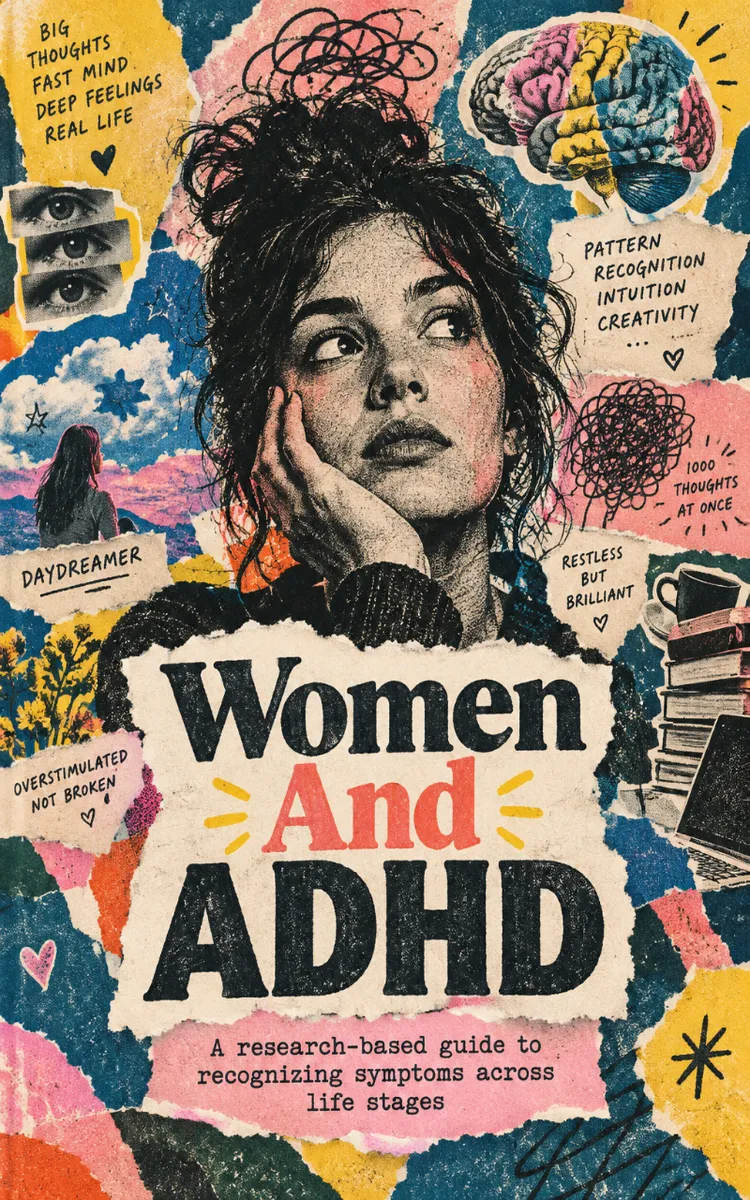
"Women And ADHD" is a health & wellness book by Anonymous with 15 chapters and approximately 24,992 words. ADHD symptoms and presentation in girls and women across life stages.
This book was created using Inkfluence AI, an AI-powered book generation platform that helps authors write, design, and publish complete books. It was made with the AI Health Book Generator.
Frequently Asked Questions
What is "Women And ADHD" about?
ADHD symptoms and presentation in girls and women across life stages
How many chapters are in "Women And ADHD"?
The book contains 15 chapters and approximately 24,992 words. Topics covered include How ADHD Works in Women, Recognizing ADHD in Young Girls, Assessment and Diagnosis for Girls, ADHD During the Teen Years, and more.
Who wrote "Women And ADHD"?
This book was written by Anonymous and created using Inkfluence AI, an AI book generation platform that helps authors write, design, and publish books.
How can I create a similar health & wellness book?
You can create your own health & wellness book using Inkfluence AI. Describe your idea, choose your style, and the AI writes the full book for you. It's free to start.
Write your own health & wellness book with AI
Describe your idea and Inkfluence writes the whole thing. Free to start.
Start writingCreated with Inkfluence AI


