

Read the first chapter
The whole of chapter one, free. About 9 min. Turn the pages with the arrows, your keyboard, or a swipe.
Chapter 1
The Single New Clue Reopens Case
The envelope had no return address, no stamp, and one dark smear along its folded edge when I found it on the records-room counter.
Case Summary: An unsolved killing in Ellison County, at an undetermined location, on an original incident date not yet verified from the incomplete file.
The room smelled of dust, cardboard, and the faint metallic chill pushed through the building’s old vents. I stood beneath the fluorescent lights with the package in my gloved hand, listening to the air conditioner click on and off. The cold case had been closed long enough for its paper labels to fade. Now one anonymous delivery had placed it back in front of me.
What made the package significant was not its size. It was the precision of the item inside: a small, time-stamped object tied by its markings to the original investigation. It might have been genuine evidence. It might have been planted by someone who had studied the case. It might have been a hoax assembled from details no outsider should have known. Before I could recommend reopening anything, I had to establish what the department possessed, what it had lost, and whether the new clue had ever been recorded.
• Date: Original incident date requires verification - Location: Ellison County; precise incident location not confirmed in the incomplete file - Victims: The victim or victims are identified in the original case file, but the surviving records are incomplete - Status: Cold Case
I carried the package to the only clear section of the counter. The records room had been built for shelves, not investigations. Metal cabinets crowded the walls. Boxes leaned against one another in narrow aisles, their handwritten labels softened by years of handling. Somewhere behind me, a fluorescent tube buzzed with the persistence of an insect.
Detective Mara Ellison - I had been assigned to review the new lead, not to inherit the case. My first instruction was simple: verify the anonymous package and decide whether it justified reopening the investigation. That meant resisting the pull of the object itself. A clue could be important without being reliable.
Evidence Technician Rylan Brooks - Rylan was the department’s evidence technician, careful to the point of irritation when a detective wanted speed. He had brought a clean evidence mat, fresh gloves, and a camera from the property unit. He did not touch the envelope until I finished documenting where I had found it.
The Anonymous Sender - Whoever mailed the package knew enough about the old investigation to connect the enclosed item to the original incident. The sender offered no name, explanation, or claim of responsibility. The silence was not proof of deception, but it removed every easy way to test motive.
The Original Investigators - Their work existed in fragments: incident reports, property sheets, photographs, and references to supplemental notes that were not in the box. The missing chain-of-custody material mattered because it could show whether the new item had once passed through official hands.
The Lab Director - The lab director would have to approve any examination that could consume or alter the item. Before that happened, the director required a foundation strong enough to show the package was not simply an elaborate hoax.
Rylan entered carrying a second pair of forceps. “You found it where?”
“On the counter. No one signed for it.”
He looked at the envelope through the clear evidence bag. “Then we start with the room, not the contents.”
The comment slowed me. I had wanted the package open. Instead, I photographed the counter, the surrounding cabinets, and the door. Rylan recorded the time, the condition of the envelope, and the position in which I had found it. The camera shutter sounded too loud in the cramped room.
8:12 a.m. - I was assigned the cold-case review after the anonymous package was brought to the records room. The case had remained inactive, with no current investigative team attached to it.
8:19 a.m. - Rylan and I secured the area and documented the package before opening it. No sender information, delivery receipt, or internal note accompanied the envelope.
8:31 a.m. - The package was opened under controlled conditions. Inside was a compact evidence item sealed in clear plastic, along with a strip of paper bearing a sequence of numbers.
8:36 a.m. - Rylan photographed the item and transferred it into a temporary evidence container. The original packaging was retained separately.
8:44 a.m. - I compared the numbers on the paper with the surviving case index. The sequence did not match the case number, property number, or any date written on the first incident report.
9:02 a.m. - We located the original case box in a locked cabinet marked for inactive investigations. The outer label had been altered at least once; beneath the current writing, an older case designation was visible.
9:17 a.m. - The case file was found to be incomplete. References to supplemental reports and chain-of-custody notes appeared in the index, but those documents were absent from the box.
9:41 a.m. - I reviewed the property sheets and found no direct entry for the enclosed item. Several entries, however, referred generally to material collected during the original incident.
10:06 a.m. [TURNING POINT] - Rylan identified the number sequence as a date-and-time code embedded in the item’s original manufacturing mark. The code placed the object within the period surrounding the original incident.
10:22 a.m. - I requested archived laboratory and property records. The request produced a partial transfer log with a gap covering the same period.
10:48 a.m. - I contacted the lab director and described the item without requesting testing. The director refused to authorize examination until the department could establish that the package had not been fabricated or substituted.
11:15 a.m. - I completed an official request to reopen the cold-case investigation, attaching the photographs, preliminary inventory, and records-gap memorandum.
The item itself was unremarkable at first glance. It had no dramatic stain, no visible fingerprint, no message hidden beneath a flap. Its importance emerged from the numbers. Rylan enlarged the photograph on his monitor and traced the markings with a gloved finger without touching the screen.
“Not a property number,” he said. “Look at the spacing.”
I leaned closer. The plastic reflected the white ceiling lights. “A date?”
“A date and time, if the format is what I think it is.”
“Can you confirm it?”
“Not without the manufacturer’s reference or a comparison sample.” He paused. “But it’s specific enough to test.”
That distinction became the center of the morning. The clue was not proof. It was a claim that could be checked.
Physical Evidence:
• Anonymous envelope: Unmarked by a return address or delivery documentation; its condition was photographed before handling. - Sealed evidence item: A compact object enclosed in clear plastic and tied to the original incident through a specific embedded date-and-time code. - Numbered paper strip: Contained a sequence that did not match the surviving case number or property number but corresponded provisionally to the item’s manufacturing mark. - Original case records: Included property sheets and an index, but the referenced chain-of-custody notes and supplemental reports were missing. - Partial transfer log: Covered the relevant period but contained a gap that prevented a complete comparison with the newly received item.
Witness Accounts:
• Rylan Brooks: Confirmed the package’s condition, assisted with controlled handling, and identified the number sequence as potentially time-based rather than case-based. - Records personnel: Confirmed that the package had been left on the records-room counter and that no standard intake record accompanied it. - Original file references: Indicated that additional evidence documentation had once existed, though no surviving witness statement established what happened to those records.
Investigative Leads:
1. Package origin: The envelope had no traceable sender information. Outcome: the source remained unknown. 2. Item identification: The enclosed object was compared against the surviving property sheets. Outcome: no direct matching entry was found. 3. Date-and-time code: The number sequence was examined as a possible embedded manufacturing mark. Outcome: it placed the item within the period surrounding the original incident, pending laboratory confirmation. 4. Chain of custody: The original index and transfer records were reviewed. Outcome: a significant documentation gap prevented confirmation of the item’s prior custody. 5. Laboratory examination: Testing was requested in principle but not authorized. Outcome: the lab director required proof that the submission was genuine and had not been staged.
By noon, the records room had become a map of absence. Empty folders marked the places where supplemental reports should have been. A property sheet ended in the middle of a transfer line. One cabinet drawer held duplicate forms for unrelated cases but nothing that explained the missing notes.
I called Rylan back to the counter. “If this was once in our system, where would the entry be?”
“Here,” he said, tapping the property index. “Or in the missing supplement.”
“And if it never was?”
“Then the sender built a clue around information that wasn’t supposed to be public.”
“Which makes it more convincing.”
“Or more suspicious.”
He was right. The package had achieved exactly what its sender intended: it forced the old case into motion while withholding the one thing that could make the motion safe.
What Changed: The new evidence was not merely an anonymous object. Its embedded date-and-time code gave it a specific relationship to the original incident, narrowing the period in which it could have entered the case. That connection was preliminary, but it was concrete enough to compare against property records, laboratory logs, and the missing chain-of-custody documentation.
Why It Mattered: Until that moment, the package was only an unverified delivery. Afterward, it became a lead capable of testing the old investigation. The records gap increased the uncertainty, but it also showed that the existing file could not support a final conclusion without further review.
What Followed:
• I preserved the item and its packaging as separate evidence. - Rylan began a formal inventory of every surviving record connected to the original investigation. - I submitted an official request to reopen the case.
The request was still printing when the telephone rang. I answered with one hand while gathering the photographs with the other.
“This is the lab director,” the voice said. “I’ve seen your request.”
“Then you know why I’m asking for an examination.”
“I know why you want one. That isn’t the same thing.”
The printer pushed out the final page. Its rollers squeaked, then stopped.
“What do you need?” I asked.
“Proof the package is not a hoax.”
“I’ve documented the chain from discovery to storage.”
“You’ve documented your handling of an unknown package. You have not shown that the item came from the original investigation.”
“That is what the examination would help establish.”
“And if it was planted yesterday?”
The question settled over the room with the weight of the missing files.
I looked at the clear evidence container on the mat. The object inside remained ordinary, its markings small enough to disappear unless someone knew where to look.
Legal Outcome: No arrest, trial, verdict, or sentencing had occurred. The case remained unsolved, and the reopening request began an investigative review rather than a criminal prosecution.
Impact:
• The cold case was returned to active investigative status for review. - The department’s missing chain-of-custody records became an immediate investigative concern. - The anonymous package created a new line of inquiry while imposing stricter authentication requirements before laboratory testing.
Unresolved Questions:
1. Who sent the package? 2. Was the enclosed item ever collected or transferred during the original investigation? 3. What happened to the missing chain-of-custody notes and supplemental reports? 4. Can laboratory examination confirm the date-and-time code and establish whether the item is connected to the original incident? 5. Was the package intended to reveal the truth, redirect the investigation, or manufacture a false lead?
I signed the reopening request and placed it in the outgoing tray. The case had moved from a locked cabinet to an active file, but the cost of that movement was clear: every conclusion would have to pass through the gap in the record.
Across the room, Rylan sealed the evidence container and wrote the time on its label.
The lab director had not rejected the case. Not yet. But before the first test could begin, we would have to prove that the single new clue was what it claimed to be.
End of chapter one. 30 more chapters in the full book.
Swipe or use the arrows to turn the page


What's inside: 31 chapters
- 1. The Single New Clue Reopens Case
- 2. Sealing the Evidence Intake
- 3. Tracing the Clue’s Time Stamp
- 4. Interviewing the Night-Shift Dispatcher
- 5. Reconciling Dispatch Logs with GPS Routes
- 6. The Missing Officer’s Department File
- 7. Requesting Archived Lab Slides
- 8. Breaking into the Offsite Storage Room
- 9. Interpreting the Missing Index Sheet
- 10. DNA Match That Doesn’t Belong
- 11. Finding the Chain-of-Custody Break
- 12. The Training Program Nobody Remembers
- 13. Following the Alternate Unit’s Paper Trail
- 14. Kestrel Freight at the Vacant Lot
- 15. Interviewing the Rental Driver Witness
- 16. The Hidden Recipient Name in Receipts
- 17. Choosing Which “N” Role Matters
- 18. The Logbook That Wasn’t There
- 19. Appeal to Command for One Week
- 20. Supervised Interview with Celia Grant
- 21. Translating the Code Phrase from Audio
- 22. The Location That Was Demolished
- 23. Mara’s Doubt After Another Dead End
- 24. Re-testing the New Clue Material
- 25. Mapping the Wrong Room Layout
- 26. The Key Code Leads to a Storage Unit
- 27. Tobin Hale’s Confession at Last
- 28. Corroborating the Insider’s Name
- 29. Serving a Warrant on the Accomplice
- 30. Decrypting the Drive Before Court
- 31. Closing the Case with One Last Check
About this book
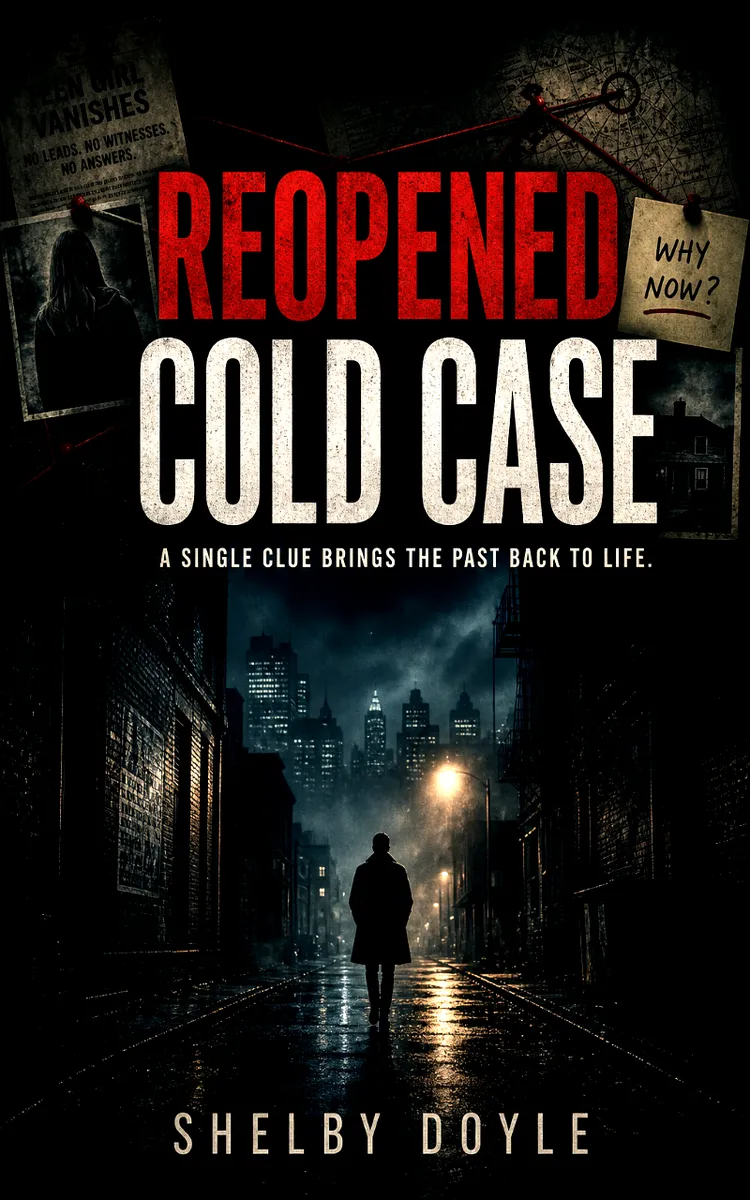
"Reopened Cold Case" is a true crime book by Shelby Doyle with 31 chapters and approximately 78,679 words. A cold-case investigation reignited by one new clue.
This book was created using Inkfluence AI, an AI-powered book generation platform that helps authors write, design, and publish complete books. It was made with the AI True Crime Book Writer.
Frequently Asked Questions
What is "Reopened Cold Case" about?
A cold-case investigation reignited by one new clue
How many chapters are in "Reopened Cold Case"?
The book contains 31 chapters and approximately 78,679 words. Topics covered include The Single New Clue Reopens Case, Sealing the Evidence Intake, Tracing the Clue’s Time Stamp, Interviewing the Night-Shift Dispatcher, and more.
Who wrote "Reopened Cold Case"?
This book was written by Shelby Doyle and created using Inkfluence AI, an AI book generation platform that helps authors write, design, and publish books.
How can I create a similar true crime book?
You can create your own true crime book using Inkfluence AI. Describe your idea, choose your style, and the AI writes the full book for you. It's free to start.
Write your own true crime book with AI
Describe your idea and Inkfluence writes the whole thing. Free to start.
Start writingCreated with Inkfluence AI


