
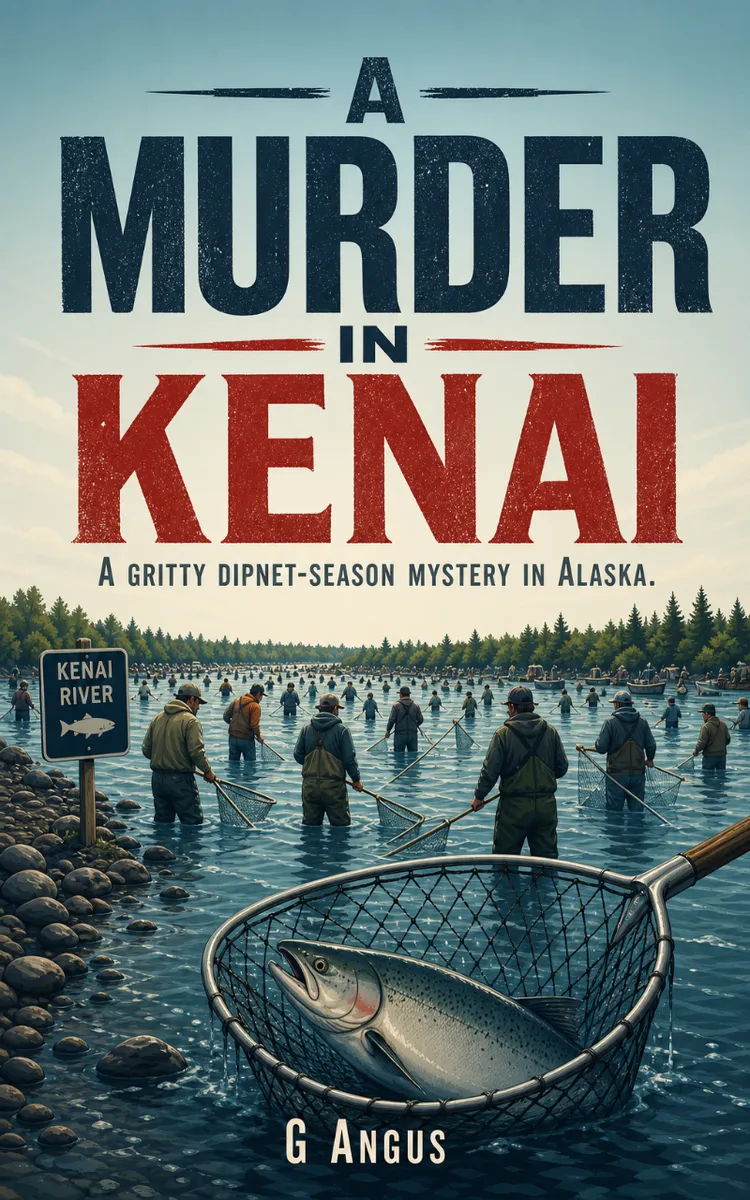

Read the first chapter
The whole of chapter one, free. About 10 min. Turn the pages with the arrows, your keyboard, or a swipe.
Chapter 1
Headless Body on Kenai Beach
The first red salmon slapped against the aluminum cooler before Hank Poole saw the body.
A woman in hip waders shouted and dropped her dipnet. The mesh collapsed over the gravel, silver fish twisting inside it. Around her, the Kenai beach kept moving - coolers dragged through wet stones, children crying, men cursing at the river, hundreds of boots grinding the shoreline into mud beneath the long, pale light of early summer.
Then the woman screamed again.
Hank turned from the access road and saw what the tide had delivered.
It lay half in the shallows, half on the black gravel, clothed in a torn brown jacket and one rubber boot. The head was gone. Not hidden beneath the water. Gone.
For one second, the beach continued as if nothing had changed. A net rose. A fish thrashed. Someone laughed near the driftwood racks.
Then the nearest people saw what Hank was looking at.
“Back up,” he said.
Nobody moved.
Hank pushed through the crowd, shoulder-first. A man holding a salmon stepped into his path.
“Sheriff, what the hell - ”
“Back up.”
The man looked past him. His face emptied.
Hank reached the waterline and stopped six feet from the body. The outgoing tide tugged at the jacket. Dark water slipped beneath the torso and ran back toward the river in thin, red-brown ribbons.
The body had been in the water long enough to swell. The hands were pale and puckered. One sleeve had torn open at the elbow. Around the neck was a ragged wound, black in the center and bright along the edges where the tide washed it clean.
Hank had seen dead men before. He had seen drowned men, frozen men, men opened by machinery and animals. This was different. The absence at the top of the body seemed to pull every eye toward it.
“Everybody off the beach,” Hank said.
A woman behind him began praying. A child asked where the man’s head was.
“Move!” Hank barked.
That worked on some of them. Others raised phones.
Hank spun toward the access road. “Put those away.”
A young man in a soaked rain shell kept his phone lifted. “This is public property.”
Hank crossed the gravel in three strides and slapped the phone from his hand. It struck a cooler and landed in the mud.
The young man stared at him. “You can’t do that.”
“I just did.”
“You assaulted me.”
“Then stand there and explain it to me while I put you in the truck.”
The young man looked at the patrol truck parked above the beach. His mouth tightened, but he bent and picked up the phone.
Hank pointed at the road. “Go.”
The young man went. Not fast. People rarely left quickly when there was death in front of them. They drifted away in clumps, whispering, looking back over their shoulders. The beach did not empty. It tightened.
Dipnetters crowded the access path. Their nets lay abandoned in the gravel, handles crossing like broken spears. Fish flopped in coolers and on tarps. A woman dragged two children toward the parking lot while an old man in a wool cap stood staring at the body with a salmon still clutched in one hand.
Hank walked back to the corpse and took out his radio.
“Dispatch, this is Poole. I need the beach access closed. Send every available deputy. Keep civilians off the shoreline. I’ve got a deceased person.”
He looked at the body.
“Possible homicide.”
The radio crackled. “Copy, Sheriff. Do you need medical?”
“Send them.”
He lowered the radio and saw a man stepping toward the water.
“Stop.”
The man wore chest waders and a camouflage cap. He held a dipnet in one hand and pointed with the other.
“I know that jacket,” he said.
Hank moved between him and the body. “You know it from where?”
“Could be nobody. I’m just saying - ”
“Say it from behind the tape when I get it up.”
“There ain’t any tape.”
“There will be.”
The man looked around at the crowd. “This is my beach too.”
“Not today.”
The man’s jaw worked. He glanced at the body again, then retreated a step.
That was the problem with Kenai. Everybody knew everybody’s truck, boat, dog, wife, brother, drinking habit, and unpaid tab. A body could not wash ashore without dragging half the town’s memory behind it.
A siren sounded from the road.
Hank turned. One of his deputies came down the access slope with a roll of yellow tape and a face gone gray. He had to stop twice to keep from slipping on the wet gravel.
“Get the tape around the whole access,” Hank said. “No one crosses it. Not for fish, not for phones, not for anything.”
The deputy nodded. “What happened?”
“Nothing you need to know yet.”
The deputy looked past him.
Hank caught his arm. “Tape.”
The deputy swallowed and moved.
A woman in a red jacket shoved through the crowd. “My husband’s down there.”
“Name?”
“Tom. He went out before dawn. He’s got a blue Ford and a - ”
“Name.”
She gave it. Hank wrote it on the back of his hand.
“He’s not the body,” Hank said.
“You don’t know that.”
“I know what I’m looking at.”
The woman’s face crumpled. She pushed toward the tape.
Hank caught her by the shoulders. “You stay here.”
“Let go of me.”
“Your husband isn’t the only person on this beach. If you go through that line, everybody follows.”
“My husband - ”
“Is probably in the parking lot gutting fish and wondering why you’re screaming.”
She stared at him, furious and frightened. Behind her, a man called out that someone should cover the body. Another shouted that the head might be farther down the beach.
Hank looked toward the river mouth.
The current rolled hard along the shore, carrying sticks, weeds, and scraps of foam toward the flats. Beyond the crowd, the beach curved north beneath the bluff. If the head had separated in the water, it could be anywhere between the river and the open inlet. Or it could have been taken before the body entered the tide.
He hated the thought because it gave the scene too many directions.
“Deputy,” he called. “Get two people to search the shoreline. Nobody touches anything. Keep them together.”
“Search for what?”
Hank looked at the body.
The deputy’s eyes followed his.
“For the rest of him.”
The words moved through the crowd like a match dropped in dry grass.
A man cursed. Someone retched beside a cooler. One of the children began crying hard enough to choke.
Hank raised his voice. “Everybody off the beach. Now. Leave the fish. Leave the nets. Leave your trucks where they are.”
That brought the anger.
“You can’t shut down dipnetting!”
“I can shut down this access.”
“We waited three hours!”
“Wait somewhere else.”
A broad man with a gray beard stepped forward. “People have rights.”
Hank met his eyes. “The dead man had rights too.”
The beard went silent.
Hank’s radio chirped.
“Sheriff, dispatch. Trooper communications is asking for details.”
Hank pressed the button. “Tell them it’s under control.”
A pause.
“They’re already en route.”
Hank looked up at the road. “Who called them?”
“Medical dispatch notified them.”
“Tell them to stay out of my scene.”
“They say they’re sending detectives.”
“Tell them I didn’t ask for detectives.”
The answer came flat through the radio. “They’re coming anyway.”
Hank shut it off.
Behind him, the deputy finished the tape. It stretched from a driftwood post to the access railing, bright yellow against the gray beach. People pressed against it, filming over one another’s shoulders.
Hank walked the perimeter, forcing them back with his stare and the promise of arrest. He found a child’s red shovel near the water, a torn piece of blue fabric caught on a branch, and a boot print in the mud that did not match the dozens of dipnetting tracks around it.
He crouched beside the print.
The tread was narrow and deep, pointed toward the water. The mud had not filled with tidewater yet. Fresh enough to matter.
A woman’s voice rose behind him. “Sheriff!”
Hank stood.
The old man in the wool cap had dropped his salmon. He was pointing downriver with a shaking hand.
Something pale rolled between the waves.
Hank ran.
The gravel shifted under his boots. Cold water struck his shins as he went in. The thing turned once, showed a curve of white, then vanished beneath a breaking swell.
“Rope!” Hank shouted. “Get me a rope!”
No one moved.
Hank plunged deeper. The current struck his legs and pulled hard. He grabbed at the water, missed, and went down to one knee. Cold flooded his boot. His hand closed around wet hair.
He hauled upward.
A human head came free of the water, gray-faced and swollen, the hair tangled with kelp.
The crowd screamed.
Hank dragged it onto the gravel and rolled it away from the tide. The face was damaged, but not unrecognizable. A deep cut crossed the forehead. The eyes were closed. The mouth hung open, packed with sand.
He stared at it, breathing hard.
The body lay twenty yards away.
The head had not drifted far.
That meant the killer had not thrown them into separate waters. Whoever did this had put the body close to shore, where the tide would bring both pieces back to the same beach.
A vehicle engine growled above the access road.
Hank stood and turned.
Two black State Trooper SUVs came down the slope, tires spitting gravel. The lead vehicle stopped behind the patrol truck. Its doors opened before the engine died.
The crowd shifted toward them, anger replacing fear.
Hank walked up the slope.
A tall trooper in a dark jacket stepped around the hood. He carried a hard case and wore the calm expression of a man arriving late to someone else’s fire.
“Sheriff Poole?”
“You know who I am.”
“Detective Sergeant - ”
“I don’t care.”
The trooper glanced toward the taped beach. “We received a homicide notification.”
“You received a request to stay out.”
“We received no such request.”
“You’re standing in it.”
The trooper looked past him at the crowd, the tape, the body, and the head lying beneath a deputy’s coat.
“What happened?”
Hank stepped closer. “A body washed in. Then the head.”
“Separate discoveries?”
“Same beach.”
The trooper’s gaze sharpened. “Could be a boating accident.”
Hank felt the anger settle into something colder.
“A boating accident doesn’t usually remove a man’s head and leave it twenty yards from his body.”
“Propeller strike.”
“Then where’s the boat?”
“Downriver. Could have drifted.”
“Could have,” Hank said. “You got a lot of those?”
The trooper ignored the question. “We’ll take over the scene.”
Behind him, a woman shouted, “They don’t belong here!”
Another voice answered, “Get them out!”
The crowd surged against the tape. The deputy grabbed the line before it fell.
Hank turned toward the beach. “Everybody back!”
The trooper raised his radio. “Secure the perimeter.”
Hank faced him again. “My deputy is securing it.”
“Not well enough.”
Hank stepped into the trooper’s path. “You don’t give orders on my beach.”
The trooper studied him. “This isn’t your beach.”
“No,” Hank said. “It’s my murder scene.”
For a moment, neither moved. Below them, the tide dragged at the dead man’s jacket. A salmon flopped inside an overturned cooler, beating its tail against the plastic until the sound stopped.
Hank took out his radio.
“Dispatch, notify the district attorney. Notify the medical examiner. I want a full crime-scene team and a boat search along the river mouth.”
The trooper’s expression tightened. “We’ll handle that.”
Hank pressed the button anyway. “And mark the State Troopers as responding without local authorization.”
The crowd heard him. A low, ugly murmur rolled across the beach.
The trooper came close enough that Hank could see rain beaded on his eyelashes.
“You’re making this harder than it needs to be.”
Hank looked down at the taped shoreline, at the head beneath the deputy’s coat, at the people who had come to catch salmon and now stood watching the state take possession of their dead.
“No,” he said. “You are.”
The trooper lifted his radio and began issuing orders.
Hank stayed where he was, blocking the road as long as he could. Then the second SUV rolled past him toward the beach, and the crowd broke open around it.
The scene was no longer his to contain.
The troopers had arrived, and every person on the Kenai beach knew the fight had just changed hands.
End of chapter one. 29 more chapters in the full book.
Swipe or use the arrows to turn the page


What's inside: 30 chapters
- 1. Headless Body on Kenai Beach
- 2. Troopers Refuse Hank’s Boundaries
- 3. The Victim’s Name Hits Hard
- 4. Dipnetters Block the River Roads
- 5. Hank’s Old Case Comes Back
- 6. A Boat Trailer Vanishes
- 7. Troopers Chase the Wrong Timeline
- 8. The Tide Erases the Tracks
- 9. Lena Finds a Secret Text Thread
- 10. The Guide’s Locker Opens Wrong
- 11. A Witness Recants Under Pressure
- 12. Troopers Seize the Evidence Bag
- 13. Hank Confronts the Guide’s Widow
- 14. The Condition Costs Hank a Favor
- 15. The Tidepool Clue Matches the Text
- 16. A Trusted Helper Goes Missing
- 17. Lena Chooses Between Truth and Safety
- 18. The Troopers Raid a Boathouse
- 19. The Staged Item Points to a Frame
- 20. The Widow’s Proof Turns Against Her
- 21. Hank Breaks His Own Rules
- 22. Troopers Arrest the Wrong Man
- 23. The River Takes Another Secret
- 24. Lena Maps the Dipnetting Routes
- 25. A Hidden Camp Near the Flats
- 26. The Boathouse Fire Confirms Motive
- 27. Hank Forces the Real Story Out
- 28. Troopers Finally Admit Hank Was Right
- 29. Lena Releases the Full Route Proof
- 30. Red Salmon Season Ends With Justice
About this book
"A Murder In Kenai" is a fiction book by G Angus with 30 chapters and approximately 59,279 words. A headless body murder mystery during Kenai dipnetting season.
This book was created using Inkfluence AI, an AI-powered book generation platform that helps authors write, design, and publish complete books. It was made with the AI Novel Writer.
Frequently Asked Questions
What is "A Murder In Kenai" about?
A headless body murder mystery during Kenai dipnetting season
How many chapters are in "A Murder In Kenai"?
The book contains 30 chapters and approximately 59,279 words. Topics covered include Headless Body on Kenai Beach, Troopers Refuse Hank’s Boundaries, The Victim’s Name Hits Hard, Dipnetters Block the River Roads, and more.
Who wrote "A Murder In Kenai"?
This book was written by G Angus and created using Inkfluence AI, an AI book generation platform that helps authors write, design, and publish books.
How can I create a similar fiction book?
You can create your own fiction book using Inkfluence AI. Describe your idea, choose your style, and the AI writes the full book for you. It's free to start.
Write your own fiction book with AI
Describe your idea and Inkfluence writes the whole thing. Free to start.
Start writingCreated with Inkfluence AI


