
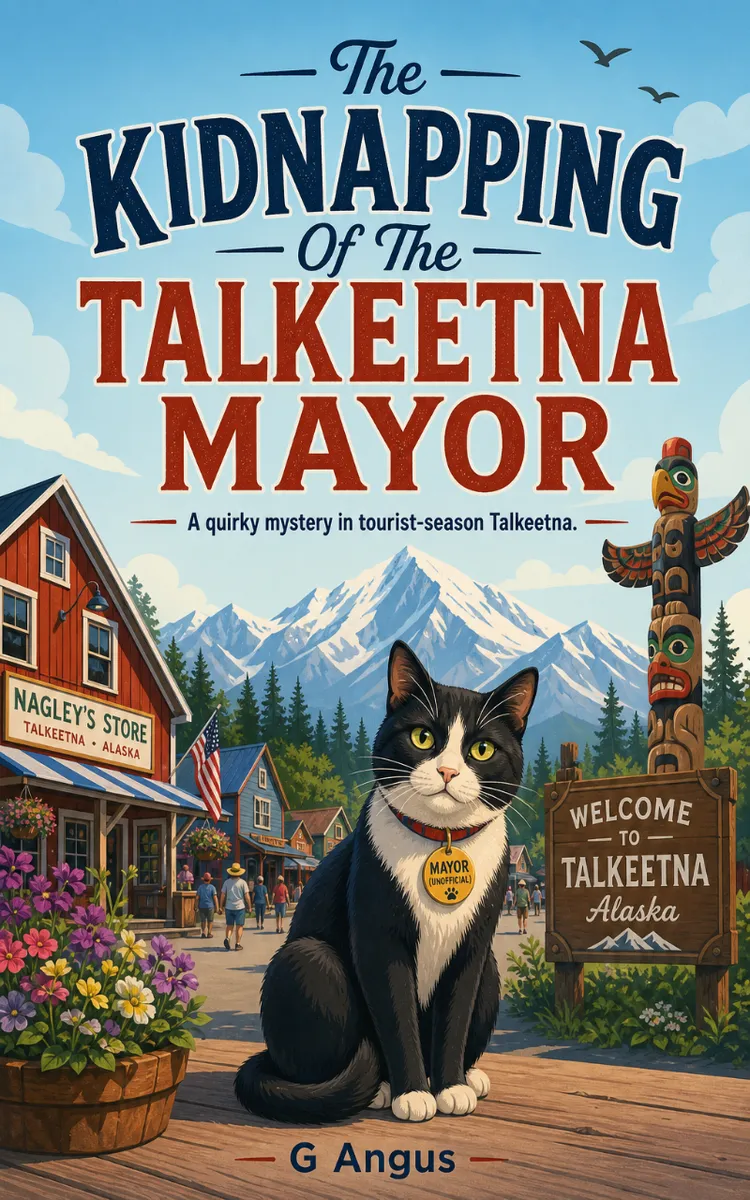

Read the first chapter
The whole of chapter one, free. About 9 min. Turn the pages with the arrows, your keyboard, or a swipe.
Chapter 1
Aurora Vanishes at Midnight Solstice
At midnight, the river stage clock coughed out its final chime, and Aurora vanished.
Tara Finch was close enough to see the mayor-cat’s silver collar flash beneath the strings of blue festival lights. One moment Aurora sat on the velvet cushion beside the Solstice microphone, supervising the speeches with the grave expression of a small official who had heard too many promises about fish. The next, the cushion rocked gently, empty except for one pale whisker.
The crowd did not notice at first. Everyone was looking up at the sky, where a green ribbon of northern light had appeared above the dark river.
Tara looked down.
“Aurora?” she called.
The festival grounds pressed around her in a cheerful, impossible tangle. Tourists crowded the boardwalk with cameras and paper cups. Children waved glow sticks. Someone near the food tents was playing a fiddle too enthusiastically, and the river stage speakers gave a soft electronic whine. Summer in Talkeetna meant tourists in every available patch of town, and tonight they had filled the Solstice festival grounds until even the mosquitoes seemed to be stepping around one another politely.
Tara climbed onto the edge of the stage.
“Has anyone seen Aurora?”
A woman in a yellow raincoat turned from the aurora borealis. “The lights are right there.”
“The cat,” Tara said. “The mayor.”
That traveled faster than any announcement.
“The mayor’s missing?”
“Aurora?”
“Who took the cat?”
Tara felt the crowd tilt toward panic. She raised both hands.
“Nobody move,” she called. “She may be under the stage.”
A man holding three souvenir mugs immediately moved.
“Please don’t move,” Tara said.
He stopped with one foot in the air, which did not improve the situation.
Tara slid off the stage and crouched near the velvet cushion. Aurora’s little wooden mayoral sign lay crooked beside it. The cushion was warm from the stage lamps. Beneath the stage, cables looped through dust and old bottle caps. No cat.
She reached behind a speaker and found a mitten, a plastic spoon, and a rubber fish. Not Aurora.
“Keep the aisle clear,” she told the nearest volunteer. “And find the festival marshal.”
The volunteer stared at her. “Should we call the police?”
“Yes.”
“Which police?”
Tara opened her mouth, then shut it. Talkeetna had several people who owned radios and one person who had once worn a police hat in a parade. None of that seemed useful at midnight.
“Call everyone with a radio,” she said. “Tell them Aurora is missing. Tell them not to frighten the crowd.”
A tall man in a wool cap pushed forward. “I saw the German tourist near the stage.”
Tara turned. “Which German tourist?”
“The one with the enormous backpack.”
“There are four German tourists with enormous backpacks.”
“This one had a camera.”
“So do most of the people here.”
“He was looking at Aurora.”
“Everyone was looking at Aurora. She was onstage.”
The man’s certainty wobbled but did not fall. Around him, heads turned toward the river path, where a blond tourist stood beside a folding map. He wore a red jacket despite the mild night and carried a camera with a lens the size of a soup thermos.
“There!” someone shouted. “That’s him!”
The tourist glanced around, alarmed.
“I did not take the cat,” he said.
No one had asked him yet.
Tara stepped between him and the gathering crowd. “Back up. All of you. This is a festival, not a lynch mob.”
A woman with a paper crown pointed at the tourist. “He was by the stage.”
“So were you.”
“I was buying fudge.”
“Then the fudge can confirm your alibi.”
The woman looked offended by the suggestion that fudge might be required to testify.
The German tourist lifted both hands. “I only photographed the mayor. She is very famous.”
“She is,” Tara said. “And she is missing.”
His face changed. “Missing?”
“Did you see anyone near her?”
He swallowed and looked toward the stage. “A man in a yellow slicker. He carried something.”
“What kind of something?”
“A box, perhaps. Or a bag. It was dark.”
The wool-capped man made an eager noise. “The tourist saw the German.”
“He is the German,” Tara said.
“That’s not what I meant.”
“It rarely is.”
A burst of feedback shrieked from the speakers. The crowd flinched, and in that instant Tara saw movement at the edge of the grounds: a figure slipping between the craft stalls, heading away from the river stage.
Yellow slicker.
Tara ran.
She cut behind a booth selling carved moose magnets, nearly collided with a woman holding a tray of berry tarts, and ducked beneath a string of paper suns. The ground changed from packed dirt to damp grass. Her boots slid. Behind her, someone shouted that the German was escaping, followed by the German shouting that he was not.
The figure in the yellow slicker disappeared behind the portable toilets.
Tara rounded the corner and found only a toppled trash bin, a torn festival banner, and a trail of crushed spruce needles leading toward the service lane.
She followed it.
The lane ran between the back of the stage and a row of parked vans. Generator fumes tickled her throat. Music from the festival came through the canvas walls in muffled bursts, cheerful and distant, as if the party belonged to another town.
Tara stopped beside the first van.
A small blue pet carrier sat behind it.
Empty.
She crouched. The carrier door hung open. Inside, a scrap of red blanket clung to the wire grate. One of Aurora’s silver collar bells lay in the grass.
Tara did not touch it.
“Aurora?” she whispered.
No answer came from the carrier, the vans, or the river beyond them.
Footsteps slapped behind her. The festival marshal arrived, breathless and wearing a sash that read FESTIVAL MARSHAL in letters large enough to guide aircraft.
“What did you find?”
“An empty carrier.”
He peered at it. “That’s bad.”
“It’s not good.”
“Could she have left voluntarily?”
Tara stared at him.
“She’s a cat,” he said. “They do that.”
“She’s also the mayor.”
“Mayors leave voluntarily too.”
A shout rose from the festival grounds.
“There he is! Stop him!”
Tara stood. Through the gap between the vans, she saw the German tourist being shepherded - or chased - toward the lane by half a dozen furious townspeople. His camera bounced against his chest. He looked as if he had accidentally wandered into a very poorly organized parade.
“I didn’t do anything!” he cried.
The wool-capped man pointed at him. “He had a bag!”
“I have a camera bag!”
“Where is the cat?”
“I do not know the cat!”
Tara stepped into the lane. “Enough!”
The crowd slowed, though nobody seemed willing to admit they had been running.
Tara held up one hand. “Nobody touches anyone. Nobody blocks the road. Nobody decides this tourist is guilty because he owns luggage.”
“He was seen by the stage,” said the woman with the paper crown.
“So was Aurora.”
A murmur moved through the crowd.
Tara looked at the German tourist. “What is your name?”
“Lukas,” he said. “Lukas Weber.”
“Lukas, did you see a person in a yellow slicker?”
“Yes. I told you.”
“And did that person carry Aurora?”
“I do not know. The box was covered.”
“What did the person do?”
Lukas pointed toward the service lane. “Walked quickly. Then stopped when the clock rang. I thought he was waiting for the fireworks.”
“There were no fireworks,” Tara said.
“I am learning many things about this festival.”
Someone behind her muttered, “Convenient.”
Tara turned sharply. “The next person who says ‘convenient’ can explain to the mayor why they delayed the search.”
That quieted them.
For three seconds.
Then the festival loudspeaker crackled. A voice, thin with panic, announced, “Attention, everyone. Please remain calm. The mayor-cat has - ”
Tara lunged for the microphone cable, but the announcement continued.
“ - apparently been kidnapped.”
The word rolled across the grounds.
Kidnapped.
It landed harder than missing. People gasped. A child began to cry. Someone dropped a tray of spruce-tip cookies. The fiddle stopped halfway through a tune.
Tara looked back at the empty carrier.
The red blanket. The loose bell. The open door.
Not wandering. Not hiding beneath the stage. Aurora had been taken.
The crowd surged toward her.
“Who did it?”
“Where’s the German?”
“Search his backpack!”
“He should be arrested!”
Lukas backed into a van. “Why are they saying this?”
“Because everyone here has become an expert,” Tara said.
A woman grabbed for his camera bag.
Tara caught her wrist - not hard, but firmly enough to stop her. “No.”
“He could have hidden her in there.”
“It’s the size of a sandwich.”
“A very determined cat could fold.”
“Aurora is not origami.”
The woman released the bag.
Tara turned to the festival marshal. “Get Lukas somewhere safe. The community hall. Keep the door locked from the inside.”
“But they think he did it.”
“They think the moon is following them when they drive. Move.”
The marshal hesitated, then led Lukas away through the crowd. People parted reluctantly, whispering German tourist as if it were a criminal profession.
Tara knelt beside the carrier again. The metal was cold. Its blue plastic sides were scratched near the latch, but the scratches looked old. She leaned closer.
Something clung to the lower hinge: a thread of yellow fabric.
The slicker.
She reached for her radio, then remembered she did not have one. She had left it charging in the town office after the afternoon parade, where it had been joined by three dead flashlights and a bowl of mints nobody trusted.
Instead, she pulled out her phone and photographed the carrier, the bell, and the thread.
A shadow crossed the lane.
Tara looked up.
At the far end, beyond the vans, a figure in a yellow slicker stood beneath the swinging glow of a security lamp. The face was hidden by a hood. The figure raised one hand - not waving, exactly. More like offering a tiny salute.
Then it turned and vanished behind the old bait shed.
Tara ran again.
The path narrowed between stacked crates and a fence patched with driftwood. She reached the shed just as a door banged shut. Inside, something clattered.
“Stop!” she shouted.
No answer.
Tara grabbed the handle and pulled. The door opened onto darkness, empty shelves, and a single puddle shining beneath the window. The back door stood ajar. Beyond it lay the riverbank, black water sliding past in the midnight light.
She stepped inside.
On the floor, beside a smear of mud, lay a torn scrap of yellow fabric.
Tara picked it up with two fingers.
From the festival grounds came another roar.
“Lukas Weber took Aurora!”
Tara closed her eyes for half a second.
The empty carrier had given her a direction. The yellow thread had given her a clue. The crowd had given itself a suspect.
She slipped the fabric into a clean paper napkin from her pocket and looked toward the river.
Somewhere beyond the shed, the known troublemaker of Talkeetna had carried Aurora into the night - or had arranged for someone else to make it look that way.
Behind Tara, the crowd began marching toward the community hall.
Ahead, the river kept its own counsel.
End of chapter one. 27 more chapters in the full book.
Swipe or use the arrows to turn the page


What's inside: 28 chapters
- 1. Aurora Vanishes at Midnight Solstice
- 2. The German Tourist Gets Blamed Fast
- 3. Aurora’s Collar Tag Tells a Story
- 4. Mara Breaks Into the Wrong Shed
- 5. Troublemaker Rafe Smiles at Mara
- 6. Solstice Lanterns Go Missing Too
- 7. Who Cut the Lantern Rope?
- 8. The River Trail Turns Into Quicksand Gossip
- 9. Mara Questions Her Own Motives
- 10. A Map Case Appears in Town Hall
- 11. The Note Mentions Aurora’s “Audience”
- 12. Stage Crew Vanishes From Their Own Schedule
- 13. Rafe Haskins Offers a Trade
- 14. Midpoint: Aurora’s Fur Leads to a Cabin
- 15. Mara Escapes the Trap Door
- 16. The Key Opens a Storage Dumpster
- 17. Aurora’s Carrier Sits Under the Pier
- 18. Mara Confronts the Mayor’s Council
- 19. A Tourist Map Leads to a Secret Stage
- 20. Rafe’s Alibi Cracks Under Pressure
- 21. The German Tourist’s Patience Runs Out
- 22. Search Party Gets Stuck in Fog
- 23. Aurora’s Script Page Falls in Mara’s Hands
- 24. Mara Traps the Misdirection Machine
- 25. The Kidnapper’s Big Reveal Backfires
- 26. Aurora Returns to Her Mayor Duties
- 27. The Town’s Conspiracy Theories Get Sorted
- 28. Mara Finch Keeps Aurora’s Secret Smile
About this book
"The Kidnapping Of The Talkeetna Mayor" is a fiction book by G Angus with 28 chapters and approximately 60,160 words. A cat mayor is kidnapped during a Solstice festival..
This book was created using Inkfluence AI, an AI-powered book generation platform that helps authors write, design, and publish complete books. It was made with the AI Novel Writer.
Frequently Asked Questions
What is "The Kidnapping Of The Talkeetna Mayor" about?
A cat mayor is kidnapped during a Solstice festival.
How many chapters are in "The Kidnapping Of The Talkeetna Mayor"?
The book contains 28 chapters and approximately 60,160 words. Topics covered include Aurora Vanishes at Midnight Solstice, The German Tourist Gets Blamed Fast, Aurora’s Collar Tag Tells a Story, Mara Breaks Into the Wrong Shed, and more.
Who wrote "The Kidnapping Of The Talkeetna Mayor"?
This book was written by G Angus and created using Inkfluence AI, an AI book generation platform that helps authors write, design, and publish books.
How can I create a similar fiction book?
You can create your own fiction book using Inkfluence AI. Describe your idea, choose your style, and the AI writes the full book for you. It's free to start.
Write your own fiction book with AI
Describe your idea and Inkfluence writes the whole thing. Free to start.
Start writingCreated with Inkfluence AI


