
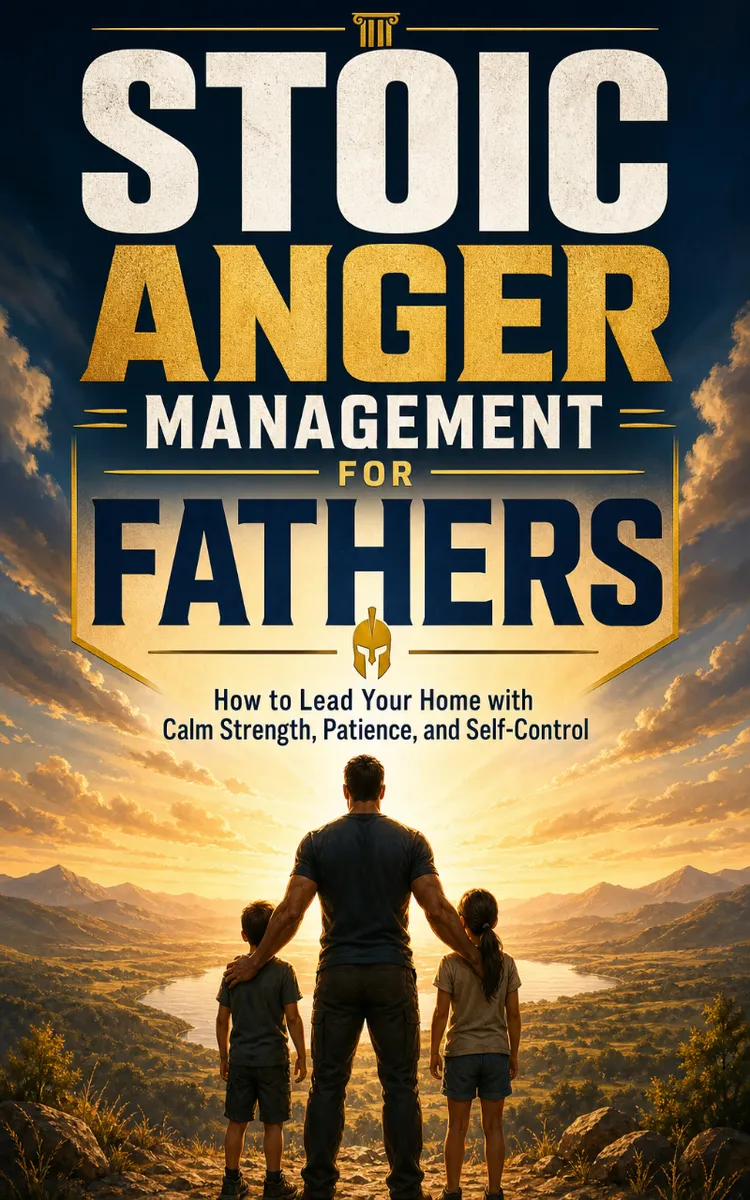
Stoic Anger Management For Fathers
Created with Inkfluence AI
Stoic-based anger management and emotional leadership for fathers
Table of Contents
- 1. Redefining Anger as a Signal
- 2. Separating What’s Yours to Control
- 3. The Virtue Compass for Fatherhood
- 4. Breaking the Trigger-Story Loop
- 5. Practicing Stoic Pause Under Pressure
- 6. Choosing Response Over Reaction
- 7. Calm Strength Without Harshness
- 8. Patience as a Skill, Not a Mood
- 9. Self-Control Through Pre-Decided Rules
- 10. The “Stop, Name, Choose” Reset
- 11. Repairing After You Slip
- 12. Discipline That Teaches, Not Attacks
- 13. Using Words That De-Escalate
- 14. Listening Like a Stoic
- 15. Setting Boundaries Without Guilt
- 16. Handling Disrespect With Dignity
- 17. Managing Anger Triggers From Exhaustion
- 18. Pre-Training for the Hardest Moments
- 19. Building a Home Culture of Calm
- 20. Living the Stoic Father Commitment
Preview: Redefining Anger as a Signal
A short excerpt from “Redefining Anger as a Signal”. The full book contains 20 chapters and 28,722 words.
Picture This
“Anger isn’t the fire. It’s the smoke alarm.” Darren used to hate hearing that line-mostly because it sounded like something people say right before they hand you a pamphlet. But one Tuesday night, after a long shift, it stopped feeling like a slogan and started feeling like truth.
He was a shift supervisor, and he’d just gotten home. The kids were loud, the kitchen was a mess, and the smallest thing-his partner asking him to “just take care of one thing”-hit him like a shove. His chest tightened, his jaw locked, and within seconds he was talking too sharp, too fast. The words came out before he even felt ready to choose them. Then came the familiar cleanup: the apology, the self-blame, the promise that he’d do better “next time.” Next time always arrived.
Here’s the question he couldn’t stop asking: What if anger isn’t your problem… but your early warning system-and you’ve been treating it like a personal failure?
The Mindset Shift
Old Belief: Anger is who you are.
If you get angry, it means you’re the kind of man who can’t handle his emotions, or you don’t care enough, or you’re just “wired wrong.”
New Reality: Anger is information.
It’s an early signal that something inside you is trying to protect you-before it turns into words you can’t take back.
That shift matters because it changes what you do in the moment. If anger is a character flaw, then the only “solution” is to suppress it, argue with it, or feel guilty until it fades. Suppression usually turns into bigger explosions later (sometimes quieter, but still sharp). Guilt doesn’t cool your body down-it just adds heat.
But if anger is information, you stop treating it like a moral verdict and start treating it like a message. Not “I’m bad,” but “Something is asking for attention.” That’s the difference between reacting and responding. You can still feel the surge. You just don’t have to drive the car.
Take Darren’s Tuesday night. The moment he felt that tight chest, his old belief made him ask, “Why can’t I be calmer?” That question dragged him into shame, and shame made him more defensive. The new reality changes the question to, “What is my anger protecting right now?” Maybe it’s protecting his need for rest. Maybe it’s protecting his sense of competence-like he’s getting pulled in every direction and no one notices how hard he’s trying. Once he asks that, he can respond with calm strength: “I’m home and I’m overloaded. Give me 10 minutes, and then I’ll handle that.” Same man, different outcome.
Now here’s the key: anger doesn’t just show up because you’re “mean.” It shows up because your mind thinks something is at risk-time, respect, control, safety, energy, fairness. Your job isn’t to pretend the risk isn’t real. Your job is to check what your mind is signaling and decide how to act.
Going Deeper
Stoics didn’t treat emotions like enemies. They treated them like events-happening in you, not proof about you. Anger rises fast because it’s built to move you. It’s supposed to protect you when you sense pressure or disrespect. The trouble is, at home, the “threat” is often misunderstood. Your mind might label noise as danger, fatigue as disrespect, or a simple request as an attack on your worth. That’s when anger stops being useful protection and starts hijacking your leadership.
The Stoic move is not “don’t feel anger.” It’s “don’t confuse anger with truth.” Your anger can be loud and still be wrong about what’s happening. That’s why the Anger-to-Action Signal Map matters: it helps you translate the signal into the action your home actually needs.
When Darren felt that surge, his anger wasn’t a random mood. It was a signal. The map helps him catch it early enough to choose a response that keeps trust intact.
Here are signs this pattern might be running your life:
1. You treat anger like a test you failed. After you snap, you spend more time hating yourself than figuring out what you were protecting in the first place.
2. Your body reacts before your values do. Tight chest, hot face, clenched jaw-then the words. You’re not choosing; you’re being taken.
3. You only notice anger when it’s already too late. The “warning smoke” is there, but you don’t read it until it’s a full fire.
4. You apologize, but the pattern repeats with different details. Same emotional shape, different trigger. That’s not bad luck-that’s a predictable signal loop.
En résumé: Anger is your mind’s alarm system-your job is to read the alarm, not punish yourself for the noise.
So what does the Anger-to-Action Signal Map actually do? It links three things:
- Anger signal (what you feel): the heat, the rush, the defensive urge
- Protection need (what your mind thinks is at risk): rest, respect, fairness, control, safety, competence
- Next action (what your home needs from you): a pause, a boundary, a request for time, a repair, or a calm instruction
...
About this book
"Stoic Anger Management For Fathers" is a self-help book by Socratic Mastery with 20 chapters and approximately 28,722 words. Stoic-based anger management and emotional leadership for fathers.
This book was created using Inkfluence AI, an AI-powered book generation platform that helps authors write, design, and publish complete books. It was made with the AI Self-Help Book Writer.
Frequently Asked Questions
What is "Stoic Anger Management For Fathers" about?
Stoic-based anger management and emotional leadership for fathers
How many chapters are in "Stoic Anger Management For Fathers"?
The book contains 20 chapters and approximately 28,722 words. Topics covered include Redefining Anger as a Signal, Separating What’s Yours to Control, The Virtue Compass for Fatherhood, Breaking the Trigger-Story Loop, and more.
Who wrote "Stoic Anger Management For Fathers"?
This book was written by Socratic Mastery and created using Inkfluence AI, an AI book generation platform that helps authors write, design, and publish books.
How can I create a similar self-help book?
You can create your own self-help book using Inkfluence AI. Describe your idea, choose your style, and the AI writes the full book for you. It's free to start.
Write your own self-help book with AI
Describe your idea and Inkfluence writes the whole thing. Free to start.
Start writingCreated with Inkfluence AI


