
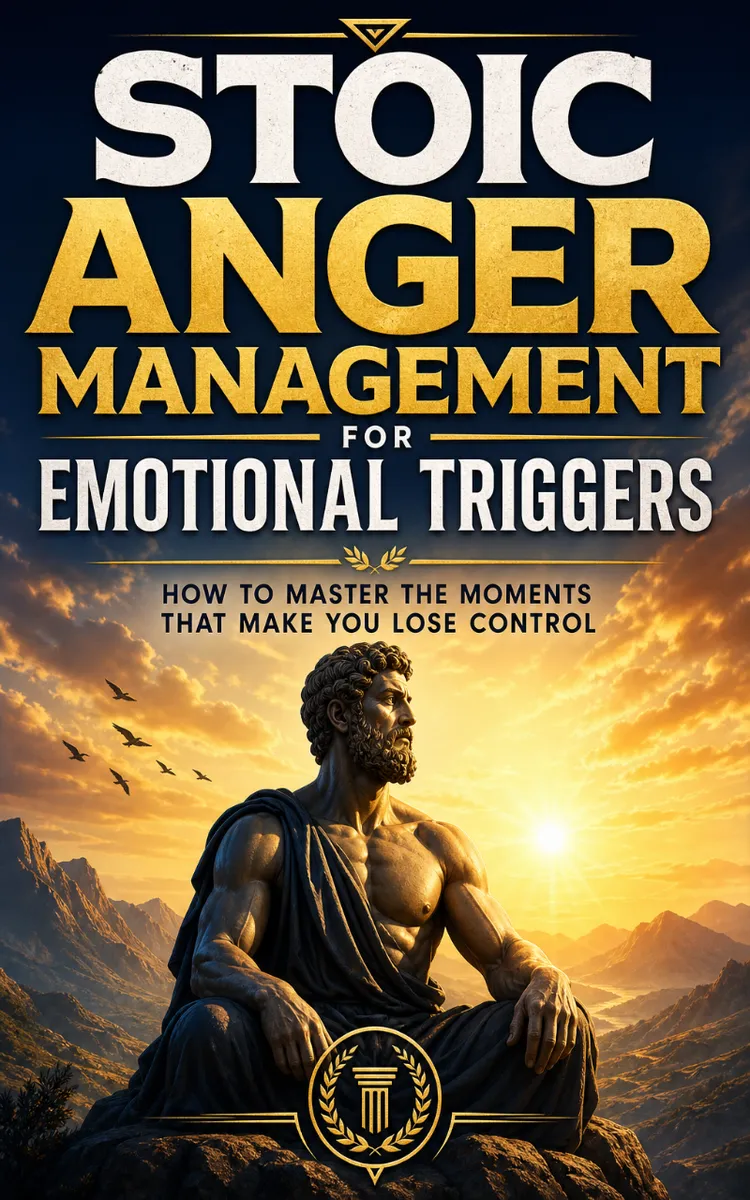
Stoic Anger Management For Emotional Triggers
Created with Inkfluence AI
Stoic-based strategies to manage anger from emotional triggers
Table of Contents
- 1. Spot Your Anger Trigger Map
- 2. Separate What You Control From Chaos
- 3. Name the Thought Behind the Feeling
- 4. Rebuild Your Identity as a Stoic
- 5. Dismantle Catastrophizing in Seconds
- 6. Practice the Pause-Then-Respond Rule
- 7. Use the Stoic “View From Above”
- 8. Train Your Body to De-Escalate
- 9. Turn Irritation Into Information
- 10. Set Boundaries Without Losing Control
- 11. Stop Mind-Reading With the Evidence Check
- 12. Handle Rejection Like a Stoic
- 13. Speak With the Virtue of Justice
- 14. Replace Revenge Urges With the “Next Right Action”
- 15. Build a Personal “Reasonable Response” Standard
- 16. Practice Pre-Trigger Rehearsal With Premeditation
- 17. Recover Fast After You Slip
- 18. Strengthen Resilience With Negative Visualization
- 19. Align Your Anger With Purposeful Values
- 20. Maintain Control With a Daily Stoic Review
Preview: Spot Your Anger Trigger Map
A short excerpt from “Spot Your Anger Trigger Map”. The full book contains 20 chapters and 28,671 words.
Picture This
Have you ever felt your anger “arrive” before you can even explain why? Like it sneaks up behind your ribs the second the phone buzzes, the second your kid twists a word wrong, the second your coworker smirks-or the second someone questions your work like you’re on trial. You react fast, then later you try to replay it like a detective story. But the facts don’t line up. Sometimes it’s the same person, sometimes it’s not. Sometimes it’s a small comment, sometimes it’s a whole chain of events. And you end up thinking, Why can’t I just be normal about this?
Here’s the tension: you’re treating your anger like a mystery, but it’s usually more like a pattern. For Darius, a warehouse supervisor at 34, it looked like this: the moment his shift handoff felt “messy,” his body would tighten-jaw first, then chest-before he even heard what the other person did. He’d snap over tone. He’d correct too hard. He’d make it a bigger deal than it needed to be. And later he’d swear he wasn’t even that mad-until he remembered exactly how his body felt right before the outburst.
If your anger is predictable, why are you still treating it like a surprise?
The Mindset Shift
Old Belief: My anger shows up out of nowhere, so I just have to “control myself” in the moment.
New Reality: My anger follows a reliable path-situation → thoughts → body cues-so I can spot it early and interrupt the pattern.
That shift matters because control-only thinking makes you fight the wrong battle. If you assume the anger is random, you keep trying to wrestle it after it’s already in full swing. That’s like trying to stop a moving truck by stepping in front of it and yelling “STOP!” You’ll feel busy. You’ll even feel strong. But you’re still using the wrong timing.
When you start seeing anger as a path, you stop asking, “Why am I like this?” and start asking, “What did my mind and body do right before it?” That’s a different kind of power-quiet, early, and actually usable. For Darius, the big unlock wasn’t “be calmer.” It was noticing that the trigger wasn’t only the handoff problem. It was the moment he noticed the handoff was going to cost him extra work and the way his brain interpreted that as disrespect or incompetence.
Concrete example: one afternoon, a worker handed off a pallet count that didn’t match the log. Darius felt the familiar tightness-shoulders up, breath shallow-then his thoughts jumped in with: They’re careless. They’re going to make me look bad. He didn’t need to “choose” anger. It was already being assembled. Once he recognized that sequence, he could pause at the body cue and run a quick check: Is this the old pattern starting? That one question didn’t make the pallet magically match. But it changed how fast he moved from interpretation to explosion.
A Stoic angle fits here: you’re not trying to suppress a feeling. You’re trying to understand what’s happening to your judgments. Your anger is often your judgment showing up early-before you’ve tested it. Spotting the Trigger Constellation Map is how you catch the judgment while it’s still forming, not after it’s already driving.
Going Deeper
Anger doesn’t usually start as “rage.” It starts as attention. Something grabs your focus, and your mind builds a story fast-about blame, disrespect, danger, unfairness, embarrassment, loss of control. Then your body joins in like it’s on the same team: tight throat, clenched jaw, heat in the face, stomach drop, restless energy in the legs, that “ready to pounce” feeling.
The Trigger Constellation Map is built on the idea that your trigger isn’t a single star. It’s a cluster. In Darius’s case, it wasn’t just “messy shift handoff.” It was the combination of: (1) being put on the spot publicly, (2) feeling like someone didn’t respect the process, (3) the thought I’m going to get blamed, and (4) the body cue of jaw tightness that arrives like a warning light. When those stars line up, his anger shows up like clockwork.
So the goal isn’t to erase your trigger. The goal is to see it. When you can name the constellation, you can interrupt the chain earlier-before your mouth does damage your brain has to clean up later.
Signs this pattern is running your life:
1. You can predict the moment anger arrives-sometimes within seconds-because your body always gives you the same early cue. If you’ve noticed jaw clenching, heat, tight chest, or a “snap-ready” feeling, that’s not random. That’s your map.
2. Your thoughts get sharper and meaner right after the situation hits, even if the facts haven’t changed. You go from “this is inconvenient” to “they’re disrespectful” or “I always get stuck with this.”
3. You react to tone or implication more than the actual content. Someone’s wording, timing, or facial expression becomes the “evidence,” and your anger treats it like a courtroom exhibit.
4....
About this book
"Stoic Anger Management For Emotional Triggers" is a self-help book by Socratic Mastery with 20 chapters and approximately 28,671 words. Stoic-based strategies to manage anger from emotional triggers.
This book was created using Inkfluence AI, an AI-powered book generation platform that helps authors write, design, and publish complete books. It was made with the AI Self-Help Book Writer.
Frequently Asked Questions
What is "Stoic Anger Management For Emotional Triggers" about?
Stoic-based strategies to manage anger from emotional triggers
How many chapters are in "Stoic Anger Management For Emotional Triggers"?
The book contains 20 chapters and approximately 28,671 words. Topics covered include Spot Your Anger Trigger Map, Separate What You Control From Chaos, Name the Thought Behind the Feeling, Rebuild Your Identity as a Stoic, and more.
Who wrote "Stoic Anger Management For Emotional Triggers"?
This book was written by Socratic Mastery and created using Inkfluence AI, an AI book generation platform that helps authors write, design, and publish books.
How can I create a similar self-help book?
You can create your own self-help book using Inkfluence AI. Describe your idea, choose your style, and the AI writes the full book for you. It's free to start.
Write your own self-help book with AI
Describe your idea and Inkfluence writes the whole thing. Free to start.
Start writingCreated with Inkfluence AI


