
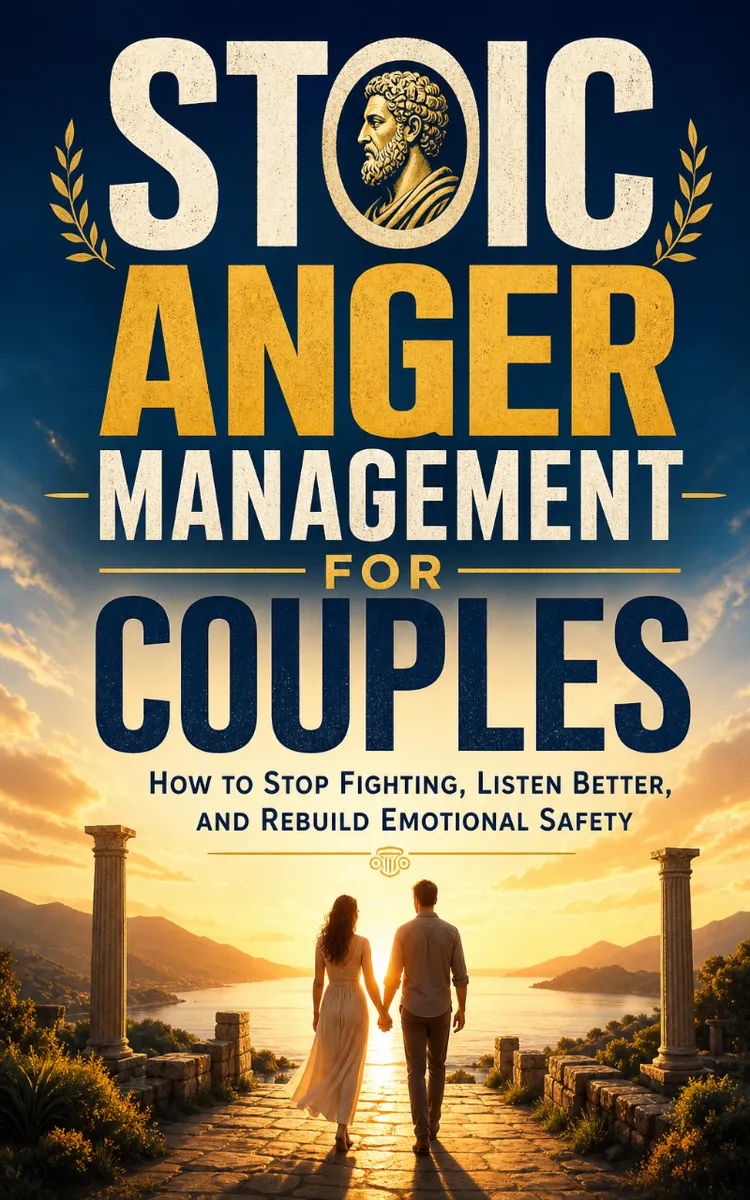
Stoic Anger Management For Couples
Created with Inkfluence AI
Stoic-based anger management and communication for couples
Table of Contents
- 1. Spot the Anger Cycle Early
- 2. Separate Facts From Judgments
- 3. Control What’s Up to You
- 4. Use Stoic Reframing for Triggers
- 5. Choose Virtues Over Winning
- 6. Build a Shared Conflict Agreement
- 7. Stop Mind-Reading With One Check
- 8. Speak in ‘I Statements’ That Land
- 9. Listen With the ‘Mirror and Ask’ Method
- 10. Use the 90-Second Pause Reset
- 11. Turn ‘You Always’ Into Specific Requests
- 12. Practice Calm Repair After a Slip
- 13. Set ‘No-Name’ Rules for Insults
- 14. Handle Silence Without Abandonment
- 15. Stop Escalating With ‘Proof’ Battles
- 16. Manage Shame and Defensiveness
- 17. Rebuild Trust With Micro-Consistency
- 18. Create a Weekly ‘Repair & Plan’ Check-in
- 19. Practice Stoic Journaling for Couples
- 20. Sustain Emotional Safety Through Meaning
Preview: Spot the Anger Cycle Early
A short excerpt from “Spot the Anger Cycle Early”. The full book contains 20 chapters and 28,325 words.
Picture This
You’re standing in the kitchen for the third time in ten minutes, holding the same mug, watching your partner’s face tighten like a drawstring. It starts small-one sentence that lands wrong. You feel it in your chest before you even “decide” to be upset. Then the tone changes. They’re not just saying the words anymore; they’re aiming them.
Nadia, 32 and a pediatric nurse, knows this exact rhythm. After a long shift, she comes home with her head still full of little voices and urgent needs. Her partner asks about dinner, she answers, and somehow it becomes a debate about who forgot what, who didn’t listen, who “always” brings the mood home. By the time someone says, “You’re doing it again,” the argument has already turned into a machine-one that keeps running even when both people are tired.
Can you spot the first spark of escalation-before it turns into the full STOP-START Loop?
The Mindset Shift
Old Belief: If we just say the right thing, the argument will calm down.
New Reality: Escalation isn’t a “talking problem”-it’s a pattern. If you interrupt the pattern early, the words have a chance.
Most people think the fix is better communication: speak nicer, explain more clearly, prove your point. But when you’re inside the STOP-START Loop, your brain isn’t trying to solve the issue-it’s trying to protect you. Nadia feels it after her shifts: her body reads tension as danger. Her partner’s tone reads like disrespect. Then thoughts flip on fast, like lights in a hallway: They’re attacking me. I have to set the record straight. If I don’t push back, I’ll get steamrolled. Those thoughts don’t stay thoughts. They drive feeling, and feeling drives action-usually the exact action that escalates things.
Here’s the concrete example Nadia noticed once she started paying attention to the first signs. Someone says, “You didn’t even ask what I wanted.” Nadia’s old move was to jump in with facts-fast, sharp, and detailed. But the new move wasn’t “be nicer.” It was this: she checked the moment before she answered. When she felt her jaw tighten and her mind race, she labeled it internally: Escalation is starting. Then she chose a different action-she slowed her response by ten seconds and asked a question instead of defending.
That small shift matters because the STOP-START Loop feeds on speed. The loop doesn’t just happen because of the topic; it happens because each person’s early signals give the other person permission to escalate. Interrupt the signals early, and you don’t need perfect words-you just need a different starting move.
Going Deeper
So what is the STOP-START Loop, really? It’s what your relationship does when anger shows up like an unexpected guest. One person’s tension rises (even subtly), and the other person reacts to that tension. The argument “starts” from a disagreement, but then it “stops” any real problem-solving because the brain gets pulled into threat mode. After that, the loop restarts-same topic, same defensive energy, same results.
When Nadia finally mapped her pattern, she realized escalation had a predictable shape. It wasn’t random. There were early warning signs, like the first flicker of a flame before the whole stove catches. Once she could recognize those signs, she didn’t have to wait for the argument to explode. She could interrupt the loop while it was still small enough to bend.
Here are the most common signs this pattern is running your life:
1. You feel yourself “speed-reading” their tone. You’re not just hearing words; you’re interpreting attitude immediately. If you catch yourself thinking, They’re mad at me on purpose, that’s a sign escalation is already in motion.
2. Your body goes first (before your mind). Tight jaw, shallow breath, heat in your face, hands that want to gesture more. Nadia noticed she’d start clenching her mug so hard her fingers hurt-before she even spoke.
3. Your first sentence becomes a defense, not a connection. Even if you don’t raise your voice, the structure is: accusation → explanation. That’s the STOP of real listening.
4. You start collecting evidence like it’s court. “Remember when…” “I always…” “You never…” Once your brain starts filing receipts, the argument has shifted from problem-solving to winning.
En résumé: When you catch the body + tone + first sentence combo early, you can stop the STOP-START Loop before it locks in.
Reflection & Self-Assessment
Use these questions to spot escalation in real time-because the goal isn’t to be calm all the time. The goal is to recognize the moment the loop is starting so you can interrupt it.
1. What’s the earliest physical sign you notice-before you speak?
Try to name it like you’re describing it to a coworker: “jaw tight,” “stomach drops,” “breath gets shallow.” Nadia’s earliest sign was the clench in her hands and the urge to answer fast.
2....
About this book
"Stoic Anger Management For Couples" is a self-help book by Socratic Mastery with 20 chapters and approximately 28,325 words. Stoic-based anger management and communication for couples.
This book was created using Inkfluence AI, an AI-powered book generation platform that helps authors write, design, and publish complete books. It was made with the AI Self-Help Book Writer.
Frequently Asked Questions
What is "Stoic Anger Management For Couples" about?
Stoic-based anger management and communication for couples
How many chapters are in "Stoic Anger Management For Couples"?
The book contains 20 chapters and approximately 28,325 words. Topics covered include Spot the Anger Cycle Early, Separate Facts From Judgments, Control What’s Up to You, Use Stoic Reframing for Triggers, and more.
Who wrote "Stoic Anger Management For Couples"?
This book was written by Socratic Mastery and created using Inkfluence AI, an AI book generation platform that helps authors write, design, and publish books.
How can I create a similar self-help book?
You can create your own self-help book using Inkfluence AI. Describe your idea, choose your style, and the AI writes the full book for you. It's free to start.
Write your own self-help book with AI
Describe your idea and Inkfluence writes the whole thing. Free to start.
Start writingCreated with Inkfluence AI


