
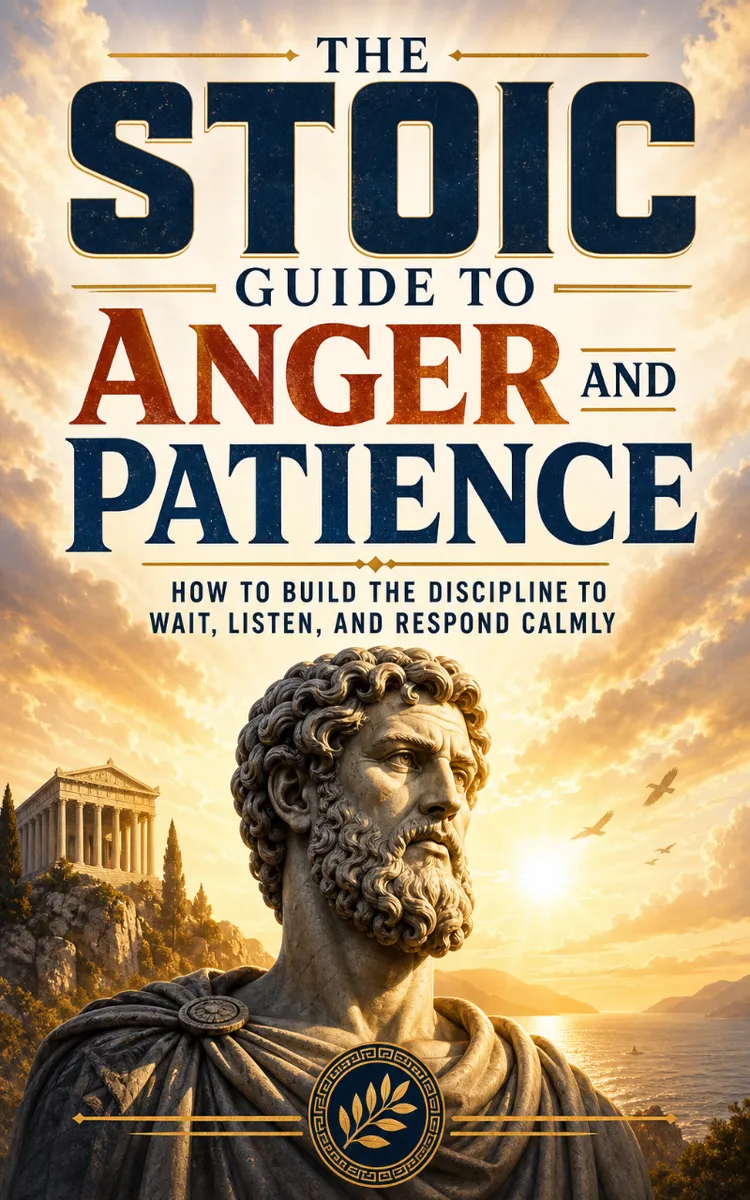
The Stoic Guide to Anger and Patience
Created with Inkfluence AI
Stoic-based strategies for managing anger and practicing patience
Table of Contents
- 1. Recognize Anger’s First Signal
- 2. Separate Events From Interpretations
- 3. Choose Your Response Over Reaction
- 4. Use the Stoic Pause Prayer
- 5. Apply the Dichotomy of Control
- 6. Replace Demands With Preferences
- 7. Audit Your Anger Beliefs
- 8. Train Virtue as Your Goal
- 9. Practice Premeditation for Calm
- 10. Build a Waiting Habit Loop
- 11. Listen for Meaning, Not Victory
- 12. Speak Using the One-Sentence Rule
- 13. Respond With the Three-Step Method
- 14. Set Boundaries Without Anger
- 15. Handle Criticism Like a Stoic
- 16. Defuse Rumination With Mental Noting
- 17. Recover Fast After You Slip
- 18. Practice Negative Visualization for Patience
- 19. Turn Stress Into Training Fuel
- 20. Live the Stoic Patience Standard
Preview: Recognize Anger’s First Signal
A short excerpt from “Recognize Anger’s First Signal”. The full book contains 20 chapters and 28,112 words.
Picture This
Have you ever felt anger “warming up” before you even said the first sharp thing? Like it starts as a tightness in your chest, then your thoughts get louder-They’re doing this on purpose. And somehow, before you know it, you’re already responding like you’re in a fight, not a conversation.
Dante, 34, a warehouse supervisor, knows that moment too well. He’s moving between pallets, coordinating the night crew, and trying to keep things tight. Then one of the orders comes in wrong-again. The printer spits the labels, but the numbers don’t match the system. Dante walks over, checks once, checks twice, and the irritation ramps up fast. His jaw locks. His hands get restless. He starts planning what he’ll say-exactly how he’ll make it clear that this can’t keep happening. By the time the other person opens their mouth, Dante’s already halfway through his response.
What if you could catch anger in the “warm-up” stage-before it becomes your words or your actions?
The Mindset Shift
Old Belief: Anger starts when you feel it.
New Reality: Anger starts earlier-when your body and mind send the first alarm signals.
That sounds small, but it changes everything. If you treat anger like it’s inevitable once you “feel it,” you’ll only start working when damage is already underway-either in your tone, your timing, or the choices you make while you’re activated. But if you learn to recognize the early cues, you get a real gap. Not a magical one. A practical one. The kind you can use.
Here’s the difference in Dante’s world. When the labels are wrong, the anger moment usually shows up as a decision: “I’m going to correct this person-firmly.” That’s the point where most people try to control themselves, and control is hard when your body is already revved. The Early-Alarm Scan flips the timing. Dante starts noticing the first physical shift (jaw tightening, shoulders lifting), the emotional shift (a quick surge of “this is unfair” or “this is disrespect”), and the thought shift (the blame story snapping on like a light). When he catches those early signals, he can pause long enough to ask, “What’s the actual problem we need to solve?” instead of “Who messed up?”
Try this mindset shift as a simple reframe you can repeat during the day: anger isn’t only a feeling-it’s a chain reaction. Feelings come later. Signals come first. Your job isn’t to “be nicer.” Your job is to notice the alarm before you act.
Going Deeper
Anger has stages. The early stage is easy to miss because it doesn’t feel dramatic-it feels like “I’m just getting ready to respond.” Your body signals first. Your mind follows. Then your mouth or hands take over. Most people only recognize anger once it’s already in motion, which is why “just calm down” rarely works. You can’t calm down your way out of a reaction you’re already inside.
The Early-Alarm Scan is about catching the chain reaction at the start. Early means earlier than your first harsh sentence. It means you’re watching for the first specific cues that show up right before you turn from listener into judge. For Dante, it might be the same pattern every time: jaw tightness within 10-20 seconds of realizing an error, the “they’re careless” thought showing up before he hears the other explanation, and the sudden urge to speed up his speech like he’s trying to win time.
You don’t need to eliminate anger. You need to interrupt the momentum.
Here are signs this pattern is running your life:
1. Your body tightens before your words do. You feel it in your jaw, chest, or hands-like you’re bracing for impact.
2. Your thoughts start narrating intent. You move from “this is a problem” to “they meant to” or “they don’t care.”
3. Your attention narrows. You stop listening for details and start scanning for evidence that supports your frustration.
4. You feel urgency to correct. Not solve-correct. Like if you don’t respond right now, you’ll lose control of the situation.
En résumé: Anger doesn’t begin with a shout-it begins with early body and thought signals you can learn to spot.
Reflection & Self-Assessment
1. Right before you get sharp, what’s the first physical cue you notice (even slightly)?
It might be jaw tension, heat in your face, tight shoulders, or a quick “snap” in your breathing. Be honest-even if it feels minor.
2. What thought shows up first: “Let’s fix this,” or “They’re wrong on purpose”?
If you notice you jump to intent, that’s a strong early-alarm signal. For Dante, it’s the “they’re careless” story that often appears before he asks a question.
3. Do you feel an urge to speed up-your speech, your decisions, your tone?
Urgency is a clue. When your brain feels time pressure, it tries to win faster, not understand better.
4....
About this book
"The Stoic Guide to Anger and Patience" is a self-help book by Socratic Mastery with 20 chapters and approximately 28,112 words. Stoic-based strategies for managing anger and practicing patience.
This book was created using Inkfluence AI, an AI-powered book generation platform that helps authors write, design, and publish complete books. It was made with the AI Self-Help Book Writer.
Frequently Asked Questions
What is "The Stoic Guide to Anger and Patience" about?
Stoic-based strategies for managing anger and practicing patience
How many chapters are in "The Stoic Guide to Anger and Patience"?
The book contains 20 chapters and approximately 28,112 words. Topics covered include Recognize Anger’s First Signal, Separate Events From Interpretations, Choose Your Response Over Reaction, Use the Stoic Pause Prayer, and more.
Who wrote "The Stoic Guide to Anger and Patience"?
This book was written by Socratic Mastery and created using Inkfluence AI, an AI book generation platform that helps authors write, design, and publish books.
How can I create a similar self-help book?
You can create your own self-help book using Inkfluence AI. Describe your idea, choose your style, and the AI writes the full book for you. It's free to start.
Write your own self-help book with AI
Describe your idea and Inkfluence writes the whole thing. Free to start.
Start writingCreated with Inkfluence AI


