
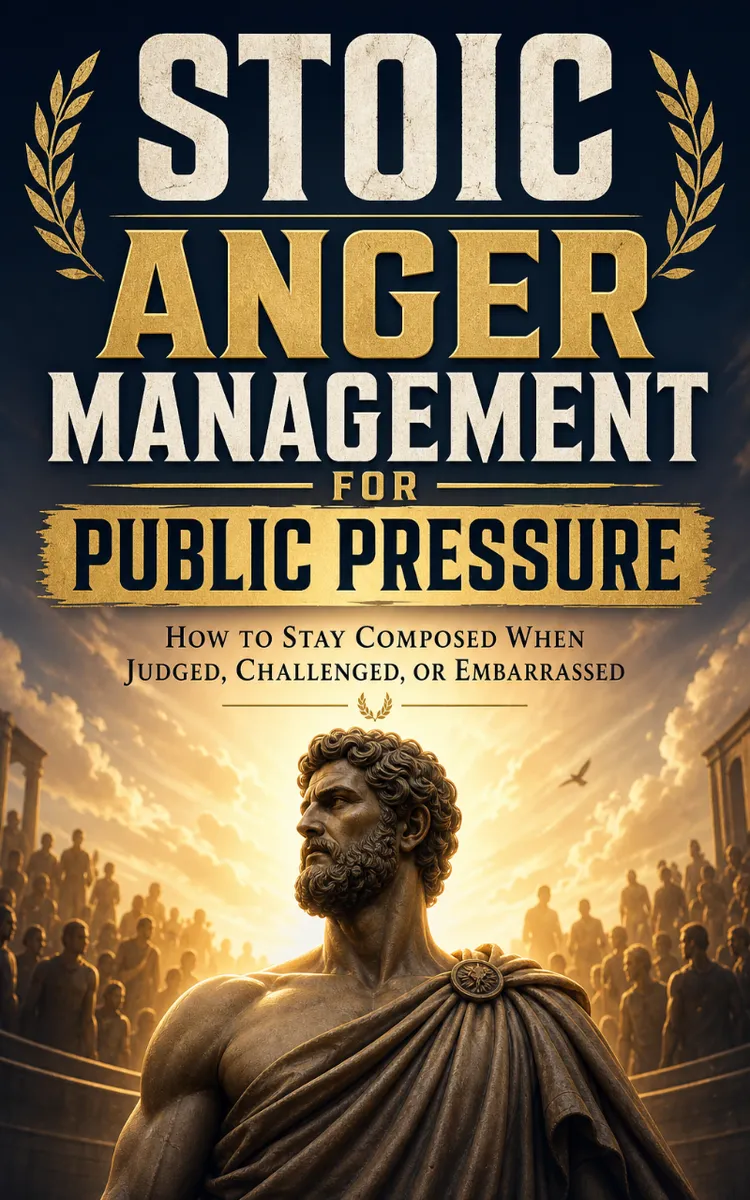
Stoic Anger Management for Public Pressure
Created with Inkfluence AI
Stoic-based strategies to manage anger under public pressure
Table of Contents
- 1. Separating Identity From Public Judgment
- 2. Replacing Hot Thoughts With Stoic Commands
- 3. The Two-Track Control Map
- 4. Training the Pause Before You Respond
- 5. Reframing Embarrassment Into Training Data
- 6. Letting Go of Winning the Moment
- 7. Using Negative Imagination for Calm
- 8. Turning Blame Into Useful Boundaries
- 9. The ‘Assume Good Intent’ Without Naivety
- 10. Managing Shame With Stoic Self-Respect
- 11. Speaking With the ‘Measured Tone’ Skill
- 12. Responding to Attacks Without Retaliation
- 13. The ‘What Would a Mentor Do?’ Filter
- 14. Building a Pre-Event Stoic Routine
- 15. Handling Online Judgement Without Doomscrolling
- 16. Repairing After a Blow-Up With Grace
- 17. Practicing Moral Courage Under Scrutiny
- 18. Releasing Control of the Crowd’s Verdict
- 19. Turning Anger Into Focused Action
- 20. Becoming Unshakeable Through Daily Stoic Review
Preview: Separating Identity From Public Judgment
A short excerpt from “Separating Identity From Public Judgment”. The full book contains 20 chapters and 28,728 words.
Picture This
Have you ever watched yourself get judged in real time and felt your body react before your brain even caught up? Like your heart speeds up, your face heats, and suddenly every stare or comment feels like a verdict. Maybe it happens at work when a customer’s tone turns sharp and you can’t tell if you’re being blamed or just misunderstood. Or maybe it’s online-someone screenshots your words, adds a snarky caption, and now you’re not just reading criticism… you’re trying to survive it.
Talia, 31, a customer support manager, knows that feeling too well. She’ll be mid-conversation with a customer-trying to stay helpful, calm, professional-when the chat shifts. The customer starts with “Seriously?” and ends with “You don’t get it.” Then there’s the silence after she sends her response. You can practically feel the room (or the notifications) waiting for you to mess up. And later, when she sees people scrolling past her comments or typing “wow” like it’s a weapon, she’ll replay the whole thing like evidence in a trial: This proves I’m not good enough. This proves I’m the problem.
How do you stop treating other people’s reactions as proof of who you are-especially when it feels personal?
The Mindset Shift
Old Belief: Criticism, stares, and online reactions are information about my worth.
New Reality: Criticism, stares, and online reactions are information about what’s happening-not proof of your identity.
That shift sounds simple, but it hits the nerve that anger loves to grab. Anger is often trying to protect your identity-your “place,” your dignity, your reputation. The problem is that when you treat public evaluation as identity, you don’t just feel annoyed. You feel attacked at the core. And then you’re stuck trying to win a case that can’t be won, because you can’t control what people assume, misunderstand, or exaggerate.
Here’s the concrete difference. When Talia gets a nasty customer message, she used to read it like a diagnosis: They think I’m incompetent, so I must be incompetent. Her anger would rise, and she’d either snap back in a colder tone or over-explain until she sounded defensive. Now she uses what I call the Identity Firewall: she draws a mental line between “this is feedback” and “this is who I am.” The customer’s message becomes a signal about the interaction-tone, clarity, boundaries-not a verdict on her character.
So instead of “They’re attacking me,” she moves to “They’re expressing frustration.” That doesn’t mean she ignores the issue or accepts bad behavior. It means she can respond without turning it into a personal identity emergency. The same words, the same situation-different internal story, and suddenly her body has room to breathe.
Think about the moment that usually sparks you. Is it when someone stares at you like you’re embarrassing? Is it when a comment gets likes, and it feels like the crowd agrees with the harsh interpretation? The Mindset Shift is the pause that stops your brain from treating those signals as a mirror. A mirror reflects what’s in front of it. It doesn’t define your face.
Going Deeper
The Identity Firewall works because it separates two things that get tangled under pressure: evaluation and identity. Evaluation is about behavior, choices, outcomes, and communication. Identity is about your value, your character, and your “right to exist in public.” Stoicism doesn’t ask you to deny evaluation. It asks you to stop assigning it the job of proving your worth.
When you don’t have that separation, your mind starts doing identity math: They disliked it → They’re judging me → I’m bad. That math is emotionally efficient. It gives you a clear story fast. But it’s also a trap. People react from their mood, their bias, their misunderstanding, their hunger for drama, their need to feel superior. Even when criticism is accurate, it still isn’t automatically a verdict on your entire identity. It’s one piece of reality, not the whole story.
This is where Stoicism helps in a very practical way: you only get to control your judgment, your intentions, and your actions. You don’t control what someone posts, how they interpret you, or whether strangers pile on. The Identity Firewall keeps you from outsourcing your self-respect to the crowd’s attention span.
Signs this pattern is running your life
1. You feel your identity tighten when you get a delayed reply, a “seen” message, or a short response that doesn’t match your effort. It’s not the logistics-it’s the meaning you assign.
2. You replay public moments like a courtroom transcript, trying to find the exact sentence that “proved” you were wrong or embarrassing.
3. You can’t separate “one bad interaction” from “I’m the kind of person who can’t handle things.” Your mind turns a moment into a label.
4. You start managing other people’s opinions instead of managing your own conduct. You become less focused on what’s right and more focused on what will look good.
...
About this book
"Stoic Anger Management for Public Pressure" is a self-help book by Socratic Mastery with 20 chapters and approximately 28,728 words. Stoic-based strategies to manage anger under public pressure.
This book was created using Inkfluence AI, an AI-powered book generation platform that helps authors write, design, and publish complete books. It was made with the AI Self-Help Book Writer.
Frequently Asked Questions
What is "Stoic Anger Management for Public Pressure" about?
Stoic-based strategies to manage anger under public pressure
How many chapters are in "Stoic Anger Management for Public Pressure"?
The book contains 20 chapters and approximately 28,728 words. Topics covered include Separating Identity From Public Judgment, Replacing Hot Thoughts With Stoic Commands, The Two-Track Control Map, Training the Pause Before You Respond, and more.
Who wrote "Stoic Anger Management for Public Pressure"?
This book was written by Socratic Mastery and created using Inkfluence AI, an AI book generation platform that helps authors write, design, and publish books.
How can I create a similar self-help book?
You can create your own self-help book using Inkfluence AI. Describe your idea, choose your style, and the AI writes the full book for you. It's free to start.
Write your own self-help book with AI
Describe your idea and Inkfluence writes the whole thing. Free to start.
Start writingCreated with Inkfluence AI


