
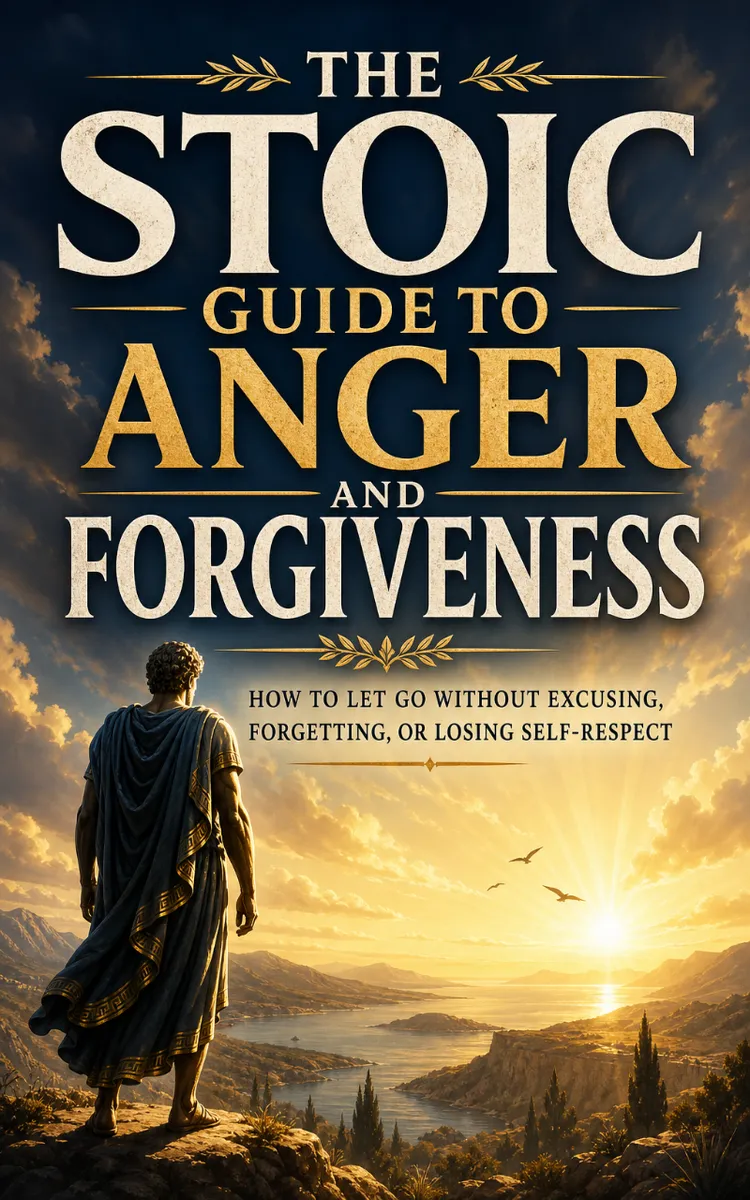
The Stoic Guide to Anger and Forgiveness
Created with Inkfluence AI
Stoic methods for managing anger and practicing forgiveness
Table of Contents
- 1. Anger as a Signal, Not a Command
- 2. Own Your Part Without Owning Blame
- 3. Separate Judgment from the Event
- 4. The Stoic Pause: 10 Breaths to Choose
- 5. Letting Go Without Excusing
- 6. Refuse the ‘Forgive Equals Forget’ Myth
- 7. Build Boundaries That Don’t Punish
- 8. Stop Seeking Closure from the Offender
- 9. Challenge the ‘They Owe Me’ Story
- 10. Use ‘What’s Up to Me’ in Real Time
- 11. Reframe Anger as Fuel for Virtue
- 12. The Forgiveness Ladder: From Release to Repair
- 13. Speak the Truth Without Burning Bridges
- 14. Stop Rumination with the ‘Three-Point Cut’
- 15. Forgive While Keeping Consequences
- 16. The Self-Respect Test for ‘Too Much’ Forgiveness
- 17. Practice Voluntary Discomfort to Stay Free
- 18. Turn Apologies into Lessons, Not Leverage
- 19. Live the New Story: From Wound to Wisdom
- 20. Ongoing Maintenance: Daily Stoic Anger Checks
Preview: Anger as a Signal, Not a Command
A short excerpt from “Anger as a Signal, Not a Command”. The full book contains 20 chapters and 29,432 words.
“Anger is not the boss of you. It’s the alarm.”
Picture this: you’re halfway through your day, and then it hits-an email, a comment, a tone of voice that lands like a slap. You feel it in your chest before you even have words for it. Your hands get a little tighter. Your mind starts building a case: They did it on purpose. They disrespect me. They’re going to keep doing it if I don’t shut it down.
Now the tension: part of you wants justice and protection. Another part knows that if you obey this heat, you’ll say something you can’t take back. You’ll “win” the moment and lose something more important-your self-respect, your relationships, your own ability to sleep at night. So the real question isn’t whether you’ll feel anger-it’s what you’ll do with it.
Picture This
Marcus Vale, 34, is a paramedic. He’s seen enough emergencies to know that panic spreads fast. So when a coworker snaps at him over something small-something that wasn’t even dangerous-Marcus feels the same quick surge he’s trained to recognize: adrenaline, heat, the urge to respond sharply.
It’s not that he’s “mean.” It’s that his body is trying to solve a problem. His mind fills in the blanks: disrespect, threat, unfairness. He imagines the scene replaying-his coworker’s face, the tone, the way everyone else might have noticed. And suddenly Marcus is standing there with a choice he hates: let the anger drive, or let his values drive while the anger screams in the passenger seat.
Will you treat anger like a signal-or like a command?
The Mindset Shift
Old Belief: If I feel angry, I have to act angry.
New Reality: Feeling anger is information; obeying it is a decision.
Most people don’t realize how quickly “feeling” turns into “doing.” Anger arrives like a smoke alarm: loud, urgent, impossible to ignore. But a smoke alarm doesn’t mean you throw water on the neighbors or start swinging your arms. It means you check the room.
Stoics make a sharp distinction that matters here: anger is a reaction-a feeling that arises. Obedience to anger is when you treat that feeling as authority over your choices. That’s the split. You don’t control whether the alarm goes off. You control whether you treat the alarm like the fire chief.
Here’s a concrete example from Marcus. His coworker’s tone feels disrespectful, and Marcus’s first impulse is to fire back with the same bite. He can almost taste the words. But Marcus pauses and notices something: the anger isn’t just about the coworker. It’s protecting something-his dignity, his competence, the teamwork he needs to do his job safely. Once he identifies what it’s protecting, he can respond in a way that honors that value without becoming reckless.
Instead of snapping, Marcus says calmly, “I hear you. Let’s talk about what happened and what you need from me.” The coworker might still be wrong. Marcus might still be annoyed. But he’s no longer letting anger pick his words.
The shift matters because forgiveness without boundaries is usually just anger disguised as silence. The Stoic way is different: you can be kind without surrendering your standards. You can let the anger tell you what matters and still choose a response that doesn’t cost you your self-respect.
Going Deeper
The Stoics aren’t trying to make you emotionless. They’re trying to make you free. Anger often comes with a story attached: This shouldn’t have happened. I’m being harmed. Someone violated my rights. That story can be partially true-sometimes people really do cross lines. But the Stoics would say: even if the story has facts, you still get to decide what those facts require from you.
Think of the Signal-to-Choice Map. Anger is the signal. Your job is to translate the signal into a choice.
When Marcus feels anger, his body is saying, “Something important is at risk.” The “something” might be respect, safety, fairness, or competence. That’s the protective function. The danger is when the signal becomes the steering wheel. That’s what “obeying” looks like: you answer before you’ve decided.
Here’s what that looks like in plain terms: you can feel the heat and still choose your next sentence. You can admit, privately, “I’m angry” without acting like anger is the only voice worth listening to. That’s how dignity stays intact.
Signs this pattern is running your life
1. You confuse intensity with truth. The angrier you feel, the more certain you become that your interpretation is the whole story.
2. You treat delay as weakness. When you pause, you worry you’ll look “soft,” so you rush to respond and then regret it.
3. You only know two settings: explode or swallow. Either you blow up, or you freeze and fume-both are obedience, just in different costumes.
4. You keep paying the price later. The moment passes, but your body stays tense, your sleep gets worse, or you rehearse the argument like it’s still happening.
...
About this book
"The Stoic Guide to Anger and Forgiveness" is a self-help book by Socratic Mastery with 20 chapters and approximately 29,432 words. Stoic methods for managing anger and practicing forgiveness.
This book was created using Inkfluence AI, an AI-powered book generation platform that helps authors write, design, and publish complete books. It was made with the AI Self-Help Book Writer.
Frequently Asked Questions
What is "The Stoic Guide to Anger and Forgiveness" about?
Stoic methods for managing anger and practicing forgiveness
How many chapters are in "The Stoic Guide to Anger and Forgiveness"?
The book contains 20 chapters and approximately 29,432 words. Topics covered include Anger as a Signal, Not a Command, Own Your Part Without Owning Blame, Separate Judgment from the Event, The Stoic Pause: 10 Breaths to Choose, and more.
Who wrote "The Stoic Guide to Anger and Forgiveness"?
This book was written by Socratic Mastery and created using Inkfluence AI, an AI book generation platform that helps authors write, design, and publish books.
How can I create a similar self-help book?
You can create your own self-help book using Inkfluence AI. Describe your idea, choose your style, and the AI writes the full book for you. It's free to start.
Write your own self-help book with AI
Describe your idea and Inkfluence writes the whole thing. Free to start.
Start writingCreated with Inkfluence AI


