
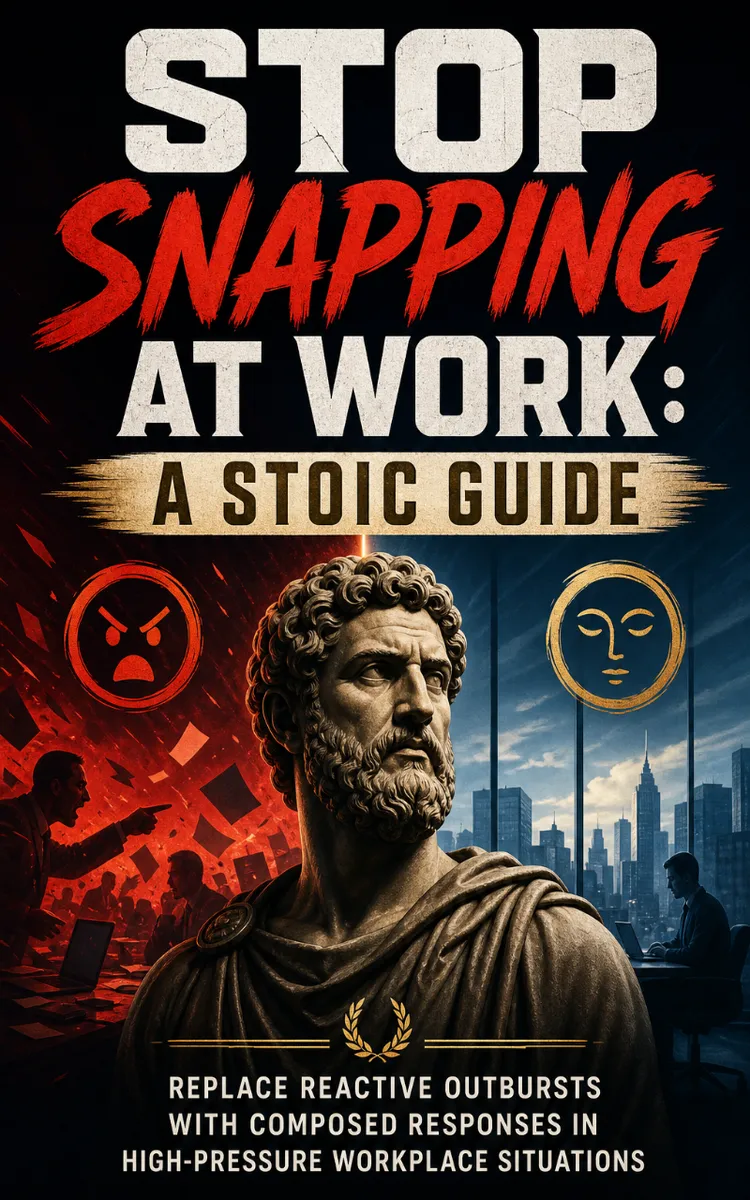
Stop Snapping at Work: A Stoic Guide
Created with Inkfluence AI
Stoic workplace tools to stop reactive outbursts
Table of Contents
- 1. Name Your Workplace Snapping Triggers
- 2. Use the Pause-and-Respond Card
- 3. Apply Stoic Reframing to Workplace Events
- 4. Choose Your Response Tone in Real Time
- 5. Send Composed Emails with Tone Checklist
- 6. Handle Criticism Without Reacting
- 7. Run a Daily Composure Tracker
- 8. Build a Two-Week Reset Plan
Preview: Name Your Workplace Snapping Triggers
A short excerpt from “Name Your Workplace Snapping Triggers”. The full book contains 8 chapters and 15,140 words.
A snapped reply usually doesn't start with a big, dramatic decision. It starts with a tiny moment your body already knows-tight chest, faster words, a face that feels hot. Then you say something sharp, and later you wish you had one more second. If you want to stop snapping at work, you need to catch the moment before it becomes a habit. This chapter gives you a simple way to do that: build a Trigger-Label Loop that names what sets you off so you can respond instead of react.
You don't need to "work on your attitude." You need a clear map of your triggers-what happened, what you interpreted, and what you did next. After you read this, you'll know exactly what to write down, how to label the trigger in plain language, and how to use that log to catch the next snap earlier. You'll also leave with a printable Trigger Log and a quick label list so you can start today, not someday.
Why This MattersWhen you snap, you pay twice: once in the moment, and again after. In the moment, you damage trust, create confusion, or shut down a conversation. After the moment, you spend time repairing-rewriting an email, clearing up a misunderstanding, or walking back what you said. The frustrating part is that snapping often feels "instant," so you assume you can't control it. In reality, snapping has a pattern. The Trigger-Label Loop helps you find it.
This chapter solves a specific problem: you keep saying, "I don't know why I snapped" or "It just happens." That's not a mindset issue-it's a data issue. Without a trigger log, your brain stores moments as vague feelings. With a log, you store moments as usable information: the request, the interruption, the tone you received, the timing, the specific sentence that landed the wrong way. Then you can practice targeted calm instead of generic self-control.
After you set up your first few entries, you'll be able to do three practical things. First, you'll spot your "start line" (the first moment your body begins to ramp up). Second, you'll label the trigger to predict what comes next. Third, you'll use those labels to prepare a pause-and-respond response in the next high-pressure moment. Ask yourself: when you snap, do you remember the exact thing that happened, yes or no? Your log will make that answer" yes."
Practical takeaway: You can't change what you can't name. Your Trigger-Label Loop gives you names for your snapping moments.
How It WorksThe Trigger-Label Loop turns random incidents into a repeatable signal. You record the trigger while it's fresh, then you label what type of trigger it was. Over time, patterns show up fast enough that you can start changing your response before the words come out.
Start with the Trigger Log. Use it like a quick injury report, not a diary. If you write "I was stressed," you won't learn much. If you write the exact situation and your interpretation, you'll learn a lot.
Use these steps:
Pick one place to log (so you don't "forget to remember").
Choose either a notes app, a single printed sheet at your desk, or a simple spreadsheet. Keep it in the same spot every day. If you change locations, you'll skip entries right when you need them.
Log right after the snap, within 2 minutes.
Your brain edits memories fast. If you wait until lunch, you'll remember the emotion but lose the trigger details. Write immediately after the conversation or email exchange ends, within two minutes.
Write three facts, then one label.
Keep it tight. Fill in: (a) what happened (the event), (b) what you told yourself (your interpretation), (c) what you did (your response), then (d) choose one label from your list (the trigger type). This forces you to separate facts from your story about the facts.
Review once a day and mark your top 1-2 labels.
Each evening, scan your entries for repeated labels. If "Last-minute change" shows up four times this week, that's a real target. You'll practice the same pause skill for the same trigger instead of guessing each time.
To make this concrete, use Nora's pattern. Nora, a customer success manager, snaps most often during "handoff confusion," when another team changes a process, and her customers get caught in the middle. In her log, she doesn't write "They messed up." She writes: Event: 'Support updated the process; I didn't get the new steps." Interpretation: "Now I look incompetent to the customer." Response: "I snapped in the Slack thread: 'That's not how we do it.'" Label: "Blindsided by change." That one label gives her something she can prepare for.
Here's the label idea in plain language: a trigger label describes the moment your brain decides, "This is unfair," "This is pointless," "I'm being judged," or "I'm stuck." You don't need fancy wording-you need consistent wording.
End-of-section reflection prompt: After you finish your first three entries, ask yourself: Do you see a trigger pattern already, or do you only see feelings?
...
About this book
"Stop Snapping at Work: A Stoic Guide" is a how-to guide book by Socratic Mastery with 8 chapters and approximately 15,140 words. Stoic workplace tools to stop reactive outbursts.
This book was created using Inkfluence AI, an AI-powered book generation platform that helps authors write, design, and publish complete books. It was made with the AI Ebook Generator.
Frequently Asked Questions
What is "Stop Snapping at Work: A Stoic Guide" about?
Stoic workplace tools to stop reactive outbursts
How many chapters are in "Stop Snapping at Work: A Stoic Guide"?
The book contains 8 chapters and approximately 15,140 words. Topics covered include Name Your Workplace Snapping Triggers, Use the Pause-and-Respond Card, Apply Stoic Reframing to Workplace Events, Choose Your Response Tone in Real Time, and more.
Who wrote "Stop Snapping at Work: A Stoic Guide"?
This book was written by Socratic Mastery and created using Inkfluence AI, an AI book generation platform that helps authors write, design, and publish books.
How can I create a similar how-to guide book?
You can create your own how-to guide book using Inkfluence AI. Describe your idea, choose your style, and the AI writes the full book for you. It's free to start.
Write your own how-to guide book with AI
Describe your idea and Inkfluence writes the whole thing. Free to start.
Start writingCreated with Inkfluence AI


