
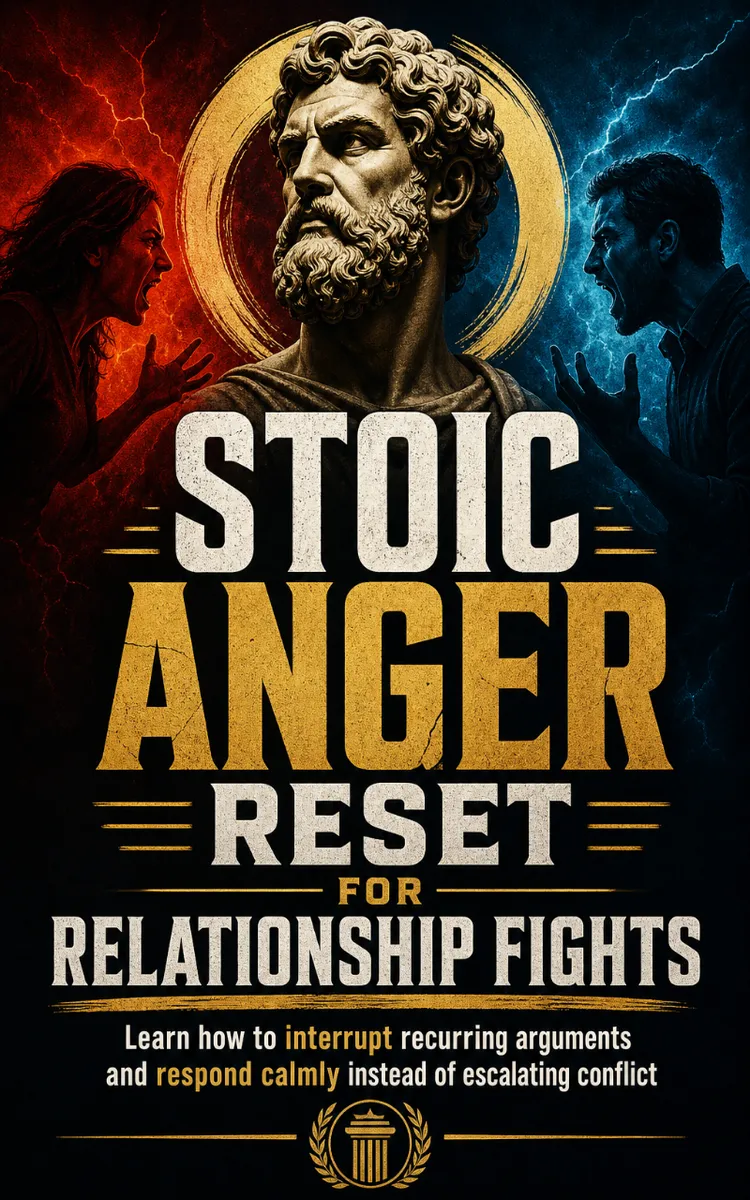
Stoic Anger Reset For Relationship Fights
Created with Inkfluence AI
Practical steps to de-escalate relationship arguments using stoic tools
Table of Contents
- 1. Spot Your Anger Cycle
- 2. Build Your Anger Trigger Map
- 3. Stoic Pause: Interrupt Before Reacting
- 4. Use Calm Response Scripts
- 5. Reflect With the Conflict Sheet
- 6. Respond to the Real Need
- 7. Set Boundaries Without Escalation
- 8. Repair After the Fight
Preview: Spot Your Anger Cycle
A short excerpt from “Spot Your Anger Cycle”. The full book contains 8 chapters and 12,806 words.
What if your "big fight" isn't random at all-what if it follows the same path every time? Ask yourself this: when the argument finally feels out of control, what happened right before that moment? For most people, it wasn't one single sentence. It was a chain of small reactions that stacked on top of each other until your brain said, "We're in danger," even when the problem was small.
In relationship fights, that chain usually runs faster than you notice. You speak, they react, you escalate, then you both look back and wonder how you got from "we need to talk" to "we're never going to work." This chapter helps you spot your anger cycle by mapping the sequence you normally take as things escalate. When you can see the steps clearly, you can interrupt the loop rather than ride it all the way to the end.
You will learn to write your own "Beat Escalation Loop" in plain language, using one real fight pattern you keep repeating. You'll also learn what "interrupt points" look like, so you know exactly when to step in and what to do next.
Why This MattersYour anger cycle matters because it controls your choices. When you notice the cycle, you stop treating every fight like a fresh emergency. Instead, you treat it like a repeatable pattern you can interrupt. That shift alone reduces the feeling of helplessness. You stop thinking, "I can't help it," and start thinking, "I can catch step three."
This chapter solves a specific problem: you keep escalating after the first issue is already fixed. Maybe it starts with a delayed reply, a messy counter, a misunderstood tone, or a money worry. Then your brain jumps to conclusions, and your mouth speeds up. The other person feels attacked. They defend. You push harder. The original issue disappears under anger, and the fight becomes about who "wins" rather than what needs to be solved.
After you finish this chapter, you will be able to do three things. First, you will identify the exact sequence that turns a small relationship issue into a full fight. Second, you will mark your personal interrupt points-those moments when you still have a choice. Third, you will write your loop in a way you can use immediately, not just understand in theory.
Takeaway prompt: Pick one recent fight and ask, "What was the first beat that started the chain?" If you can't name it yet, that's exactly what you'll build here.
How It WorksThe core of this chapter is the 4-Beat Escalation Loop. It's a simple pattern you can map using your own words. You will not guess your way through it-you will watch for the same four beats showing up in your fights.
Here are the four beats. Each one has a typical "signal" in your body and your speech, so you can spot it even when you feel flustered.
Beat 1: Trigger + Threat Story
A trigger happens (a comment, a delay, a look, a tone). Then your brain adds a "threat story," like "They don't care" or "They're trying to control me."
Concrete sign: you feel heat in your chest, or your stomach tightens, and your mind starts scanning for proof.
Beat 2: Defensive Moves
You try to fix the threat story quickly by defending yourself, accusing them, or demanding clarity sharply.
Concrete sign: you talk faster, you use "always/never," or you ask a question that sounds like a challenge.
Beat 3: Counterattack + Meaning Gets Locked
They respond, and your brain locks onto the meaning you feared. You treat their response as confirmation.
Concrete sign: you stop listening and start collecting "receipts." Your next sentences escalate even if the facts haven't changed.
Beat 4: Full Fight Mode
You move from solving to punishing. The conversation becomes about blame, disrespect, or "what you always do."
Concrete sign: you raise your voice, you bring up older issues, or you threaten to end the discussion (or worse).
To map your escalation loop, you need one real fight you can remember clearly. Use the fight as your "data." Don't pick your most painful argument-you need one you can describe in enough detail to find the four beats. If you can't remember the exact words, use rough phrases. Your goal is accuracy, not perfection.
Now let's use your primary case study persona: Nina, 31, customer support manager. Nina often hears the same pattern in her workplace: when a customer feels unheard, they escalate fast. Nina brings that same rhythm home. One common loop Nina notices looks like this: a delayed reply from her partner becomes Beat 1 ("They don't care"), then Nina goes into Beat 2 ("So you're ignoring me"), then the partner gets defensive (Beat 3), and Nina then adds older examples (Beat 4). The original issue-just a missed message or busy schedule-gets buried under a locked-in story about disrespect.
How interrupt points work: An interrupt point happens when you still have a choice before you cross into the next beat. Beat 1 has interrupt points because the threat story just started....
About this book
"Stoic Anger Reset For Relationship Fights" is a how-to guide book by Socratic Mastery with 8 chapters and approximately 12,806 words. Practical steps to de-escalate relationship arguments using stoic tools.
This book was created using Inkfluence AI, an AI-powered book generation platform that helps authors write, design, and publish complete books. It was made with the AI Ebook Generator.
Frequently Asked Questions
What is "Stoic Anger Reset For Relationship Fights" about?
Practical steps to de-escalate relationship arguments using stoic tools
How many chapters are in "Stoic Anger Reset For Relationship Fights"?
The book contains 8 chapters and approximately 12,806 words. Topics covered include Spot Your Anger Cycle, Build Your Anger Trigger Map, Stoic Pause: Interrupt Before Reacting, Use Calm Response Scripts, and more.
Who wrote "Stoic Anger Reset For Relationship Fights"?
This book was written by Socratic Mastery and created using Inkfluence AI, an AI book generation platform that helps authors write, design, and publish books.
How can I create a similar how-to guide book?
You can create your own how-to guide book using Inkfluence AI. Describe your idea, choose your style, and the AI writes the full book for you. It's free to start.
Write your own how-to guide book with AI
Describe your idea and Inkfluence writes the whole thing. Free to start.
Start writingCreated with Inkfluence AI


