
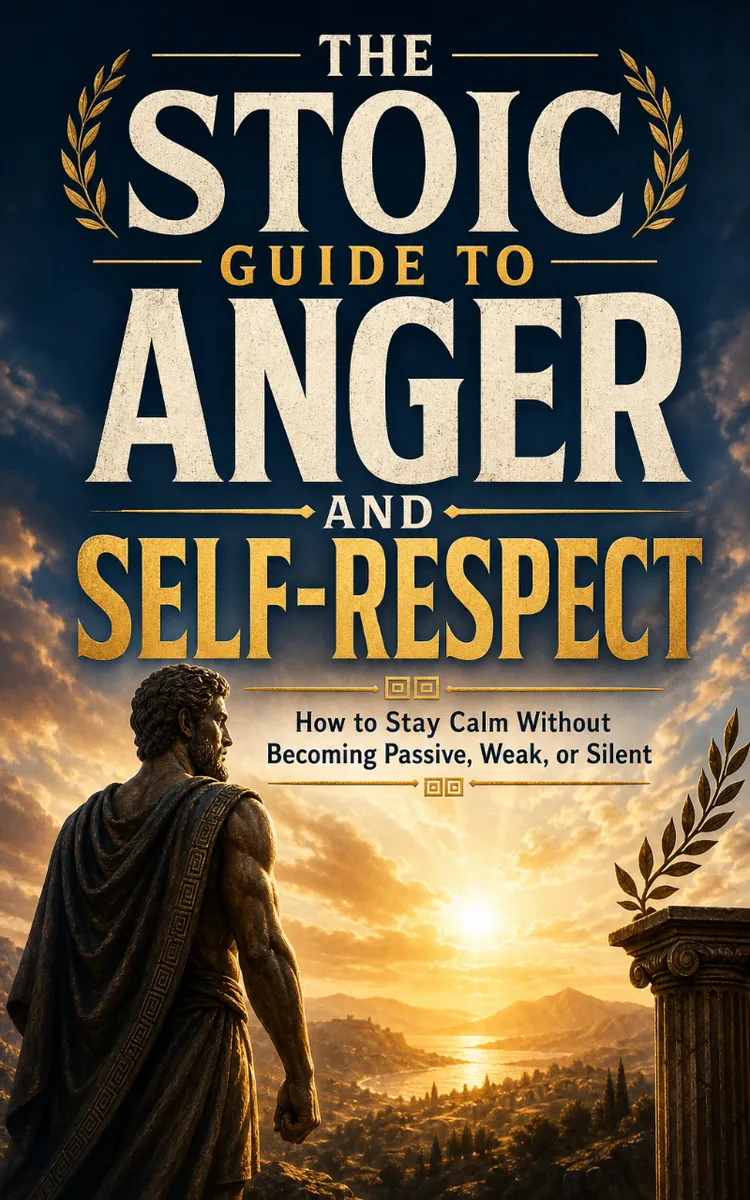
The Stoic Guide to Anger and Self-Respect
Created with Inkfluence AI
Stoic-based strategies for managing anger and self-respect
Table of Contents
- 1. Redefining Anger as a Signal
- 2. The Strength Myth of Outbursts
- 3. Choosing Your Inner Ruler
- 4. Separating What’s Yours and Theirs
- 5. The Three Judgments Behind Anger
- 6. Replacing Demands with Preferences
- 7. Practicing Voluntary Discomfort
- 8. The Pause That Prevents Damage
- 9. Cooling the Body, Not Just the Mind
- 10. Using Negative Visualization Wisely
- 11. Turning Off the Mind’s Courtroom
- 12. Building Boundaries Without Guilt
- 13. Asserting Yourself Without Escalation
- 14. The Stoic Listening Rule
- 15. Repairing After a Slip
- 16. Managing Anger at Work and Home
- 17. Converting Resentment into Action
- 18. The Virtue Compass for Hard Conversations
- 19. Resilience Through Premeditation
- 20. Living Self-Respect Without Silence
Preview: Redefining Anger as a Signal
A short excerpt from “Redefining Anger as a Signal”. The full book contains 20 chapters and 28,491 words.
Picture This
Ever been so mad in the moment that it feels like your body is doing push-ups-jaw tight, chest hot, hands ready to grab the problem by the throat? Picture this: Darius, 34, a warehouse supervisor, is juggling a late delivery, a forklift issue that “shouldn’t be his problem,” and a new hire who keeps missing the same staging mark. Then the customer calls. The tone is sharp. The blame lands fast. And suddenly Darius feels it-anger rising like a siren that says, Good. Now you’re finally awake. Now you can fix this.
But there’s a second wave too. Not just “I’m upset,” but “I know what this person is.” Anger starts turning into certainty. Darius hears the customer’s words and translates them into a judgment: They’re disrespecting me. His mind starts stacking evidence in real time-proof that he’s being treated unfairly-and his response starts to shape itself before he even speaks. He doesn’t just want to correct the mistake. He wants to make the disrespect stop, permanently.
When your anger shows up, how do you tell the difference between a useful signal and a judgment that’s about to ruin your self-respect?
The Mindset Shift
Old Belief: Anger is strength, so if you feel it, you’re right to act like it.
New Reality: Anger is a signal-sometimes useful, sometimes hijacked by judgment-so you don’t have to obey it.
The Stoic difference isn’t “don’t feel anger.” It’s sharper than that. Stoics treat anger like a dashboard light. A dashboard light can mean “engine problem-act now.” Or it can mean “sensor is glitching-don’t panic, diagnose.” The problem is when you treat the light as proof that you’re already in the correct story about what’s happening.
In Darius’s case, the signal might be real: Something needs attention. A deadline matters. A safety issue matters. That kind of anger can energize you to act clearly and fast. But judgment is different. Judgment turns the situation into a verdict about people-they’re idiots, they’re disrespecting me, they’re doing this on purpose. Once judgment takes the wheel, anger stops being a tool and starts being a weapon. You don’t just respond to the problem. You attack the person. And that’s how self-respect gets traded for the temporary relief of “winning the moment.”
Here’s the concrete contrast. Suppose Darius has to call the customer back. In the old belief, he answers hot: clipped tone, blame-first, maybe even a threat about “how this always goes.” The message might be accurate in parts-but his pride drives the delivery. Afterward, he feels justified, but he also feels smaller, like he had to become harder to be taken seriously.
In the new reality, Darius still feels anger. He just treats it as information, not identity. He asks: Is this anger pointing to a real need, or is it pointing to my ego’s demand for respect right now? Then he chooses language that protects the outcome and his character. Same situation, different internal control.
Going Deeper
Stoics separate two things that feel tangled in real life: the energy of anger and the “story” anger attaches to it. The energy can be useful-attention, urgency, a push to act. The story is the dangerous part: the claim that the other person is bad, the claim that you’re owed something, the claim that your image can’t survive neutrality.
A simple way to frame it is this: anger as a signal says, “Pay attention-something requires action.” Anger as judgment says, “You are being wronged, and the world must confirm it through your reaction.” The signal aims at the task. The judgment aims at the status.
When judgment runs the show, you start defending a feeling instead of fixing a situation. You stop being curious about what’s true and start being loyal to what feels insulting. That’s why the anger escalates. You’re not just trying to solve a problem-you’re trying to force reality to match your interpretation, and you won’t get that kind of control without collateral damage.
Signs this pattern is running your life
1. You feel anger before you have enough information-like your mind is already done listening.
2. Your anger comes with a “must” statement: They must respect me. I can’t let this slide. I have to make it clear.
3. You notice you’re polishing your comeback instead of choosing your next step. Even if you don’t say it out loud, you’re rehearsing it.
4. After the moment, you feel either “amped up but empty,” or “right but not proud.” Your output may be effective, but your character feels compromised.
En résumé: Anger becomes destructive when it turns into judgment-when it stops pointing at a problem and starts proving a verdict about people.
A useful Stoic question sits right in the middle of this: What exactly am I angry about? Not the surface answer. The real one....
About this book
"The Stoic Guide to Anger and Self-Respect" is a self-help book by Socratic Mastery with 20 chapters and approximately 28,491 words. Stoic-based strategies for managing anger and self-respect.
This book was created using Inkfluence AI, an AI-powered book generation platform that helps authors write, design, and publish complete books. It was made with the AI Self-Help Book Writer.
Frequently Asked Questions
What is "The Stoic Guide to Anger and Self-Respect" about?
Stoic-based strategies for managing anger and self-respect
How many chapters are in "The Stoic Guide to Anger and Self-Respect"?
The book contains 20 chapters and approximately 28,491 words. Topics covered include Redefining Anger as a Signal, The Strength Myth of Outbursts, Choosing Your Inner Ruler, Separating What’s Yours and Theirs, and more.
Who wrote "The Stoic Guide to Anger and Self-Respect"?
This book was written by Socratic Mastery and created using Inkfluence AI, an AI book generation platform that helps authors write, design, and publish books.
How can I create a similar self-help book?
You can create your own self-help book using Inkfluence AI. Describe your idea, choose your style, and the AI writes the full book for you. It's free to start.
Write your own self-help book with AI
Describe your idea and Inkfluence writes the whole thing. Free to start.
Start writingCreated with Inkfluence AI


