
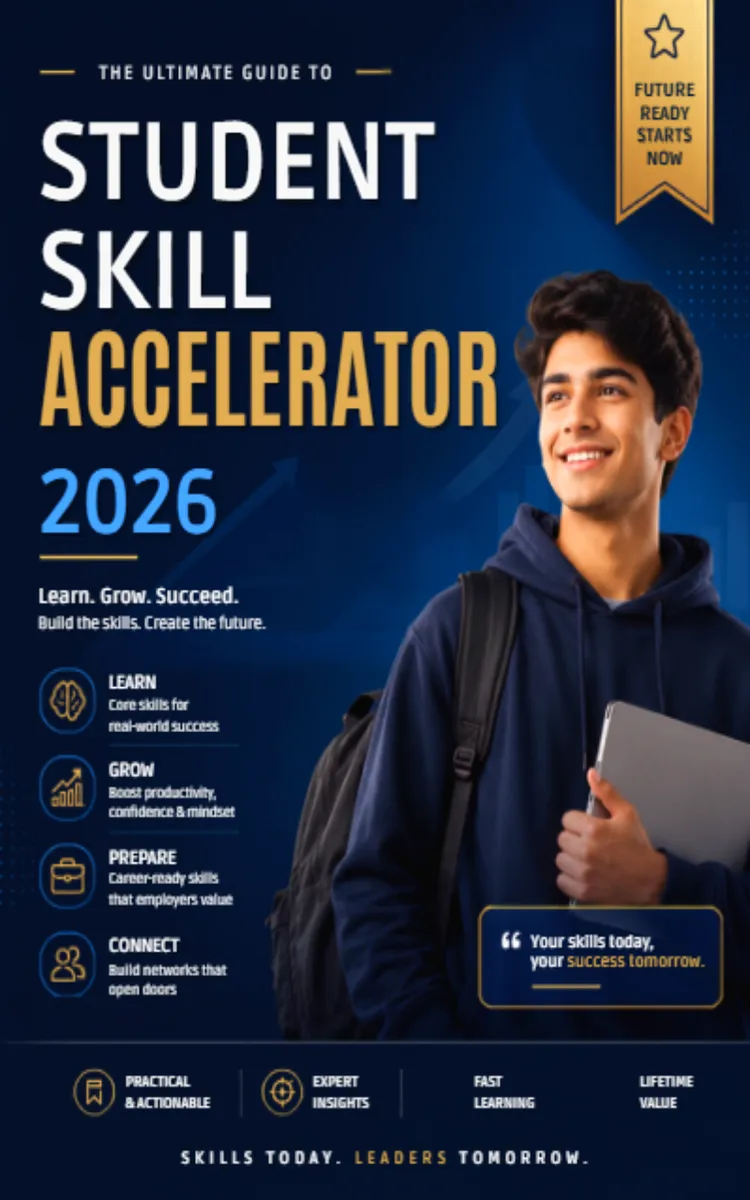
Student Skill Accelerator 2026
Created with Inkfluence AI
Skill-building roadmap for students: internships, freelancing, AI, communication
Table of Contents
- 1. Student Skill Mindset Reset
- 2. AI, Future Jobs, and Skill Economy
- 3. 10 Skills to Build a Career
- 4. Free Learning Resources and Courses
- 5. Free Certifications and Internship Readiness
Preview: Student Skill Mindset Reset
A short excerpt from “Student Skill Mindset Reset”. The full book contains 5 chapters and 10,196 words.
Marks-to-Skills Switch: Why You’re Stuck, Why Grades Don’t Pay, and How to Start Skill-Building
When was the last time you used your exam skills to get an internship email reply? If you’re like most college students, you can score well in class but still struggle to land interviews, get freelancing clients, or explain what you can do in simple words.
That gap happens because marks measure one thing: how well you follow a tested format under time pressure. Skills measure something else: how well you can produce results in messy real-life situations - deadlines, unclear requirements, and people who ask follow-up questions. This chapter helps you fix the mismatch by using a simple framework called The Marks-to-Skills Switch and backing it up with reflection prompts you can do in 20-30 minutes.
After this chapter, you’ll be able to take any course you completed (or are currently taking), identify the exact skills hiding inside your syllabus, and turn them into a short “skill proof” plan you can use for resume bullets, internship conversations, and early freelancing outreach.
---
The Marks-to-Skills Switch: Turn Exam Effort into Real Skill Proof
Riya, 19, second-year college student, got good grades in a subject that involved reports and presentations. She could “study and pass,” but when she applied for internships, her resume looked like a list of topics: “Learned marketing basics,” “Did presentations,” “Studied analytics.” No one could tell what she actually produced. So she didn’t get callbacks. Not because she wasn’t capable - because her grades didn’t automatically translate into clear skill proof.
The Marks-to-Skills Switch works like this: you stop asking “What did I score?” and start asking “What did I build, practice, and improve?” Grades still matter, but you treat them as a signal, not the finish line. You extract concrete skill evidence from your work: the outputs you created, the decisions you made, and the feedback you applied.
Here’s the switch in a clean, repeatable way. Use it on one course, one assignment, or one project you already have.
1. List your course outputs (not topics).
Write every deliverable you made: report, presentation slide deck, lab exercise, code file, case analysis, spreadsheet, weekly submission, etc. If you can name it, you can prove it.
2. Pick the “skill verbs” inside each output.
Convert the deliverable into action words: summarize, research, edit, structure, design, write, explain, calculate, test, revise. Skills show up as verbs.
3. Match each skill verb to a real workplace task.
Ask: “Where would someone use this at work?” Example: a report becomes “Write a clear weekly update”; a presentation becomes “Create a short pitch with key points”.
4. Create one skill proof line per output.
Turn the workplace task into a simple proof statement you can reuse:
“I created [output] to [task] by [method], and I improved it using [feedback].”
Even if you don’t have a job yet, you can still prove your process.
Concrete example (using Riya’s situation)
Riya’s class had two deliverables: a report and a presentation. She used The Marks-to-Skills Switch like this:
- Output: report → Skill verbs: research, structure, write, revise → Workplace task: write a clear summary with sources → Skill proof line:
“I wrote a 6-8 page report to summarize key findings using sources, then revised it after instructor feedback on clarity.”
- Output: presentation → Skill verbs: design slides, explain ideas, handle Q&A → Workplace task: present a short update and answer questions → Skill proof line:
“I built a slide deck for a 7-10 minute presentation and improved it after feedback on flow and clarity.”
Notice the difference: her grades told people she studied. Her skill proof lines tell people what she can produce.
Practical takeaway / reflection prompt:
Pick one class you finished or one assignment you already have. Write down the deliverable names only (no topics). Then ask: “What outputs did I create that I can show someone?”
---
How Reflection Prompts Turn Marks into Skills You Can Use
Many students avoid reflection because they think it’s “extra work.” But reflection here is not journaling. It’s a quick extraction tool that turns what you did into what you can repeat.
Use reflection at two moments: right after you submit work and right before you apply for internships or freelancing. In both cases, you want answers that help you talk clearly and act fast.
Start with these prompts and use the exact answers to build your skill proof lines:
- “What did I produce?”
Write the deliverable exactly. Example: “10-slide deck,” “Excel sheet,” “lab results summary,” “500-word article.”
- “What part took real effort?”
Choose one: research, structuring, editing, formatting, debugging, or meeting a deadline.
...
About this book
"Student Skill Accelerator 2026" is a how-to guide book by Anonymous with 5 chapters and approximately 10,196 words. Skill-building roadmap for students: internships, freelancing, AI, communication.
This book was created using Inkfluence AI, an AI-powered book generation platform that helps authors write, design, and publish complete books. It was made with the AI Ebook Generator.
Frequently Asked Questions
What is "Student Skill Accelerator 2026" about?
Skill-building roadmap for students: internships, freelancing, AI, communication
How many chapters are in "Student Skill Accelerator 2026"?
The book contains 5 chapters and approximately 10,196 words. Topics covered include Student Skill Mindset Reset, AI, Future Jobs, and Skill Economy, 10 Skills to Build a Career, Free Learning Resources and Courses, and more.
Who wrote "Student Skill Accelerator 2026"?
This book was written by Anonymous and created using Inkfluence AI, an AI book generation platform that helps authors write, design, and publish books.
How can I create a similar how-to guide book?
You can create your own how-to guide book using Inkfluence AI. Describe your idea, choose your style, and the AI writes the full book for you. It's free to start.
Write your own how-to guide book with AI
Describe your idea and Inkfluence writes the whole thing. Free to start.
Start writingCreated with Inkfluence AI


