
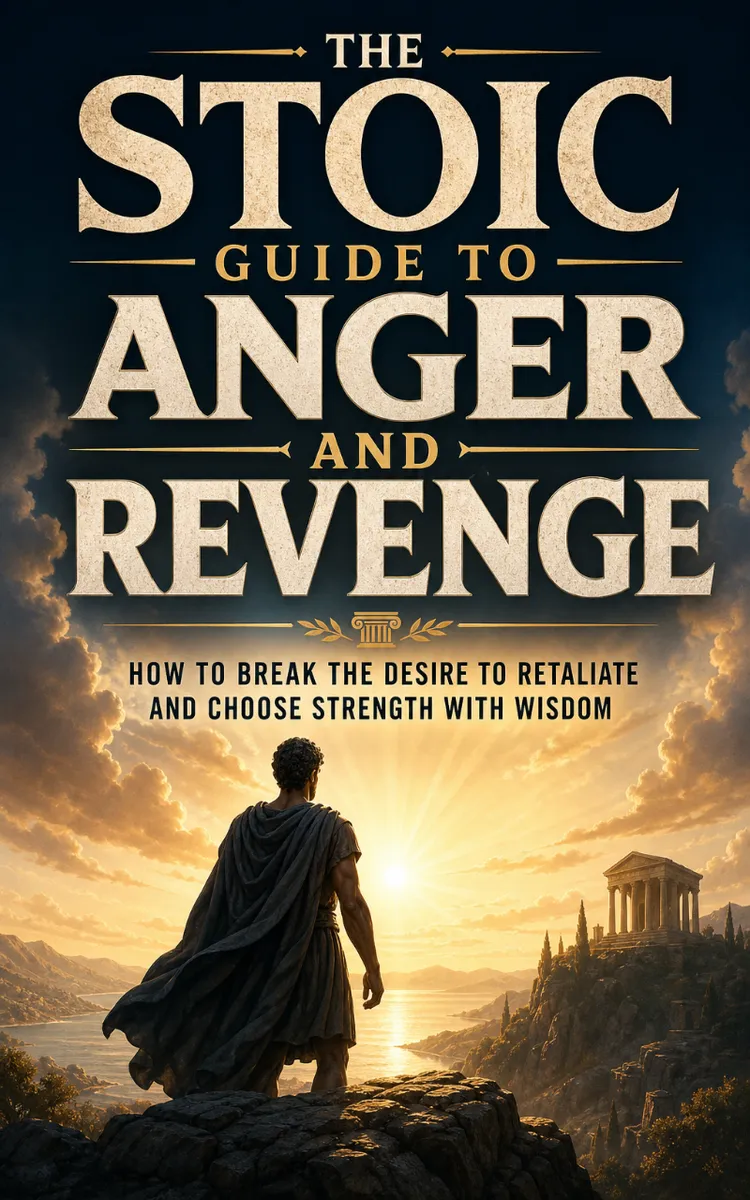
The Stoic Guide to Anger and Revenge
Created with Inkfluence AI
Stoic methods to manage anger and stop revenge impulses
Table of Contents
- 1. Recognize Anger’s First Spark
- 2. Separate Fact From Interpretation
- 3. Use the Stoic Control Compass
- 4. Choose Your Response, Not Your Reaction
- 5. Break the Revenge Story Loop
- 6. Define Virtue Over Victory
- 7. Practice Negative Visualization
- 8. Turn Off the Mind’s Threat Alarm
- 9. Name the Emotion Without Obeying It
- 10. Reframe Insult as Information
- 11. Set Boundaries Without Revenge
- 12. Respond With the ‘Second Sentence’
- 13. Choose Silence When It’s Strategic
- 14. Stop Rumination With the ‘Now Return’
- 15. Handle Betrayal Without Paying Back
- 16. Use ‘Amor Fati’ for Hard People
- 17. Turn Conflict Into Character Training
- 18. Repair Relationships Without Self-Sabotage
- 19. Build a Daily ‘Virtue Rehearsal’
- 20. Live Revenge-Free With Purpose
Preview: Recognize Anger’s First Spark
A short excerpt from “Recognize Anger’s First Spark”. The full book contains 20 chapters and 28,829 words.
Picture This
Have you ever felt it before you even “did” anything-like a heat wave that shows up half a second early? Maybe it’s the moment someone cuts in line at the warehouse gate, or the text you read and your chest tightens before you can even finish the sentence. You don’t just feel annoyed. You feel activated. Your body starts preparing to act like retaliation is the only sensible response.
Darius, 34, warehouse supervisor, knows that moment too well. It’s usually small at first: a coworker “forgets” to lock down a pallet, or a delivery driver snaps back when Darius points out a safety issue. The words don’t even have to be harsh. Sometimes it’s just the tone. And then-there it is-the first spark: a sudden urge to correct them back harder, to make sure they “learn,” to hit send with something sharper than necessary. He catches himself a beat later, but by then the impulse has already started steering the car.
Can you spot anger before it becomes action-so retaliation loses its steering wheel?
The Mindset Shift
Old Belief: “Anger is just what happens when I’m disrespected. If I feel it, I’m allowed to respond however it comes out.”
New Reality: Anger is an alarm, not a command. The spark is information-what you do next is your choice.
This shift matters because retaliation doesn’t usually start with a grand decision. It starts with momentum. The first spark feels like truth: They meant it. They deserve it. I have to fix this right now. But the Stoic move is to treat that spark like smoke from a fire alarm-loud, urgent, and potentially helpful. You don’t rush to “retaliate” just because the alarm is ringing. You check what’s actually burning.
Here’s a concrete example from Darius’s world. A driver once argued about a delivery being “done already.” Darius felt the spark immediately-jaw tight, heat rising-followed by the urge to embarrass the driver in front of everyone. In that moment, his old belief said, “I’m angry for a reason, so I should respond tough.” But the new reality asks a different question: What is the spark telling me? It’s telling him he feels disrespected and threatened to his role. That recognition doesn’t make him weak. It gives him space to choose a response that protects safety and authority without turning into a weapon.
Most people try to “stop anger” by wrestling with it. But this mindset shift aims at something more practical: interrupt the impulse early. When you treat the spark as an alarm, you can respond like a supervisor instead of a spark-chaser. You still act. You just stop acting from heat.
Going Deeper
Anger’s first spark is the mind trying to solve a problem fast. It notices threat-real or perceived-and it tries to restore control. Sometimes control is about safety. Sometimes it’s about respect. Sometimes it’s about feeling like you’ll lose status if you don’t push back. The problem is that the spark doesn’t care whether your response builds trust or breaks it. It only cares that you feel powerful again.
Stoics would say the spark is part of your impressions-your first mental picture of what’s happening. The danger is that you treat the impression as fact. You assume, “This is disrespect,” or “This is disrespectful behavior,” as if your first read of reality is the final verdict. But the spark is only the first draft. It’s a signal, not a sentence.
When you learn to catch it early, you’re not denying your feelings. You’re changing the path from feeling to action. That’s the whole win: the retaliation impulse loses time, and time is where wisdom lives.
Signs this pattern is running your life
1. You feel the urge to “prove” something immediately-like you can’t let it slide without becoming the punchline.
2. Your body reacts before your thoughts do (tight jaw, quick pulse, sudden focus on “getting back”).
3. You replay the moment in your head and it keeps getting worse, like the story is being edited to justify revenge.
4. You notice you’re not just angry at the event-you’re angry at the meaning you assigned to it (they think they can, they’re disrespecting me, I’ll look weak).
En résumé: The first spark is your mind sounding an alarm-your job is to slow down long enough to interpret it correctly.
A key detail: the spark doesn’t always feel dramatic. Sometimes it’s a calm, cold irritation that still wants payback. Darius has had days where he didn’t even raise his voice-he just delivered a cutting comment that “stung enough.” That’s still retaliation. It’s just retaliation with manners.
So the real practice here isn’t “be less emotional.” It’s “recognize the earliest version of the impulse,” when you still have options.
Reflection & Self-Assessment
1. Where do you feel the first spark in your body?
Is it heat in your face, tightness in your chest, a knot in your stomach, or a sudden “locked-in” focus? Name it. If you can’t locate it, you can’t catch it.
2....
About this book
"The Stoic Guide to Anger and Revenge" is a self-help book by Socratic Mastery with 20 chapters and approximately 28,829 words. Stoic methods to manage anger and stop revenge impulses.
This book was created using Inkfluence AI, an AI-powered book generation platform that helps authors write, design, and publish complete books. It was made with the AI Self-Help Book Writer.
Frequently Asked Questions
What is "The Stoic Guide to Anger and Revenge" about?
Stoic methods to manage anger and stop revenge impulses
How many chapters are in "The Stoic Guide to Anger and Revenge"?
The book contains 20 chapters and approximately 28,829 words. Topics covered include Recognize Anger’s First Spark, Separate Fact From Interpretation, Use the Stoic Control Compass, Choose Your Response, Not Your Reaction, and more.
Who wrote "The Stoic Guide to Anger and Revenge"?
This book was written by Socratic Mastery and created using Inkfluence AI, an AI book generation platform that helps authors write, design, and publish books.
How can I create a similar self-help book?
You can create your own self-help book using Inkfluence AI. Describe your idea, choose your style, and the AI writes the full book for you. It's free to start.
Write your own self-help book with AI
Describe your idea and Inkfluence writes the whole thing. Free to start.
Start writingCreated with Inkfluence AI


