
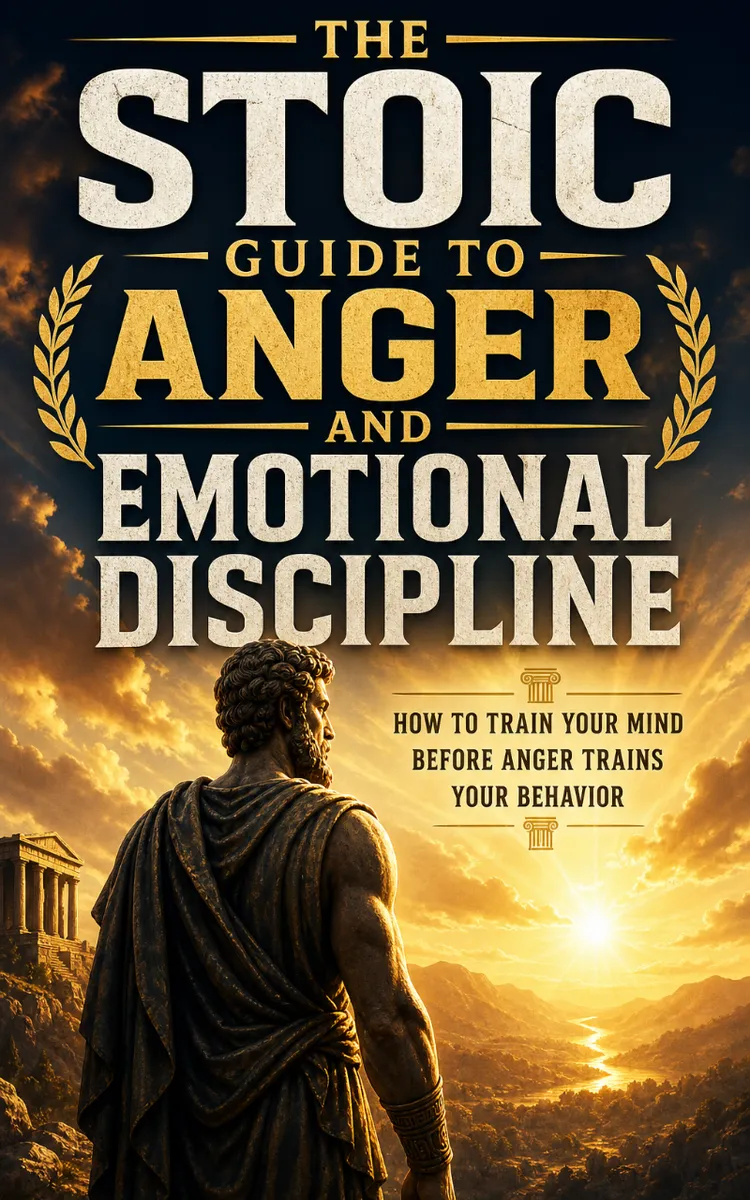
The Stoic Guide to Anger and Emotional Discipline
Created with Inkfluence AI
Stoic-based techniques for anger management and emotional discipline
Table of Contents
- 1. Anger Is Judgment, Not Fate
- 2. Define Your Anger Triggers Precisely
- 3. Practice the Pause Before Reacting
- 4. Choose Virtue Over Being Right
- 5. Separate Control From Influence
- 6. Rehearse Adversity With Premeditation
- 7. Turn “Should” Into “What Is”
- 8. Stop Catastrophizing the Meaning
- 9. Name the Emotion Without Obeying It
- 10. Use the Stoic “View From Above”
- 11. Set a Boundary With Calm Clarity
- 12. Speak in “Virtue Sentences”
- 13. Practice Active Listening Under Heat
- 14. Repair After a Blow-Up Fast
- 15. Manage Anger in the Body
- 16. Build a Daily Emotional Training Habit
- 17. Journal With the Stoic Obstacle Log
- 18. Develop Moral Courage in Conflict
- 19. Turn Anger Into Constructive Energy
- 20. Live the Stoic Discipline Long-Term
Preview: Anger Is Judgment, Not Fate
A short excerpt from “Anger Is Judgment, Not Fate”. The full book contains 20 chapters and 29,239 words.
Picture This
“Anger feels like the problem. But most of the time it’s just the verdict.”
Leandra, 34, an ER nurse, knows the sound of trouble. It’s the raised voice at triage, the slammed clipboard, the patient who arrives fine until someone says the wrong thing. One moment she’s moving fast-vitals, supplies, calm instructions-and the next she’s hit with heat. Not because something new happened in the room, exactly. Something was labeled the wrong way. A family member looks at her and says, “You people don’t care,” and suddenly her chest tightens like her body is taking a side in a court case.
She tells herself, I’m being disrespected. She feels justified in being mad. Then she notices what anger does next: it makes her talk sharper, scan the room less kindly, and lose the patient’s trust before she even speaks. Later, when things quiet down, she can’t point to a single “fate” that forced her hands. She can only point to the moment her mind decided what the moment “meant.”
When anger shows up, are you reacting to what happened-or to what your mind declared it meant?
The Mindset Shift
Old Belief: Anger is something that happens to you.
New Reality: Anger is a judgment you make about what happened.
That shift matters because it changes where you aim your training. If anger is “something that happens,” then you’re stuck waiting for it to pass. You can only manage the symptoms-volume, speed, tone-and hope you don’t mess up. But if anger is a judgment, then you can practice changing the decision that comes before the heat.
Here’s what that looks like for Leandra. A visitor says, “You don’t care.” In the raw facts, the visitor spoke. In the raw facts, Leandra heard it. In the raw facts, she kept working. None of that forces anger. What forces anger is the mind’s quick courtroom move: They’re accusing me. They’re disrespecting me. I don’t deserve this. This is wrong. That final “wrong” isn’t found in the sound waves. It’s added by judgment.
In the ER, judgments come fast because the brain is trying to protect you. But protection can turn into punishment. Leandra might think, They’re wrong about me, and then her anger starts defending her identity instead of helping her do her job. The Mindset Shift doesn’t mean “be nice” or “ignore disrespect.” It means recognizing anger as a verdict-then deciding whether that verdict is accurate, fair, and useful.
So the question becomes: can you separate what happened from what you judged about it-while the heat is still forming? That’s the difference between being dragged around by anger and steering your behavior with intention.
Going Deeper
Stoics were blunt about this: anger isn’t just a feeling that arrives. It’s the mind assenting to a value-judgment-often in a split second-followed by a desire to respond in a certain way. The “split second” part is the trap. Because it feels automatic, you assume it’s fate. But automatic doesn’t mean unchangeable. It means the mind learned a pattern, and patterns can be trained.
When something happens-someone speaks sharply, a system fails, a patient’s family blames you-your mind immediately tries to interpret. That interpretation is where anger grows. Not the event itself. The event is neutral in the way a spark is neutral: it can become a flame or it can fizzle out, depending on what you do next. The Stoic move is to catch the spark before you treat it like fire.
A practical way to see the difference is this: what you can observe is the event. What you can’t observe is the verdict you attach to it. In Leandra’s case, she can observe: A person accused me. She can’t directly observe: I am being harmed in my worth. That “harm to my worth” is a judgment, not a fact.
Here are signs this judgment pattern is running your life:
1. Your anger tracks meaning, not events. The same fact-raised voice, delayed response-hits you differently depending on what your mind decides it “stands for.”
2. You feel certain you’re right while you’re getting less effective. Heat shows up, and somehow your performance drops: you rush, you snap, you stop listening.
3. You keep replaying the “why they did it” story. You don’t just remember what was said-you build a motive that makes your anger feel earned.
4. You treat your reaction as proof of the truth. If you’re furious, you conclude the situation must be morally wrong or personally threatening. (That’s not logic-it’s loyalty to the verdict.)
En résumé: Anger is the mind’s verdict, not the event itself.
The key isn’t to deny your feelings. Leandra’s anger is real in her body. But the Stoic distinction is about authority: you don’t have to hand the steering wheel to the first verdict your mind produces. You can treat it like a draft. You can test it.
...
About this book
"The Stoic Guide to Anger and Emotional Discipline" is a self-help book by Socratic Mastery with 20 chapters and approximately 29,239 words. Stoic-based techniques for anger management and emotional discipline.
This book was created using Inkfluence AI, an AI-powered book generation platform that helps authors write, design, and publish complete books. It was made with the AI Self-Help Book Writer.
Frequently Asked Questions
What is "The Stoic Guide to Anger and Emotional Discipline" about?
Stoic-based techniques for anger management and emotional discipline
How many chapters are in "The Stoic Guide to Anger and Emotional Discipline"?
The book contains 20 chapters and approximately 29,239 words. Topics covered include Anger Is Judgment, Not Fate, Define Your Anger Triggers Precisely, Practice the Pause Before Reacting, Choose Virtue Over Being Right, and more.
Who wrote "The Stoic Guide to Anger and Emotional Discipline"?
This book was written by Socratic Mastery and created using Inkfluence AI, an AI book generation platform that helps authors write, design, and publish books.
How can I create a similar self-help book?
You can create your own self-help book using Inkfluence AI. Describe your idea, choose your style, and the AI writes the full book for you. It's free to start.
Write your own self-help book with AI
Describe your idea and Inkfluence writes the whole thing. Free to start.
Start writingCreated with Inkfluence AI


