
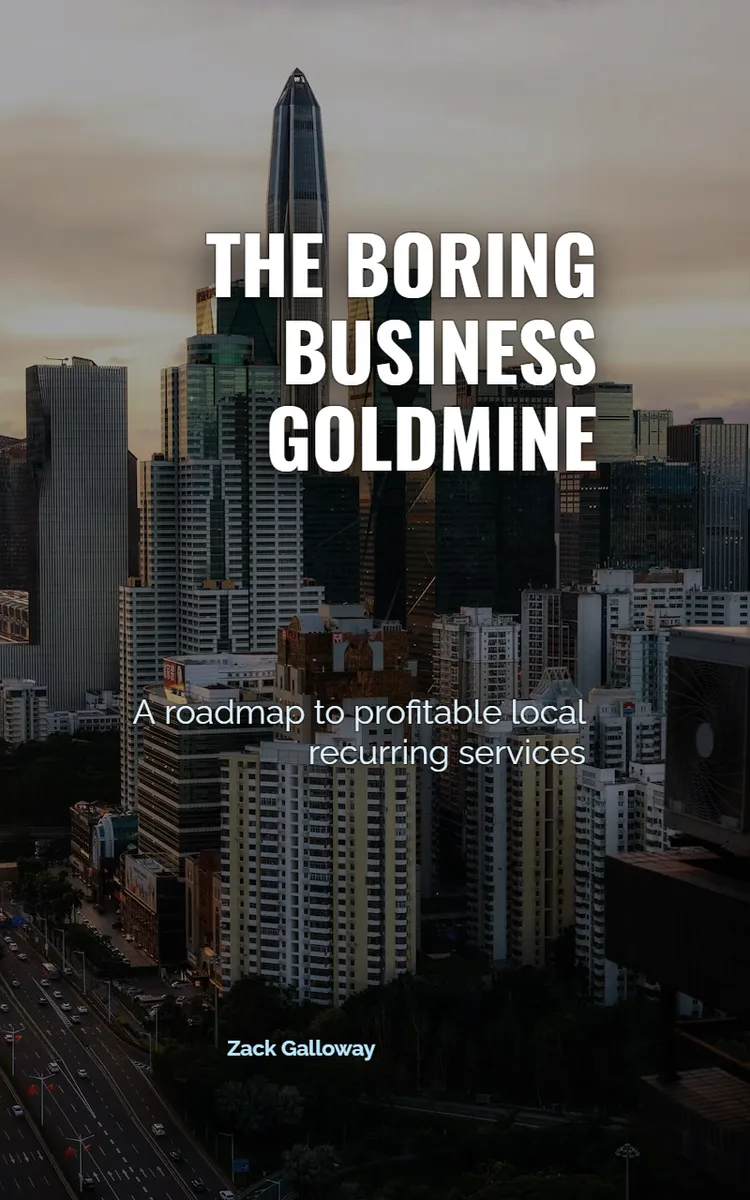

Read the first chapter
The whole of chapter one, free. About 6 min. Turn the pages with the arrows, your keyboard, or a swipe.
Chapter 1
From Next Big Thing to Boring
A phone screen shows another “can’t-miss” business opportunity. The pitch promises easy money, rapid growth, and freedom from ordinary work. Outside the window, a dumpster overflows behind a restaurant, a rental property’s gutters sag with leaves, and three local contractors drive dirty trucks with no time to clean them. One opportunity demands attention online. The others already have customers waiting.
That contrast explains the central mistake many new owners make: they search for something exciting instead of looking for something necessary. Hype creates crowds. Boring problems create customers. A business built around cleaning, hauling, checking, maintaining, delivering, or handling an unpleasant task can produce durable revenue because the customer cannot simply ignore the problem forever.
The goal is not to make boring work sound glamorous. The goal is to recognize where dependable money already moves and build a company that captures it reliably.
Why Hype Attracts Competition and Boring Problems Attract Buyers
Trendy business ideas spread quickly because they are easy to talk about. People can describe an app, product, or online scheme in one sentence, share it widely, and chase the same customers within days. That attention creates competition before anyone proves that customers need the offer repeatedly.
Local service problems behave differently. A property manager still needs vacant units cleaned before new tenants arrive. A restaurant still needs grease handled. A business owner still needs overflowing waste removed, parking areas maintained, and broken gates repaired. These needs may not generate exciting conversations, but they create direct buying situations.
A useful test separates entertainment from opportunity: if the customer delays the purchase, what happens? A delayed purchase may mean a minor inconvenience, a failed inspection, lost rental income, an unhappy tenant, a safety issue, or a more expensive repair. The stronger the consequence, the more likely the customer will pay for dependable help.
Boring work also benefits from local reality. A customer cannot always order a nearby property cleanup from a distant online seller. A landlord cannot download a clean building. A fleet cannot outsource every physical task to a national platform. Distance, timing, access, weather, equipment, and trust create room for a small operator who shows up and finishes the job.
Do not confuse “boring” with “small.” A simple service can support multiple crews, routes, contracts, and commercial accounts when the owner builds repeatable delivery around it. The work starts with a task. The opportunity comes from the pattern behind that task.
The BORING MONEY FORMULA
Use the BORING MONEY FORMULA to examine any local service before you spend money on equipment or advertising:
Necessary + Repetitive + Inconvenient + Underserved + Profitable + Repeatable + Systemizable = Opportunity
Each term forces a practical question.
Necessary means the customer must address the problem. A business may want a cleaner storefront, but it may need waste removal, pest control, or a functioning commercial door. Necessity protects demand when customers cut optional spending.
Repetitive means the problem returns. A single move can create revenue once. A recurring trash, cleaning, maintenance, or inspection need can create a customer relationship. Look for work that returns with the calendar, usage, weather, tenancy, or regulation.
Inconvenient means customers would rather pay than handle the task themselves. Heavy lifting, foul odors, awkward hours, specialized tools, travel, and messy cleanup all create inconvenience. The more a task disrupts the customer’s day, the more value reliable completion provides.
Underserved means customers struggle to find a provider who answers, arrives, communicates, and finishes properly. You do not need an empty market. You need a market where current service leaves obvious gaps. A town with several cleaners may still lack one who handles early-morning commercial work and sends completion photos.
Profitable means the price can cover direct costs, labor, travel, equipment, overhead, risk, and owner compensation. Revenue alone proves nothing. A full schedule can still produce a weak business if each job consumes too much time or cash.
Repeatable means you can deliver the service with consistent steps, tools, timing, and quality. If every job requires a completely different solution, the business may depend too heavily on the owner.
Systemizable means another trained person can eventually follow your process. The customer should buy a dependable result, not your personal heroics. A service becomes more valuable when you can document the work, schedule it, check it, and improve it.
Consider commercial exterior cleaning. It can satisfy all seven terms: businesses need presentable properties; dirt returns; owners dislike the work; reliable providers may be scarce; pricing can support equipment and labor; crews can repeat the same service pattern; and the process can become a route with documented standards. That does not guarantee success. It tells you the opportunity deserves serious testing.
Turning a Messy Observation Into a Business Hypothesis
Start with a specific observation, not a business label. “There are many property services” tells you little. “Four apartment buildings have overflowing trash areas on collection day, and tenants leave bulky items beside the containers” gives you a testable problem.
Write the observation in one sentence, then identify the buyer, the trigger, and the consequence. The buyer might be a property manager. The trigger might be a weekly inspection or tenant complaint. The consequence might include extra hauling charges, poor curb appeal, or staff time spent chasing a solution.
Next, define a narrow first offer. Do not begin with “property maintenance.” Begin with a result such as scheduled trash-area cleanup for small apartment properties, with a fixed visit schedule and photo confirmation. A narrow offer makes the conversation clear and helps you measure whether customers actually buy.
Ask direct questions before making large purchases:
• Who handles this task now? - How often does it occur? - What causes the most frustration? - What happens when nobody handles it? - What would a dependable solution need to include? - Who approves and pays for the work?
Listen for repeated pain, not compliments. “That sounds useful” does not equal demand. A buyer who explains the current failure, gives a service frequency, asks about availability, or requests a price has provided stronger evidence.
Keep your initial test small. Use equipment you already own when safe and appropriate, sell a defined result, and record the time, travel, materials, disposal, and communication required. Why? Because the first job should teach you whether the work can support a business, not merely whether you can complete it.
Separating a Job From a Durable Business
One urgent job can produce cash. A durable business produces a pattern.
Look for customers with multiple locations, repeated schedules, predictable triggers, or ongoing responsibility. A property manager may control several buildings. A contractor may operate a fleet. A restaurant group may need the same service at multiple sites. These buyers can create more value than a long list of unrelated one-time customers because each successful job can lead to another logical assignment.
Reliability becomes your advantage when the service feels ordinary but failure creates headaches. Answer promptly. Confirm the scope. Arrive when promised. Complete every agreed task. Send clear documentation. Make the next appointment easy. Customers remember the provider who removes a recurring problem from their mental list.
Trust matters because boring services often involve access, keys, tenant areas, business hours, equipment, or sensitive property conditions. A clean vehicle, clear invoice, and consistent communication signal control before the customer sees the finished work. You do not need an elaborate brand. You need evidence that you will handle the customer’s property and schedule responsibly.
The strongest early position often sounds almost unimpressive: “We handle this specific task on this schedule, for this type of customer, with this documented result.” That clarity beats a broad promise to do everything.
The First Boring Decision
Choose three visible or frequently reported problems and write one BORING MONEY FORMULA assessment for each. Mark every term that you can support with an actual observation, customer comment, or operating fact. Leave unsupported terms blank. Then contact the people who experience the problem and ask how they handle it now.
Do not buy a trailer because a service sounds profitable. Do not build a website because a trend looks popular. First prove that a necessary, repetitive, inconvenient problem has a buyer, a workable price, and a delivery pattern you can repeat.
The next big thing may attract attention. The boring thing may pay the invoice. Learn to tell the difference, and the ordinary details of your town start looking less like background scenery and more like a list of businesses waiting for someone dependable to take responsibility.
End of chapter one. 34 more chapters in the full book.
Swipe or use the arrows to turn the page


What's inside: 35 chapters
- 1. From Next Big Thing to Boring
- 2. The Boring Gold Score Worksheet
- 3. Opportunity Audit: Walk Your Town
- 4. Google Review Goldmine Sorting
- 5. Community Complaint Mining System
- 6. 48-Hour Demand Test Protocol
- 7. $100, $500, and First Five
- 8. First Ten Reviews Test
- 9. Route Density Test Math
- 10. Recurring Revenue Test Rules
- 11. Hireability Test: Can You Staff It?
- 12. The FIVE-LAYER PRICE Framework
- 13. Minimum Charges That Save You
- 14. Stop Pricing Like an Employee
- 15. True Job Costing: Every Line
- 16. Boring Is Beautiful: Demand Signals
- 17. Your Offer: Packages, Minimums, Deposits
- 18. Trust as a Business Asset
- 19. Customer Acquisition That Works Locally
- 20. Scripts and Templates for Fast Booking
- 21. Boring Business Operating System (BOS)
- 22. Service Stacking Maps: One Customer
- 23. One Core Before Five Side Services
- 24. Recurring Revenue Upgrade Playbook
- 25. B2B: Where Boring Gets Bigger
- 26. Commercial Contracts Change the Game
- 27. Routes Before Payroll: Build Capacity First
- 28. Your First Employee and Quality Control
- 29. The Owner Bottleneck and Delegation
- 30. Automation Possibilities Without Hype
- 31. Financial Models: $1K to $50K Monthly
- 32. Boring Business Wealth Ladder
- 33. Hiring, Crew, and Route Ownership Path
- 34. 100-Business Goldmine Ranking Matrix
- 35. Your 90-Day Execution and Transformation
About this book
"The Boring Business Goldmine" is a business book by Zack Galloway with 35 chapters and approximately 56,782 words. Finding and building profitable local service businesses.
This book was created using Inkfluence AI, an AI-powered book generation platform that helps authors write, design, and publish complete books. It was made with the AI Business Book Writer.
Frequently Asked Questions
What is "The Boring Business Goldmine" about?
Finding and building profitable local service businesses
How many chapters are in "The Boring Business Goldmine"?
The book contains 35 chapters and approximately 56,782 words. Topics covered include From Next Big Thing to Boring, The Boring Gold Score Worksheet, Opportunity Audit: Walk Your Town, Google Review Goldmine Sorting, and more.
Who wrote "The Boring Business Goldmine"?
This book was written by Zack Galloway and created using Inkfluence AI, an AI book generation platform that helps authors write, design, and publish books.
How can I create a similar business book?
You can create your own business book using Inkfluence AI. Describe your idea, choose your style, and the AI writes the full book for you. It's free to start.
Write your own business book with AI
Describe your idea and Inkfluence writes the whole thing. Free to start.
Start writingCreated with Inkfluence AI


